
Maryland CPC Requirements: Hours, Exams & Step-by-Step Guide
Stop guessing if your categories match Maryland requirements. License Trail checks your direct, indirect, and supervision hours against CPC requirements continuously and flags mismatches before you submit.
No credit card required · Free plan available
Quick Requirements Overview
- CPC (Certified Professional Counselor) is not available to new applicants in MD (grandfathered; only for those certified on/before 9/30/2008)—current pathway is LGPC → LCPC
- Education: Master’s in counseling/related with ≥60 graduate credits (incl. alcohol & drug counseling + supervised field experience) or Doctorate with ≥90 graduate hours
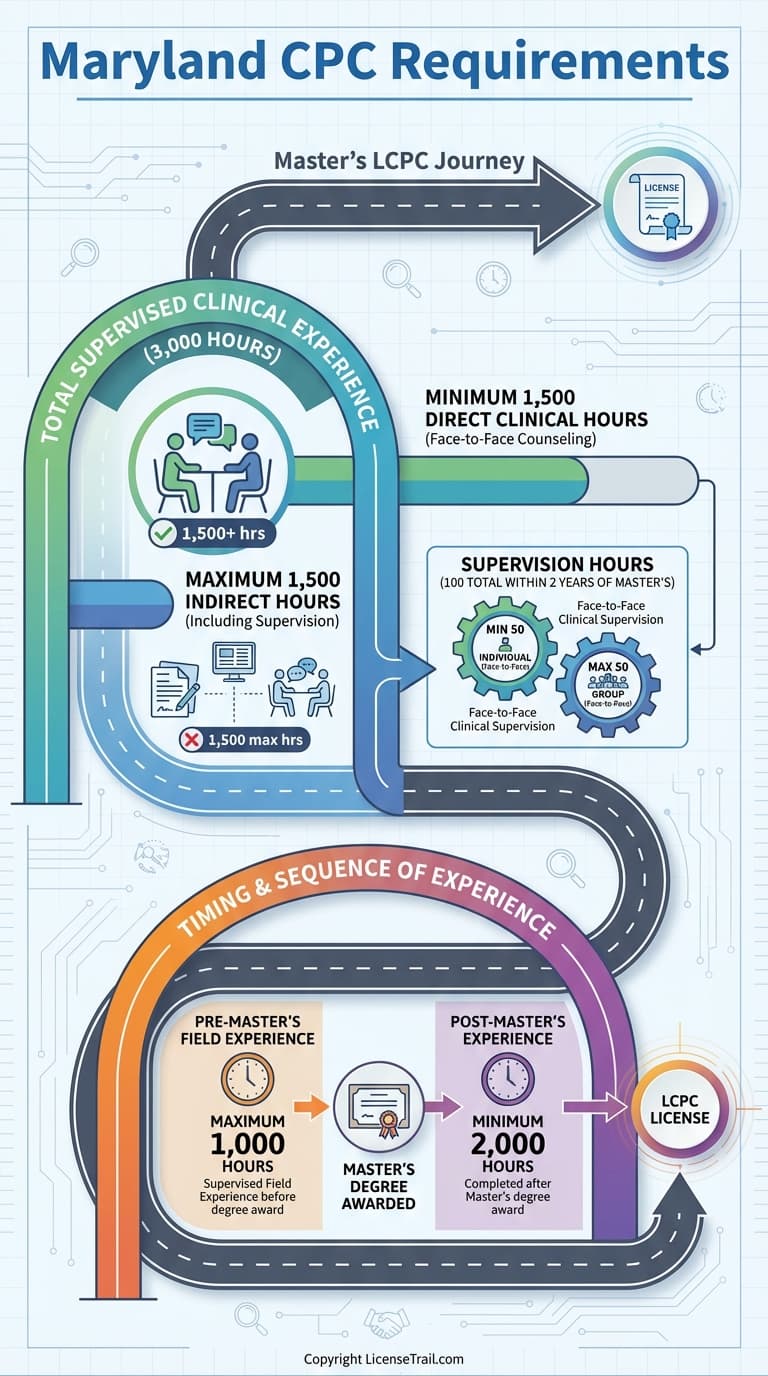
- LCPC (Master’s route) experience: 3 years / 3,000 hours total clinical counseling experience
- Hours split (Master’s route): ≥1,500 direct (face-to-face) and ≤1,500 indirect clinical services
- Post-degree supervised requirement (Master’s route): ≥2,000 hours post-master’s while licensed as LGPC; ≤1,000 hours may come from graduate supervised field experience
- Supervision meetings (Master’s route): 100 hours face-to-face supervision (≥50 individual; ≤50 group) after master’s (within 2 years)
- Supervisor type: ≥50% of supervised hours must be under a Board-approved LCPC supervisor (remainder under other allowed supervisors)
- Doctoral LCPC alternative: 2,000 hours total (≥1,000 direct; ≤1,000 indirect), ≥1,000 post-doctorate, plus 50 hours face-to-face supervision (≥25 individual; ≤25 group) within 1 year
License Details
Procedures
Maryland’s counseling credentials are defined very precisely in statute and regulation, including the exact number and type of hours you must complete. What follows focuses on the pathway that actually exists for new applicants in 2025, and then explains how that relates to the “CPC – Certified Professional Counselor” title.
1. CPC vs LCPC in Maryland: what title is actually available?
Maryland law distinguishes between:
- Certified Professional Counselor (CPC) – a certificate, not a license, for “certified professional counselor.”
- Licensed Clinical Professional Counselor (LCPC) – a license to practice “clinical professional counseling.”
Under Maryland Health Occupations §17‑401, the CPC credential is grandfathered: the provisions governing certification as a professional counselor apply only to individuals who were certified on or before September 30, 2008. (codes.findlaw.com) In other words:
You cannot newly become a CPC in 2025; new professional counselors are credentialed as LGPC (Licensed Graduate Professional Counselor) and then LCPC (Licensed Clinical Professional Counselor).
Because of that, if you mean “becoming a Board‑recognized professional counselor now,” you are really asking about LCPC requirements. All hour requirements below come from the Maryland Board of Professional Counselors and Therapists and the Code of Maryland Regulations (COMAR).
2. Educational foundation (briefly)
Before supervised hours matter, you must meet the Board’s education requirements for professional counseling (for either certification as a professional counselor or licensure as a clinical professional counselor):
-
Master’s pathway
- A counseling (or closely related) degree at the master’s level with at least 60 graduate semester credits (or Board‑approved equivalent), including:
- Core counseling coursework, including a course in alcohol and drug counseling and a supervised field experience (practicum/internship). (health.maryland.gov)
- A counseling (or closely related) degree at the master’s level with at least 60 graduate semester credits (or Board‑approved equivalent), including:
-
Doctoral pathway
- A counseling or counseling‑related doctoral degree, with at least 90 graduate semester hours and Board‑approved training. (health.maryland.gov)
Once your education is accepted, the Board looks at your supervised clinical experience hours in very specific categories.
3. Supervised clinical experience for LCPC – master’s degree route
The main regulation is COMAR 10.58.12.05 – Licensed Clinical Professional Counselors. For a master’s‑level applicant, to qualify for LCPC you must have: (regs.maryland.gov)
3.1 Total experience and time frame
- At least 3 years of experience in clinical professional counseling, and
- A minimum of 3,000 hours of experience in clinical professional counseling.
All 3,000 hours are considered clinical professional counseling experience, but they are subdivided.
3.2 Direct vs indirect clinical hours
Within the 3,000 total hours, COMAR specifies that:
-
At least 1,500 hours must be “direct clinical counseling services.”
- These are face‑to‑face services with clients (individual, couple, family, or group), including counseling, intake, assessment, diagnosis, and crisis intervention.
-
Up to 1,500 hours may consist of “indirect clinical counseling services.”
- These include non‑face‑to‑face activities related to client care such as case notes, treatment planning outside of client sessions, consultation, record keeping, and clinically relevant trainings. (regs.maryland.gov)
So for a master’s‑prepared LCPC applicant, the Board’s own language is essentially:
“A minimum of 3 years and 3,000 hours of experience in clinical professional counseling, of which a minimum of 1,500 hours shall be direct clinical counseling services and a maximum of 1,500 hours may consist of indirect clinical counseling services.” (regs.maryland.gov)
3.3 What must be supervised, and when
Within those 3,000 hours, COMAR adds further requirements:
- At least 2,000 hours of supervised clinical experience must be completed after the master’s degree, while you hold a Licensed Graduate Professional Counselor (LGPC) license, under a Board‑approved supervisor. (regs.maryland.gov)
- Up to 1,000 hours may be completed as “supervised field experience” (your graduate‑level practicum/internship) as defined in COMAR 10.58.12.04A(2)(k). (regs.maryland.gov)
In practical terms:
- Total clinical experience: 3,000 hours.
- Of these, at least 2,000 hours must be post‑master’s, supervised as an LGPC.
- Up to 1,000 hours may come from your graduate supervised field experience (if it meets the Board’s definitions).
3.4 Required clinical supervision hours (within the 3,000)
The Board distinguishes general “supervised experience” from formal clinical supervision meetings. For master’s‑level LCPC applicants:
- You must complete 100 hours of face‑to‑face clinical supervision after your master’s, within a two‑year period following the degree.
- Of those 100 hours:
- At least 50 hours must be individual, face‑to‑face clinical supervision; and
- No more than 50 hours may be group, face‑to‑face clinical supervision. (regs.maryland.gov)
These 100 supervision hours are in addition to the direct vs indirect client hours, but they occur within the same 3,000‑hour supervised experience period.
3.5 Who must supervise, and how many hours under each type
Maryland further specifies:
- At least half of all supervised clinical experience hours (direct + indirect) must be completed under a Board‑approved supervisor who is a Licensed Clinical Professional Counselor (LCPC).
- No more than half of those supervised hours may be under other types of Board‑approved supervisors (e.g., certain other licensed mental health professionals defined in COMAR). (regs.maryland.gov)
4. Supervised clinical experience for LCPC – doctoral degree route
If you are applying with a qualifying doctoral degree, COMAR reduces the hour requirement: (regs.maryland.gov)
4.1 Total hours and time frame
- Minimum of 2,000 hours of experience in clinical professional counseling.
4.2 Direct vs indirect hours
Within those 2,000 hours:
- At least 1,000 hours must be direct, face‑to‑face clinical counseling services.
- Up to 1,000 hours may be indirect clinical counseling services. (regs.maryland.gov)
4.3 When the hours must be earned
- At least 1,000 of the 2,000 hours must be completed after the doctoral degree is awarded.
- Up to 1,000 hours may be completed before the doctoral degree (e.g., as supervised field experience during the program). (regs.maryland.gov)
4.4 Clinical supervision hours
For doctoral‑level LCPC applicants:
- You must complete 50 hours of face‑to‑face clinical supervision within one year of earning the doctorate.
- These 50 hours must include:
- At least 25 hours of individual face‑to‑face supervision, and
- Up to 25 hours of group face‑to‑face supervision. (regs.maryland.gov)
4.5 Supervisor type
As with the master’s route:
- At least half of your supervised direct + indirect hours must be under an LCPC supervisor approved by the Board, and
- No more than half may be under other qualifying supervisors defined in COMAR. (regs.maryland.gov)
5. How this compares to the older CPC (Certified Professional Counselor) framework
The general regulations (COMAR 10.58.01.05) describe requirements for:
- Certification as a professional counselor, and
- Licensure as a clinical professional counselor.
In that regulation, for a master’s‑level applicant, the Board requires:
- Not less than 3 years and 3,000 hours of supervised clinical experience in professional counseling, under an approved supervisor, of which:
- 1,500 hours must be face‑to‑face client contact;
- 100 hours must be face‑to‑face clinical supervision, including at least 50 individual and up to 50 group hours;
- At least 2 years and 2,000 hours must be post‑master’s, with up to 1,000 hours pre‑master’s. (mdrules.elaws.us)
That structure is essentially the same as the LCPC structure now codified in 10.58.12.05, but framed around the older certification pathway (CPC). Since new CPC certifications are no longer issued after 2008, the current pathway is functionally:
- Meet educational requirements for professional counseling;
- Obtain LGPC;
- Accrue supervised clinical hours with the 3,000/2,000/1,500/100 or 2,000/1,000/50 breakdown, depending on degree level;
- Qualify for LCPC.
6. Step‑by‑step pathway (current practice) using the Board’s hour language
Putting the current Maryland requirements into a simple sequence for a master’s‑level applicant:
-
Complete education
- Earn a qualifying master’s degree (60 graduate credits, required content areas, including alcohol and drug counseling and an approved “supervised field experience” course). (health.maryland.gov)
-
Apply for LGPC
- Submit transcripts and application to the Maryland Board to become a Licensed Graduate Professional Counselor (LGPC), which allows you to practice under supervision.
-
Accrue supervised experience in clinical professional counseling
- Accumulate at least 3 years and 3,000 hours of clinical professional counseling experience, correctly divided as:
- ≥ 1,500 hours – direct clinical counseling services (face‑to‑face counseling with clients), and
- ≤ 1,500 hours – indirect clinical counseling services (documentation, planning, consultations, etc.). (regs.maryland.gov)
- Ensure at least 2,000 of the 3,000 hours are post‑master’s supervised experience while you hold the LGPC.
- You may count up to 1,000 hours of supervised field experience from your graduate internship/practicum if it meets the Board’s definition.
- Accumulate at least 3 years and 3,000 hours of clinical professional counseling experience, correctly divided as:
-
Meet supervision structure requirements
- Complete 100 hours of face‑to‑face clinical supervision after the master’s, within 2 years, including:
- At least 50 hours individual supervision,
- Up to 50 hours group supervision. (regs.maryland.gov)
- Make sure at least half of your supervised hours (direct + indirect) are under a Board‑approved LCPC supervisor; the remainder may be under other approved mental health supervisors as allowed by COMAR. (regs.maryland.gov)
- Complete 100 hours of face‑to‑face clinical supervision after the master’s, within 2 years, including:
-
Pass required examinations
- Pass a national counseling examination approved by the Board (e.g., NBCC’s NCE or NCMHCE, as specified in Board materials), and
- Pass the Board’s examination on Maryland law and regulations governing counselors (Health Occupations Article, Title 17, and COMAR Subtitle 58). (regs.maryland.gov)
-
Apply for LCPC
- Once the education, hour, supervision, and exam requirements are met, submit the LCPC application, fees, and verification of hours and supervision to the Maryland Board.
7. Summary of hour requirements in the Board’s own terms
For master’s‑level LCPC:
- 3 years / 3,000 hours of experience in clinical professional counseling, including:
- 1,500 hours minimum – direct clinical counseling services
- Up to 1,500 hours – indirect clinical counseling services
- At least 2,000 hours as post‑master’s supervised clinical experience as an LGPC
- Up to 1,000 hours from supervised field experience during the degree
- 100 hours of face‑to‑face clinical supervision (≥ 50 individual, ≤ 50 group)
- At least half of all supervised hours under a Board‑approved LCPC supervisor. (regs.maryland.gov)
For doctoral‑level LCPC:
- 2,000 hours of experience in clinical professional counseling, including:
- ≥ 1,000 hours direct, face‑to‑face clinical counseling
- Up to 1,000 hours indirect clinical counseling
- 1,000 hours minimum acquired after the doctoral degree
- Up to 1,000 hours pre‑doctoral supervised experience
- 50 hours face‑to‑face clinical supervision (≥ 25 individual, ≤ 25 group) within 1 year of degree
- Same supervisor‑type proportions as above (at least half under LCPC). (regs.maryland.gov)
Those are the controlling, hour‑by‑hour requirements set by the Maryland Board of Professional Counselors and Therapists for becoming a licensed clinical professional counselor today. The historic CPC (Certified Professional Counselor) credential used the same basic hour structure but is no longer available to new applicants; the modern equivalent route is LGPC → LCPC under the requirements summarized above.
Track your CPC hours with confidence
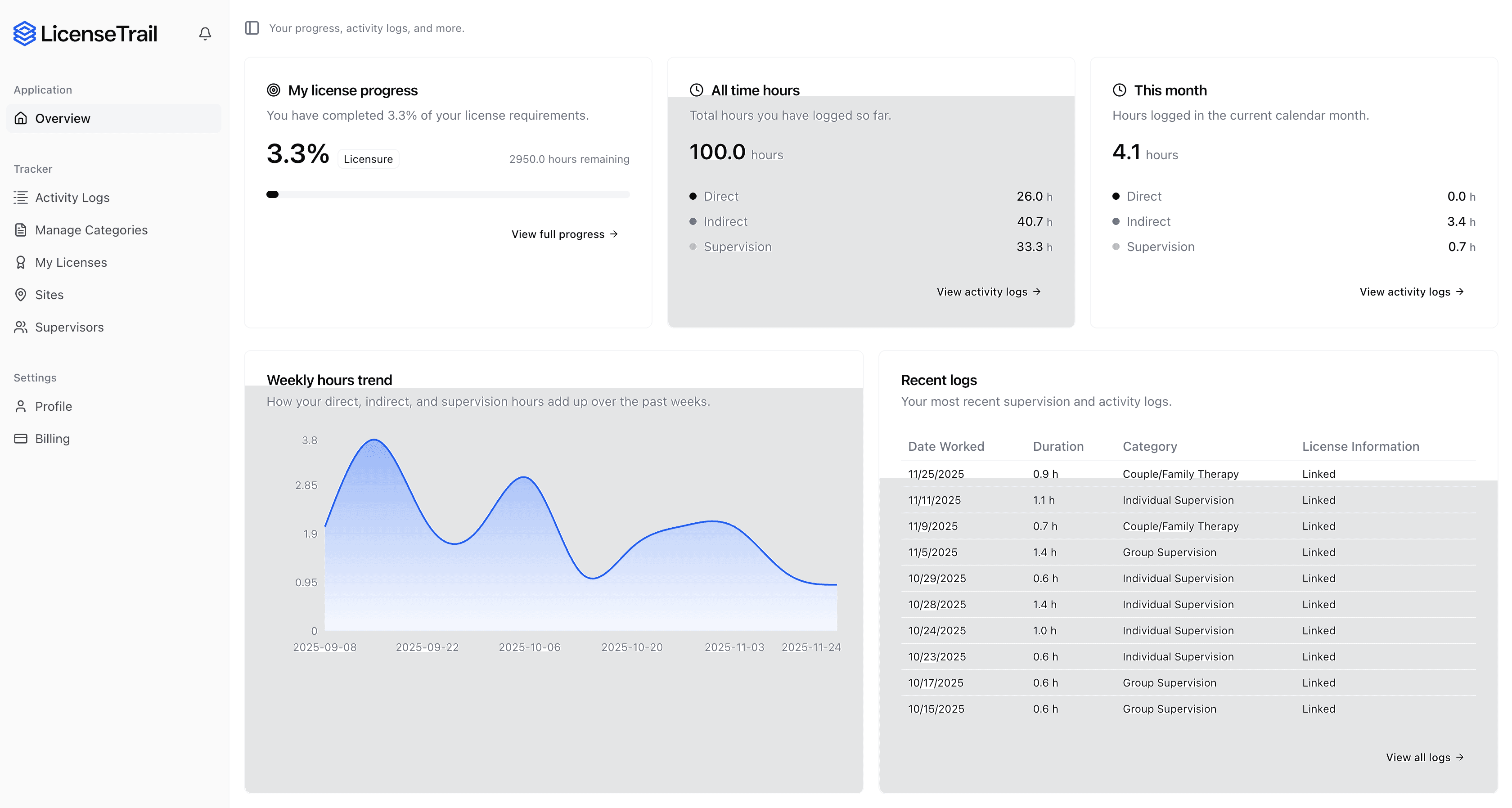
License Trail checks your direct, indirect, and supervision hours against Maryland CPC requirements continuously and flags mismatches before you submit.
 Start Tracking for Free
No credit card required · Free plan available
Related Licenses
Certified professional counselor — alcohol and drug
CPC-AD
Certified professional counselor—marriage and family therapist
CPC-MFT
Licensed clinical alcohol and drug counselor
LCADC
Licensed clinical marriage and family therapist
LCMFT
Licensed Clinical Professional Art Therapist
LCPAT
Licensed clinical professional counselor
LCPC
Is your spreadsheet hiding Maryland CPC risks?
Stop guessing if your categories match Maryland Board of Professional Counselors and Therapists requirements. License Trail checks your direct, indirect, and supervision hours continuously and flags mismatches before you submit.
Import or log
Bring your spreadsheet or start fresh
Upload your existing tracking spreadsheet and we'll map every hour into the right Maryland Board of Professional Counselors and Therapists categories automatically.
Verify against Maryland
Catch mismatches before the board does
License Trail checks your direct, indirect, and supervision hours against Maryland CPC requirements continuously.
Export board-ready
One-click clean reports
Generate professional, board-ready reports for supervision meetings and Maryland Board of Professional Counselors and Therapists submissions in seconds.
No credit card required · Free plan available