
Maryland CPC-MFT Requirements: Hours, Exams & Step-by-Step Guide
Stop guessing if your categories match Maryland requirements. License Trail checks your direct, indirect, and supervision hours against CPC-MFT requirements continuously and flags mismatches before you submit.
No credit card required · Free plan available
Quick Requirements Overview
- CPC‑MFT (MD) is closed/grandfathered: only applies to individuals certified on or before 9/30/2008; no new CPC‑MFT certifications issued.
- Current MFT route instead: LGMFT → LCMFT for independent marriage & family therapy practice.
- LGMFT education: MFT (or equivalent) Master’s 60 semester credits/90 quarter (or Doctorate 90/135); includes specified coursework.
- LGMFT practicum/internship (in program): ≥300 direct client hours (incl. ≥100 relational), plus ≥60 hours under Board‑approved supervisor.
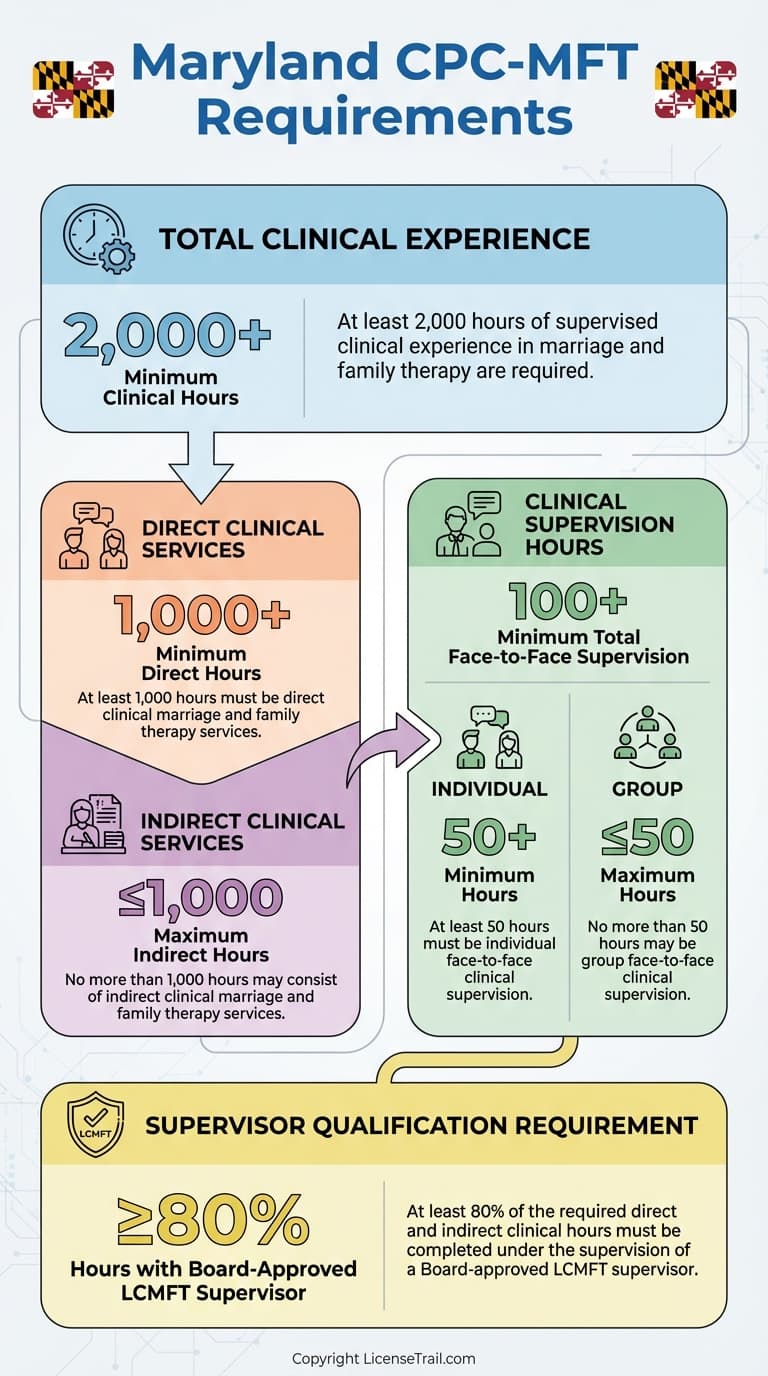
- LCMFT post‑degree experience: 2 years + 2,000 hours after master’s, while appropriately credentialed (typically as LGMFT).
- LCMFT hour split: ≥1,000 direct clinical therapy hours; ≤1,000 indirect clinical therapy hours.
- LCMFT supervision: 100 face‑to‑face supervision hours (≥50 individual, ≤50 group); ≥80% of total hours supervised by a Board‑approved LCMFT (≤20% by other Board‑approved qualified supervisors).
- LCMFT exams: pass Board‑approved national MFT exam + MD law/regs (Title 17 & COMAR Subtitle 58) exam.
License Details
Procedures
The Maryland Board of Professional Counselors and Therapists regulates both “professional counselors” and “marriage and family therapists” under the same statute (Health Occupations Article, Title 17) and COMAR Title 10, Subtitle 58. Understanding how the Certified Professional Counselor–Marriage and Family Therapist (CPC‑MFT) designation fits into that system is the first step.
1. What CPC‑MFT is – and why you generally cannot get it anymore
Under Maryland law:
- A “certified professional counselor–marriage and family therapist” is defined as “an individual who is certified by the Board to practice marriage and family therapy in the State.” (health.maryland.gov)
- “Practice marriage and family therapy” means engaging in marriage and family therapy while representing yourself as a CPC‑MFT. (health.maryland.gov)
However, new certifications as CPC‑MFT are essentially closed:
- The statute explicitly says that the subsection governing certification as a certified professional counselor or certified professional counselor–marriage and family therapist “only applies to individuals certified by the Board … on or before September 30, 2008.” (health.maryland.gov)
In other words:
You cannot newly become a CPC‑MFT in 2025. That title is grandfathered for people who already held it by September 30, 2008.
Today, if you want to practice independently as a marriage and family therapist in Maryland, the active pathway is:
- Licensed Graduate Marriage and Family Therapist (LGMFT) →
- Licensed Clinical Marriage and Family Therapist (LCMFT)
Those licenses (not CPC‑MFT) are what the Board now issues for marriage and family therapy. (health.maryland.gov)
Because CPC‑MFT is closed, Maryland’s current regulations no longer lay out a step‑by‑step application process for new CPC‑MFT certifications. The detailed, hour‑by‑hour requirements you can actually use now are those for LGMFT/LCMFT (marriage and family therapy license) and LGPC/LCPC (professional counseling license).
The rest of this guide explains those current, enforceable hour requirements in Board language, which is what you can actually rely on for licensure planning.
2. Current Maryland pathway to independent marriage and family practice (LCMFT)
2.1. Step 1 – Educational requirements for LGMFT
To become a Licensed Graduate Marriage and Family Therapist, you must complete:
- A master’s degree in marriage and family therapy (or substantially equivalent) with at least 60 graduate semester credits / 90 quarter credits, or
- A doctoral degree in marriage and family therapy (or substantially equivalent) with at least 90 graduate semester credits / 135 quarter credits. (regulations.justia.com)
Within that program, you need at least 45 graduate semester credits (or 68 quarter credits) in specified content areas, including:
- A supervised clinical internship or practicum that includes:
- At least 60 hours completed under a Board‑approved supervisor; and
- At least 300 hours of direct client contact with couples, families, and individuals, of which at least 100 hours must be “relational therapy” (working with couples or family units). (regulations.justia.com)
Those practicum hours are educational hours; they do not by themselves satisfy the post‑degree supervised experience needed for full clinical licensure.
2.2. Step 2 – Licensed Graduate Marriage and Family Therapist (LGMFT)
Once you meet the degree and coursework requirements, you apply for the LGMFT license. As an LGMFT you:
- Practice “graduate marriage and family therapy” under supervision; and
- Work toward the supervised clinical experience required by Health Occupations §17‑303 and COMAR 10.58.08.04–.05. (health.maryland.gov)
You cannot practice independently or provide supervision yourself while you are an LGMFT. (regulations.justia.com)
2.3. Step 3 – Supervised clinical experience for LCMFT (the key hours)
To move from LGMFT to Licensed Clinical Marriage and Family Therapist (LCMFT), Maryland requires:
“a minimum of 2 years and 2,000 hours of clinical experience in marriage and family therapy” (law.cornell.edu)
COMAR 10.58.08.05 breaks those 2,000 hours down as follows:
-
Direct vs. indirect clinical services
Of the 2,000 total hours:
- At least 1,000 hours must be “direct clinical therapy services.” (law.cornell.edu)
- “Direct clinical marriage and family therapy services” are defined as face‑to‑face services to clients and their significant others, such as providing therapy sessions, diagnostics, and other direct interventions.(law.cornell.edu)
- Up to 1,000 hours may be “indirect clinical therapy services.” (law.cornell.edu)
- Indirect clinical work includes activities like treatment planning, case staffing, consultation with other professionals, record‑keeping, report writing, case notes, case management, and other administrative duties related to clinical marriage and family therapy. (law.cornell.edu)
So, structurally:
- 1,000 hours minimum – direct, face‑to‑face therapy;
- Up to 1,000 hours – indirect, non‑session clinical tasks;
- Total required clinical experience: 2,000 hours.
- At least 1,000 hours must be “direct clinical therapy services.” (law.cornell.edu)
-
Timing and status while hours are earned
- All 2,000 hours of supervised clinical experience must be completed after your master’s degree, while you hold an LGMFT (or another Board‑approved credential). (law.cornell.edu)
-
Supervision requirements and supervisor type
- At least 80% of the total direct + indirect hours must be under a Board‑approved marriage and family therapy supervisor who is a Licensed Clinical Marriage and Family Therapist. (law.cornell.edu)
- No more than 20% of the hours may be under a Board‑approved supervisor who is:
- a Licensed Clinical Alcohol and Drug Counselor,
- a Licensed Clinical Professional Counselor,
- a Licensed Clinical Professional Art Therapist, or
- another licensed mental health care provider approved by the Board,
and who can document at least 5 years of experience delivering marriage and family therapy services. (law.cornell.edu)
-
Face‑to‑face clinical supervision hours
Within those 2,000 clinical hours, you must also complete 100 hours of “face‑to‑face clinical supervision” within 2 years of the award of the master’s degree, broken down as:
- At least 50 hours of individual face‑to‑face clinical supervision;
- Up to 50 hours of group face‑to‑face clinical supervision. (law.cornell.edu)
A “clinical supervision hour” is defined as at least 45 minutes of direct supervision time with the supervisee present. (law.cornell.edu)
2.4. Step 4 – Examinations and jurisprudence
To be licensed as an LCMFT, you must also:
- Achieve a passing score on a national certification examination approved by the Board (for MFTs, this is typically the AMFTRB national MFT exam); and
- Pass an examination covering:
- Maryland Health Occupations Article, Title 17; and
- COMAR Subtitle 58 (the Board’s regulations). (law.cornell.edu)
Only after you meet the degree, supervised‑experience, and exam requirements, and satisfy the Board’s character and ethics standards, can you be licensed as a Licensed Clinical Marriage and Family Therapist.
3. Where CPC‑MFT fits relative to these current licenses
Because CPC‑MFT certification has been closed to new applicants since 2008, the Board uses it today only in two ways:
- To define and protect a title for those who were already certified; and
- To include CPC‑MFT certificate holders in its disciplinary and teletherapy regulations alongside current licensees. (mdrules.elaws.us)
For example, COMAR defines “certificate” to include “Certified professional counseling–marriage and family therapy (CPC‑MFT)”, and lists “Certified professional counselor–marriage and family therapist” among the certificate holders subject to disciplinary sanctions. (mdrules.elaws.us)
But there is no longer an active COMAR chapter giving a fresh applicant route into CPC‑MFT. Instead, the Board’s detailed hour‑by‑hour requirements are written for:
- Professional counselors (LGPC/LCPC) – COMAR 10.58.01 and 10.58.12; and
- Marriage and family therapists (LGMFT/LCMFT) – COMAR 10.58.08 and 10.58.15.
That is why, when you’re planning for practice now, you focus on LGMFT/LCMFT (for MFT) or LGPC/LCPC (for counseling), not on CPC‑MFT.
4. Supervised‑experience hour breakdown for clinical professional counselors (LCPC)
Although this is not the CPC‑MFT credential, the Board’s LCPC rules are where you see the hour breakdown closest to the example you gave (1,500 direct vs. 1,500 indirect), and they use definitions that also appear in the general regulations that used to apply to CPC certificate holders.
4.1. Educational foundation (applies to “professional counselor” level)
COMAR 10.58.01.05 sets the baseline requirements “to qualify for certification as a professional counselor” (CPC). This includes: (mdrules.elaws.us)
- A master’s degree (60 graduate semester credits) or doctoral degree (90 credits) in a professional counseling or related field; and
- At least 3 graduate credits in each of multiple content areas:
- Human growth and personality development
- Social and cultural foundations
- Counseling theory and counseling techniques
- Group dynamics
- Lifestyle and career development
- Appraisal
- Research and evaluation
- Professional, legal, and ethical responsibilities
- Marriage and family therapy (overview of systems theories, working with couples and families, family life cycle, intervention strategies)
- Alcohol and drug counseling
- Supervised field experience including a minimum of 125 hours of face‑to‑face client counseling in an internship/practicum.
Additionally, to be certified as a professional counselor, the Board requires:
-
For a master’s‑level applicant:
- “Not less than 3 years with a minimum of 3,000 hours of supervised clinical experience in professional counseling, of which at least 2 years and 2,000 hours shall be completed after the award of the master’s degree.” (mdrules.elaws.us)
-
For a doctoral‑level applicant:
- “Not less than 2 years with a minimum of 2,000 hours of supervised clinical experience in professional counseling, of which at least 1 year and 1,000 hours shall be completed after the award of the doctoral degree.” (mdrules.elaws.us)
These supervised‑experience hours are global counseling hours, not broken down into direct vs indirect in the CPC regulation itself.
4.2. Clinical licensure (LCPC) – current detailed hour breakdown
The more detailed breakdown you asked about appears in the Licensed Clinical Professional Counselor regulations (COMAR 10.58.12.05). To qualify for LCPC:
- You must already hold a Licensed Graduate Professional Counselor (LGPC) or equivalent; and
- You must complete a minimum of 3 years and 3,000 hours of “experience in clinical professional counseling” if you are a master’s‑level applicant. (regulations.justia.com)
For a master’s‑level applicant, the Board states that those 3,000 hours must include:
-
Direct vs indirect clinical counseling
- “A minimum of 1,500 hours shall be direct clinical counseling services.”
- “A maximum of 1,500 hours may consist of indirect clinical counseling services.” (regulations.justia.com)
In practical terms:
- Direct clinical counseling services are face‑to‑face client work (individual, couple, family, or group sessions).
- Indirect clinical counseling services include case documentation, treatment planning, case consultation, participation in treatment team meetings, and other clinical support activities as defined in the Board’s “indirect” descriptions and general supervision definitions. (law.cornell.edu)
-
Timing and status
- At least 2,000 of the 3,000 hours must be supervised clinical experience as a LGPC completed after the master’s degree under a Board‑approved supervisor.
- Up to 1,000 of the 3,000 hours may come from supervised field experience (internship/practicum) that met the Board’s “supervised field experience” definition. (regulations.justia.com)
-
Required clinical supervision hours
Within those 3,000 hours, you must complete:
- 100 hours of face‑to‑face clinical supervision within 2 years of the master’s degree, broken down as:
- At least 50 hours individual face‑to‑face supervision;
- Up to 50 hours group face‑to‑face supervision. (regulations.justia.com)
Here again, a “face‑to‑face client contact hour” and a “face‑to‑face clinical supervision hour” are each defined as at least 45 minutes of direct time with the client or supervisee present. (mdrules.elaws.us)
- 100 hours of face‑to‑face clinical supervision within 2 years of the master’s degree, broken down as:
For a doctoral‑level LCPC applicant, COMAR requires 2,000 hours of clinical professional counseling experience, split into 1,000 direct and up to 1,000 indirect hours, plus 50 hours of face‑to‑face clinical supervision (25 individual and up to 25 group). (regulations.justia.com)
5. Historical hours specifically tied to CPC‑MFT (grandfathered, not current)
Older statutory language in Health Occupations §17‑306 describes how the Board could waive certain requirements for individuals seeking certification as a professional counselor–marriage and family therapist during the initial grandfathering period. It required, among other things, that such an applicant:
- Hold a master’s degree in a marriage and family field (or substantially equivalent program); and
- Have “not less than 3 years with a minimum of 3,000 hours of supervised experience in marriage and family therapy approved by the Board, 2 years of which shall have been completed after the award of the master’s degree or its substantial equivalent.” (law.justia.com)
That specific 3‑year / 3,000‑hour standard applied to pre‑existing practitioners transitioning into certification and is not an active application pathway today. It does, however, show that even historically, CPC‑MFT status was tied to several thousand hours of supervised marriage and family therapy experience.
6. Putting it together
If your goal is to practice marriage and family therapy in Maryland now:
- You cannot newly obtain the CPC‑MFT certificate; it is restricted to those who were certified on or before September 30, 2008. (health.maryland.gov)
- The current active path is:
- Complete an MFT degree (60+ credits) with the required practicum (300 direct hours, including 100 relational). (regulations.justia.com)
- Become a Licensed Graduate Marriage and Family Therapist (LGMFT). (regulations.justia.com)
- Accrue 2,000 supervised clinical hours as an LGMFT, including:
- 1,000 direct clinical therapy hours,
- Up to 1,000 indirect clinical hours, and
- 100 hours of face‑to‑face supervision (50 individual, up to 50 group), with 80% of all hours supervised by an LCMFT. (law.cornell.edu)
- Pass the national MFT exam and Maryland law/regulations exam and satisfy character/ethics requirements. (law.cornell.edu)
If instead your focus is on clinical professional counseling (not solely marriage and family), the parallel pathway is LGPC → LCPC, where a master’s‑level applicant must complete 3,000 hours of clinical professional counseling experience, with 1,500 hours direct clinical services, up to 1,500 indirect, and 100 hours of face‑to‑face supervision. (regulations.justia.com)
Those are the Board’s current, binding hour requirements and definitions for licensure in Maryland that correspond most closely to the now‑grandfathered CPC‑MFT role.
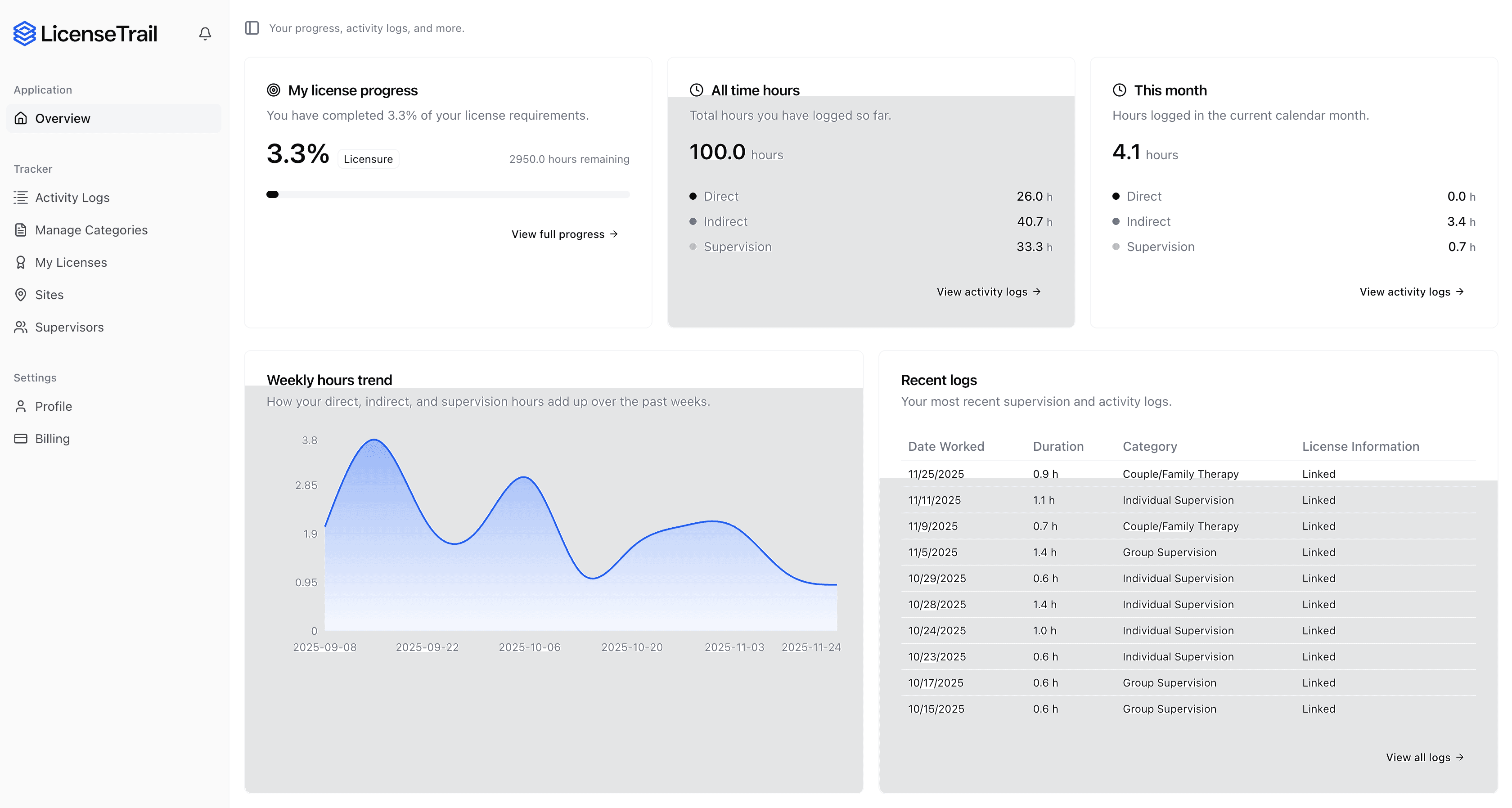
Track your CPC-MFT hours with confidence
License Trail checks your direct, indirect, and supervision hours against Maryland CPC-MFT requirements continuously and flags mismatches before you submit.
 Start Tracking for Free
No credit card required · Free plan available
Related Licenses
Is your spreadsheet hiding Maryland CPC-MFT risks?
Stop guessing if your categories match Maryland Board of Professional Counselors and Therapists requirements. License Trail checks your direct, indirect, and supervision hours continuously and flags mismatches before you submit.
Import or log
Bring your spreadsheet or start fresh
Upload your existing tracking spreadsheet and we'll map every hour into the right Maryland Board of Professional Counselors and Therapists categories automatically.
Verify against Maryland
Catch mismatches before the board does
License Trail checks your direct, indirect, and supervision hours against Maryland CPC-MFT requirements continuously.
Export board-ready
One-click clean reports
Generate professional, board-ready reports for supervision meetings and Maryland Board of Professional Counselors and Therapists submissions in seconds.
No credit card required · Free plan available