
Maryland CPC-AD Requirements: Hours, Exams & Step-by-Step Guide
Stop guessing if your categories match Maryland requirements. License Trail checks your direct, indirect, and supervision hours against CPC-AD requirements continuously and flags mismatches before you submit.
No credit card required · Free plan available
Quick Requirements Overview
- Status: CPC‑AD is legacy/renewal‑only in MD; no new issuance and no reinstatement if it lapses
- Renewal: Board renewal application + fee + 40 CEUs every 2 years (per COMAR 10.58.05.05/.06)
- Basic eligibility (legacy statutory): 18+ and good moral character
- Education: Master’s or doctorate in Board‑approved (or substantially equivalent) health/human services counseling field; 60 graduate credits (master’s) or 90 (doctoral) with required counseling core content
- AOD coursework: ~26–27 graduate credits in alcohol/drug counseling topics (assessment/treatment planning, ethics, counseling modalities, etc.)
- Experience: 3 years AOD counseling experience with ≥2,000 hours supervised; ≥2 years post‑degree
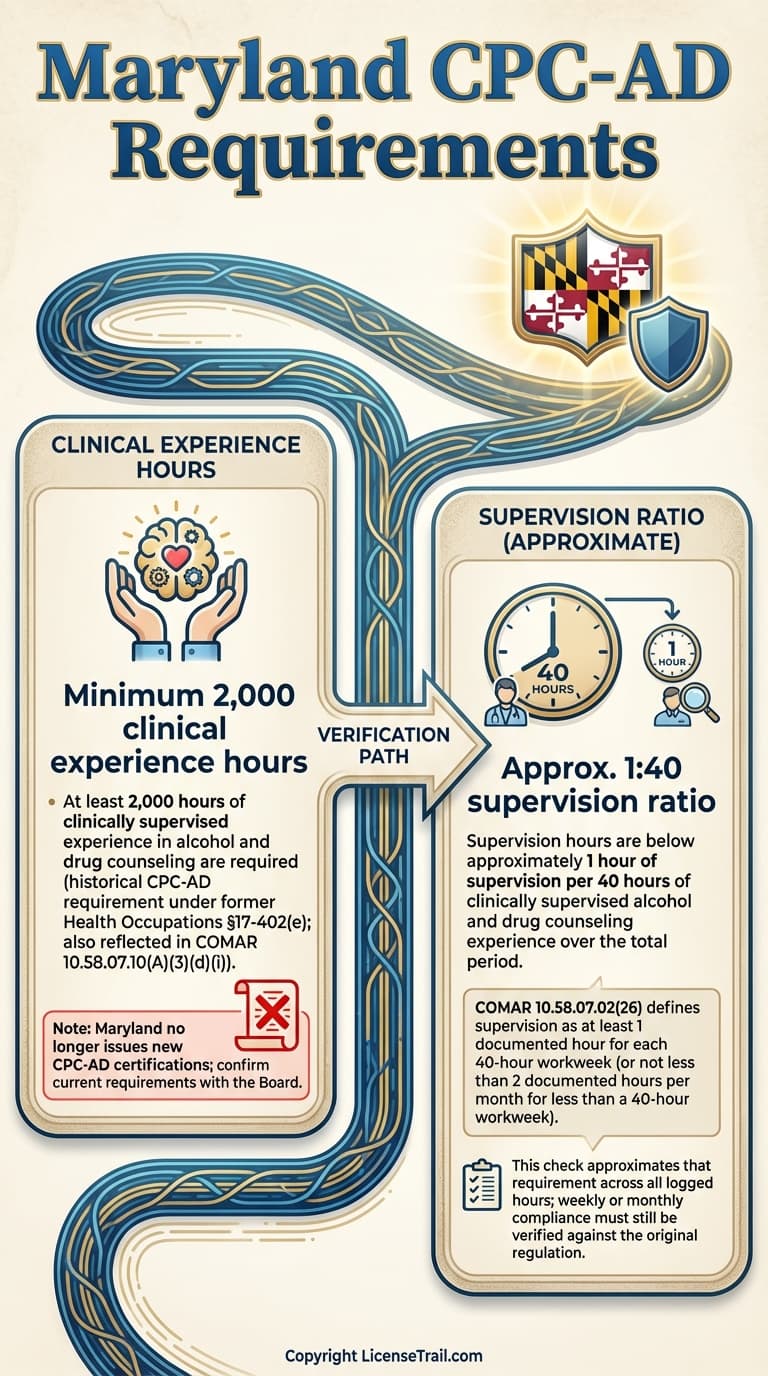
- Supervision rules: Under an approved AOD supervisor; minimum 1 supervision hour per 40 work hours (or 2 hours/month if part‑time), documented
- Exams (legacy statutory): Board‑approved AOD exam + Maryland law exam
License Details
Procedures
The Certified Professional Counselor – Alcohol and Drug (CPC‑AD) credential in Maryland is now essentially a legacy certification. Understanding that status is critical before looking at the hour requirements.
1. Current status of the CPC‑AD in Maryland
Maryland law still recognizes the CPC‑AD as one of the alcohol and drug counseling credentials, alongside the Certified Associate Counselor – Alcohol and Drug (CAC‑AD) and Certified Supervised Counselor – Alcohol and Drug (CSC‑AD).(law.justia.com)
However, the current regulations in COMAR 10.58.07.06 make two things clear:
- They define only the scope of practice for CPC‑ADs and
- They address renewal only, with no pathway for reinstatement if the certification lapses.(regulations.justia.com)
Section 10.58.07.06(B)–(C) provides that:
- To renew, a CPC‑AD must:
- Submit a Board‑approved renewal application
- Pay the required fee
- Attest to completing continuing education as specified in COMAR 10.58.05.05 and .06(regulations.justia.com)
- “The Board may not reinstate the certification of a certified professional counselor–alcohol and drug who has failed to renew for any reason.”(regulations.justia.com)
Third‑party licensure guides now also list the professional counselor certifications in Maryland as “renewal only,” reflecting that no new CPC‑AD certifications are being issued.(addiction-counselor.org)
Practical implication:
As of 2025, you should assume that:
- You cannot newly obtain a CPC‑AD in Maryland.
- The credential is being maintained only for existing certificate holders, who must keep it continuously renewed or lose it permanently.
What follows describes the legal/statutory requirements that define what a CPC‑AD is and what was required to qualify, because that is the only “requirement structure” that now exists in law.
2. Statutory eligibility requirements for CPC‑AD
The detailed qualification requirements for CPC‑AD appear in the Health Occupations Article, §17‑402 (“Requirements for certified professional counselor – alcohol and drug”), and in the Board’s consolidated Health Occupations summary.(law.justia.com)
2.1. Basic eligibility
To qualify as a Certified Professional Counselor – Alcohol and Drug, the statute requires that an applicant:
- Be of good moral character.(law.justia.com)
- Be at least 18 years old.(law.justia.com)
2.2. Degree requirements
The CPC‑AD is a master’s/doctoral‑level alcohol and drug counseling credential.
The statute and the Board’s summary require that the applicant:(law.justia.com)
- Hold a master’s or doctoral degree in a health and human services counseling field from a regionally accredited institution approved by the Board,
or complete a program of studies the Board judges “substantially equivalent” in subject matter and training. - For a doctoral‑level applicant:
- At least 90 graduate credit hours in counselor training, including specific content areas such as counseling theory and ethics, counseling techniques, human growth and development, group dynamics, social and cultural foundations, lifestyle and career development, appraisal, research and evaluation, supervised practicum, marriage and family therapy, and alcohol and drug counseling.(law.justia.com)
- For a master’s‑only applicant:
- At least 60 graduate credit hours in counselor training, including instruction in the same core areas listed above.(law.justia.com)
2.3. Required alcohol and drug coursework
The Board’s Health Occupations summary (reflecting §17‑402) states that the CPC‑AD applicant must complete a minimum of 26–27 graduate credit hours (depending on version) in alcohol and drug counselor training, including instruction in all of the following:(law.justia.com)
- Medical aspects of chemical dependency
- Group counseling
- Individual counseling
- Family counseling
- Assessment and treatment planning
- Ethics for alcohol and drug counselors
- Human development
- Abnormal psychology
- Courses on the core counselor functions (e.g., screening, intake, orientation, case management, crisis intervention, education and prevention, referral, consultation, reports and recordkeeping, and special alcohol and drug dependency topics)
This coursework must be part of, or in addition to, the 60/90 total graduate credits, from a regionally accredited institution and in a program acceptable to the Board.
2.4. Experience and hour requirements
The key clinical experience requirement for CPC‑AD is set directly in statute.
The Board’s Health Occupations summary paraphrases §17‑402(e) as requiring that the applicant:(health.maryland.gov)
- “have completed not less than 3 years with a minimum of 2,000 hours of supervised experience in alcohol and drug counseling approved by the Board,
2 years of which shall have been completed after the award of the master’s or doctoral degree or its substantial equivalent.”
In other words, for CPC‑AD:
- Total required experience:
- At least 3 years of alcohol and drug counseling experience.
- Minimum number of hours:
- At least 2,000 hours of supervised experience in alcohol and drug counseling.
- Post‑degree requirement:
- At least 2 of those 3 years must be after the master’s or doctoral degree is awarded.
- Type of hours (as the state’s own wording):
- The statute calls these “supervised experience” in alcohol and drug counseling; earlier versions used “clinically supervised experience,” and the Board’s summary uses “supervised experience in alcohol and drug counseling approved by the Board.”(health.maryland.gov)
Unlike the newer licensed credentials (for example, LCADC) where COMAR explicitly breaks down the supervised hours into “1,500 hours face‑to‑face client contact” and “100 hours face‑to‑face clinical supervision” out of 2,000 total hours,(health.maryland.gov) the CPC‑AD statute does not subdivide the 2,000 hours into specific categories of direct vs. supervision hours. The only hard numeric requirement is:
not less than 3 years with a minimum of 2,000 hours of supervised experience in alcohol and drug counseling approved by the Board.(health.maryland.gov)
2.5. Examination requirement
The statute also requires that the CPC‑AD applicant:(law.justia.com)
- Pass “an examination approved by the Board” under Title 17 (a national alcohol and drug counselor exam), and
- Pass the Maryland law exam covering the Professional Counselors and Therapists Act (Title 17) and relevant COMAR chapters (the same law exam required of other alcohol and drug credentials).
3. How the supervised hours must be structured
While §17‑402 sets the amount of supervised experience (3 years / 2,000 hours), other sections define how supervision for alcohol and drug counseling must be conducted and by whom.
3.1. Who may supervise
The Health Occupations Article defines an “approved alcohol and drug supervisor” for counseling trainees as:(health.maryland.gov)
- A certified professional counselor–alcohol and drug (CPC‑AD);
- A licensed clinical alcohol and drug counselor (LCADC); or
- A health care provider licensed or certified under Maryland law with documented expertise in alcohol and drug counseling, approved by the Board.
COMAR 10.58.07.14 (Supervisor Qualifications) further requires that a Board‑approved supervisor:(regulations.justia.com)
- Hold one of several licenses/certifications (LCADC, LCPC, LCMFT, LCPAT, CPC‑AD, or CAC‑AD), or be a Board‑approved licensed mental health care provider; and
- Have 3 years of documented experience in alcohol and drug counseling, including 3,000 hours of direct client contact, plus specified training in clinical supervision.
3.2. Supervision ratio and format
Maryland law also defines what it means to work “under the supervision of an approved alcohol and drug supervisor”. The Board’s Health Occupations summary of §17‑406 provides that this supervision:(health.maryland.gov)
- Is an ongoing process with direct, on‑site, face‑to‑face individual or group meetings with the supervisor;
- Focuses on:
- Quality of alcohol and drug counseling services provided, and
- Improvement of counseling skills;
- Must meet at least this minimum supervision ratio:
- 1 documented hour of supervision for each 40‑hour workweek, or
- For less than full‑time, not less than 2 documented hours of supervision per month.
These supervision rules apply broadly to individuals accumulating supervised hours toward alcohol and drug counseling credentials, including the supervised experience counted for CPC‑AD.
Thus, for the 2,000 supervised hours required for CPC‑AD, the state expects:
- Those hours to be paid or otherwise compensated counseling work in approved settings (per COMAR 10.58.14.03’s reference to “supervised, compensated work experience hours” for certified alcohol and drug counselors and trainees).(mdrules.elaws.us)
- Supervision to meet the 1‑hour‑per‑40‑hours (or 2‑hours‑per‑month) standard and be documented.
4. Renewal and loss of the CPC‑AD certification
Because the CPC‑AD is now a renewal‑only credential, the renewal rules matter as much as the original qualification requirements.
Current regulations in COMAR 10.58.07.06 provide:(regulations.justia.com)
- Scope of practice: A CPC‑AD may:
- Perform biopsychosocial evaluations (screening, assessment, and participation in diagnostic impressions for substance use and co‑occurring disorders),
- Provide treatment planning, referral, service coordination/case management,
- Provide counseling/therapy and trauma‑informed care with individuals, families, and groups,
- Offer client, family, and community education,
- Handle documentation and professional/ethical responsibilities, and
- Provide supervision for all categories of certified alcohol and drug counselors or trainees in the certification track.
- Renewal requirements:
- Submit a Board‑approved renewal application before the certificate expires;
- Pay the renewal fee set in COMAR 10.58.02; and
- Attest to completion of the required continuing education under COMAR 10.58.05.05 and .06 (currently 40 CEUs every 2 years, with content and sponsor requirements for alcohol and drug counseling).(regulations.justia.com)
- Loss of certification:
- If a CPC‑AD fails to renew on time, the Board may not reinstate the certification for any reason. The credential is permanently lost.(regulations.justia.com)
Because reinstatement is prohibited, anyone who already holds a CPC‑AD must treat each renewal deadline as a hard cutoff.
5. For someone starting now: the practical clinical path
If your goal is to newly enter the field of alcohol and drug counseling in Maryland in 2025, you should be aware that:
- The CPC‑AD path is effectively closed to new applicants; the active clinical credential is the Licensed Clinical Alcohol and Drug Counselor (LCADC).
- For LCADC, COMAR 10.58.07.03 requires:(health.maryland.gov)
- A qualifying master’s/doctoral degree with substantial alcohol and drug coursework;
- An internship or 1,000 hours of alcohol and drug counseling work;
- At least 2,000 hours of supervised experience in alcohol and drug counseling after the degree, of which:
- 1,500 hours must be face‑to‑face client contact, and
- 100 hours must be face‑to‑face clinical supervision (at least 50 individual, up to 50 group).
This breakdown—2,000 total hours, 1,500 direct client contact, 100 supervision hours—is the kind of explicit hour specification you may have seen referenced in modern Maryland licensure guides, but it applies to LCADC, not to CPC‑AD.
Summary of hour‑related requirements specifically for CPC‑AD
Based on the Board’s statutory summary and the controlling statute (§17‑402), and excluding later‑developed license types:
-
Supervised experience for CPC‑AD
- Minimum 3 years of alcohol and drug counseling experience.
- At least 2,000 hours of supervised experience in alcohol and drug counseling, approved by the Board.
- At least 2 of those 3 years must be post‑master’s or post‑doctoral degree.(health.maryland.gov)
-
Supervision conditions for those hours
- Must be under an approved alcohol and drug supervisor (CPC‑AD, LCADC, or other Board‑approved health professional with AOD expertise).(health.maryland.gov)
- Must include documented supervision at a minimum of 1 hour per 40‑hour workweek, or at least 2 hours of supervision per month for those working less than full time.(health.maryland.gov)
- Hours are expected to be supervised, compensated work experience hours in approved settings.(mdrules.elaws.us)
Those elements constitute the Board‑defined “type of hours” and supervisory structure for the CPC‑AD, even though, in current practice, no new CPC‑AD certifications are being issued and the credential exists primarily in a renewal‑only, legacy form.
Track your CPC-AD hours with confidence
License Trail checks your direct, indirect, and supervision hours against Maryland CPC-AD requirements continuously and flags mismatches before you submit.
 Start Tracking for Free
No credit card required · Free plan available
Related Licenses
Certified professional counselor
CPC
Certified professional counselor—marriage and family therapist
CPC-MFT
Licensed clinical alcohol and drug counselor
LCADC
Licensed clinical marriage and family therapist
LCMFT
Licensed Clinical Professional Art Therapist
LCPAT
Licensed clinical professional counselor
LCPC
Is your spreadsheet hiding Maryland CPC-AD risks?
Stop guessing if your categories match Maryland Board of Professional Counselors and Therapists requirements. License Trail checks your direct, indirect, and supervision hours continuously and flags mismatches before you submit.
Import or log
Bring your spreadsheet or start fresh
Upload your existing tracking spreadsheet and we'll map every hour into the right Maryland Board of Professional Counselors and Therapists categories automatically.
Verify against Maryland
Catch mismatches before the board does
License Trail checks your direct, indirect, and supervision hours against Maryland CPC-AD requirements continuously.
Export board-ready
One-click clean reports
Generate professional, board-ready reports for supervision meetings and Maryland Board of Professional Counselors and Therapists submissions in seconds.
No credit card required · Free plan available