
Maryland LCADC Requirements: Hours, Exams & Step-by-Step Guide
Stop guessing if your categories match Maryland requirements. License Trail checks your direct, indirect, and supervision hours against LCADC requirements continuously and flags mismatches before you submit.
No credit card required · Free plan available
Quick Requirements Overview
- Graduate degree: Master’s (≥60 semester/90 quarter credits) or Doctorate (≥90 semester/135 quarter credits) in a health & human services counseling field (or substantially equivalent), regionally accredited
- AOD-specific education: ≥39 semester (65 quarter) credits in alcohol & drug counselor training (COMAR-specified content)
- Core clinical coursework: ≥3 graduate semester credits each in personality development; diagnosis & psychopathology; psychotherapy/treatment of mental & emotional disorders
- Pre-licensure field training: Either 6 semester-credit (10 quarter-credit) AOD internship or 1,000 hours AOD counseling work verified by a Board-approved AOD supervisor
- Post-degree supervised experience: ≥2 years and 2,000 hours AOD counseling after degree under an approved LCADC supervisor
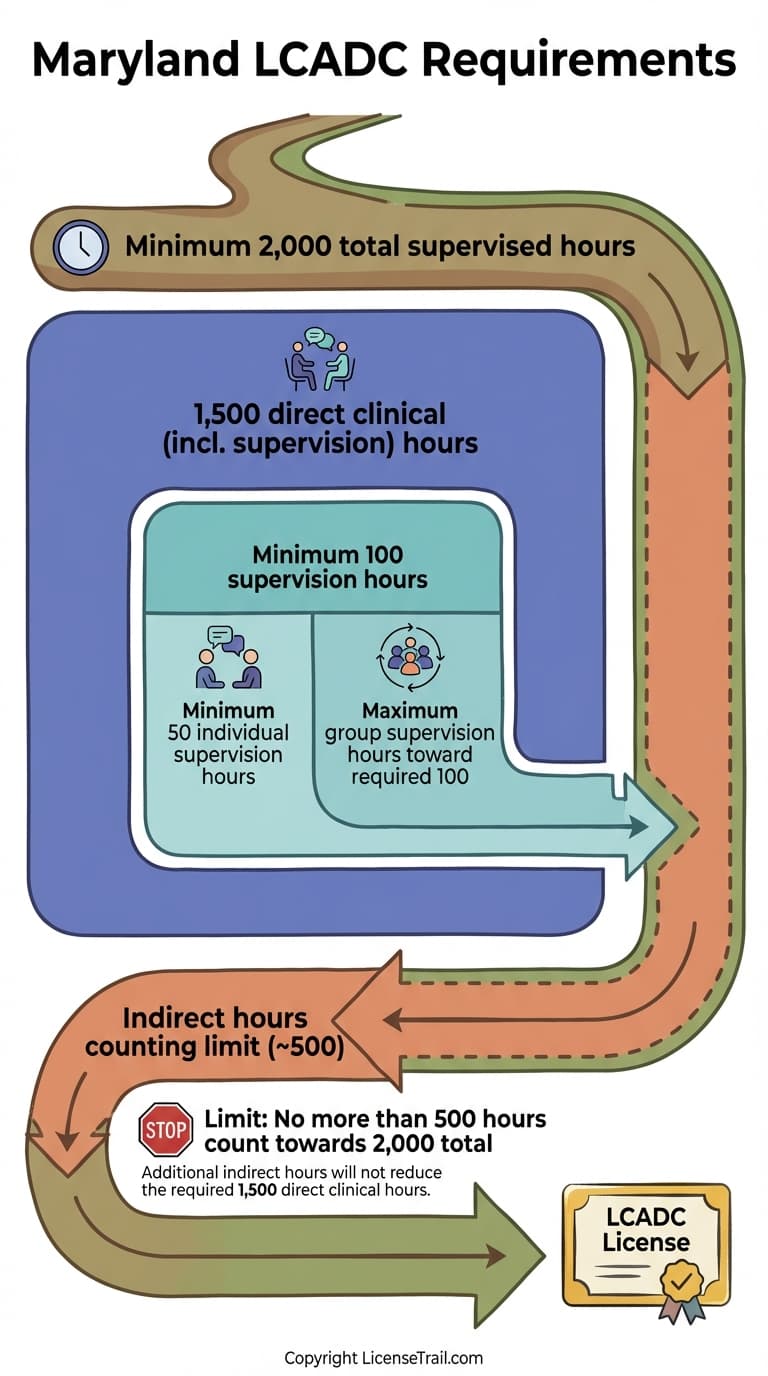
- Hour breakdown (within 2,000): 1,500 face-to-face client contact + 100 face-to-face clinical supervision (≥50 individual; ≤50 group)
- Exams: Board-approved national AOD counselor exam + Maryland law/regs exam (Health Occupations Title 17 & COMAR 10.58)
- Admin: Application, fees, documentation, and criminal background check (must comply with Board ethics/regs)
License Details
Procedures
Becoming a Licensed Clinical Alcohol and Drug Counselor (LCADC) in Maryland involves meeting specific education, training, supervised experience, and examination requirements set by the Maryland Board of Professional Counselors and Therapists under COMAR 10.58.07 and Health Occupations Article, Title 17. (health.maryland.gov)
Below is a structured guide, with an emphasis on the exact types and amounts of hours the Board requires.
1. Role and Legal Definition
Maryland defines “practice clinical alcohol and drug counseling” as engaging professionally and for compensation in alcohol and drug counseling and appraisal activities, using counseling principles and methods in the diagnosis, prevention, treatment, and amelioration of psychological, emotional, or mental conditions of individuals, couples, families, and groups. (health.maryland.gov)
LCADC is the independent, clinical-level license for this scope of practice.
2. Snapshot: Core LCADC Requirements
To qualify for LCADC in Maryland, an applicant must, among other things: (health.maryland.gov)
-
Degree
- Master’s or doctoral degree in a “health and human services counseling field” (or substantially equivalent program) from a regionally accredited institution.
- Minimum 60 graduate semester credits (or 90 quarter credits) at the master’s level, or 90 semester / 135 quarter credits at the doctoral level.
-
Substance Use–Specific Coursework
- At least 39 semester credits (or 65 quarter credits) in alcohol and drug counselor training, with required content areas specified in COMAR.
-
Pre-licensure Internship or Work
- Either:
- A 6‑semester‑credit (or 10‑quarter‑credit) internship in alcohol and drug counseling, OR
- 1,000 hours of alcohol and drug counseling work under and verified by a Board‑approved alcohol and drug counselor supervisor.
- Either:
-
Post‑graduate Supervised Experience (KEY HOURS)
- At least 2 years with a minimum of 2,000 hours of supervised experience in alcohol and drug counseling, obtained after the master’s or doctoral degree, under an approved licensed clinical alcohol and drug counselor supervisor, broken down as:
- 1,500 hours of face‑to‑face client contact hours (these are your direct clinical counseling services), and
- 100 hours of face‑to‑face clinical supervision, including:
- At least 50 hours of individual face‑to‑face clinical supervision; and
- Up to 50 hours of face‑to‑face group clinical supervision. (health.maryland.gov)
- At least 2 years with a minimum of 2,000 hours of supervised experience in alcohol and drug counseling, obtained after the master’s or doctoral degree, under an approved licensed clinical alcohol and drug counselor supervisor, broken down as:
-
Examinations
- A national alcohol and drug counselor examination approved by the Board; and
- A Maryland law and regulations exam covering Health Occupations Article, Title 17, and COMAR 10.58. (health.maryland.gov)
-
Background and Application
- Criminal background check, completed Board‑approved application, and payment of required fees. (health.maryland.gov)
3. Step 1 – Obtain a Qualifying Graduate Degree
3.1 Degree type
COMAR requires that an LCADC applicant have: (health.maryland.gov)
- A master’s degree in a health and human services counseling field (e.g., clinical mental health counseling, counseling psychology, addictions counseling, marriage and family counseling, etc.), or a program the Board deems “substantially equivalent,” with:
- At least 60 graduate semester credits or 90 quarter credits;
OR
- At least 60 graduate semester credits or 90 quarter credits;
- A doctoral degree in a Board‑approved health and human services counseling field (or substantially equivalent) with at least 90 graduate semester credits (or 135 quarter credits).
The Board defines a “health and human services counseling field” as a specific degree program with a counseling emphasis within various behavioral health disciplines. (health.maryland.gov)
4. Step 2 – Complete Required Alcohol & Drug Counselor Coursework
For LCADC, COMAR requires: (health.maryland.gov)
- A minimum of 39 semester credits (or 65 quarter credits) in alcohol and drug counselor training from a regionally accredited institution.
- Within those credits, at least one 3‑semester‑credit (or 5‑quarter‑credit) course in each of a set of specified content areas, which (among others) explicitly include:
- Topics in substance‑related and addictive disorders; and
- Family counseling. (health.maryland.gov)
In addition, the regulations require at least 3 graduate semester credits (or 5 quarter credits) in each of the following broader clinical content areas: (health.maryland.gov)
- Personality development
- Diagnosis and psychopathology
- Psychotherapy and treatment of mental and emotional disorders
Your transcript must show that these credits are completed as part of your program or otherwise from a regionally accredited institution.
5. Step 3 – Satisfy the Internship or 1,000-Hour Work Requirement
Before you can move into the post‑graduate supervised experience phase, the Board requires hands‑on alcohol and drug counseling training in one of two forms: (health.maryland.gov)
You must complete one of the following:
-
Formal Internship Route
- An internship in alcohol and drug counseling totaling:
- 6 semester credits or
- 10 quarter credits
- An internship in alcohol and drug counseling totaling:
-
Work-Experience Substitution Route
- At least 1,000 hours of alcohol and drug counseling work that is:
- Completed under, and
- Verified by, a Board‑approved alcohol and drug counselor supervisor.
- At least 1,000 hours of alcohol and drug counseling work that is:
This 1,000‑hour work option is expressly allowed as a substitution for the academic internship.
6. Step 4 – Post‑Graduate Supervised Experience (The Crucial Hour Breakdown)
6.1 Total supervised experience required
COMAR spells out a very specific supervised experience requirement for LCADC: (health.maryland.gov)
- You must “complete not less than 2 years with a minimum of 2,000 hours of supervised experience in alcohol and drug counseling”, which must:
- Be obtained after the awarding of the master’s or doctoral degree; and
- Be under the supervision of an approved licensed clinical alcohol and drug counselor supervisor.
The term “supervised experience in alcohol and drug counseling” is defined as providing alcohol and drug counseling services under close or moderate supervision of an approved licensed or certified alcohol and drug counselor supervisor. (health.maryland.gov)
6.2 Required breakdown of those 2,000 hours
Within the 2,000 supervised hours, the Board further requires: (health.maryland.gov)
-
1,500 hours – Face‑to‑face client contact hours
- These hours must be direct counseling services with clients (individuals, couples, families, or groups) in the practice of alcohol and drug counseling.
- In earlier and parallel formulations, the Board also refers to these as “direct clinical counseling services” in alcohol and drug counseling.
-
100 hours – Face‑to‑face clinical supervision, which must include:
- At least 50 hours of individual face‑to‑face clinical supervision; and
- No more than 50 hours of face‑to‑face group clinical supervision.
“Face‑to‑face” is defined to include in‑person or real‑time video conferencing supervision where supervisor and supervisee can see and hear one another; it specifically excludes purely telephone or email‑only contact. (health.maryland.gov)
The remaining supervised hours (beyond the 1,500 direct client hours and 100 supervision hours) can consist of other approved alcohol and drug counseling activities under supervision (e.g., documentation, case management, coordination, treatment planning) as defined in the regulation’s scope of practice for LCADC. (health.maryland.gov)
7. Step 5 – Pass Required Examinations
To be licensed as an LCADC, you must achieve passing scores on: (health.maryland.gov)
-
A national alcohol and drug counselor examination approved by the Board.
- Historically this has included the Master’s-level addictions exam; the exact exam titles can change, so the Board directs applicants to its website and COMAR 10.58.07 for the current approved exam(s).
-
A Maryland law and regulations examination covering:
- Health Occupations Article, Title 17, Annotated Code of Maryland, and
- COMAR 10.58 (the counseling and therapy regulations).
8. Step 6 – Criminal Background Check and Application
In addition to meeting the education, experience, and exam requirements, the applicant must: (health.maryland.gov)
- Submit a completed Board‑approved application for LCADC, including documentation of post‑graduate experience;
- Pay all applicable fees specified in COMAR 10.58.02;
- Submit to a criminal background check; and
- Comply with:
- Health Occupations Article, Title 17; and
- The Board’s Code of Ethics in COMAR 10.58.03.
9. Typical Pathway (Putting It All Together)
In practice, Maryland applicants often follow this sequence:
-
Earn a qualifying master’s (or doctoral) degree in a health and human services counseling field with:
- 60+ graduate credits, including
- 39+ credits in alcohol and drug counselor training,
- Required core clinical courses (personality development; diagnosis and psychopathology; psychotherapy & treatment of mental/emotional disorders).
-
Complete the internship or 1,000‑hour work requirement in alcohol and drug counseling under a Board‑approved supervisor.
-
Obtain supervised post‑graduate experience (often while licensed as a Licensed Graduate Alcohol and Drug Counselor – LGADC) until you reach:
- 2,000 total supervised hours of alcohol and drug counseling after the degree, including:
- 1,500 hours of face‑to‑face client contact, and
- 100 hours of face‑to‑face clinical supervision (50+ individual; up to 50 group).
- 2,000 total supervised hours of alcohol and drug counseling after the degree, including:
-
Pass the national alcohol and drug counselor exam approved by the Board and the Maryland law/COMAR exam.
-
Submit your LCADC application, documentation of hours, transcripts, exam results, fees, and background check materials to the Board.
10. Key Hour Requirements – Quick Reference
For Maryland LCADC (post‑degree): (health.maryland.gov)
- Supervised experience in alcohol and drug counseling:
- Total: 2 years, minimum 2,000 hours, after award of qualifying degree, under an approved licensed clinical alcohol and drug counselor supervisor.
- Within that 2,000 hours:
- Face‑to‑face client contact (direct clinical counseling): 1,500 hours
- Face‑to‑face clinical supervision: 100 hours, with:
- ≥ 50 hours individual supervision
- ≤ 50 hours group supervision
Combined with the pre‑licensure internship or 1,000‑hour work requirement, the 39 semester credits of alcohol and drug counselor training, and the degree and exam requirements, this constitutes the Board’s current pathway to LCADC licensure in Maryland.
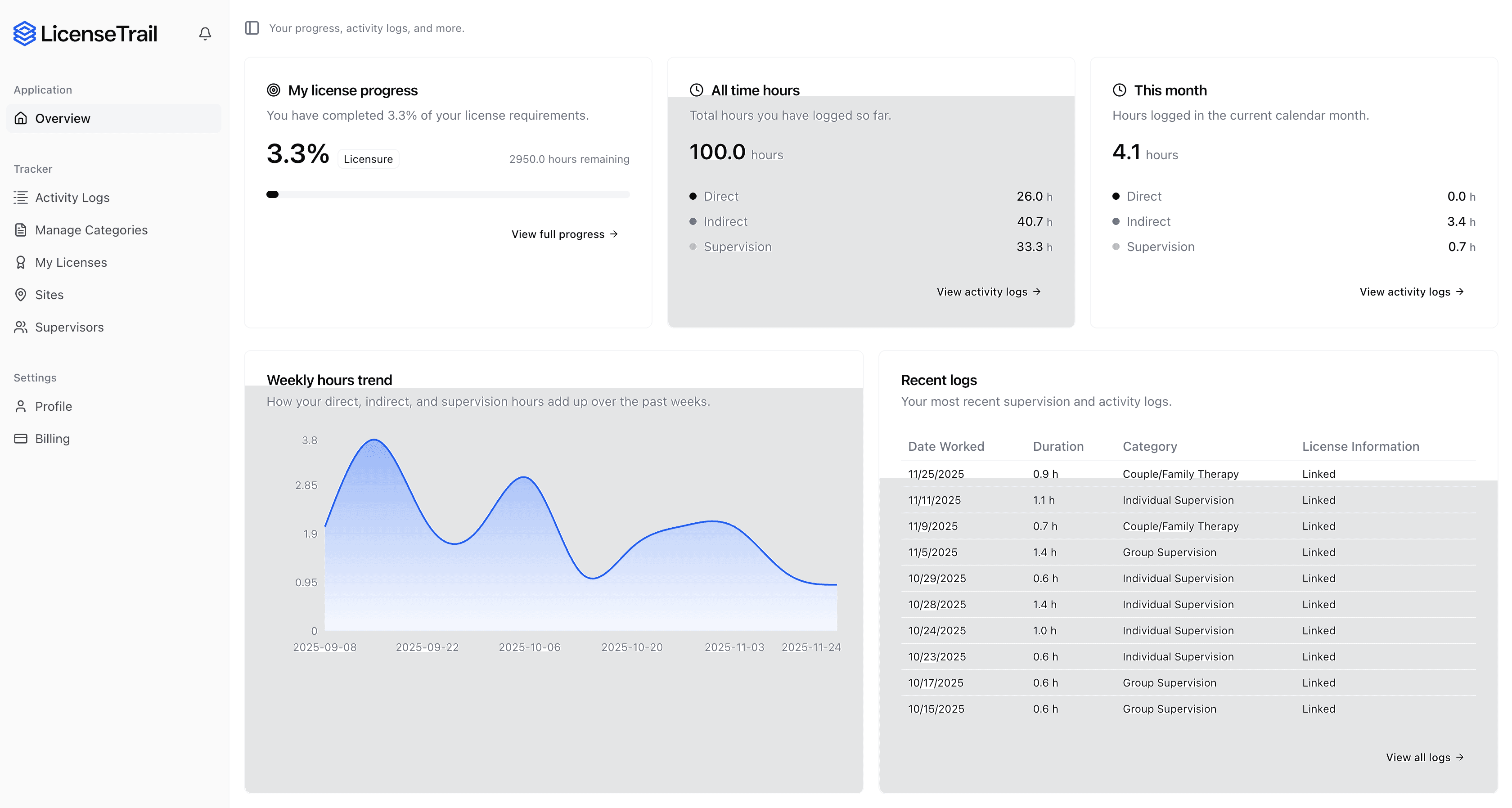
Track your LCADC hours with confidence
License Trail checks your direct, indirect, and supervision hours against Maryland LCADC requirements continuously and flags mismatches before you submit.
 Start Tracking for Free
No credit card required · Free plan available
Related Licenses
Certified professional counselor
CPC
Certified professional counselor — alcohol and drug
CPC-AD
Certified professional counselor—marriage and family therapist
CPC-MFT
Licensed clinical marriage and family therapist
LCMFT
Licensed Clinical Professional Art Therapist
LCPAT
Licensed clinical professional counselor
LCPC
Is your spreadsheet hiding Maryland LCADC risks?
Stop guessing if your categories match Maryland Board of Professional Counselors and Therapists requirements. License Trail checks your direct, indirect, and supervision hours continuously and flags mismatches before you submit.
Import or log
Bring your spreadsheet or start fresh
Upload your existing tracking spreadsheet and we'll map every hour into the right Maryland Board of Professional Counselors and Therapists categories automatically.
Verify against Maryland
Catch mismatches before the board does
License Trail checks your direct, indirect, and supervision hours against Maryland LCADC requirements continuously.
Export board-ready
One-click clean reports
Generate professional, board-ready reports for supervision meetings and Maryland Board of Professional Counselors and Therapists submissions in seconds.
No credit card required · Free plan available