
Maryland LCPC Requirements: Hours, Exams & Step-by-Step Guide
Stop guessing if your categories match Maryland requirements. License Trail checks your direct, indirect, and supervision hours against LCPC requirements continuously and flags mismatches before you submit.
No credit card required · Free plan available
Quick Requirements Overview
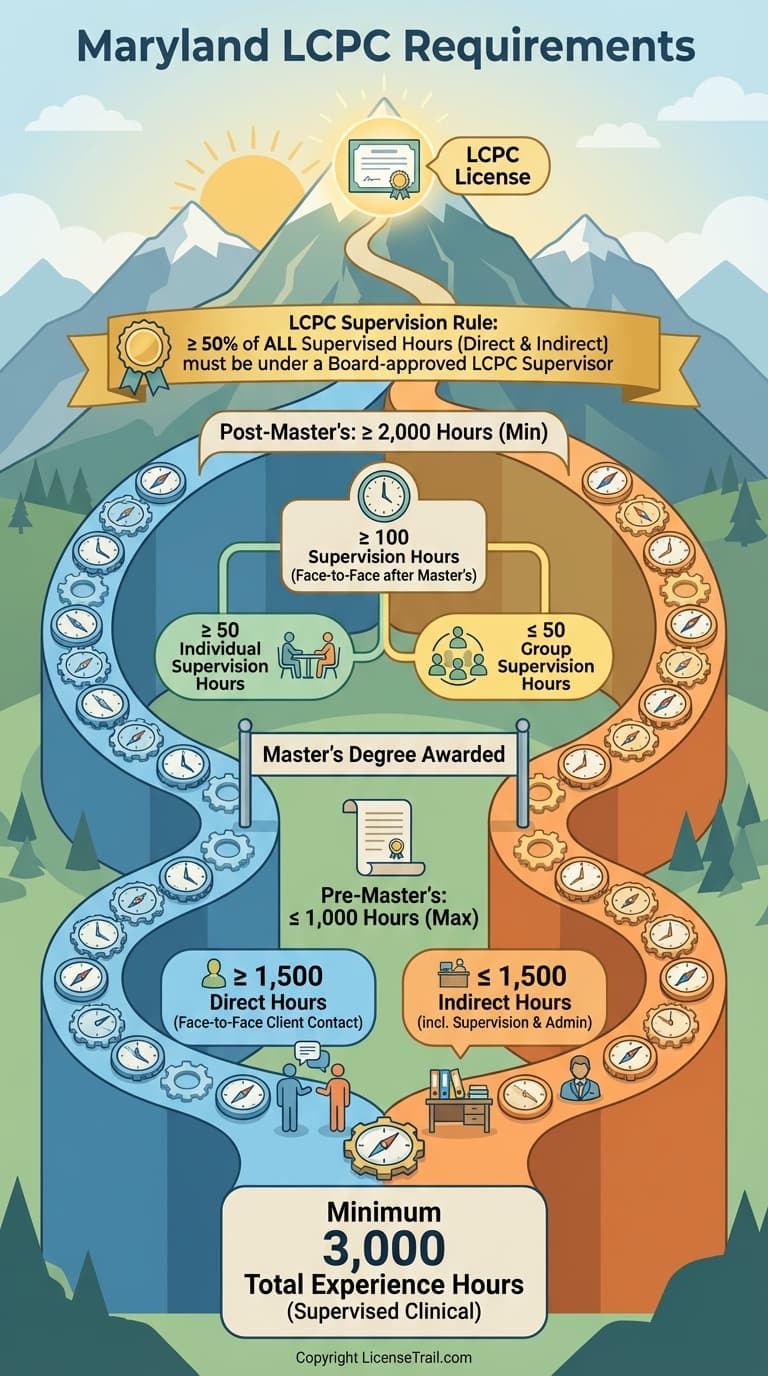
- Degree: Master’s (≥60 grad semester credits) or Doctorate (≥90) in counseling/related field; required core content areas (≥3 credits each) incl. diagnosis/treatment
- Two-step path: Typically LGPC → LCPC; LGPC practice is supervised only under a Board-approved supervisor (with supervision contract)
- Experience (Master’s route): 3 years / 3,000 hours total; ≥1,500 direct (face-to-face clinical) and ≤1,500 indirect
- Post-degree requirement (Master’s): ≥2,000 hours must be post-master’s as LGPC under Board-approved supervision; ≤1,000 hours may come from supervised graduate field placement
- Experience (Doctoral route): 2,000 hours total; ≥1,000 direct and ≤1,000 indirect; ≥1,000 hours post-doctoral (≤1,000 pre-doctoral)
- Supervisor mix (both routes): ≥50% of hours under a Board-approved LCPC supervisor; ≤50% under other Board-approved supervisors
- Required supervision hours: Master’s—100 face-to-face supervision hours within 2 years post-degree (≥50 individual, ≤50 group); Doctorate—50 within 1 year (25 individual, ≤25 group)
- Exams & admin: Pass Board-approved national exam (NCE) + Maryland law/regs exam; submit application, transcripts, verified hours, fees, and criminal history background check (age 18+, good moral character)
License Details
Procedures
Becoming a Licensed Clinical Professional Counselor (LCPC) in Maryland is a structured, two‑license process governed by the Maryland Board of Professional Counselors and Therapists and set out in the Code of Maryland Regulations (COMAR) and Board policy. The LCPC is the independent clinical license; most applicants first become a Licensed Graduate Professional Counselor (LGPC) and then accrue supervised experience toward LCPC.
Below is a step‑by‑step guide with the Board’s own terminology and hour breakdowns.
1. Overview of the Licensure Pathway
Maryland issues two counseling credentials in this track: (health.maryland.gov)
- Licensed Graduate Professional Counselor (LGPC) – entry‑level, practice only under the supervision of a Board‑approved supervisor while completing supervised clinical experience.
- Licensed Clinical Professional Counselor (LCPC) – independent practice license after meeting education, supervised experience, and exam requirements.
In regulation, LCPC requirements are codified at COMAR 10.58.12.05 “Licensed Clinical Professional Counselors”. (regs.maryland.gov)
2. Educational Requirements (Master’s or Doctoral)
Degree level
For LCPC, you must have one of the following in a professional counseling or related field from an accredited institution approved by the Board: (health.maryland.gov)
- Master’s degree with at least 60 graduate semester credit hours (or 90 quarter hours), or
- Doctoral degree with at least 90 graduate semester credit hours (or 135 quarter hours).
Core coursework
COMAR and Board policy require a minimum of 3 graduate semester credits (or 5 quarter hours) in each of a set of counseling core areas (for example, human growth and personality development, social and cultural foundations, counseling theories and techniques, group dynamics, appraisal, research and evaluation, professional, legal and ethical responsibilities, marriage and family therapy, alcohol and drug counseling, supervised field experience, diagnosis and treatment of mental and emotional disorders). (health.maryland.gov)
You must also meet any clinical content requirements that build on professional counselor education for clinical practice (e.g., diagnosis and psychopathology, psychotherapy and treatment of mental and emotional disorders), as outlined in COMAR 10.58.01.05(B). (mdrules.elaws.us)
3. Key Board Definitions for Hours
Maryland uses very specific language about the kinds of hours you must accrue. COMAR 10.58.12.02 (Definitions) provides the controlling definitions. (law.cornell.edu)
-
“Direct clinical counseling services” – face‑to‑face clinical professional counseling services to clients and their significant others. These include, but are not limited to:
- Individual, group, family, and couples counseling
- Evaluation, intake or assessment
- Diagnosis
- Treatment planning with a client
- Crisis management or intervention (law.cornell.edu)
-
“Indirect clinical counseling services” – case management and professional activities related to the provision of clinical professional counseling services, such as:
- Referrals; non–face‑to‑face intakes/assessments
- Receiving individual or group supervision
- Consultation and treatment planning with other professionals
- Case staffing, staff meetings, trainings and seminars
- Record keeping, report writing, case note taking
- Providing clinical training, telephone triage, case management, program development, and other clinical administrative duties. (law.cornell.edu)
-
“Client contact hour” – at least 45 minutes of direct session time with a client present. (law.cornell.edu)
-
“Clinical supervision hour” – at least 45 minutes of direct supervision time with the supervisee present. (law.cornell.edu)
-
“Board‑approved supervisor” – generally an LCPC, LCMFT, LCPC‑art therapist, or clinical alcohol and drug counselor, or another licensed mental health professional legally authorized to diagnose and treat psychological problems, all specifically approved by the Board to supervise. (law.cornell.edu)
-
“Licensed graduate professional counselor” (LGPC) – an individual approved by the Board to practice graduate professional counseling under the supervision of a Board‑approved supervisor while fulfilling the supervised clinical experience for LCPC licensure. (law.cornell.edu)
These definitions drive how you must track and categorize your experience hours.
4. Supervised Clinical Experience Requirements
COMAR 10.58.12.05 lays out the hour requirements and how they must be composed. Requirements differ slightly for master’s‑level and doctoral‑level applicants. (regs.maryland.gov)
4.1 Master’s‑Level Applicants
To qualify for LCPC with a master’s degree, you must have:
-
Total experience requirement
- “A minimum of 3 years and 3,000 hours of experience in clinical professional counseling”. (regs.maryland.gov)
-
Direct vs. indirect clinical hours (within the 3,000 hours)
COMAR specifies the composition: (regs.maryland.gov)- “A minimum of 1,500 hours shall be direct clinical counseling services.”
- “A maximum of 1,500 hours may consist of indirect clinical counseling services.”
In practical terms, you must document at least 1,500 hours of direct, face‑to‑face clinical work and you may count up to 1,500 hours of indirect activities as defined above.
-
How many hours must be supervised after the master’s degree?
- “A minimum of 2,000 hours of supervised clinical experience as a licensed graduate professional counselor shall be completed after the awarding of the master’s degree under a Board‑approved supervisor.” (regs.maryland.gov)
This means:
- At least 2,000 of your 3,000 hours must be accrued post‑master’s while you hold the LGPC (or another Board‑accepted credential) and are under approved supervision.
- The Board’s LCPC requirements page separately summarizes this as: “Applicants must complete 3 years with a minimum of 3,000 hours of supervised clinical experience in professional counseling under an approved supervisor. Of the required 3 years, 2 years must be post‑graduate clinical supervision hours. One year may be acquired before the awarding of the master’s degree.” (health.maryland.gov)
-
How many hours can come from your graduate field placement?
- “A maximum of 1,000 hours of supervised clinical experience may be acquired as supervised field experience as defined under Regulation .04A(2)(k) of this chapter.” (regs.maryland.gov)
In practice, up to 1,000 hours from a supervised practicum/internship/field placement meeting Board criteria can count toward the 3,000 hours.
-
Who must supervise most of your hours?
For master’s applicants, COMAR requires: (regs.maryland.gov)- “At least half of the requisite direct and indirect hours included as supervised clinical experience hours shall be completed under the supervision of a Board‑approved supervisor who is a licensed clinical professional counselor.”
- “No more than half of the requisite direct and indirect hours … shall be completed under a Board‑approved supervisor” who is another type of approved mental health professional (e.g., LCSW‑C, psychologist, psychiatrist, psychiatric nurse, LCMFT, etc.)
So, ≥ 1,500 of your 3,000 hours must be supervised by an LCPC, and ≤ 1,500 hours may be supervised by other Board‑approved supervisors.
-
Required clinical supervision hours (meta‑supervision time, not service hours)
COMAR specifies a separate requirement for explicit supervision time: (regs.maryland.gov)- “100 hours of face‑to‑face clinical supervision hours shall be completed within 2 years of the awarding of the master’s degree, of which:
- A minimum of 50 hours shall be individual face‑to‑face clinical supervision; and
- A maximum of 50 hours may be face‑to‑face group clinical supervision.”
Because a “clinical supervision hour” is at least 45 minutes, you must document 100 such hours within the first 2 years after your master’s degree. (law.cornell.edu)
- “100 hours of face‑to‑face clinical supervision hours shall be completed within 2 years of the awarding of the master’s degree, of which:
4.2 Doctoral‑Level Applicants
To qualify for LCPC with a doctoral degree in clinical professional counseling or a related field, COMAR 10.58.12.05 sets out a different total: (regs.maryland.gov)
-
Total experience requirement
- “Completed a minimum of 2,000 hours of experience in clinical professional counseling”.
-
Direct vs. indirect clinical hours
Within those 2,000 hours: (regs.maryland.gov)- “A minimum of 1,000 hours shall be face‑to‑face direct clinical counseling services.”
- “A maximum of 1,000 hours may consist of indirect clinical counseling services.”
-
Pre‑ vs. post‑doctoral hours
- “1,000 hours shall be acquired after the doctoral degree has been awarded.”
- “A maximum of 1,000 hours of clinical experience may be acquired before the awarding of the doctoral degree.” (regs.maryland.gov)
So you must have at least 1,000 post‑doctoral hours, and you may count up to 1,000 pre‑doctoral hours if they meet the Board’s supervised clinical experience criteria.
-
Supervisor type distribution
The same LCPC‑supervisor emphasis applies: (regs.maryland.gov)- At least half of the direct and indirect hours must be under a Board‑approved LCPC supervisor.
- No more than half under other Board‑approved supervisors.
-
Required clinical supervision hours
- “50 hours of face‑to‑face clinical supervision hours shall be completed within 1 year of the awarding of the doctoral degree, including:
- 25 hours shall be individual face‑to‑face clinical supervision; and
- A maximum of 25 hours may be face‑to‑face group clinical supervision.” (regs.maryland.gov)
- “50 hours of face‑to‑face clinical supervision hours shall be completed within 1 year of the awarding of the doctoral degree, including:
Again, each clinical supervision hour is at least 45 minutes.
5. Step‑by‑Step: From Graduate to LCPC
Step 1 – Complete the qualifying degree and coursework
- Finish a qualifying master’s (≥60 credits) or doctoral (≥90 credits) program in counseling or a related field with all required content areas. (health.maryland.gov)
- Ensure your program includes a supervised field experience (practicum/internship) that meets Board standards; up to 1,000 hours of this can later count toward LCPC if you are a master’s‑level applicant. (regs.maryland.gov)
Step 2 – Become a Licensed Graduate Professional Counselor (LGPC)
COMAR 10.58.12.04 and Board guidance require you to obtain the LGPC before accruing most post‑degree hours: (dsd.maryland.gov)
- Apply to the Board for LGPC licensure once your degree and coursework are complete.
- As an LGPC, you “may practice graduate professional counseling for 2 years under the supervision of an approved supervisor while fulfilling the 2 years post graduate supervised clinical experience.” (health.maryland.gov)
- You must have a written supervision contract with a Board‑approved supervisor, and you may not practice independently. (law.cornell.edu)
Step 3 – Accrue the required supervised experience hours
Track your hours in line with the definitions in Section 3:
-
For master’s‑level LCPC applicants:
- Accumulate 3,000 total hours of experience in clinical professional counseling over at least 3 years.
- Ensure at least 1,500 hours are direct clinical counseling services and no more than 1,500 are indirect clinical counseling services.
- Ensure at least 2,000 hours are post‑master’s supervised clinical experience as an LGPC, with no more than 1,000 hours coming from pre‑degree supervised field experience.
- Make sure at least half (≥1,500 hours) are supervised by an LCPC, with the remainder under other Board‑approved supervisors. (regs.maryland.gov)
-
For doctoral‑level LCPC applicants:
- Accumulate 2,000 total hours of experience in clinical professional counseling.
- Ensure 1,000 hours are face‑to‑face direct clinical counseling services and up to 1,000 are indirect.
- Ensure 1,000 of those hours are post‑doctoral; up to 1,000 may be from pre‑doctoral supervised clinical experience.
- Meet the same LCPC‑supervisor proportion requirements as master’s applicants. (regs.maryland.gov)
In both cases, hours must meet the definition of “supervised clinical experience in clinical professional counseling” (counseling services conducted under the supervision of a Board‑approved supervisor). (law.cornell.edu)
Step 4 – Complete required clinical supervision hours
-
Master’s route:
- 100 hours of face‑to‑face clinical supervision within 2 years of the master’s degree:
- At least 50 hours individual supervision
- Up to 50 hours group supervision (regs.maryland.gov)
- 100 hours of face‑to‑face clinical supervision within 2 years of the master’s degree:
-
Doctoral route:
- 50 hours of face‑to‑face clinical supervision within 1 year of the doctoral degree:
- 25 hours individual
- Up to 25 hours group (regs.maryland.gov)
- 50 hours of face‑to‑face clinical supervision within 1 year of the doctoral degree:
These are supervision sessions between you and your supervisor; they are not the same as client contact hours.
Step 5 – Pass the required examinations
For LCPC, COMAR requires that the applicant has: (regs.maryland.gov)
- “Achieved a passing score on a national certification exam approved by the Board” – for professional counseling this is currently the National Counselors Examination (NCE), as referenced in COMAR 10.58.01.05 and Board materials.
- “Achieved a passing score on an examination of:
- Health Occupations Article, Title 17, Annotated Code of Maryland; and
- This subtitle [COMAR 10.58].”
The Board administers the Maryland Law exam/assessment to fulfill the state law and regulations requirement. (health.maryland.gov)
Step 6 – Apply for LCPC licensure
Once all education, hour, and exam requirements are met, you submit an LCPC application under COMAR 10.58.12.03: (law.cornell.edu)
You must:
- Complete and return the Board‑approved application (LCPC application form or LGPC‑to‑LCPC transfer application). (health.maryland.gov)
- Submit official transcripts from your accredited educational institution showing the highest counseling‑related degree.
- Document supervised clinical experience, typically via Board supervision verification forms signed by supervisors that detail:
- Total hours
- Direct vs. indirect hours
- Dates and settings
- Supervisor type (LCPC vs. other Board‑approved supervisor)
- Clinical supervision hours (individual and group).
- Pay all applicable fees (see COMAR 10.58.02). (law.cornell.edu)
- Submit to a criminal history background check under Health Occupations §17‑501.1. (law.cornell.edu)
- Attest that you are at least 18 years old and of good moral character. (law.cornell.edu)
The Board will review your application and either approve it, request additional documentation, or deny it in accordance with COMAR. (law.cornell.edu)
6. Summary of the Hour Requirements in Board Language
Master’s‑level LCPC applicant (most common route): (regs.maryland.gov)
- 3 years and 3,000 hours of experience in clinical professional counseling, of which:
- Minimum 1,500 hours – direct clinical counseling services
- Maximum 1,500 hours – indirect clinical counseling services
- Within those 3,000 hours:
- Minimum 2,000 hours – supervised clinical experience as a licensed graduate professional counselor after the master’s
- Maximum 1,000 hours – supervised field experience (graduate practicum/internship)
- Supervision structure:
- At least half (≥1,500 hours) under a Board‑approved supervisor who is an LCPC
- No more than half (≤1,500 hours) under other Board‑approved supervisors
- Plus 100 hours of face‑to‑face clinical supervision within 2 years of the master’s:
- At least 50 individual
- Up to 50 group
Doctoral‑level LCPC applicant: (regs.maryland.gov)
- 2,000 hours of experience in clinical professional counseling, of which:
- Minimum 1,000 hours – face‑to‑face direct clinical counseling services
- Maximum 1,000 hours – indirect clinical counseling services
- Time distribution:
- 1,000 hours must be post‑doctoral
- Up to 1,000 hours may be pre‑doctoral
- Supervision structure:
- At least half of direct + indirect hours under a Board‑approved LCPC supervisor
- No more than half under other Board‑approved supervisors
- Plus 50 hours of face‑to‑face clinical supervision within 1 year of the doctorate:
- 25 individual
- Up to 25 group
These requirements, along with the exam and application provisions, are the specific, current LCPC standards used by the Maryland Board of Professional Counselors and Therapists as of the latest COMAR updates (through mid‑2025).
Track your LCPC hours with confidence
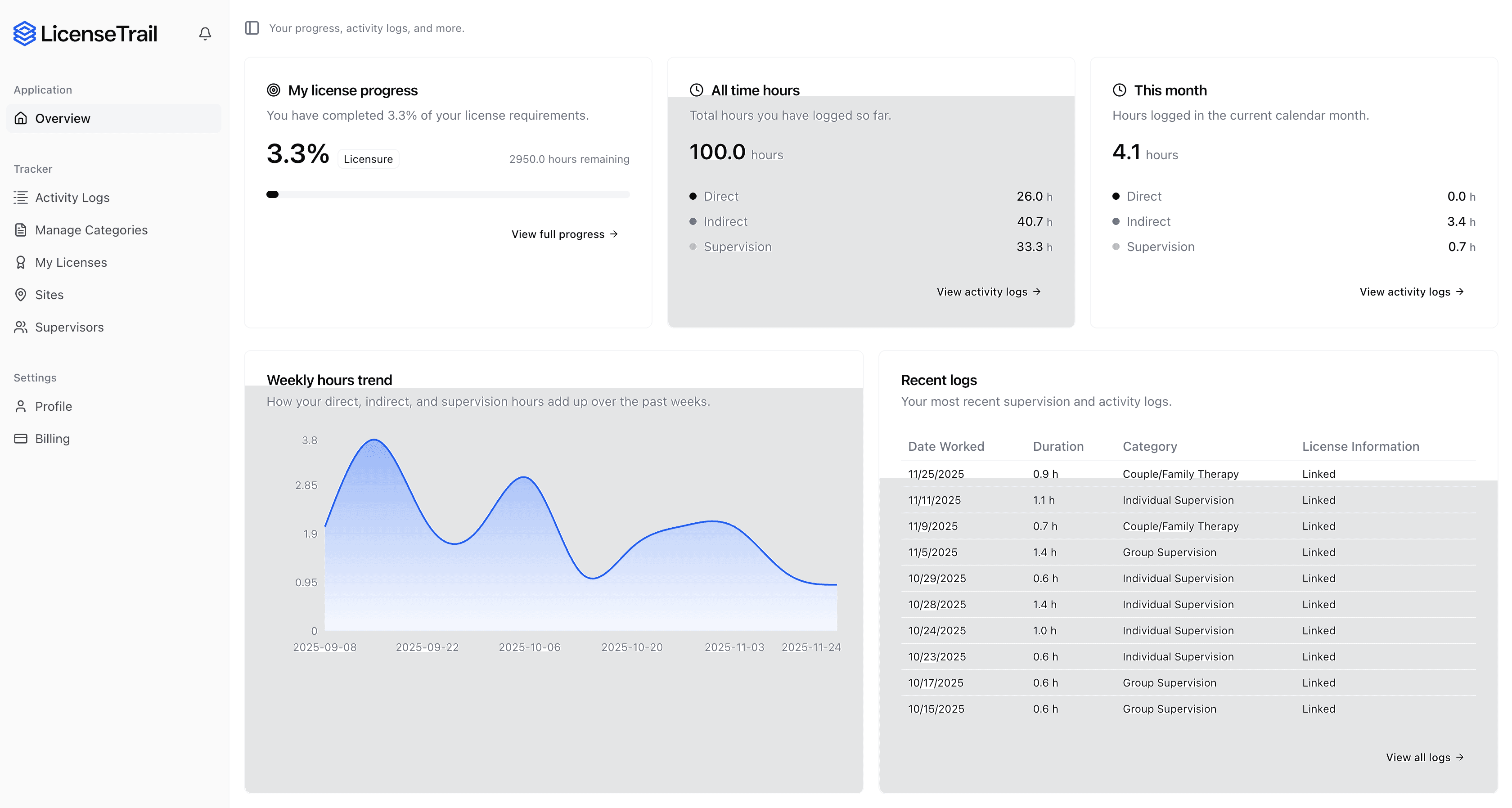
License Trail checks your direct, indirect, and supervision hours against Maryland LCPC requirements continuously and flags mismatches before you submit.
 Start Tracking for Free
No credit card required · Free plan available
Related Licenses
Certified professional counselor
CPC
Certified professional counselor — alcohol and drug
CPC-AD
Certified professional counselor—marriage and family therapist
CPC-MFT
Licensed clinical alcohol and drug counselor
LCADC
Licensed clinical marriage and family therapist
LCMFT
Licensed Clinical Professional Art Therapist
LCPAT
Is your spreadsheet hiding Maryland LCPC risks?
Stop guessing if your categories match Maryland Board of Professional Counselors and Therapists requirements. License Trail checks your direct, indirect, and supervision hours continuously and flags mismatches before you submit.
Import or log
Bring your spreadsheet or start fresh
Upload your existing tracking spreadsheet and we'll map every hour into the right Maryland Board of Professional Counselors and Therapists categories automatically.
Verify against Maryland
Catch mismatches before the board does
License Trail checks your direct, indirect, and supervision hours against Maryland LCPC requirements continuously.
Export board-ready
One-click clean reports
Generate professional, board-ready reports for supervision meetings and Maryland Board of Professional Counselors and Therapists submissions in seconds.
No credit card required · Free plan available