
Maryland LCPAT Requirements: Hours, Exams & Step-by-Step Guide
Stop guessing if your categories match Maryland requirements. License Trail checks your direct, indirect, and supervision hours against LCPAT requirements continuously and flags mismatches before you submit.
No credit card required · Free plan available
Quick Requirements Overview
- Regulator: MD State Board of Professional Counselors and Therapists (COMAR 10.58.17; Health Occupations Title 17); typical path LGPAT → supervised hours → LCPAT
- Eligibility/admin: ≥18, good moral character, criminal background check, comply with Board ethics (COMAR 10.58.03)
- Education: Board-approved master’s (≥60 grad credits) or doctorate (≥90) or Board-equivalent; coursework includes specified content areas + supervised field experience with ≥125 face-to-face client therapy hours
- Exams: Pass ATCBE (Board-approved national exam) and MD law/regulations exam (Title 17 + COMAR 10.58)
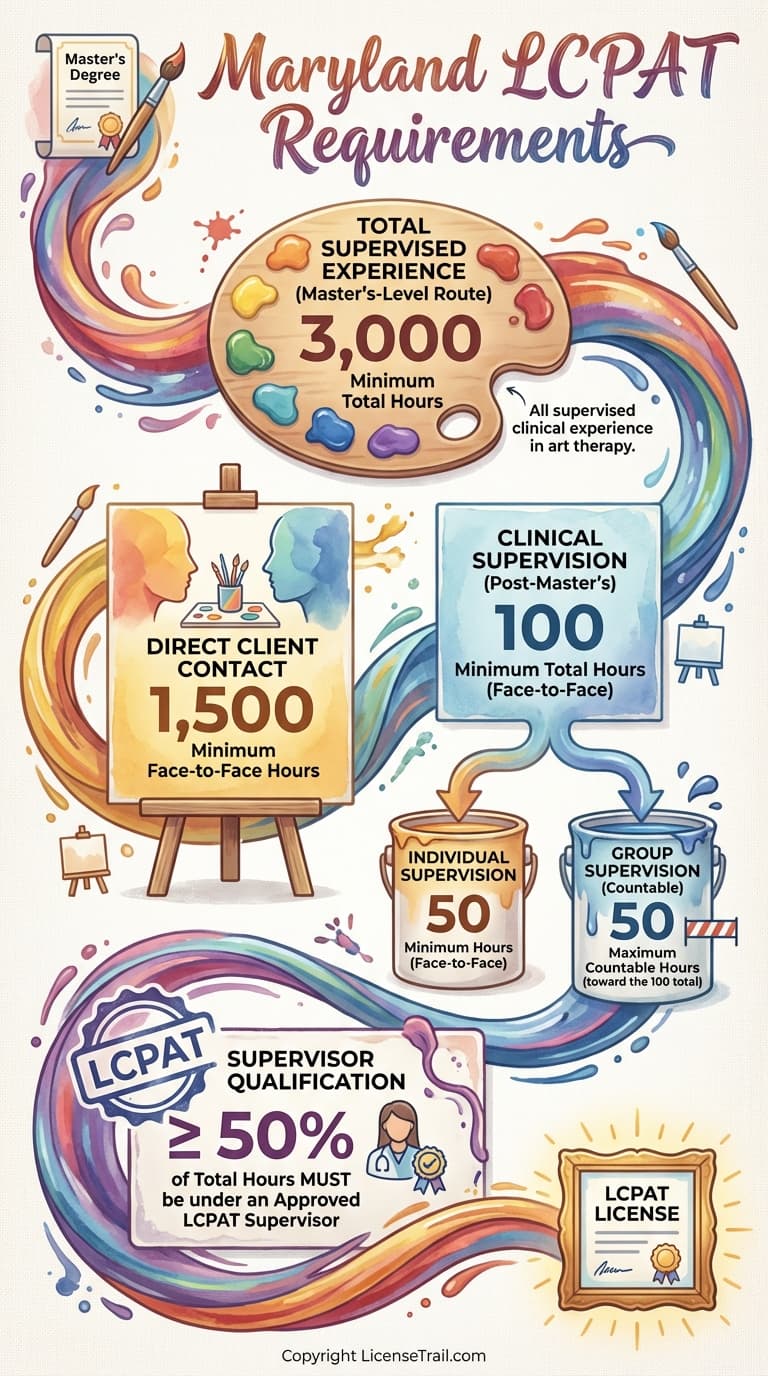
- Supervised experience (Master’s): 3,000 hrs / ≥3 years; ≥1,500 direct face-to-face + up to 1,500 indirect; 100 hrs face-to-face supervision post-degree (≥50 individual, ≤50 group); ≤1,000 hrs/1 year pre-degree; ≥2,000 hrs/2 years post-degree as LGPAT
- Supervised experience (Doctoral): 2,000 hrs / ≥2 years; ≥1,000 direct face-to-face + up to 1,000 indirect; 50 hrs face-to-face supervision post-degree (25 individual, ≤25 group); ≤1,000 hrs/1 year pre-degree; ≥1,000 hrs/1 year post-degree
- Supervision rules: Hours must be under a Board-approved art therapy supervisor; face-to-face = in-person or real-time video (no phone/text/email); ≥50% of hours must be supervised by a Board-approved LCPAT
License Details
Procedures
Maryland’s Licensed Clinical Professional Art Therapist (LCPAT) credential is regulated by the State Board of Professional Counselors and Therapists under COMAR 10.58.17 and Health Occupations Article, Title 17. The license sits at the “independent clinical practice” level; most applicants first become Licensed Graduate Professional Art Therapists (LGPAT) and then complete post‑graduate supervised experience toward LCPAT. (health.maryland.gov)
Below is a step‑by‑step outline of what Maryland requires, with emphasis on the types and amounts of hours and the Board’s own terminology.
1. License titles and overall pathway
Maryland issues two art-therapy-specific licenses: (health.maryland.gov)
-
LGPAT – Licensed Graduate Professional Art Therapist
- For new graduates. You practice “graduate professional art therapy” only under supervision while you accumulate the hours required for clinical licensure.
-
LCPAT – Licensed Clinical Professional Art Therapist
- For independently practicing clinicians providing “clinical professional art therapy.”
Regulations define a “licensed graduate professional art therapist” as someone approved by the Board to practice under supervision “while fulfilling the supervised clinical experience for licensure” under Health Occupations §17‑304.1 and COMAR 10.58.17.04. (health.maryland.gov)
In practice, the usual sequence is:
- Complete a qualifying graduate degree and coursework.
- Pass the required exams and obtain the LGPAT.
- Accrue the supervised clinical experience in professional art therapy.
- Apply for and obtain the LCPAT once all requirements are met.
2. Baseline eligibility (statutory & Board criteria)
To qualify for LCPAT, you must: (regs.maryland.gov)
- Be at least 18 years old and “of good moral character.”
- Have no disqualifying disciplinary history or conduct under Health Occupations §17‑509.
- Submit to and pass a criminal background check.
- Comply with Health Occupations Article, Title 17 and the Board’s Code of Ethics (COMAR 10.58.03).
These are in addition to the degree, coursework, exams, and supervised experience described below.
3. Education: degree and required coursework
3.1 Degree requirement
For both LGPAT and LCPAT, you must complete one of the following from an accredited educational institution approved by the Board: (health.maryland.gov)
- A master’s degree in an art therapy program approved by the Board with at least 60 graduate semester credits (or 90 quarter credits); or
- A doctoral degree in an art therapy program approved by the Board with at least 90 graduate semester credits (or 135 quarter credits); or
- A graduate-level degree the Board deems “equivalent”, meaning it:
- Includes all required coursework listed below, and
- Has a substantial art-therapy emphasis and sufficient training for the intended level of licensure.
3.2 Required graduate coursework (content areas)
COMAR 10.58.17.03A(2) requires at least 3 graduate semester credits (or the quarter-credit equivalent) in each of these areas: (health.maryland.gov)
- Human growth and personality development
- Social and cultural foundations of counseling
- Theories of art therapy
- Art therapy techniques
- Group dynamics, processing, and counseling
- Lifestyle and career development
- Appraisal
- Research and evaluation
- Professional, legal, and ethical responsibilities
- Marriage and family therapy
- Supervised field experience that includes:
- A supervised clinical internship/externship/field experience or practicum, and
- At least 125 hours of face-to-face client therapy in art therapy
- Alcohol and drug counseling
- Psychopathology
- Diagnosis and treatment of mental and emotional disorders
The Board has specifically cautioned that “internship” or “internship-related courses” do not satisfy the separate “professional, legal, and ethical responsibilities” coursework requirement, and that “thesis” or “thesis writing” courses do not satisfy the “research and evaluation” requirement. (health.maryland.gov)
4. Required examinations
Regulations require that an LCPAT applicant must have achieved a passing score on: (health.maryland.gov)
- “A national certification exam approved by the Board” – In practice this is the Art Therapy Credentials Board Examination (ATCBE), as described by the Maryland Art Therapy Association and the Board. (marylandarttherapy.org)
- An exam covering:
- Health Occupations Article, Title 17, and
- COMAR 10.58 (Maryland law and regulations on counselors and therapists).
Even if you have taken the National Counselor Examination for another license, Maryland requires the ATCBE specifically for art therapy licensure. (marylandarttherapy.org)
You must pass these exams before or as part of licensure at the LGPAT level; the LCPAT regulations assume you already hold the graduate-level art therapy credential approved by the Board. (health.maryland.gov)
5. Supervised clinical experience and hours (core of LCPAT requirements)
Maryland’s LCPAT is built on “supervised clinical experience in professional art therapy.”
The Board defines “supervised clinical experience in professional art therapy” as therapy services conducted under an approved art therapy supervisor that include: (health.maryland.gov)
- Monitoring the supervisee’s performance; and
- Providing consultation, guidance, and instruction regarding clinical skills and competencies.
The regulations distinguish between:
- Direct clinical art therapy services / face-to-face client contact hours – time spent delivering art therapy to clients. (health.maryland.gov)
- Indirect clinical art therapy services – related clinical work such as documentation, case consultation, treatment planning, and other non–face-to-face clinical activities. (law.cornell.edu)
- Face-to-face clinical supervision hours – scheduled supervision time with a Board-approved supervisor, in person or via real-time video.
The Board defines “face-to-face” as being in the physical presence of the other party or using real-time video conferencing where supervisor and supervisee can see and hear each other; telephone-only or text/email communication does not qualify as “face-to-face.” (health.maryland.gov)
5.1 Supervised experience for master’s-level applicants
For a master’s-level applicant seeking LCPAT, Maryland requires: (health.maryland.gov)
-
Minimum duration:
- At least 3 years of supervised clinical experience in professional/clinical professional art therapy.
-
Total hours:
- At least 3,000 hours of experience in clinical professional art therapy.
-
Breakdown of those 3,000 hours:
- At least 1,500 hours must be direct clinical art therapy services / face-to-face client contact hours.
- This is direct client therapy delivered as an art therapist.
- Up to 1,500 hours may be indirect clinical art therapy services.
- These hours may involve charting, treatment planning, case conferences, consultation, and other clinically related but non–face-to-face activities.
- Within the total hours, you must also complete:
- 100 hours of face-to-face clinical supervision obtained after the master’s degree is awarded, of which:
- At least 50 hours must be individual face-to-face clinical supervision, and
- Up to 50 hours may be face-to-face group clinical supervision.
- 100 hours of face-to-face clinical supervision obtained after the master’s degree is awarded, of which:
- At least 1,500 hours must be direct clinical art therapy services / face-to-face client contact hours.
-
Pre‑degree vs. post‑degree hours: (health.maryland.gov)
- You may count no more than 1 year and 1,000 hours of supervised clinical experience before the master’s degree is awarded (typically in internship/practicum).
- At least 2 years and 2,000 hours must be completed after the master’s degree.
- The Board further specifies that a minimum of 2,000 hours of supervised clinical experience must be completed as a Licensed Graduate Professional Art Therapist (LGPAT) under a Board-approved supervisor.
-
Supervisor type and distribution:
- At least half of your direct and indirect supervised clinical experience hours must be completed under a Board-approved art therapy supervisor who is a licensed clinical professional art therapist.
- No more than half of those hours can be under other Board-approved art therapy supervisors (for example, ATCB-credentialed art therapists or other licensed mental health providers approved by the Board). (health.maryland.gov)
In other words, for a typical master’s applicant the Board is effectively requiring:
- 3,000 total supervised hours, comprised of:
- 1,500 hours of direct, face-to-face clinical art therapy services, and
- Up to 1,500 hours of indirect clinical art therapy services;
- All 3,000 hours must be supervised, with:
- 100 hours of face-to-face clinical supervision post‑master’s (50 individual / 50 group max), and
- At least 2,000 of the 3,000 hours completed post‑degree as an LGPAT.
5.2 Supervised experience for doctoral-level applicants
For a doctoral-level applicant, Maryland requires a smaller but still tightly defined set of hours: (health.maryland.gov)
-
Minimum duration:
- At least 2 years of supervised clinical experience in professional/clinical professional art therapy.
-
Total hours:
- At least 2,000 hours of experience in clinical professional art therapy.
-
Breakdown of those 2,000 hours:
- At least 1,000 hours must be face-to-face direct clinical art therapy services;
- Up to 1,000 hours may be indirect clinical art therapy services.
- Within these:
- 50 hours of face-to-face clinical supervision must be obtained after the doctoral degree is awarded, consisting of:
- 25 hours of individual face-to-face clinical supervision, and
- Up to 25 hours of face-to-face group clinical supervision.
- 50 hours of face-to-face clinical supervision must be obtained after the doctoral degree is awarded, consisting of:
-
Pre‑degree vs. post‑degree hours: (health.maryland.gov)
- You may count up to 1 year and 1,000 hours of supervised experience before the doctoral degree.
- At least 1 year and 1,000 hours must be completed after the doctoral degree is awarded.
-
Supervisor type and distribution:
- As with master’s applicants, at least half of the direct and indirect hours must be completed under a Board-approved art therapy supervisor who is a licensed clinical professional art therapist, and no more than half under other approved art therapy supervisors. (health.maryland.gov)
6. Supervisor qualifications and definitions that affect your hours
Your hours only count if they are under an approved art therapy supervisor and meet COMAR 10.58.17’s supervision rules.
Key Board terms: (health.maryland.gov)
-
“Approved art therapy supervisor” may be:
- An Art Therapy Credentials Board Certified Supervisor (ATCS),
- An ATCB Registered or Board Certified Art Therapist (ATR/ATR‑BC),
- A licensed clinical professional art therapist (LCPAT), or
- Another mental health care provider licensed under Title 17 and approved by the Board.
-
“Face-to-face” supervision:
- Must be in person or via real-time video conferencing allowing both parties to see and hear one another.
- Telephone-only, email, texting, and non-video internet communication do not count as “face-to-face.”
-
Certain individuals may not supervise LGPATs, including relatives, LGPATs themselves, and other graduate-level licensees (LGPC, LGMFT, LGADC, etc.), and any supervisor with whom there is a conflict of interest. (health.maryland.gov)
Because Maryland ties licensure eligibility to these definitions, it is important that your supervision contracts and logs clearly document that your supervisor is Board-approved and that your supervision sessions meet the “face-to-face” standard.
7. Step‑by‑step outline for a typical master’s‑level LCPAT candidate
Putting it together for a master’s-trained art therapist:
-
Complete an approved master’s degree in art therapy
- Minimum 60 graduate semester credits with all required course content (including 125 hours of face-to-face client therapy in supervised field experience). (health.maryland.gov)
-
Pass the required exams
- Pass the ATCBE (national certification exam approved by the Board).
- Pass the Maryland law exam on Health Occupations Title 17 and COMAR 10.58. (health.maryland.gov)
-
Apply for and obtain the LGPAT
- Submit the Board-approved application, official transcript, fees, and to a criminal background check; demonstrate good moral character; pass the exams above. (health.maryland.gov)
-
Work under supervision as an LGPAT and accrue your hours
- Over at least 3 years, accumulate:
- 3,000 hours of supervised clinical experience in clinical professional art therapy,
- including 1,500 direct face-to-face clinical art therapy hours, and
- up to 1,500 indirect clinical art therapy hours.
- Within those hours, complete 100 hours of post‑master’s face-to-face clinical supervision (≥50 individual, ≤50 group).
- Ensure that:
- At least 2,000 hours and 2 years of the supervised experience occur after the master’s degree and while licensed as LGPAT.
- No more than 1,000 hours and 1 year are counted from pre‑master’s internship/practicum.
- At least half of all supervised hours are under an LCPAT approved to supervise. (health.maryland.gov)
- 3,000 hours of supervised clinical experience in clinical professional art therapy,
- Over at least 3 years, accumulate:
-
Apply for the LCPAT
- Demonstrate that you:
- Hold the LGPAT (or other Board-approved graduate art therapy credential),
- Have completed the 3,000 supervised hours with the required direct/indirect and supervision breakdown,
- Have met all educational and exam requirements,
- Have complied with Title 17 and COMAR 10.58 and maintained good moral character. (law.cornell.edu)
- Demonstrate that you:
-
Maintain your license
- Once licensed as LCPAT, you must renew periodically with continuing education, but those renewal requirements are separate from initial licensure. (health.maryland.gov)
8. Quick numerical summary of hour requirements
Master’s-level LCPAT applicant
- Total supervised clinical experience in clinical professional art therapy:
- 3,000 hours over at least 3 years
- Direct vs. indirect hours:
- 1,500 hours minimum direct clinical art therapy services / face-to-face client contact
- Up to 1,500 hours indirect clinical art therapy services
- Supervision within those hours (post‑master’s):
- 100 hours face-to-face clinical supervision, including:
- ≥ 50 hours individual
- ≤ 50 hours group
- 100 hours face-to-face clinical supervision, including:
- Timing:
- ≤ 1,000 hours / 1 year pre‑master’s
- ≥ 2,000 hours / 2 years post‑master’s (as LGPAT)
Doctoral-level LCPAT applicant
- Total supervised clinical experience in clinical professional art therapy:
- 2,000 hours over at least 2 years
- Direct vs. indirect hours:
- 1,000 hours minimum face-to-face direct clinical art therapy services
- Up to 1,000 hours indirect clinical art therapy services
- Supervision within those hours (post‑doctorate):
- 50 hours face-to-face clinical supervision, including:
- 25 hours individual
- ≤ 25 hours group
- 50 hours face-to-face clinical supervision, including:
- Timing:
- ≤ 1,000 hours / 1 year pre‑doctorate
- ≥ 1,000 hours / 1 year post‑doctorate
All hours must qualify as “supervised clinical experience in professional art therapy” under an approved art therapy supervisor, with at least half the hours under a Board-approved LCPAT supervisor and within the Board’s “face-to-face” definition. (health.maryland.gov)
Because regulations can be amended, it is prudent to check the most current versions of COMAR 10.58.17 and the Maryland Board’s art therapist page before finalizing your education plan or supervision contracts.
Track your LCPAT hours with confidence
License Trail checks your direct, indirect, and supervision hours against Maryland LCPAT requirements continuously and flags mismatches before you submit.
 Start Tracking for Free
No credit card required · Free plan available
Related Licenses
Certified professional counselor
CPC
Certified professional counselor — alcohol and drug
CPC-AD
Certified professional counselor—marriage and family therapist
CPC-MFT
Licensed clinical alcohol and drug counselor
LCADC
Licensed clinical marriage and family therapist
LCMFT
Licensed clinical professional counselor
LCPC
Is your spreadsheet hiding Maryland LCPAT risks?
Stop guessing if your categories match Maryland Board of Professional Counselors and Therapists requirements. License Trail checks your direct, indirect, and supervision hours continuously and flags mismatches before you submit.
Import or log
Bring your spreadsheet or start fresh
Upload your existing tracking spreadsheet and we'll map every hour into the right Maryland Board of Professional Counselors and Therapists categories automatically.
Verify against Maryland
Catch mismatches before the board does
License Trail checks your direct, indirect, and supervision hours against Maryland LCPAT requirements continuously.
Export board-ready
One-click clean reports
Generate professional, board-ready reports for supervision meetings and Maryland Board of Professional Counselors and Therapists submissions in seconds.
No credit card required · Free plan available