
Massachusetts LAABA Requirements: Hours, Exams & Step-by-Step Guide
Stop guessing if your categories match Massachusetts requirements. License Trail checks your direct, indirect, and supervision hours against LAABA requirements continuously and flags mismatches before you submit.
No credit card required · Free plan available
Quick Requirements Overview
- Regulator/authority: MA Board of Registration of Allied Mental Health & Human Services Professions (M.G.L. c.112 §§163–172; 262 CMR 10.00)
- Eligibility basics: good moral character; no disqualifying conduct; meet education + supervised experience + exam requirements
- Education: bachelor’s degree from a recognized institution plus ABA coursework meeting Board standards (typically 9 credits/135 classroom hours, or Board‑approved course sequence/equivalent)
- ABA coursework content: must cover required areas (e.g., ethics, principles/concepts, assessment/intervention, measurement/data, research methods per credit model) per 262 CMR 10.04(3)
- Supervised experience (choose one track or approved combination; only one category at a time; hours start after beginning required coursework):
- Independent Fieldwork: 1,000 total incl. ≥50 supervised; 10–30 hrs/wk; supervision ≥5% each 2‑week period and ≥1x/2 weeks
- Practicum: 670 total (for academic credit) incl. ≥50 supervised; 10–30 hrs/wk; supervision ≥7.5% weekly and ≥1x/week
- Intensive Practicum: 500 total (for academic credit) incl. ≥50 supervised; 10–30 hrs/wk; supervision ≥10% weekly and ≥1x/week
- Supervisor rules (current): supervision must be by a MA‑licensed LABA who is BACB‑qualified to supervise; supervisor cannot be related to/subordinate to/employed by supervisee
- Exam: must pass a Board‑approved ABA exam (confirm current accepted exam at time of application)
- Post‑licensure practice: LAABA must practice under supervision; ≥1 hour/month individual, face‑to‑face supervision in the treatment setting; supervisor must approve treatment plans and maintain Board‑acceptable documentation
License Details
Procedures
Massachusetts Requirements for Licensure as a Licensed Assistant Applied Behavior Analyst (LAABA)
In Massachusetts, the formal title is “licensed assistant applied behavior analyst”, regulated by the Board of Registration of Allied Mental Health and Human Services Professions under M.G.L. c. 112, §§163–172 and 262 CMR 10.00. (mass.gov)
A LAABA is defined in statute as a person who, by training, experience and examination, meets the Board’s requirements and is licensed to practice applied behavior analysis under supervision of a licensed applied behavior analyst (LABA) or a qualified physician/psychologist. (mass.gov)
The Board does not frame the requirement as “1,500 hours of direct experience and 1,500 hours of supervised experience.” Instead, it requires a specific mix of total experience hours and embedded supervised hours, depending on which supervised-experience category you choose (Independent Fieldwork, Practicum, or Intensive Practicum). (law.cornell.edu)
1. Core eligibility criteria
Under M.G.L. c.112 §165 and 262 CMR 10.04(2), an applicant for original LAABA licensure must demonstrate that they: (mass.gov)
- Are of good moral character.
- Have not engaged in conduct that would be grounds for license denial under M.G.L. c.112 §169 (e.g., certain serious misconduct).
- Have successfully completed a qualifying bachelor’s degree program meeting the Board’s ABA coursework standards (detailed below).
- Have successfully completed a Practicum or Supervised Experience in the practice of behavior analysis that meets Board requirements.
- Have successfully completed a Board‑approved examination related to the principles and practice of applied behavior analysis.
There is also a historical “grandfather” path for individuals who were already BCaBAs and applied before June 5, 2017, but that window is now closed. (regulations.justia.com)
2. Required education and ABA coursework
2.1. Bachelor’s degree requirement
For LAABA licensure, the law requires that the applicant: (mass.gov)
- Has successfully completed a bachelor’s degree program from a “recognized educational institution” (accredited in a manner acceptable to the Board); and
- That program includes at least 135 classroom hours of instruction specifically in behavior analysis, or the applicant holds a bachelor’s degree plus a Board‑approved ABA course sequence or coursework that meets professional standards.
In the Board’s regulations, a “Bachelor’s Degree Program” for this purpose is defined as a bachelor’s program at a recognized educational institution that:
- Includes a minimum of nine (9) semester credit hours of instruction specifically in behavior analysis, or
- Is paired with a Board‑approved course sequence or equivalent coursework meeting professional standards. (law.cornell.edu)
(Those 9 semester credits correspond to roughly 135 “classroom hours” of instruction contemplated in the statute.)
2.2. Board‑accepted ABA content areas at the bachelor’s level
Under 262 CMR 10.04(3), the Board will accept bachelor’s programs that meet one of two content‑distribution models. In paraphrased form: (regulations.justia.com)
Model A – Minimum of 9 credits in ABA:
At least 9 semester credits distributed across content areas such as:
- Ethical considerations
- Definitions/characteristics; principles, processes, and concepts of behavior analysis
- Behavioral assessment and selecting intervention outcomes/strategies
- Experimental evaluation of interventions; measurement of behavior; display/interpretation of data
- Behavioral change procedures and systems support
- Discretionary coursework related to behavior analysis
Model B – Minimum of 12 credits in ABA:
At least 12 semester credits, including:
- Ethics and professional conduct
- Concepts and principles of behavior analysis
- Research methods in behavior analysis
- Applied behavior analysis coursework covering:
- Fundamental elements of behavior change and specific procedures
- Identification of the problem and assessment
- Intervention and behavior‑change considerations, behavior‑change systems, and implementation/management/supervision
Programs commonly align these requirements with BACB‑verified course sequences, but what legally matters is that your coursework matches the credit‑hour and content distribution in 262 CMR 10.04(3) or is otherwise approved by the Board. (law.cornell.edu)
3. Required supervised experience hours
3.1. High‑level statutory requirement
Statute requires that an LAABA applicant “has successfully completed a practicum or supervised experience in the practice of behavior analysis that meets the eligibility requirements established by the board.” (mass.gov)
Those eligibility requirements are spelled out in 262 CMR 10.04(4) and in the definitions of “Practicum,” “Supervised Experience,” and “Supervised Independent Fieldwork.” (law.cornell.edu)
3.2. When you can start counting hours
The Board is explicit that you may not begin counting supervised-experience hours until after you have started attending the coursework required for LAABA licensure. Specifically, supervisees “may not begin accumulating Supervised Independent Fieldwork, Practicum, or intensive Practicum hours” until they have started the required courses. (regulations.justia.com)
3.3. Types of experience recognized and exact hour requirements
Massachusetts recognizes three experience categories. You may qualify using one category or an approved combination, but you can accrue hours in only one category at a time. (regulations.justia.com)
Below is a concise summary of the requirements as written in 262 CMR 10.04(4) (paraphrased):
Option 1: Supervised Independent Fieldwork
- Total required hours:
- 1,000 hours of independent fieldwork in behavior analysis.
- Minimum supervised hours inside that total:
- At least 50 hours must be supervised.
- Weekly hour limits:
- You must accrue at least 10, but no more than 30, hours per week.
- Supervision intensity and frequency:
- You must be supervised at least once every two weeks, and
- Supervision must total at least 5% of the hours you accrued in independent fieldwork during each two‑week period. (regulations.justia.com)
In other words, the regulation requires 1,000 total experience hours, with supervision embedded at a minimum of 5% of your fieldwork time, and at least 50 of those hours being formal supervision.
Option 2: Practicum
- Total required hours:
- 670 hours of Practicum experience in behavior analysis.
- Context:
- Must be within a Recognized Educational Institution Practicum program and taken for academic credit (the regulation references graduate academic credit, though you are training for an assistant‑level license).
- Minimum supervised hours inside that total:
- At least 50 hours must be supervised.
- Weekly hour limits:
- At least 10 hours per week, but no more than 30 hours per week.
- Supervision intensity and frequency:
- Supervision must occur at least once per week, and
- The total supervision per week must be at least 7.5% of the total Practicum hours for that week. (regulations.justia.com)
Option 3: Intensive Practicum
- Total required hours:
- 500 hours of intensive Practicum experience in behavior analysis.
- Context:
- Must be within a Recognized Educational Institution Practicum program and taken for academic credit.
- Minimum supervised hours inside that total:
- At least 50 hours must be supervised.
- Weekly hour limits:
- At least 10 hours per week, but no more than 30 hours per week.
- Supervision intensity and frequency:
- Supervision must occur at least once per week, and
- The total supervision per week must be at least 10% of the intensive Practicum hours for that week. (regulations.justia.com)
Combined experience
The Board permits you to combine these categories (e.g., some Independent Fieldwork plus some Practicum), but you: (regulations.justia.com)
- May elect to combine any of the three experience categories, and
- May accrue experience in only one category at a time (you cannot call the same hours both Practicum and Independent Fieldwork, for example).
3.4. What “experience” and “supervised experience” mean in Board language
The Board defines: (law.cornell.edu)
- “Practicum” as a distinctly defined, supervised clinical experience designed to develop ABA skills under supervision (occurring on campus or in the field).
- “Supervised Experience” as ABA services rendered under supervision to help the supervisee build and integrate applied behavior analysis skills for initial professional practice.
- “Supervised Independent Fieldwork” as supervised experience not for course credit, begun after you start the required ABA courses.
These definitions are broad: the “hours” are hours of ABA practice and training, not just 1:1 direct therapy, and “supervised hours” refer to structured supervision meetings and activities that meet the Board’s percentage and frequency rules.
3.5. Supervisor qualifications and restrictions
The regulations also address who can supervise and under what conditions: (regulations.justia.com)
- For hours in Massachusetts:
- Before Jan 1, 2015: supervision could be provided by a licensed applied behavior analyst or a BCBA.
- Jan 1, 2015–Dec 31, 2017: supervision had to be by a licensed ABA or a BCBA qualified to supervise by the BACB.
- On/after Jan 1, 2018: supervision must be by a Massachusetts‑licensed applied behavior analyst who is also BACB‑qualified to supervise.
- For hours outside Massachusetts, analogous rules apply (licensed ABA in that state, or BCBA qualified to supervise if that state has no ABA license).
- The supervisor may not be related to, subordinate to, or employed by the supervisee (but the supervisee may pay the supervisor for supervision services).
4. The examination requirement
By statute and regulation, LAABA applicants must pass a “Board‑approved examination related to the principles and practice of applied behavior analysis.” (mass.gov)
The Board’s regulations do not name a specific exam in the CMR text; historically, Massachusetts has aligned with the national BCaBA examination, but you must follow the current application instructions and FAQs to confirm which exam is recognized at the time you apply. (mass.gov)
5. Application process and documentation
Under 262 CMR 10.04(1), the application process has several formalities: (law.cornell.edu)
- You must apply “in the manner prescribed by the Board” using forms it approves.
- The Board will not review an application unless:
- It is on the correct Board‑approved forms,
- It is completely and properly filled out as prescribed,
- It is signed under the penalties of perjury, and
- It is accompanied by the prescribed application fee and any other information the Board requires.
Practically, your LAABA application packet typically needs to include (as reflected in Board checklists and FAQs): (mass.gov)
- Official transcripts showing your bachelor’s degree and ABA coursework.
- Documentation of supervised experience hours (often on forms that capture:
- dates of supervision meetings,
- duration, format (individual vs group),
- total experience hours, and
- total supervision hours).
- Proof of passing the Board‑approved exam.
- Any required references or attestations related to moral character or disciplinary history.
6. Licensure by reciprocal recognition
Massachusetts also allows licensure by reciprocal recognition for assistant applied behavior analysts licensed elsewhere. Under 262 CMR 10.04(6), the Board may issue a license without examination if: (regulations.justia.com)
- You hold a current assistant applied behavior analyst (or equivalent) license, certificate, or registration issued by another state or jurisdiction;
- That jurisdiction’s standards are substantially equivalent to or exceed Massachusetts standards; and
- Your out‑of‑state license is current and in good standing.
You must still file a Board application, pay the fee, and provide documentation for the Board to evaluate equivalence and good standing.
7. Supervision requirements after you are licensed
Even after you become a LAABA, Massachusetts requires ongoing supervision while you practice. Under 262 CMR 8.04(5), paraphrased: (regulations.justia.com)
-
A licensed assistant applied behavior analyst who is practicing ABA must:
- Receive at least one hour per month of individual, face‑to‑face supervision in the treatment setting from a Massachusetts‑licensed applied behavior analyst or a Board‑approved physician/psychologist;
- Obtain prior approval for all treatment plans from that supervisor before providing treatment; and
- Maintain documentation of supervision on forms acceptable to the Board.
-
Supervising LABAs must:
- Provide supervision of a type, frequency, and duration consistent with client needs and acceptable clinical standards, including at least one hour per month of individual, face‑to‑face supervision in the treatment setting;
- Approve treatment plans used by the LAABA;
- Assume professional responsibility for clinical oversight of all clients served by the LAABA; and
- Maintain supervision records on Board‑acceptable forms.
This supervision requirement is in addition to the pre‑licensure Practicum/fieldwork hours.
8. Special notes about telehealth and timing
The Board issued a policy (now expired) that teletherapy client sessions and remote supervision (video or telephone) from September 1, 2021 through September 30, 2023 could be counted toward experience, direct‑client, and supervision requirements for all license types, to the extent applicable. (mass.gov)
If you accrued LAABA experience during that window, those remote hours can still be part of your qualifying total as long as they otherwise meet the Board’s requirements. For hours outside that period, you should assume the normal in‑person requirements apply unless and until the Board issues a new policy.
9. How to think about the “types” of hours
Putting this into the kind of breakdown you asked for:
-
Massachusetts does not say “1,500 direct hours + 1,500 supervised hours.”
-
Instead, it requires one of these supervised‑experience packages (or an allowed combination):
Experience Type Total ABA Experience Hours Minimum Supervised Hours Supervision Intensity Independent Fieldwork 1,000 ≥ 50 ≥ 5% of hours, every 2 wks Practicum 670 ≥ 50 ≥ 7.5% of hours weekly Intensive Practicum 500 ≥ 50 ≥ 10% of hours weekly
All of these hours are “experience in behavior analysis” under supervision as defined by 262 CMR 10.02 and 10.04—i.e., ABA practice and training activities, with a specified proportion of that time spent in structured supervision meetings and activities. (law.cornell.edu)
To verify details for your specific situation (e.g., whether your program’s coursework and field experience are already Board‑aligned), you should match your transcripts and supervision logs line‑by‑line against M.G.L. c.112 §165 and 262 CMR 10.02 & 10.04, and consult the LAABA Application Checklist and ABA/LAABA FAQ published by the Board. (mass.gov)
Track your LAABA hours with confidence
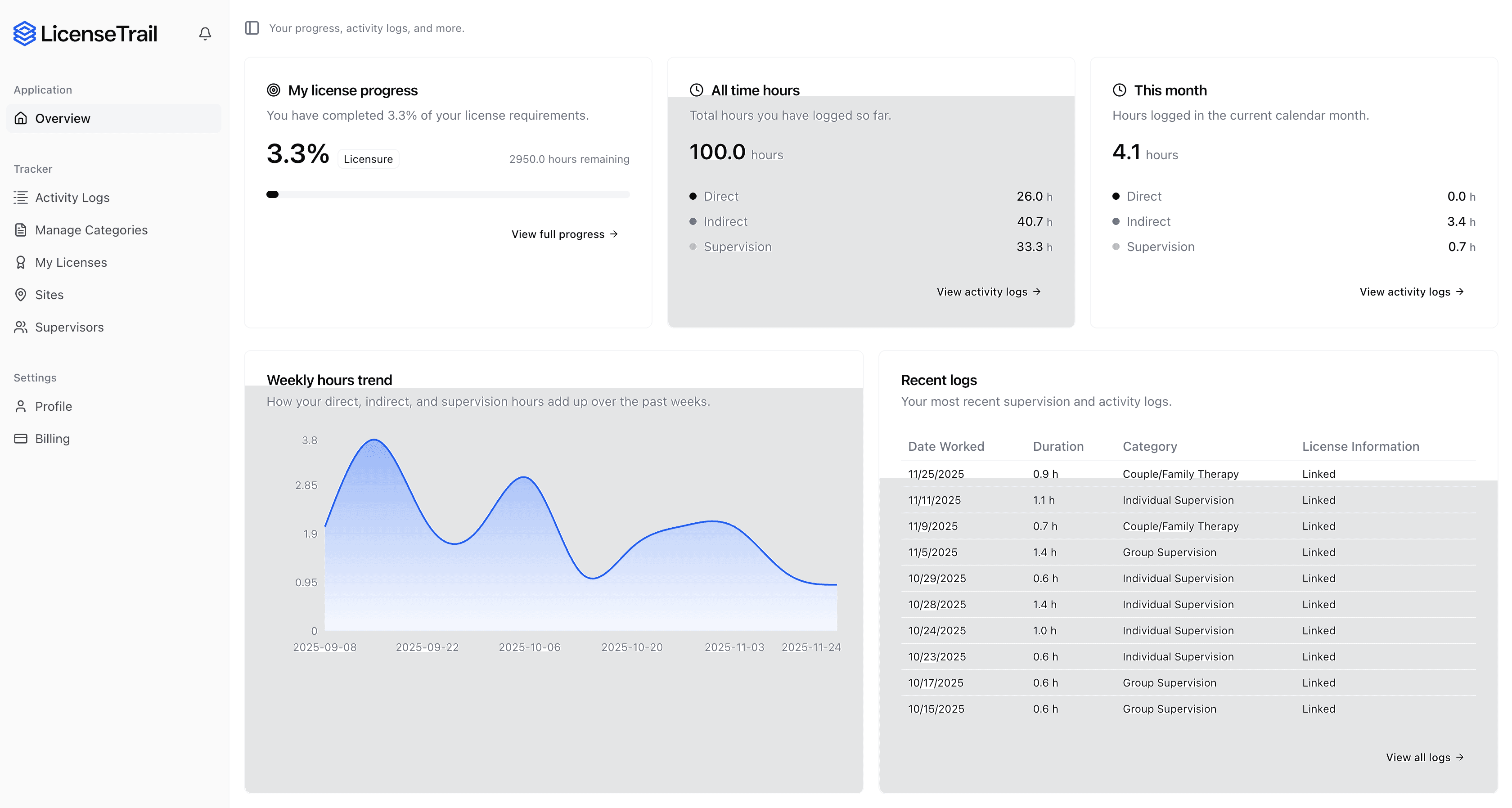
License Trail checks your direct, indirect, and supervision hours against Massachusetts LAABA requirements continuously and flags mismatches before you submit.
 Start Tracking for Free
No credit card required · Free plan available
Is your spreadsheet hiding Massachusetts LAABA risks?
Stop guessing if your categories match Massachusetts Board of Registration of Allied Mental Health and Human Services Professions requirements. License Trail checks your direct, indirect, and supervision hours continuously and flags mismatches before you submit.
Import or log
Bring your spreadsheet or start fresh
Upload your existing tracking spreadsheet and we'll map every hour into the right Massachusetts Board of Registration of Allied Mental Health and Human Services Professions categories automatically.
Verify against Massachusetts
Catch mismatches before the board does
License Trail checks your direct, indirect, and supervision hours against Massachusetts LAABA requirements continuously.
Export board-ready
One-click clean reports
Generate professional, board-ready reports for supervision meetings and Massachusetts Board of Registration of Allied Mental Health and Human Services Professions submissions in seconds.
No credit card required · Free plan available