
Montana ACLC Requirements: Hours, Exams & Step-by-Step Guide
Stop guessing if your categories match Montana requirements. License Trail checks your direct, indirect, and supervision hours against ACLC requirements continuously and flags mismatches before you submit.
No credit card required · Free plan available
Quick Requirements Overview
- Hold ACLC (LAC Candidate) to legally practice under supervision while earning required experience hours in MT
- Education prerequisite (complete before applying): meet one degree path (BA+/approved field; AA/certificate in addiction; any degree + specified credits; or Board-approved experience equivalency)
- Complete 285 addiction-specific contact hours in required content areas (assessment, counseling, pharmacology, ethics, A&D studies, treatment planning/documentation, multicultural, co-occurring, gambling/gaming)
- Apply via state portal with transcripts, 285-hour documentation, Training & Supervision Plan, fingerprint-based background check, and fee
- Maintain ACLC via annual renewal (Board renewal window/late period applies; Board may limit time in candidate status)
- After ACLC issuance: complete 1,000 supervised work hours over ≥7 months, post-degree/certificate, in a qualified treatment program (max 2 programs)
- Within the 1,000 hours: at least 500 hours across Board-set skill areas (e.g., screening, assessment, treatment planning, referrals, case management, individual/group counseling, education, documentation, ethics, multicultural)
- Supervision rules: 20:1 client-contact to supervision, includes individual + group, plus ≥10 hours direct observation
License Details
Procedures
Montana regulates addiction counselors through the Department of Labor & Industry’s Board of Behavioral Health. To practice under supervision while you complete your experience hours, you must hold the provisional credential generally referred to as an Addiction Counselor Licensure Candidate (ACLC) or Licensed Addiction Counselor Candidate (LAC Candidate).
The requirements for this candidate license are set in Montana statute (Title 37, chapter 35) and in the Board’s administrative rules (ARM 24.219, subchapter 50). (law.justia.com)
What follows is an organized, step‑by‑step description of what the Board actually requires, with the specific hour counts and categories.
1. Understand what the ACLC / LAC Candidate credential is
State law defines a two‑stage process:
- First you complete the education required for licensure.
- Then you register as an addiction counselor licensure candidate in order to lawfully do addiction counseling and earn your supervised work experience hours in Montana. (law.justia.com)
The candidate license is the status you hold during this supervised work period. You renew it annually until you qualify for full Licensed Addiction Counselor (LAC) licensure. (law.justia.com)
2. Meet the degree requirement
Montana statute lays out several ways to meet the degree prerequisite for addiction counselor licensure (and, by extension, for candidate status, because you must “have completed the education required for licensure” before registering as a candidate). (law.justia.com)
You must meet one of the following:
-
Bachelor’s or higher degree in an approved field
A minimum of a baccalaureate or advanced degree from an accredited college or university in one of these areas:- alcohol and drug studies
- psychology
- sociology
- social work
- counseling
- human services
- psychiatric rehabilitation
- community health (law.justia.com)
-
Associate degree or certificate in an addiction‑specific field
At least an associate of arts degree or a certificate from an accredited institution in one of:- alcohol and drug studies
- addiction
- substance abuse (law.justia.com)
-
Any bachelor’s/master’s degree plus specific supporting coursework
If your degree is in another field, you can qualify by adding, from an accredited college/university:- 6 semester credits in human behavior, sociology, psychology, or a similar emphasis
- 3 semester credits in psychopathology or abnormal/deviant behavior
- 6 semester credits in counseling (3 in group counseling and 3 in counseling theory) (law.justia.com)
-
Board‑approved work‑experience equivalency
If you do not meet any of the degree pathways above, the Board can accept additional work experience in an addiction treatment program that it has set by rule as “equivalent and necessary” to meet the degree provisions. (law.justia.com)
You must complete one of these degree paths before you can register as an ACLC/LAC Candidate.
3. Complete the Board‑required addiction‑specific education hours
Separate from the academic degree itself, the Board requires 285 “contact hours” of training in addiction studies, either as part of your degree/certificate or through additional approved training. (regulations.justia.com)
Under Administrative Rule 24.219.5006, those 285 hours must be distributed as:
-
60 hours – Addiction assessment
Must cover chemical dependency assessment, biopsychosocial testing, diagnosis, referrals, and patient placement. -
90 hours – Addiction counseling
-
15 hours – Pharmacology
Must address drug classification, effects, detoxification, and withdrawal. -
15 hours – Ethics for counselors
-
30 hours – Alcohol and drug studies
-
30 hours – Addiction treatment planning and documentation
-
15 hours – Multicultural competency
Focused on understanding cultural factors and applying culturally relevant skills. -
15 hours – Co‑occurring disorders
-
15 hours – Gambling/gaming disorder assessment and counseling (regulations.justia.com)
Key points about these hours:
- A “contact hour” is defined by the Board as academic coursework, an approved workshop, or an approved home‑study course completed hour‑for‑hour. (regulations.justia.com)
- These hours can be met through a mix of college courses, approved continuing education, workshops, or other training that the Board accepts.
- If you did not complete all 285 hours within your degree program, you may complete the missing hours outside the degree. (regulations.justia.com)
You must have this education in place to satisfy the “education required for licensure” that makes you eligible to register as a candidate. (law.justia.com)
4. Apply for the Licensed Addiction Counselor Candidate (ACLC) license
Once you have:
- an approved degree path, and
- the required 285 addiction‑specific contact hours,
you can apply to the Board for the candidate license.
4.1. Legal requirement to register as a candidate
State law states that a person who has completed the education required for licensure, but not the supervised experience, “shall register as an addiction counselor license candidate in order to engage in addiction counseling and earn supervised work experience hours in this state.” (law.justia.com)
In other words, you cannot legally provide addiction counseling services in Montana to accrue your required hours unless you hold this candidate registration (or are already fully licensed).
4.2. Application components
From the Board’s LAC Candidate page and statewide counseling licensure summaries, the application for an LAC Candidate/ACLC license typically includes: (boards.bsd.dli.mt.gov)
- Online application through the Montana Department of Labor & Industry licensing portal.
- Proof of qualifying degree (transcripts) showing you meet 37‑35‑202’s degree requirements.
- Documentation of your addiction‑specific training hours (often on an “Addiction Specific Courses” or similar Board form).
- Training and Supervision Plan form
- This outlines where you will work, who your supervisor will be, and how your supervised work experience will meet the Board’s requirements.
- Fingerprint‑based criminal background check
- The Board states that LAC candidate applicants must submit fingerprints to the Montana Department of Justice; results are sent directly to the Board. (boards.bsd.dli.mt.gov)
- Application fee
- Current summaries list a $250 application fee for LAC Candidate status (check the Board’s site/portal for the latest amount). (counselingschools.com)
4.3. License maintenance while you are a candidate
- Statute requires that a person registered as an addiction counselor licensure candidate must register annually until they become a licensed addiction counselor, and the Board may limit how many years you may remain in candidate status. (law.justia.com)
- The Board’s LAC Candidate page states:
- Renewal period: May 2 – June 30 each year
- Late renewal: 45‑day grace period with late fees
- Renewal fee: $85 (subject to change) (boards.bsd.dli.mt.gov)
5. Complete supervised work experience as an ACLC / LAC Candidate
Once your candidate license is issued and your Training and Supervision Plan is approved, you can begin accruing the supervised experience required for full LAC licensure.
5.1. Total hours and timeframe
Administrative Rule 24.219.5008 requires: (regulations.justia.com)
- Minimum of 1,000 hours of supervised work experience, and
- Those hours must be obtained over at least seven months
- All hours must be post‑degree or post‑certificate and completed in an addiction counseling qualified treatment program as defined by ARM 24.219.5010.
The Board further limits that the 1,000 hours must be completed in no more than two different qualified treatment programs. (regulations.justia.com)
Montana does not use a model like “1,500 hours of direct experience plus 1,500 hours of supervised experience” (as some other states do). Instead, it requires 1,000 total supervised hours, with a required distribution across specific skill areas and a defined supervision ratio.
5.2. Required distribution of at least 500 “skill area” hours
Within those 1,000 supervised hours, at least 500 hours must fall into specific core skill areas, with minimum hours in each category as follows: (regulations.justia.com)
- Screening: minimum 30 hours
- Assessment / patient placement: minimum 100 hours
- Treatment planning: minimum 50 hours
- Referrals: minimum 20 hours
- Case management: minimum 50 hours
- Individual counseling: minimum 60 hours
- Group counseling: minimum 100 hours
- Client education: minimum 35 hours
- Documentation: minimum 35 hours
- Professional and ethical responsibilities: minimum 10 hours
- Multicultural competency: minimum 10 hours
These minimums add up to 500 hours. The remaining 500 of the 1,000 total hours can be spread across these same activities or other approved addiction‑counseling tasks within a qualified treatment program, as long as your work and supervision together satisfy the Board’s competency expectations.
5.3. What “supervised work experience” must include
The Board’s general definitions rule (ARM 24.219.301) describes “supervised work experience” as experience where a candidate gains minimal competencies in: (regulations.justia.com)
- using an identified theoretical framework
- applying differential diagnosis
- establishing and monitoring treatment plans
- developing and appropriately using the professional relationship
- assessing risk of imminent danger
- implementing a professional and ethical relationship with clients and colleagues
Your supervision and daily work must be structured to develop you in all of these areas.
5.4. Supervision ratio and format
ARM 24.219.5008 also sets explicit supervision requirements: (regulations.justia.com)
- Supervision must occur at a 20:1 ratio of client‑contact hours to supervision.
- Practically, this means about 1 hour of supervision for every 20 hours of client contact.
- Over 1,000 client‑contact hours, this translates to roughly 50 hours of formal supervision.
- Supervision must include both group and individual supervision.
- Supervision must include at least 10 hours of direct observation (your supervisor directly observes you providing services, in person or via secure live video per the Board’s definition of “face‑to‑face” supervision). (regulations.justia.com)
Supervisors themselves must meet Board criteria (set in other ARM sections), and your Training and Supervision Plan must identify them and describe how supervision will be delivered.
6. From ACLC / LAC Candidate to full Licensed Addiction Counselor
Once you have:
- Met the degree requirements
- Completed the 285 addiction‑specific contact hours
- Accrued at least 1,000 hours of supervised work experience satisfying the skill‑area minimums and supervision requirements
you are eligible to move from candidate status to full LAC licensure.
That transition involves: (addiction-counselors.com)
-
Verification of supervised experience
- Your supervisor completes the Board’s “Evaluation of Supervised Experience: LAC Candidate” (or current equivalent form), documenting your 1,000 hours and required competencies.
-
Passing a Board‑approved national exam
The Board lists these exams as acceptable for LAC licensure:- NAADAC National Certified Addiction Counselor (NCAC) Level I or Level II, or MAC
- IC&RC Alcohol and Drug Counselor (ADC) or Advanced ADC
- Northwest Certification II
- Southwest Certification II
-
Application for full LAC license
- Submit the LAC application, fee, exam results, and experience verification.
Your candidate license remains in effect (with required annual renewal) until the Board grants full LAC licensure or you leave the pathway.
Summary of key hour‑based requirements for ACLC / LAC Candidate in Montana
- Degree: Associate/certificate in addiction field, or bachelor’s/advanced degree in specified behavioral health fields, or any degree with specific behavior/psychopathology/counseling credits, or Board‑approved experience equivalency. (law.justia.com)
- Addiction‑specific education: 285 contact hours in Board‑specified content areas (assessment, counseling, pharmacology, ethics, alcohol & drug studies, treatment planning/documentation, multicultural competency, co‑occurring disorders, gambling/gaming). (regulations.justia.com)
- Candidate registration: Required once education is complete but before starting supervised work; renewed annually; fingerprint‑based background check and fees required. (law.justia.com)
- Supervised work experience:
- At least 1,000 supervised hours over a minimum of seven months, in a qualified addiction treatment program, in no more than two settings.
- Of those, at least 500 hours must be in specified skill areas (screening, assessment, treatment planning, referrals, case management, individual & group counseling, education, documentation, ethics, multicultural competency).
- Supervision must be at a 20:1 client‑contact to supervision ratio, include group and individual formats, and include at least 10 hours of direct observation. (regulations.justia.com)
This is the current structure the Montana Board of Behavioral Health uses for the Licensed Addiction Counselor Candidate (ACLC/LAC Candidate) pathway as of the most recent rules and statutory provisions.
Track your ACLC hours with confidence
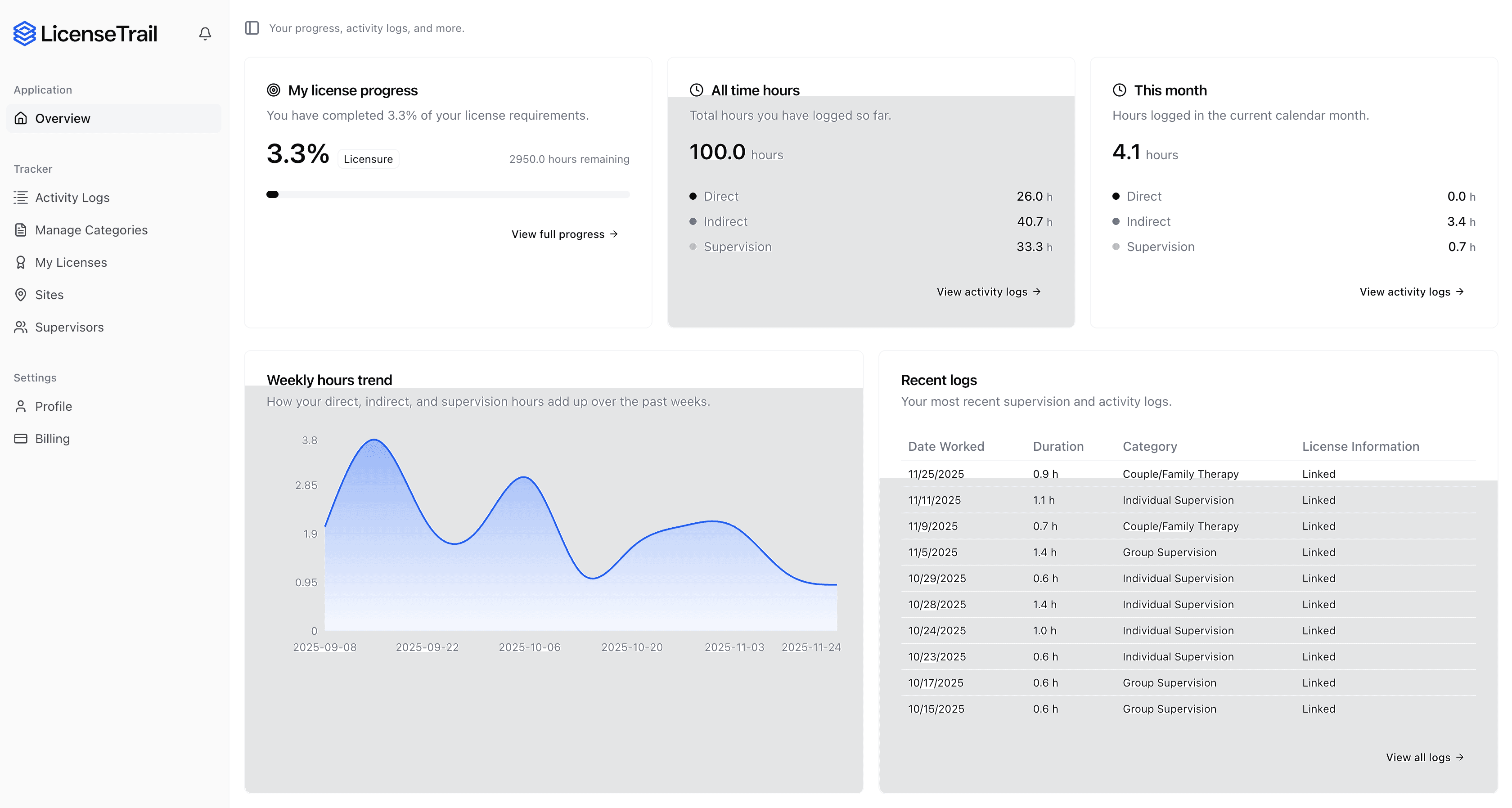
License Trail checks your direct, indirect, and supervision hours against Montana ACLC requirements continuously and flags mismatches before you submit.
 Start Tracking for Free
No credit card required · Free plan available
Is your spreadsheet hiding Montana ACLC risks?
Stop guessing if your categories match Montana Board of Behavioral Health requirements. License Trail checks your direct, indirect, and supervision hours continuously and flags mismatches before you submit.
Import or log
Bring your spreadsheet or start fresh
Upload your existing tracking spreadsheet and we'll map every hour into the right Montana Board of Behavioral Health categories automatically.
Verify against Montana
Catch mismatches before the board does
License Trail checks your direct, indirect, and supervision hours against Montana ACLC requirements continuously.
Export board-ready
One-click clean reports
Generate professional, board-ready reports for supervision meetings and Montana Board of Behavioral Health submissions in seconds.
No credit card required · Free plan available