
Montana PCLC Requirements: Hours, Exams & Step-by-Step Guide
Stop guessing if your categories match Montana requirements. License Trail checks your direct, indirect, and supervision hours against PCLC requirements continuously and flags mismatches before you submit.
No credit card required · Free plan available
Quick Requirements Overview
- Education: Master’s+ in counseling (typically 60 semester credits/90 quarter; 45-credit exception allowed with remaining coursework completed within 5 years)
- Apply/submit: Board application + fee, official transcripts/coursework summary, fingerprint-based MT/FBI background check, good moral character, and Board Training & Supervision Plan/Form (sites + supervisors)
- Title/authority: Must use “Professional Counselor Licensure Candidate (PCLC)”; may practice only per Board conditions while accruing supervised hours
- Total experience for LCPC: 3,000 hours of supervised counseling practice (all hours supervised); ≥1,500 must be post-degree; ≤1,500 may be pre-degree if graduate-program approved
- Post-degree direct hours: Must include 1,000 hours direct client contact in a clinical setting; ≤250 of those 1,000 may be group/co-facilitation
- Supervision ratio: 1 hour face-to-face supervision per 20 hours of professional counseling (applies across the 3,000 hours)
- Renewal: Annual PCLC renewal (Nov 1–Dec 31); $85 fee; no CE required for candidates
- Upgrade to LCPC: After completing supervised hours and passing the required national exam (NCE or NCMHCE)
License Details
Procedures
Montana’s pathway to independent practice as a Licensed Clinical Professional Counselor (LCPC) is built around a provisional license called the Professional Counselor Licensure Candidate, commonly referred to by the Board as the LCPC Candidate (PCLC). (boards.bsd.dli.mt.gov) As a candidate, you hold a state license that allows you to practice counseling while accruing the supervised experience required for full LCPC licensure.
Below is a step‑by‑step outline of what the Montana Board of Behavioral Health requires, with emphasis on the types of hours, how many are needed, and the Board’s own wording where it matters.
1. Terminology and license types
The Montana Board of Behavioral Health lists the following counseling license structure: (boards.bsd.dli.mt.gov)
- Licensed Clinical Professional Counselor (LCPC) – the independent practice license.
- Candidate (PCLC) – the associated candidate license for LCPC.
In statute, this role is called a “professional counselor licensure candidate”. A person who has completed the education required for licensure but not the supervised work experience must register in this category “in order to engage in professional counseling and earn supervised work experience hours in this state.” (law.justia.com)
Once approved, you must use the title “professional counselor licensure candidate” (practitioners and the Board typically abbreviate this as PCLC).
2. Requirements to obtain the PCLC (LCPC Candidate) license
2.1. Educational requirement
Montana’s statute and rules require a graduate counseling degree that is “primarily counseling in nature” and meets Board‑defined content requirements. (law.justia.com)
Key points:
-
Standard route:
- A counseling (or closely related) master’s or higher degree of at least 60 semester credits (or 90 quarter credits), from:
- a CACREP‑accredited program, or
- another accredited institution whose program includes CACREP core competencies and fieldwork standards. (law.cornell.edu)
- A counseling (or closely related) master’s or higher degree of at least 60 semester credits (or 90 quarter credits), from:
-
45‑credit exception at candidate stage:
The Board may license someone who has a minimum 45‑semester‑hour counseling‑related graduate degree and then requires additional coursework to reach the equivalent of the 60‑credit standard within five years. (archive.legmt.gov)
In practice, most applicants enter the PCLC stage with a 60‑credit counseling degree that already satisfies LCPC education rules.
2.2. Application components
Under Mont. Code Ann. § 37‑23‑213, to register as a professional counselor licensure candidate, you must submit: (law.justia.com)
- Application and fee required by the Board.
- Proof of completion of the education requirement.
- Fingerprints for state and FBI criminal background checks (per § 37‑1‑307, MCA).
- Proof of good moral character.
- A training and supervision plan that meets Board requirements.
The Board’s LCPC Candidate page adds that you must: (boards.bsd.dli.mt.gov)
- Apply online as an LCPC candidate.
- Complete the fingerprint‑based background check through the Montana Department of Justice, with results sent directly to the Board.
- Provide official graduate transcripts and an academic coursework summary.
- Submit the Board’s Training and Supervision Form that spells out:
- the sites where you will practice,
- your proposed supervisor(s),
- how supervision will be provided.
You register annually as a professional counselor licensure candidate, and the Board may limit the total number of years you can remain in that status. (law.justia.com) The Board’s website notes that PCLC licenses renew each year between November 1 and December 31, with a candidate renewal fee of $85 and no continuing‑education requirement for candidates. (boards.bsd.dli.mt.gov)
3. The supervised‑experience requirement you must complete as a PCLC
Once you hold the PCLC license, the central task is to complete the supervised experience needed for full LCPC licensure.
3.1. Total number of hours
Montana law requires 3,000 hours of supervised counseling practice to qualify for LCPC licensure. The statute states that an applicant must have:
completed 3,000 hours of counseling practice supervised by a licensed professional counselor or licensed member of an allied mental health profession, at least half of which was postdegree. (archive.legmt.gov)
All 3,000 hours are supervised hours. Montana does not split them into “direct experience” hours vs. separate “supervised experience” hours as some other states do. Instead:
- All 3,000 hours must be supervised counseling practice.
- Within those 3,000 hours, there are specific minimums and limits on:
- timing (pre‑ vs. post‑degree),
- direct client‑contact hours, and
- the amount and format of supervision.
3.2. Pre‑degree vs. post‑degree hours
Current Board rule ARM 24.219.604 (LCPC Supervised Work Experience Requirements), updated through June 6, 2025, provides this breakdown: (regulations.justia.com)
- Total required supervised experience: 3,000 hours (as referenced to House Bill 137 (2023)).
- Pre‑degree hours:
- Up to 1,500 of the 3,000 hours may be obtained pre‑degree (e.g., in practicum/internship) under the academic requirements of your degree program,
- but only if those hours are approved by your graduate program.
- Post‑degree hours:
- At least 1,500 of the 3,000 hours must be post‑degree (to satisfy the “at least half… postdegree” language in § 37‑23‑202). (law.justia.com)
In plain terms:
- You must accumulate 3,000 supervised counseling hours in total.
- Maximum pre‑degree that can count: 1,500 hours, from Board‑acceptable practicum or internship.
- Minimum post‑degree (nearly always completed as a PCLC): 1,500 hours.
3.3. Direct client‑contact hours (post‑degree)
ARM 24.219.604(2) is very specific about what must be included in the post‑degree portion of your experience:
- Post‑degree hours must include 1,000 hours of direct client contact in a clinical setting (as defined elsewhere in the rules).
- These 1,000 hours must be under face‑to‑face supervision in that clinical setting.
- No more than 250 of those 1,000 direct hours may be in a group or co‑facilitative therapy situation. (regulations.justia.com)
So, if you are looking for a concise breakdown comparable to the example you gave:
- 3,000 total supervised counseling hours, of which:
- At least 1,500 hours must be post‑degree.
- Within the post‑degree hours, at least 1,000 must be direct client‑contact hours (individual, couple, family, or group),
- and of those 1,000 direct hours, no more than 250 may be in group or co‑facilitation.
There is no separate requirement like “1,500 direct hours + 1,500 supervised hours.” In Montana, every hour that counts must be supervised; within that supervised set, 1,000 post‑degree hours must be direct client contact.
3.4. What counts as “counseling practice” or “professional counseling”?
The statute uses the phrase “counseling practice supervised by a licensed professional counselor or licensed member of an allied mental health profession” for the 3,000 hours. (archive.legmt.gov)
ARM 24.219.604(3) refers to “professional counseling as defined in [House Bill 137 (2023) Section 2(11)],” which is a detailed definition but essentially covers activities like: (regulations.justia.com)
- Assessing and diagnosing mental, emotional, or behavioral conditions.
- Developing and implementing counseling treatment plans.
- Providing individual, family, and group counseling and psychotherapy.
- Applying counseling theories, techniques, and evidence‑based interventions.
In practical terms, hours that typically qualify include:
- Direct therapy sessions with individuals, couples, families, or groups.
- Clinical assessment and diagnosis.
- Treatment planning, clinical documentation, and case consultation directly tied to client care.
- Crisis intervention and safety planning.
- Collateral contact when directly related to client treatment (e.g., brief consultations with family members or other providers).
Non‑clinical activities like purely administrative meetings or unrelated teaching generally do not count unless they are clearly part of professional counseling services as defined by the Board.
3.5. Required supervision ratio and format
ARM 24.219.604(3) sets a specific supervision requirement for all 3,000 supervised experience hours:
- Supervisors must provide at least one hour of face‑to‑face supervision and consultation for every 20 hours of professional counseling. (regulations.justia.com)
This means:
- If you complete all 3,000 hours in Montana, you will receive at least 150 hours of face‑to‑face supervision (3,000 ÷ 20 = 150).
- Supervision must be face‑to‑face (in person or, under current policies, possibly secure video if allowed by the Board) and tied directly to your counseling activities.
The statute also requires that your PCLC registration include a training and supervision plan approved by the Board. (law.justia.com) That plan lays out:
- Who your supervisor(s) will be,
- Their credentials and relationship to you,
- How often supervision will occur and in what format, and
- The settings in which you will practice.
If you change jobs or supervisors, you typically must submit an updated supervision plan for Board approval.
4. Candidate status, conduct standards, and renewal
Under § 37‑23‑213, once you are registered as a professional counselor licensure candidate: (law.justia.com)
- You may engage in professional counseling only under the conditions set by the Board.
- You must use the title “professional counselor licensure candidate” (PCLC).
- You must conform to the same standards of professional conduct that apply to all licensees.
- The Board may:
- impose discipline or sanctions if you fail to meet supervision or conduct requirements, and
- deny or place conditions on your eventual LCPC license based on your conduct while a candidate.
Annual renewal as a candidate (with fee and any Board‑required updates) continues until you complete:
- All supervised‑experience requirements (3,000 hours, with the required breakdown), and
- The required national exam (NCE or NCMHCE). (boards.bsd.dli.mt.gov)
At that point, you apply to upgrade from PCLC to full LCPC.
5. Summary of hour requirements in Board language
Putting the core requirements into one place, using the Board’s own structure:
-
Supervised experience required for LCPC
- “3,000 hours of counseling practice supervised by a licensed professional counselor or licensed member of an allied mental health profession, at least half of which was postdegree.” (law.justia.com)
- Up to 1,500 of the 3,000 hours may be obtained pre‑degree if approved by the graduate program. (regulations.justia.com)
- Post‑degree experience must include 1,000 hours of direct client contact in a clinical setting, with no more than 250 of those 1,000 hours in group or co‑facilitative therapy. (regulations.justia.com)
- Supervision for all 3,000 hours must include at least one hour of face‑to‑face supervision and consultation for every 20 hours of professional counseling. (regulations.justia.com)
-
Role of the PCLC license in this structure
- A person who has completed the education, but not yet the supervised work experience, “shall register as a professional counselor licensure candidate in order to engage in professional counseling and earn supervised work experience hours in this state” and shall use the title “professional counselor licensure candidate.” (law.justia.com)
Functionally, your PCLC status is the vehicle through which you complete the 1,500+ post‑degree hours, including the 1,000 direct‑contact hours, within the overall 3,000 supervised hours required for LCPC licensure.
This is the structure currently in force as of the June 6, 2025 update to ARM 24.219.604 and the 2022–2024 versions of the Montana Code. For any actual application, the Board’s current checklists and forms and the text of ARM 24.219.601 and 24.219.604 plus §§ 37‑23‑202 and 37‑23‑213, MCA should be treated as controlling.
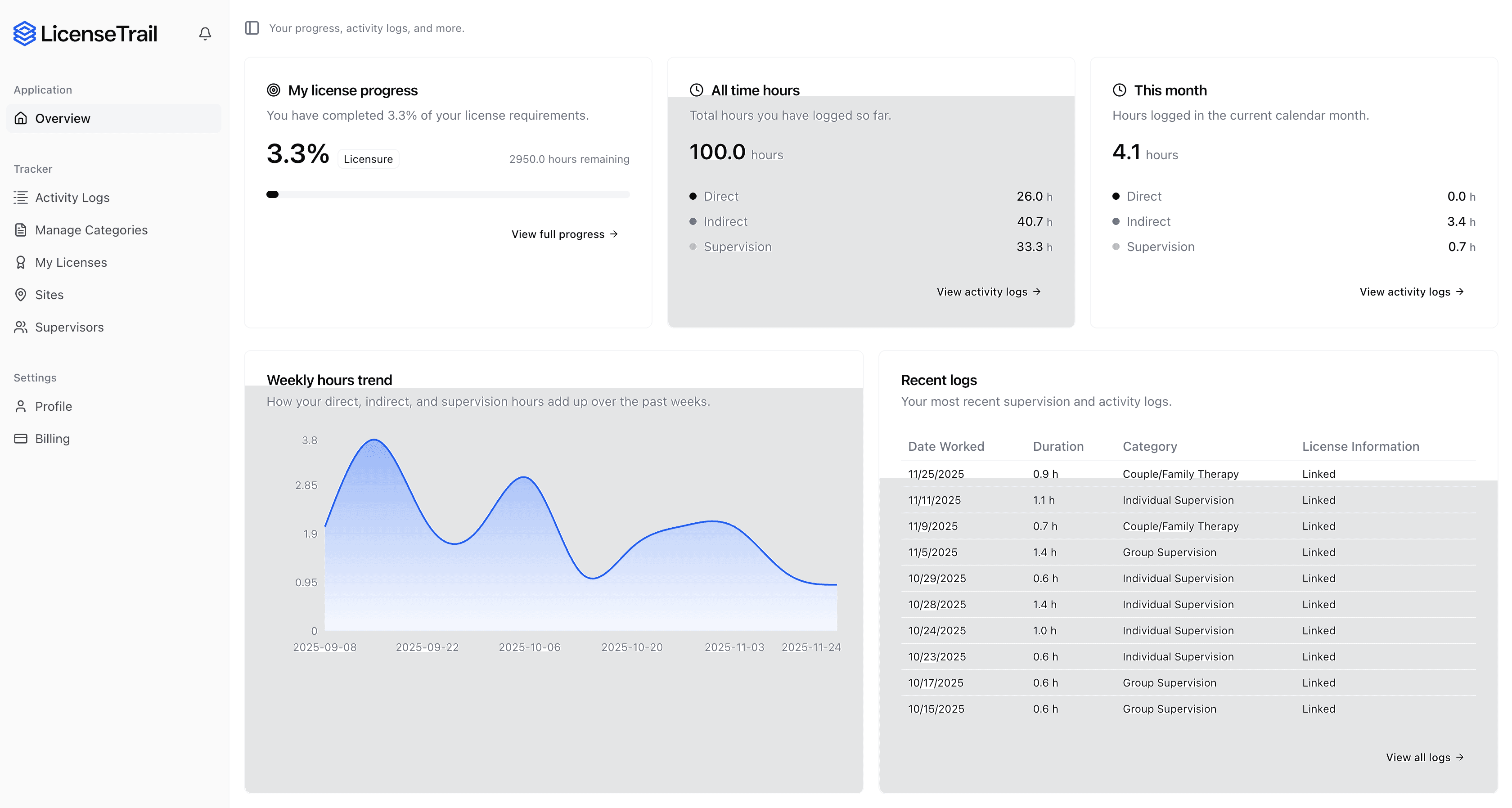
Track your PCLC hours with confidence
License Trail checks your direct, indirect, and supervision hours against Montana PCLC requirements continuously and flags mismatches before you submit.
 Start Tracking for Free
No credit card required · Free plan available
Is your spreadsheet hiding Montana PCLC risks?
Stop guessing if your categories match Montana Board of Behavioral Health requirements. License Trail checks your direct, indirect, and supervision hours continuously and flags mismatches before you submit.
Import or log
Bring your spreadsheet or start fresh
Upload your existing tracking spreadsheet and we'll map every hour into the right Montana Board of Behavioral Health categories automatically.
Verify against Montana
Catch mismatches before the board does
License Trail checks your direct, indirect, and supervision hours against Montana PCLC requirements continuously.
Export board-ready
One-click clean reports
Generate professional, board-ready reports for supervision meetings and Montana Board of Behavioral Health submissions in seconds.
No credit card required · Free plan available