
Montana SWLC Requirements: Hours, Exams & Step-by-Step Guide
Stop guessing if your categories match Montana requirements. License Trail checks your direct, indirect, and supervision hours against SWLC requirements continuously and flags mismatches before you submit.
No credit card required · Free plan available
Quick Requirements Overview
- Purpose/Scope: SWLC = required candidate license to practice only under supervision while accruing LCSW hours (no independent practice)
- Education prerequisite: MSW or higher from a CSWE-accredited program completed before applying
- Application requires: Board application/fee, education proof, fingerprint-based DOJ/FBI background check, good moral character, and a written supervision/training plan
- Qualified supervisor: LCSW/LCPC/LMFT/Psychologist/Psychiatrist; must be in good standing and meet experience/training criteria (e.g., 3 years licensed or supervision education/training)
- Experience hours (toward LCSW): 3,000 supervised post-degree hours over ≥24 months, completed within 5 years; includes ≥1,500 direct client contact hours
- Supervision hours: ≥100 total supervision hours; ≥50 must be individual face-to-face with an LCSW, incl. ≥10 hours direct observation of service delivery; maintain 2 hrs supervision per 160 hrs practice minimum
- Key definitions: “Direct client contact” includes in-person/phone/interactive video with client/family/rep; “direct observation” includes live, mirror, recording review, or interactive video observation
- Ongoing/renewal & records: Annual registration/renewal (Nov 1–Dec 31; $85; no CE); keep supervision records 7 years; supervisor changes must be reported within 20 business days
License Details
Procedures
Montana regulates clinical social work through the Board of Behavioral Health, which issues a candidate license called the Social Worker Licensure Candidate (SWLC) for those working toward the Licensed Clinical Social Worker (LCSW) credential. The SWLC is the status you must hold while you earn the supervised hours required for full LCSW licensure.
What follows focuses on:
- How to qualify for and apply for the SWLC
- The exact supervised work and supervision hour requirements you must complete while you hold the SWLC
- How the Board defines key terms like “direct client contact” and “direct observation of service delivery”
All citations are to Montana statutes, administrative rules, and Board documents current through mid‑2025. (boards.bsd.dli.mt.gov)
1. What an SWLC License Is
Montana law requires anyone who has completed the education for LCSW but not the supervised work experience to register as a social worker licensure candidate in order to engage in social work and accrue hours toward licensure. (law.justia.com)
The Board’s license table and licensure checklist identify this license as:
- Licensed Clinical Social Worker – Candidate (SWLC) (boards.bsd.dli.mt.gov)
This is a time‑limited, supervised license: you cannot practice clinical social work independently while you are an SWLC.
2. Education Required Before You Can Be an SWLC
To hold the SWLC (LCSW candidate) license, you must already have:
- A master’s degree or higher in social work from a program accredited by the Council on Social Work Education (CSWE). (boards.bsd.dli.mt.gov)
The Board’s SWLC checklist summarizes this simply as:
- “Master’s degree or higher in social work from a program accredited by the Council on Social Work Education (CSWE).” (boards.bsd.dli.mt.gov)
You cannot register as an SWLC until that degree is completed.
3. Supervisor Requirements for SWLCs
To be licensed as an SWLC, you must have a qualified supervisor lined up. The Board’s checklist specifies that your supervisor must be one of the following license types, active and in good standing: (boards.bsd.dli.mt.gov)
- LCSW (Licensed Clinical Social Worker)
- LCPC (Licensed Clinical Professional Counselor)
- LMFT (Licensed Marriage & Family Therapist)
- Psychologist
- Psychiatrist
In addition, the supervisor must either:
- Have been licensed for at least 3 years, or
- Have 1 semester credit of graduate education in supervision, or
- Have 20 hours of Board‑approved training in supervision. (boards.bsd.dli.mt.gov)
The Board separately requires that a supervisor:
- Meet the definition in ARM 24.219.421, and
- Have experience with your client population and methods of practice (e.g., individual, group, family, crisis). (law.cornell.edu)
4. How to Apply for SWLC Status
Under Montana Code 37‑22‑313, a person who has completed the education required for licensure but not the supervised work experience must register as a social worker licensure candidate in order to practice and earn supervised hours in Montana. (law.justia.com)
To register as an SWLC, you must submit to the Board: (law.justia.com)
-
Application and fee
- Apply online via the Board’s “Apply for a License” portal as an LCSW Candidate (SWLC).
-
Proof of education
- Documentation that you completed the CSWE‑accredited MSW (or higher) required for LCSW.
-
Fingerprint‑based background check
- Fingerprints for checks by the Montana Department of Justice and the FBI, submitted as directed after you apply.
-
Proof of good moral character
- Typically via application attestations and any requested supporting documents.
-
Training and supervision plan
- A written plan that meets Board requirements, describing:
- Your practice setting
- Your supervisor’s qualifications
- How you will gain required supervised experience hours and supervision
- A written plan that meets Board requirements, describing:
Once the Board approves these items, you may: (law.justia.com)
- Use the appropriate title of “social worker licensure candidate” (for your level; in this case, the LCSW‑track SWLC), and
- Engage in social work only under the conditions set by the Board and under supervision.
5. The Hour Requirements While You Are an SWLC
Holding the SWLC itself does not require a certain number of hours; rather, SWLC is the license status you must hold while completing the LCSW supervised work experience. Those requirements are defined in both statute and administrative rule.
5.1 Total supervised work hours and timeframe
Montana Code 37‑22‑301 requires that an applicant for the LCSW: (archive.legmt.gov)
- Must have registered as a social worker licensure candidate (SWLC), and
- Must complete at least 24 months of supervised post‑master’s degree work experience in psychotherapy, which must include:
- 3,000 hours of social work experience, and
- At least 1,500 of those hours in direct client contact,
- All within the past 5 years before application for LCSW.
Putting that into a simple breakdown:
- 3,000 total post‑degree supervised hours, over
- A minimum of 24 months,
- Within a 5‑year window,
- With at least 1,500 hours of direct client contact (face‑to‑face/telehealth with clients or their family/representatives).
5.2 Required supervision hours within the 3,000 hours
Administrative Rule 24.219.504 adds the detailed supervision hour requirements for LCSW supervised work experience: (law.cornell.edu)
- 3,000 total supervised hours post‑degree (this aligns with the statute).
- Within those 3,000 hours, you must have at least 100 hours of individual or group supervision by a qualified supervisor.
- Of those 100 supervision hours:
- At least 50 hours must be individual, face‑to‑face supervision provided by an LCSW (not just any qualified supervisor).
- At least 10 of those 50 face‑to‑face hours must involve direct observation of service delivery.
In addition, supervisors must meet an ongoing ratio requirement:
- A supervisor must provide at least 2 hours of supervision for every 160 hours of social work practice for LCSW candidates. (law.cornell.edu)
In summary, for an SWLC working toward LCSW, Montana’s Board expects:
- 3,000 total supervised hours,
- 1,500+ hours of those in direct client contact, and
- 100+ supervision hours, including:
- 50+ individual, face‑to‑face supervision hours with an LCSW, and
- 10+ hours of direct observation of your service delivery.
5.3 How the Board defines key terms
The Board defines these terms in ARM 24.219.301: (law.cornell.edu)
-
“Direct client contact”
- Contact where the client, a client family member, or a client representative is present with you physically, by phone, or via interactive video link.
-
“Direct observation of service delivery”
- Your supervisor watches your clinical work directly, which may include:
- Participating in the session,
- Viewing through a two‑way mirror,
- Reviewing an audio or video recording, or
- Observing via an interactive video link.
- Your supervisor watches your clinical work directly, which may include:
-
“Face‑to‑face” supervision
- Supervision that is in person or via a real‑time, two‑way audio‑visual electronic connection between you and your supervisor.
-
“Supervised work experience”
- A structured process in which you gain minimal competencies in core clinical areas such as:
- Working from an identified theory base,
- Applying differential diagnosis,
- Establishing and monitoring treatment plans,
- Assessing risk, and
- Implementing ethical professional relationships with clients and colleagues.
- A structured process in which you gain minimal competencies in core clinical areas such as:
These definitions determine what does and does not “count” toward your LCSW hours.
6. Recordkeeping and Supervision Conditions for SWLCs
The Board’s general supervision and recordkeeping rule (ARM 24.219.422) sets expectations for candidates (including SWLCs): (law.cornell.edu)
- You must maintain supervision records for at least 7 years from the date of licensure (or 7 years from expiration if you never become licensed).
- Your records must include, at minimum:
- Names and license numbers for you and your supervisor.
- Dates and length of each supervision session (in at least 15‑minute increments).
- A brief content summary of each supervision session (without confidential client identifiers).
- Documentation that shows your developing competence in the areas required under ARM 24.219.504.
- A supervisor attestation that the records are accurate.
Other key conditions:
- You cannot practice as an SWLC without a supervisor who meets Board requirements. (law.cornell.edu)
- If your supervisor changes, both you and the supervisors (outgoing and new) must notify the Board within 20 business days, using Board forms. (law.cornell.edu)
- Failure to maintain supervision or to keep required records can lead to disciplinary action for you and/or your supervisor. (law.cornell.edu)
7. Maintaining SWLC Status
The Board’s LCSW Candidate page notes: (boards.bsd.dli.mt.gov)
- Renewal period: November 1 – December 31 each year (with a 45‑day late renewal window and late fees).
- Renewal fee (candidate): $85 (LCSW – Candidate).
- Continuing education: No CE is required for candidates.
Separately, statute requires that social worker licensure candidates: (law.justia.com)
- Register annually as candidates, and
- Comply with the same standards of professional conduct as licensees (unprofessional conduct during candidacy can affect whether and how you are later licensed).
The Board may also limit the number of years you may remain a candidate (practically linked to the requirement that your 3,000 supervised hours and 24 months of experience be completed within a 5‑year period for LCSW). (law.justia.com)
8. Transitioning from SWLC to Full LCSW
Once you, as an SWLC, have met the supervised work requirements, the process to become fully licensed as an LCSW includes: (archive.legmt.gov)
-
Complete all supervised work requirements
- 3,000 total hours post‑degree, including 1,500 direct client contact hours; at least 24 months; within 5 years.
- Supervision hours and ratios as described above.
-
Obtain documentation from your supervisor
- Supervised Work Experience Evaluation or equivalent Board form verifying your hours and competence.
-
Submit an LCSW license application
- Using the Board’s LCSW application/checklist and paying the required fee.
-
Provide three professional references
- From professionals licensed by the Board or academic faculty who know your professional performance (required by statute). (archive.legmt.gov)
-
Pass the ASWB Clinical Examination
- Montana accepts ASWB Clinical exam scores as the licensing examination for LCSWs. (boards.bsd.dli.mt.gov)
Only after all these requirements are met and the Board issues your LCSW license may you practice clinical social work independently in Montana.
Concise hour breakdown for an SWLC on the LCSW track in Montana
While you hold the SWLC (LCSW Candidate) license, you must complete:
- 3,000 hours of supervised post‑master’s social work experience in psychotherapy,
- Over at least 24 months,
- Completed within 5 years of applying for LCSW,
- Including 1,500 hours of direct client contact, and
- 100 supervision hours total, of which:
- 50 hours must be individual, face‑to‑face supervision by an LCSW, and
- 10 of those 50 hours must be direct observation of your service delivery,
- With supervision provided at a minimum ratio of 2 hours of supervision for every 160 hours of social work practice. (archive.legmt.gov)
Those are the core, Board‑defined hour and supervision requirements that govern an SWLC’s path to full LCSW licensure in Montana.
Track your SWLC hours with confidence
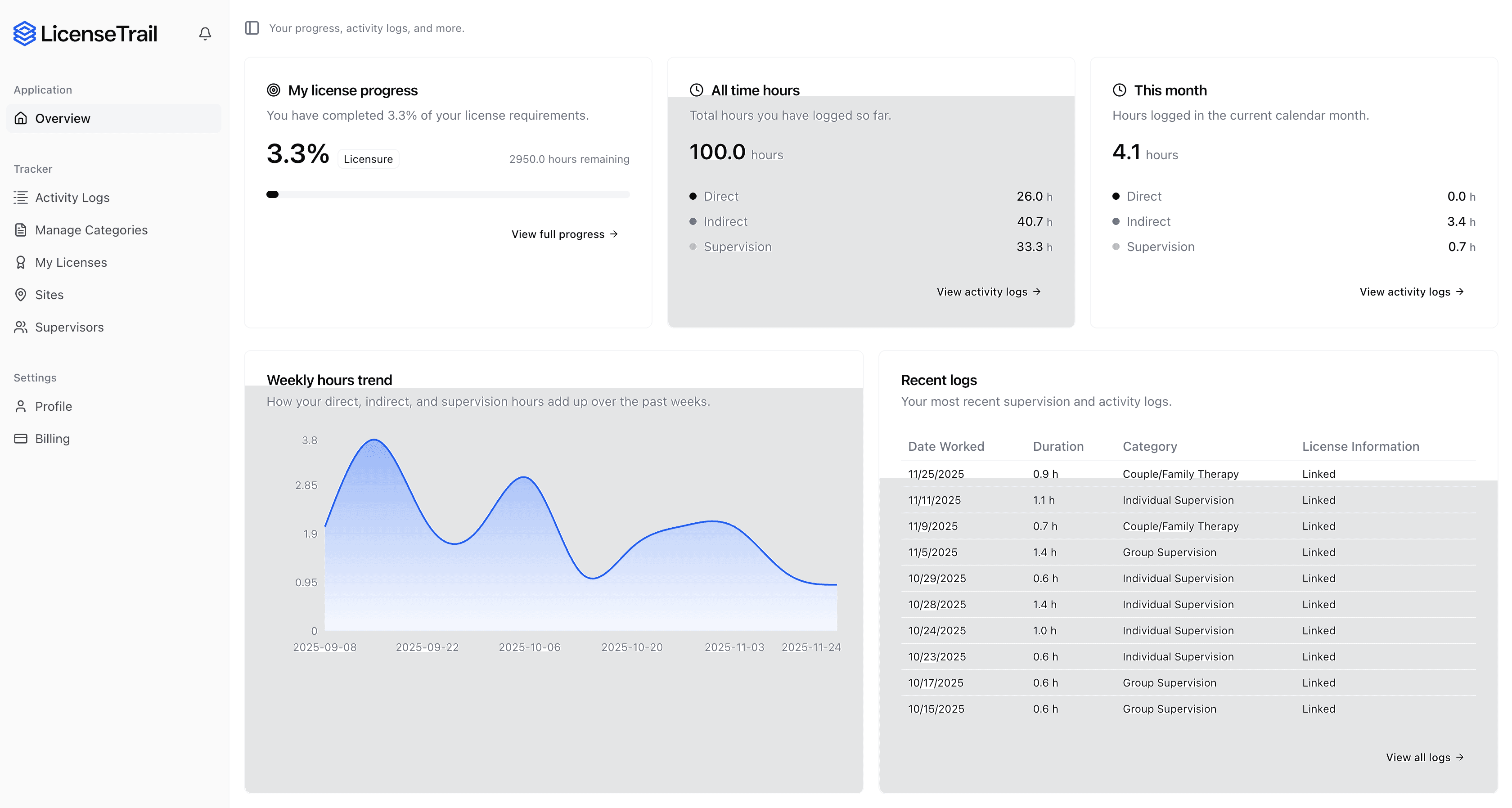
License Trail checks your direct, indirect, and supervision hours against Montana SWLC requirements continuously and flags mismatches before you submit.
 Start Tracking for Free
No credit card required · Free plan available
Is your spreadsheet hiding Montana SWLC risks?
Stop guessing if your categories match Montana Board of Behavioral Health requirements. License Trail checks your direct, indirect, and supervision hours continuously and flags mismatches before you submit.
Import or log
Bring your spreadsheet or start fresh
Upload your existing tracking spreadsheet and we'll map every hour into the right Montana Board of Behavioral Health categories automatically.
Verify against Montana
Catch mismatches before the board does
License Trail checks your direct, indirect, and supervision hours against Montana SWLC requirements continuously.
Export board-ready
One-click clean reports
Generate professional, board-ready reports for supervision meetings and Montana Board of Behavioral Health submissions in seconds.
No credit card required · Free plan available