
Montana MFLC Requirements: Hours, Exams & Step-by-Step Guide
Stop guessing if your categories match Montana requirements. License Trail checks your direct, indirect, and supervision hours against MFLC requirements continuously and flags mismatches before you submit.
No credit card required · Free plan available
Quick Requirements Overview
- Credential/Scope: MFLC (LMFT Candidate) required to practice/earn hours pre‑LMFT; practice only under Board‑approved supervision; use candidate title.
- Board: Montana Board of Behavioral Health regulates/issues MFLC.
- Education: Master’s/doctoral in MFT (COAMFTE or equivalent) or allied graduate degree deemed equivalent (often cited as 48+ graduate semester hours in core MFT content).
- Application items: Board application + fee, official transcripts, fingerprint-based DOJ/FBI background check, moral character, and training/supervision plan.
- Supervised experience (LMFT): 3,000 total supervised hours including 1,000 face‑to‑face client-contact hours (up to 500 may be from degree practicum).
- Post‑degree specifics: 1,000 post‑degree client-contact hours within last 5 years; ≥50% with couples/families; 20:1 client-contact-to-supervision ratio.
- Supervision requirements: 200 face‑to‑face supervision hours (150 individual); 100 hours must use raw clinical data; group supervision max 6; ≥80 hours per supervisor.
- Maintenance: Annual renewal; typically max 5 registrations (extensions by written request); no CE required for candidates (per Board page).
License Details
Procedures
In Montana, the “Licensed Marriage & Family Therapist Candidate” credential (board abbreviation: MFLC) is the status you hold while completing supervised post‑graduate experience on the way to full LMFT licensure. The credential is issued and regulated by the Montana Board of Behavioral Health.(boards.bsd.dli.mt.gov)
Below is a step‑by‑step outline of what the Board and statutes require, with emphasis on hours and supervision.
1. Understand what the MFLC credential is
- The Board’s license information page lists “Licensed Marriage & Family Therapist (LMFT) – and Candidate (MFLC)” among its license types.(boards.bsd.dli.mt.gov)
- Under Montana Code 37‑37‑205, once you’ve met the education requirement but not yet completed supervised work experience, you must register as a “marriage and family therapist licensure candidate” in order to practice MFT and earn supervised hours in Montana.(law.justia.com)
As an MFLC, you may practice marriage and family therapy in Montana only under Board‑approved supervision and only while you are accumulating the required supervised experience for LMFT licensure.(law.justia.com)
2. Meet the education and practicum requirements
2.1 Degree requirement
Montana law requires that an LMFT applicant (and therefore an MFLC) have:(law.justia.com)
- Either:
- A master’s or doctoral degree in marriage and family therapy from a recognized educational institution or a COAMFTE‑accredited MFT program; or
- A graduate degree in an allied field with graduate‑level work the Board finds equivalent to a master’s in marriage and family therapy or marriage and family counseling.
The Board and national summaries explain this more concretely as:(mft-license.com)
- At least 48 semester hours of graduate coursework in core MFT content (e.g., human development, family dynamics, MFT theory and practice, ethics, research), typically within a 60‑credit counseling or MFT degree program.
2.2 Practicum / internship (pre‑degree clinical hours)
Board‑linked summaries describe the minimum pre‑degree fieldwork (this is separate from the 3,000 post‑graduate supervised hours):(mft-license.com)
- At least 500 hours of direct client contact in practicum/internship.
- At least 50% of these 500 hours must be with couples or families.
- At least 100 hours of supervision for that field experience.
- At least 75% of those 100 supervision hours must be individual supervision (i.e., one supervisor with at most one other supervisee).
Under the LMFT statute, up to 500 of the eventual 1,000 “face‑to‑face client contact” hours required for licensure (see Section 4) may be accumulated while you are earning this degree.(law.justia.com)
3. Apply to become an MFLC (marriage & family therapist licensure candidate)
Once your qualifying degree is complete, you apply to the Board for MFLC status.
3.1 Application and registration
Montana Code 37‑37‑205 and the Board’s LMFT Candidate page require that, to register as a marriage and family therapist licensure candidate, you must submit:(law.justia.com)
- Application and fee prescribed by the Board.
- Proof of completion of the education requirement (official transcripts).
- Fingerprint‑based background check via the Montana Department of Justice and FBI (per 37‑1‑307, MCA).
- Proof of good moral character (e.g., attestation and any requested documentation).
- A training and supervision plan that meets Board standards.
Upon Board approval, you may practice MFT under those conditions and must use the title “marriage and family therapist licensure candidate.”(law.justia.com)
The Board’s own LMFT Candidate page confirms:
- Fingerprint‑background check is mandatory before candidate licensure.
- MFLC renewal is annual; currently, no continuing education is required for candidates.(boards.bsd.dli.mt.gov)
3.2 Annual registration limits
Under Administrative Rule 24.219.431:(regulations.justia.com)
- LMFT candidates must register annually.
- You are normally allowed to register as a candidate no more than five times (i.e., roughly five years).
- To register beyond five years, you must submit a written request explaining why additional time is needed to finish the supervised work experience.
4. Understand the supervised experience you must complete as an MFLC
The post‑degree supervised experience you complete as an MFLC is what qualifies you to sit for the exam and apply for full LMFT licensure.
4.1 Big picture: total supervised hours
Montana statute 37‑37‑201 requires that an LMFT applicant must have:(law.justia.com)
- At least 3,000 hours of work under the direct supervision of a qualified supervisor,
- including 1,000 hours of face‑to‑face client contact in the practice of marriage and family therapy;
- of those 1,000 direct contact hours, up to 500 may be earned while you are completing your graduate education.
In practical terms, this means:
- 3,000 total supervised experience hours in MFT practice.
- At least 1,000 of those 3,000 hours must be direct, face‑to‑face client contact delivering MFT services.
- Up to 500 of these 1,000 direct hours may come from your graduate practicum/internship.
- The remainder must be obtained post‑degree as an MFLC.
The remaining non‑direct hours within the 3,000 can include other supervised professional activities in the practice of marriage and family therapy (documentation, case consultation, treatment planning, etc.), as allowed by Board standards.(mft-license.com)
4.2 Detailed post‑degree clinical and supervision requirements
Administrative Rule 24.219.704, “LMFT Supervised Work Experience Requirements,” lays out more specific requirements for the hours you earn post‑degree:(law.cornell.edu)
-
Post‑degree client‑contact hours
- You must complete at least 1,000 post‑degree client‑contact hours.
- These 1,000 post‑degree hours must be:
- Accumulated within the last five years before you apply.
- At least 50% with couples and families (i.e., not just individual clients).
- There must be a 20:1 ratio of client‑contact hours to supervision hours (see below).
-
Total supervision hours and formats
- You must have at least 200 hours of face‑to‑face supervision, with:
- At least 150 hours in individual supervision (supervisor with no more than one other supervisee).
- At least 80 supervision hours earned with each supervisor you count toward these totals.
- You must have at least 100 hours of supervision involving “raw clinical data”—that is, supervision that directly reviews:
- live observation in the therapy room,
- observation via one‑way mirror or live camera, or
- recorded sessions (video or audio).(law.cornell.edu)
- Group supervision is allowed but groups cannot exceed six candidates.(law.cornell.edu)
- You must have at least 200 hours of face‑to‑face supervision, with:
-
Supervision ratio
- The rule repeats that there must be a 20:1 ratio of client‑contact hours to supervision hours. Put differently, one hour of supervision for every 20 hours of client contact.(law.cornell.edu)
Taken together with the statute, the Board’s scheme can be summarized as:
- 3,000 total supervised hours, including:
- At least 1,000 face‑to‑face client‑contact hours in MFT practice
- At least 1,000 of your client‑contact hours must be post‑degree,
- At least half of those post‑degree client hours must be with couples or families, and
- At least 200 hours of face‑to‑face supervision, of which:
- At least 150 hours are individual supervision,
- At least 100 hours involve direct review of raw clinical data, and
- Group supervision, if used, has no more than six candidates present.
- At least 1,000 face‑to‑face client‑contact hours in MFT practice
4.3 Who can supervise you?
Under Administrative Rule 24.219.421 (Supervisor Qualifications):(law.cornell.edu)
- LMFT candidates (MFLCs) must be supervised by one of the following:
- Licensed Clinical Social Worker (LCSW)
- Licensed Clinical Professional Counselor (LCPC)
- Licensed Marriage & Family Therapist (LMFT)
- Licensed psychologist
- Licensed and board‑certified psychiatrist
In addition, supervisors must:
- Hold an active license in good standing in the jurisdiction where supervision occurs; and
- Either:
- Have been licensed in their discipline for at least three years (excluding time as a candidate); or
- Have completed board‑approved supervision training (at least one graduate semester credit in supervision or 20 hours of board‑approved supervision training).
Your training and supervision plan, submitted with your MFLC application, must identify supervisors, their licenses, and how your hours and supervision will meet these requirements.(studocu.com)
5. Maintaining MFLC status while you gain hours
While you are accruing these hours:
- You must maintain your MFLC registration annually, staying within the usual five‑year cap unless the Board grants more time.(regulations.justia.com)
- You must practice only under supervision and abide by the same standards of professional conduct that apply to fully licensed LMFTs.(law.justia.com)
- According to the Board’s LMFT Candidate page, no continuing education is currently required for renewal of the candidate license.(boards.bsd.dli.mt.gov)
Unprofessional conduct or failure to meet supervision requirements as a candidate can lead the Board to restrict your candidate status or later deny, condition, or discipline your LMFT license.(law.justia.com)
6. Moving from MFLC to full LMFT licensure
When you have:
- Completed the required 3,000 supervised hours (with the specific breakdown above),(law.justia.com)
- Met all exam requirements (Montana uses the National Examination in Marital and Family Therapy administered by AMFTRB),(boards.bsd.dli.mt.gov)
- Cleared all background and moral character checks,(law.justia.com)
you can apply through the Board for full Licensed Marriage & Family Therapist (LMFT) status. At that point, you discontinue the MFLC title and practice independently within the scope of LMFT licensure.
Core hour requirements at a glance (MFLC → LMFT, Montana)
-
Pre‑degree (within the qualifying MFT program)
- 500 direct client contact hours, at least 50% with couples/families.
- 100 supervision hours (≥75% individual).(onlinegrad.pepperdine.edu)
- Up to 500 of these client‑contact hours may count toward the 1,000 face‑to‑face hours required for LMFT licensure.(law.justia.com)
-
Post‑degree (as an MFLC)
- 3,000 total supervised experience hours, including:
- At least 1,000 face‑to‑face client‑contact hours in MFT practice (combined pre‑ and post‑degree, but at least 1,000 client‑contact hours must be post‑degree, 50% with couples/families).(law.cornell.edu)
- At least 200 hours of face‑to‑face supervision,
- at least 150 hours individual supervision,
- at least 100 hours using raw clinical data,
- group supervision limited to six candidates.(law.cornell.edu)
- 3,000 total supervised experience hours, including:
These are the governing Board and statutory requirements that define the MFLC path to full LMFT licensure in Montana as of 2024–2025. Always confirm current checklists and forms directly on the Montana Board of Behavioral Health website before applying, as rules and fees can change.
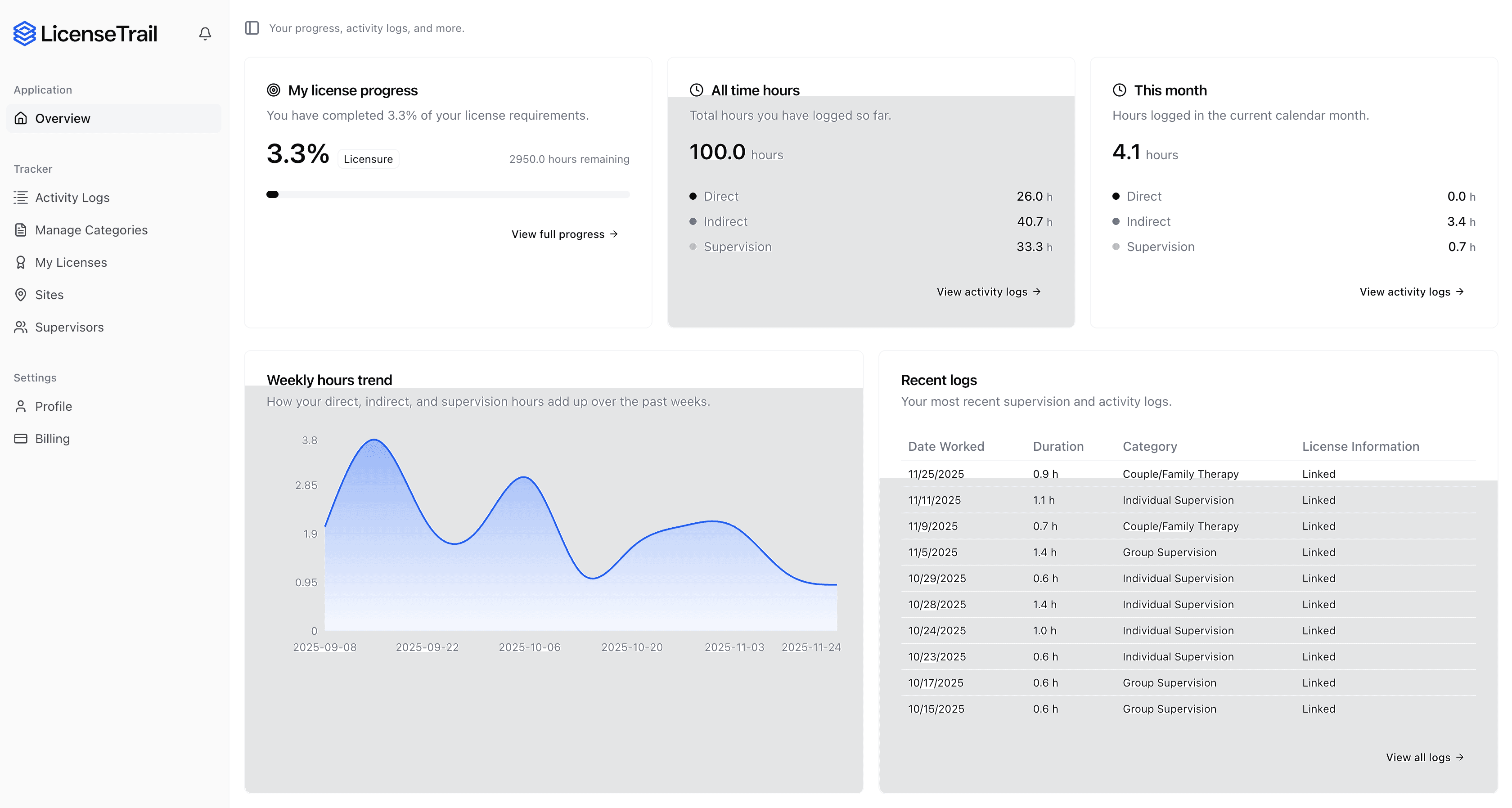
Track your MFLC hours with confidence
License Trail checks your direct, indirect, and supervision hours against Montana MFLC requirements continuously and flags mismatches before you submit.
 Start Tracking for Free
No credit card required · Free plan available
Is your spreadsheet hiding Montana MFLC risks?
Stop guessing if your categories match Montana Board of Behavioral Health requirements. License Trail checks your direct, indirect, and supervision hours continuously and flags mismatches before you submit.
Import or log
Bring your spreadsheet or start fresh
Upload your existing tracking spreadsheet and we'll map every hour into the right Montana Board of Behavioral Health categories automatically.
Verify against Montana
Catch mismatches before the board does
License Trail checks your direct, indirect, and supervision hours against Montana MFLC requirements continuously.
Export board-ready
One-click clean reports
Generate professional, board-ready reports for supervision meetings and Montana Board of Behavioral Health submissions in seconds.
No credit card required · Free plan available