
Montana SWLM Requirements: Hours, Exams & Step-by-Step Guide
Stop guessing if your categories match Montana requirements. License Trail checks your direct, indirect, and supervision hours against SWLM requirements continuously and flags mismatches before you submit.
No credit card required · Free plan available
Quick Requirements Overview
- Credential/Board: SWLM = Licensed Master’s Social Worker Candidate (non‑clinical), issued by the Montana Board of Behavioral Health
- Education: MSW from CSWE-accredited program (or Board-approved by rule)
- Application items: application + fee, proof of MSW, fingerprint-based DOJ/FBI background check, good moral character, and a Board-compliant training/supervision plan
- Supervised experience (while SWLM): 1,500 hours minimum over ≥18 months
- Supervision minimums: 75 hours of individual/group supervision by a qualified supervisor; ≥25 of those hours must align with the client populations served
- Supervision ratio: ≥2 supervision hours per 160 work hours
- Recency: hours must be earned within 5 years of the LMSW application (if not actively licensed elsewhere)
- Renewal: annual candidate registration; SWLM renewal fee noted as $85; no CE for SWLM renewal
License Details
Procedures
Montana licenses non‑clinical master’s‑level social workers in two stages: first as a Licensed Master’s Social Worker Candidate (credential code SWLM), then as a fully Licensed Master’s Social Worker (LMSW). The SWLM credential is issued by the Montana Board of Behavioral Health and is the status you hold while you accumulate the supervised work experience required for the LMSW license.(boards.bsd.dli.mt.gov)
Below is a step‑by‑step outline focused on (1) how to qualify for SWLM status and (2) exactly what hours the state requires you to complete while you hold that candidate license.
1. Understand what SWLM is in Montana
The Board lists “Licensed Master’s Social Worker (LMSW) – and Candidate (SWLM)” as one of its social work license types.(boards.bsd.dli.mt.gov)
By statute, anyone who has completed the education for a master’s‑level social work license but has not yet completed the supervised work experience must register as a “social worker licensure candidate” in order to practice and earn hours in Montana.(law.justia.com)
For the LMSW track, that candidate registration is what the Board operationalizes as the SWLM license.
2. Educational prerequisite for SWLM
To be eligible for the LMSW track (and therefore for SWLM candidate status), you must have:
- A master’s degree in social work from a program:
- accredited by the Council on Social Work Education (CSWE), or
- another program approved by the Board by rule.(law.justia.com)
Montana law states that an applicant for a licensed master’s social worker:
“must have a master’s degree in social work from a program accredited by the council on social work education or a program approved by the board by rule.” (law.justia.com)
You must have completed this degree before you can register as a social worker licensure candidate (SWLM).
3. Registering as a Social Worker Licensure Candidate (SWLM)
Once you have the MSW, you register as a “social worker licensure candidate” under Montana Code 37‑22‑313. The statute applies to clinical and non‑clinical tracks alike and lays out the baseline requirements.(law.justia.com)
3.1 What you must submit
To register as a candidate, you must submit to the Board:(law.justia.com)
-
Application and fee
- The LMSW candidate page lists “Licensing Requirements & Application Submission Checklist – LMSW Candidate” and notes an SWLM renewal fee of $85.(boards.bsd.dli.mt.gov)
-
Proof of education
- Documentation that you have completed the MSW meeting the requirements of 37‑22‑308.(law.justia.com)
-
Fingerprint‑based background check
- Statute requires fingerprints for a Department of Justice and FBI check as a prerequisite to licensure; the Board’s LMSW candidate page expressly states that LMSW candidate applicants must complete a background check through submission of fingerprints to Montana DOJ, with results sent directly to the department.(law.justia.com)
-
Proof of good moral character(law.justia.com)
-
Training and supervision plan
- You must submit “a training and supervision plan that meets the requirements set by the board”.(law.justia.com)
- This plan should spell out where you will work, who your supervisor(s) will be, how supervision will occur, and how you will meet the specific hour requirements in ARM 24.219.504 (see Section 4 below).
Once the Board approves your application and plan, statute provides that you may:
“engage in social work under the conditions set by the board and use the title of ‘social worker licensure candidate’ that is appropriate to the applicant's proposed level of licensure.” (law.justia.com)
For the master’s‑level non‑clinical track, that means you function as an LMSW Candidate (SWLM).
4. Supervised work experience requirements while you are SWLM
While you hold the SWLM license, your main task is to complete the supervised practice hours required to become an LMSW. Montana sets these hours in Administrative Rule of Montana (ARM) 24.219.504 – “LCSW, LMSW, and LBSW Supervised Work Experience Requirements.”(regulations.justia.com)
For LMSW applicants, the rule requires:
4.1 Total hours and timeframe
- You must complete “a minimum of 1500 total hours of supervised work experience over a period of no less than 18 months.”(regulations.justia.com)
Key points:
- These are post‑degree supervised hours in social work practice.
- They must span at least 18 months; you cannot compress all 1,500 hours into a shorter period and meet the rule.
- For LMSW (unlike LCSW), the Board does not currently specify an exact numeric minimum of “direct client contact” hours in the administrative rule; instead, state law says that “some of the required hours must be in direct client contact.”(law.justia.com)
4.2 Required “individual or group supervision” hours
Within those 1,500 total supervised hours, ARM 24.219.504 specifies a separate requirement for formal supervision:
- At least 75 hours must consist of “individual or group supervision by a qualified supervisor under ARM 24.219.421.”(regulations.justia.com)
So, for an LMSW applicant (SWLM):
- 1,500 total supervised work experience hours, including
- 75 hours of structured supervision (individual or group) with a Board‑qualified supervisor.
4.3 Client‑population‑specific supervision requirement
Of those 75 supervision hours, the rule further requires that:
- At least 25 hours must be “with the client populations that will be served by the LMSW candidate.”(regulations.justia.com)
The rule gives examples of “client population,” such as child, adolescent, adult, or chemically dependent/substance use disorder, and examples of methods of practice such as individual, group, family, crisis, or brief interventions. Your supervisor must have experience with the population and methods that match your practice.(regulations.justia.com)
4.4 Ongoing supervision ratio requirement
ARM 24.219.504 also sets a global supervision ratio that applies to LCSW, LMSW, and LBSW candidates:
- Supervisors must provide “at least two hours of supervision … for every 160 hours of social work.”(regulations.justia.com)
In practice:
- For every 160 hours of paid or volunteer social work practice you perform as an SWLM, you must receive at least 2 hours of documented supervision (which may be counted toward your 75‑hour supervision minimum, if it meets those standards).
4.5 Recency of hours
For LMSW and LBSW applicants who are not already actively licensed in another jurisdiction, ARM 24.219.504 states that:
- All supervised work experience hours “must have been earned within five years of the date of application.”(regulations.justia.com)
So you must complete your 1,500 supervised hours during a 5‑year window ending at the time you apply for full LMSW licensure.
5. What “qualified supervisor” means
Your 75 hours of supervision, and the ongoing 2‑hours‑per‑160‑hours ratio, must be provided by a “qualified supervisor under ARM 24.219.421.”(regulations.justia.com)
Under ARM 24.219.421, supervisors must generally:(regulations.justia.com)
- Hold an active license in good standing in the jurisdiction where supervision occurs; and
- Either:
- have been licensed in their discipline for at least three years (excluding any period as a candidate), or
- have completed Board‑approved supervision training (at least one semester‑credit graduate course in supervision or 20 hours of Board‑approved supervision training).
For LCSW, LCPC, and LMFT candidates, supervisors must be one of several independent behavioral health licensees (LCSW, LCPC, LMFT, psychologist, or board‑certified psychiatrist). For LMSW candidates, the supervisor must still meet the general licensure and experience/training requirements and must have experience with your client population and practice methods.(regulations.justia.com)
6. Candidate status, conduct, and renewal
6.1 Title and scope while SWLM
Once approved, you may practice social work only under the conditions set by the Board, and you must use the title appropriate to your level, which in this context is social worker licensure candidate on the LMSW track (SWLM).(law.justia.com)
You are required to:
- Conform to “the standards of conduct applicable to all licensees.”(law.justia.com)
- Work within the scope of practice and supervision arrangements approved in your training and supervision plan.
Unprofessional conduct or failure to meet supervision conditions can lead to disciplinary action or restriction of your authority to act as a candidate and can affect your future licensure.(law.justia.com)
6.2 Duration and renewal
By statute, a person “shall register annually as a social worker licensure candidate” and the Board may limit the number of years a person can remain a candidate.(law.justia.com)
The Board’s LMSW candidate page adds practical renewal details:(boards.bsd.dli.mt.gov)
- Renewal period: November 1 – December 31 each year
- Late renewal: Up to 45 days after December 31 (late fees apply)
- Continuing education: None required for SWLM renewal
7. Transitioning from SWLM to full LMSW
After you have completed the required supervised work experience as a social worker licensure candidate, state law says an LMSW applicant must:(law.justia.com)
-
Complete the licensing examination
- You must “satisfactorily complete an examination prescribed by the board by rule.”
- The Board’s materials indicate that for the LMSW level, Montana accepts scores from the ASWB Master’s examination.(boards.bsd.dli.mt.gov)
-
Submit the full LMSW application and fee
- File the Board’s LMSW application form, including verification of:
- your 1,500 supervised hours meeting the ARM 24.219.504 requirements, and
- your passing ASWB Master’s exam score.(law.justia.com)
- File the Board’s LMSW application form, including verification of:
-
Maintain good standing as a candidate until licensure
- You may continue as a social worker licensure candidate and reapply for the exam if you fail, subject to terms set by the Board.(law.justia.com)
Once the Board verifies your hours, exam, and background, it may issue the Licensed Master’s Social Worker (LMSW) license, at which point you no longer practice under SWLM candidate status.
8. Summary of hour requirements for an SWLM on the LMSW track
Putting the key quantitative requirements together:
-
Total supervised work experience required for LMSW (while you are SWLM):
- 1,500 total hours of supervised work experience in social work practice.
- Must be accumulated over no less than 18 months.(regulations.justia.com)
-
Supervision hours within that total:
- At least 75 hours of individual or group supervision by a qualified supervisor.(regulations.justia.com)
- Of those 75 hours, at least 25 hours must be with the client populations that will be served by the LMSW candidate.(regulations.justia.com)
-
Ongoing supervision ratio:
- At least 2 hours of supervision for every 160 hours of social work performed by the candidate.(regulations.justia.com)
-
Direct client contact:
- Statute requires that some portion of the supervised work experience hours be in direct client contact, but—as of the current rule—no specific minimum number of “direct client contact” hours is fixed in ARM 24.219.504 for LMSW (in contrast to the LCSW requirements, which specify both total and direct‑contact minimums).(law.justia.com)
-
Recency:
- If you are not already actively licensed in another jurisdiction, your 1,500 supervised hours must be completed within five years before the date of your LMSW application.(regulations.justia.com)
These are the Montana‑specific hour categories and state‑board language that govern the path from SWLM candidate to full LMSW licensure.
Track your SWLM hours with confidence
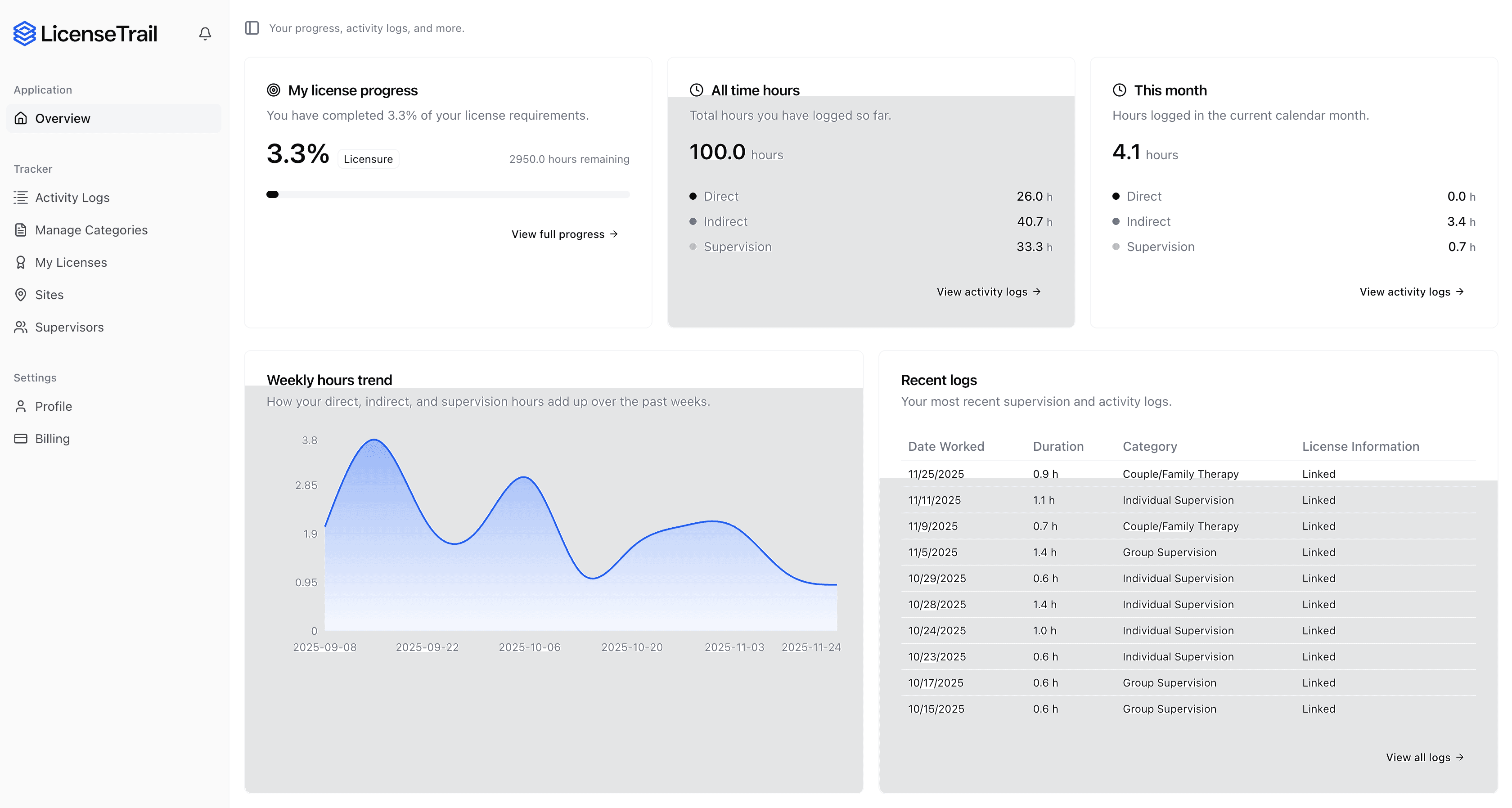
License Trail checks your direct, indirect, and supervision hours against Montana SWLM requirements continuously and flags mismatches before you submit.
 Start Tracking for Free
No credit card required · Free plan available
Is your spreadsheet hiding Montana SWLM risks?
Stop guessing if your categories match Montana Board of Behavioral Health requirements. License Trail checks your direct, indirect, and supervision hours continuously and flags mismatches before you submit.
Import or log
Bring your spreadsheet or start fresh
Upload your existing tracking spreadsheet and we'll map every hour into the right Montana Board of Behavioral Health categories automatically.
Verify against Montana
Catch mismatches before the board does
License Trail checks your direct, indirect, and supervision hours against Montana SWLM requirements continuously.
Export board-ready
One-click clean reports
Generate professional, board-ready reports for supervision meetings and Montana Board of Behavioral Health submissions in seconds.
No credit card required · Free plan available