
New-hampshire LSWA Requirements: Hours, Exams & Step-by-Step Guide
Stop guessing if your categories match New-hampshire requirements. License Trail checks your direct, indirect, and supervision hours against LSWA requirements continuously and flags mismatches before you submit.
No credit card required · Free plan available
Quick Requirements Overview
- Education (either pathway): Associate’s or bachelor’s in approved field (or equivalent) from an accredited school
- Required education hours: 300 hours social work/mental health education (in-program or separate)
- Required practicum hours: 300 hours supervised practical training (in-program or separate)
- Supervised work experience: Bachelor’s = 4,000 hours (2–4 years); Associate’s = 6,000 hours (≥3 years); excludes coursework/practicum
- Supervision (within work experience): Bachelor’s = 100 hrs; Associate’s = 150 hrs; individual face-to-face, ~1 hr/week; HIPAA-compliant synchronous virtual allowed
- Exam: Pass ASWB Bachelor’s-level exam (board-approved national proctored exam)
- Continuing education (during supervision period): 30 CE hours across specified practice/ethics/DEI-related domains
- Conditional license option: May practice under board-approved supervision agreement while accruing hours; valid up to 2 years and renewable once (good standing)
License Details
Procedures
Becoming a Licensed Social Work Associate (LSWA) in New Hampshire involves meeting detailed education, experience, and supervision requirements set by the New Hampshire Office of Professional Licensure and Certification, Board of Mental Health Practice. The LSWA credential is designed for associate‑ or bachelor‑level practitioners who provide screening, assessment, treatment planning, and treatment of mental health conditions under clinical supervision. (law.justia.com)
Below is a step‑by‑step guide focused on the exact hour requirements and terminology used by the statute (RSA 330‑A) and the Board’s administrative rules (Mhp 308).
1. Governing law and rules
Two main sets of requirements apply:
- Statute: RSA 330‑A:18‑c, “Licensed Social Work Associate: Initial License.” (law.justia.com)
- Administrative Rules: N.H. Admin. Code Mhp 308.01–308.04 (Social Work Associate) and Mhp 308.03 (Supervised Work Experience). (gc.nh.gov)
New Hampshire also has a conditional licensure framework in RSA 330‑A:18‑d and Mhp 309.01–309.03, which allows you to practice under supervision while you accrue the required hours. (gc.nh.gov)
2. Two education pathways to LSWA
You can qualify as an LSWA with either:
A. Bachelor’s‑degree pathway
Under RSA 330‑A:18‑c, I(a) and Mhp 308.01(a)(1), you must: (law.justia.com)
-
Hold a qualifying bachelor’s degree
- A bachelor’s degree in “clinical mental health, social work, psychology, behavioral health counseling, human services discipline, or [an] equivalent program from an accredited college or university.”
-
Complete 300 hours of social work or mental health education
- Mhp 308.01(a)(1)a requires “300 hours of social work or mental health education within the degree‑granting program or separately.” (law.cornell.edu)
-
Complete 300 hours of supervised practical training
- Mhp 308.01(a)(1)b requires “300 hours of supervised practical training within the degree granting program or separately.” (law.cornell.edu)
-
Complete 4,000 hours of supervised work experience
- Mhp 308.01(a)(1)c requires you to have “completed 4,000 hours of supervised work experience within 2 years but no more than 4 years.” (law.cornell.edu)
-
Pass the ASWB bachelor’s‑level exam
- Mhp 308.01(a)(1)d and Mhp 308.04 require that you “pass the national ASWB bachelor’s level examination.” (law.cornell.edu)
-
Complete 30 hours of continuing education during supervised practice
- During your supervised practice, Mhp 308.01(a)(1)e requires “30 hours of continuing education” across nine specified content areas (ethics, DEI, human rights, practice‑informed research, policy practice, engagement, assessment, intervention, and evaluation). (law.cornell.edu)
B. Associate‑degree pathway
Under RSA 330‑A:18‑c, I(b) and Mhp 308.01(a)(2), you must: (law.justia.com)
-
Hold a qualifying associate’s degree
- An associate’s degree in “clinical mental health, social work, psychology, behavioral health counseling, human services discipline, or equivalent program from an accredited college or university.”
-
Complete 300 hours of social work or mental health education
- Mhp 308.01(a)(2)a mirrors the bachelor requirement: 300 hours of social work or mental health education within or outside the degree. (law.cornell.edu)
-
Complete 300 hours of supervised practical training
- Mhp 308.01(a)(2)b requires “300 hours of supervised practical training within the degree granting program as part of the supervised work experience or separately.” (law.cornell.edu)
-
Complete 6,000 hours of supervised work experience
- Mhp 308.01(a)(2)c requires “6,000 hours of supervised work experience in no fewer than 3 years.” (law.cornell.edu)
-
Pass the ASWB bachelor’s‑level exam
- Mhp 308.01(a)(2)d again requires that you “pass the national ASWB bachelor’s level examination.” (law.cornell.edu)
-
Complete 30 hours of continuing education during supervised practice
- Mhp 308.01(a)(2)e requires “30 hours of continuing education” in the same nine content areas listed for bachelor’s‑level candidates, completed during the supervised practice period. (law.cornell.edu)
3. The hour requirements broken down by “type” of hours
3.1 Educational hours (both pathways)
For both associate and bachelor’s candidates, the Board uses these categories:
-
“300 hours of social work or mental health education”
- Classroom or structured educational hours, which may be within your degree program or separate from it. (law.cornell.edu)
-
“300 hours of supervised practical training”
- Practicum/field‑placement type training done under supervision, usually embedded in the degree program but it can also be completed separately. (law.cornell.edu)
These 600 hours (education + supervised practical training) are in addition to the post‑degree supervised work experience described below; Board rule Mhp 308.03(g) explicitly states that “supervised experience shall not include class work, practicum experience, or other course related experiences.” (law.cornell.edu)
3.2 Supervised work experience hours
These are the large blocks of post‑degree hours the Board requires before granting full LSWA licensure:
-
Bachelor’s pathway:
- 4,000 hours of supervised work experience, and Mhp 308.01(a)(1)c specifies that these must be completed “within 2 years but no more than 4 years.” (law.cornell.edu)
-
Associate’s pathway:
- 6,000 hours of supervised work experience, completed “in no fewer than 3 years.” (law.cornell.edu)
Board rule Mhp 308.03(a) further clarifies that these must be “at least 2 years of post‑bachelors or post‑associate supervised clinical work experience in a mental health or social service setting.” (law.cornell.edu)
In other words:
-
Bachelor’s LSWA candidates:
- 4,000 hours of post‑bachelor’s, supervised clinical work
- Completed in no less than 2 and no more than 4 years
-
Associate LSWA candidates:
- 6,000 hours of post‑associate, supervised clinical work
- Completed in no less than 3 years (no stated maximum in the rule)
These hours are not subdivided in the rules into “direct client contact” vs “indirect” time. The terminology the Board uses is simply “supervised work experience” and “supervised clinical work experience in a mental health or social service setting.” (law.cornell.edu)
3.3 Supervision hours within the work experience
Within those 4,000 or 6,000 hours, the Board adds separate requirements for formal supervision hours:
Under Mhp 308.03: (law.cornell.edu)
-
Bachelor’s‑degree LSWA candidates must have:
- At least 100 hours of individual, face‑to‑face supervision, provided at a minimum rate of one hour per week, by an approved supervisor.
-
Associate‑degree LSWA candidates must have:
- At least 150 hours of individual, face‑to‑face supervision, again at roughly one hour per week, by an approved supervisor.
The rule states:
- For associate‑level applicants, the supervisor “shall have provided a minimum of one hour per week of individual face‑to‑face supervision… for a total of 150 hours.”
- For bachelor‑level applicants, supervision must provide “a minimum of one hour per week of individual face‑to‑face supervision… for a total of 100 hours.” (law.cornell.edu)
These supervision hours are qualitatively different from the general 4,000/6,000 “work experience” hours. They are dedicated time spent with your supervisor reviewing cases, addressing clinical and ethical issues, and developing your practice skills.
3.4 Continuing education hours during supervised practice
Mhp 308.01 adds a third distinct category of hours during the supervision period:
- 30 hours of continuing education completed during the supervised practice, in nine specific domains (ethics, human rights and justice, anti‑racism/DEI, practice‑informed research, policy practice, engagement, assessment, intervention, and evaluation). (law.cornell.edu)
These hours are not part of the 4,000/6,000 “work experience” total; they are a separate CE requirement.
4. Who can supervise and how supervision must be structured
Mhp 308.03 sets out who may supervise LSWA candidates and under what conditions: (law.cornell.edu)
-
Approved supervisor types
- Licensed Clinical Social Worker
- Licensed Marriage and Family Therapist
- Licensed Mental Health Counselor
- Licensed Pastoral Psychotherapist
-
License location
- Your supervisor must be licensed in the state where the supervision takes place.
-
Format
- Supervision may be in physical presence or via a HIPAA‑compliant synchronous virtual platform.
-
Work relationship
- The rule states that “a 1099 employee of an independent private practice shall not be considered an acceptable supervised professional experience.”
- Practically, you should expect to be a W‑2 employee or otherwise in a non‑independent contractor relationship with the practice.
-
Dual relationships prohibited
- The supervisor “shall not have a dual relationship with the applicant which may impair their objectivity,” such as being a close relative or having another conflicting role. (law.cornell.edu)
5. Conditional LSWA license while you earn hours
New Hampshire allows you to work under a conditional license while you accumulate the supervised work hours and supervision hours needed for full LSWA licensure.
5.1 Statutory conditional license (RSA 330‑A:18‑d)
For a Licensed Social Work Associate (conditional), RSA 330‑A:18‑d, I(d) requires that you: (gc.nh.gov)
- Hold an associate’s or bachelor’s degree in an approved field (same list as above).
- Complete 300 hours of social work or mental health education within your degree or separately.
- Complete 300 hours of supervised practical training within the degree‑granting program, “as part of the supervised work experience or separately.”
- Obtain a board‑approved supervisory agreement consistent with RSA 330‑A:18‑c, III, showing your intent to pursue LSWA licensure.
- Meet any other criteria set by the Board.
- Once the supervisory agreement is approved, the Office of Professional Licensure and Certification issues the conditional license.
5.2 Duration of conditional license
- RSA 330‑A:18‑d, II and Mhp 309.03 both state that a conditional license is valid “for a period not to exceed 2 years from the date of issuance”, and may be renewed once for an additional period if you are in good standing. (gc.nh.gov)
During your conditional licensure, you work under approved supervision while accruing:
- The 4,000 (bachelor) or 6,000 (associate) supervised work experience hours;
- The 100 or 150 individual supervision hours; and
- The 30 hours of required continuing education.
6. Examination requirement
Both the statute and rules describe a “national proctored examination approved by the board” for LSWA. RSA 330‑A:18‑c uses that phrase, and Mhp 308.01 and Mhp 308.04 specify that this is the Association of Social Work Boards (ASWB) bachelor’s‑level examination. (law.justia.com)
- You apply to the Board for permission to sit for the ASWB exam using a “Request to Sit for ASWB Bachelor’s Level Examination” form (Mhp 308.04(c)). (law.cornell.edu)
- The ASWB sends written verification of your passing score directly to the Board.
7. Scope of practice and supervision once licensed
RSA 330‑A:18‑c, II–III describes the LSWA’s scope of practice and supervision requirements: (law.justia.com)
- LSWA practice consists of “screening, assessment, treatment planning, and treatment of mental health conditions under clinical supervision.”
- An LSWA may practice only under the clinical supervision of one of the following:
- Licensed Clinical Social Worker
- Licensed Mental Health Counselor
- Master Licensed Alcohol and Drug Counselor
- Psychiatric APRN
- Another licensed mental health provider approved by the board
- The supervising clinician must sign off on any clinical diagnostic assessment and treatment plan established by the LSWA.
8. Summary of hour requirements, by category
Putting it all together, for LSWA licensure in New Hampshire under the Board of Mental Health Practice:
Bachelor’s‑degree LSWA
- Education:
- 300 hours – social work or mental health education
- 300 hours – supervised practical training
- Post‑degree supervised work experience:
- 4,000 hours – supervised work experience in a mental health or social service setting
- Must be completed in at least 2 years but no more than 4 years
- Clinical supervision (within those 4,000 hours):
- 100 hours – individual, face‑to‑face supervision (about 1 hour per week)
- Continuing education during supervised practice:
- 30 hours – CE in nine specified social work practice content areas
- Examination:
- ASWB bachelor’s‑level exam (national proctored exam approved by the Board)
Associate‑degree LSWA
- Education:
- 300 hours – social work or mental health education
- 300 hours – supervised practical training
- Post‑degree supervised work experience:
- 6,000 hours – supervised work experience in a mental health or social service setting
- Completed in no fewer than 3 years
- Clinical supervision (within those 6,000 hours):
- 150 hours – individual, face‑to‑face supervision (about 1 hour per week)
- Continuing education during supervised practice:
- 30 hours – CE in the same nine content areas
- Examination:
- ASWB bachelor’s‑level exam
All of these requirements are grounded in RSA 330‑A:18‑c and 330‑A:18‑d and implemented in detail through N.H. Admin. Code Mhp 308.01–308.04 and Mhp 309.01–309.03, which together define exactly how many hours of each “type” you must complete and how those hours must be structured and supervised. (law.justia.com)
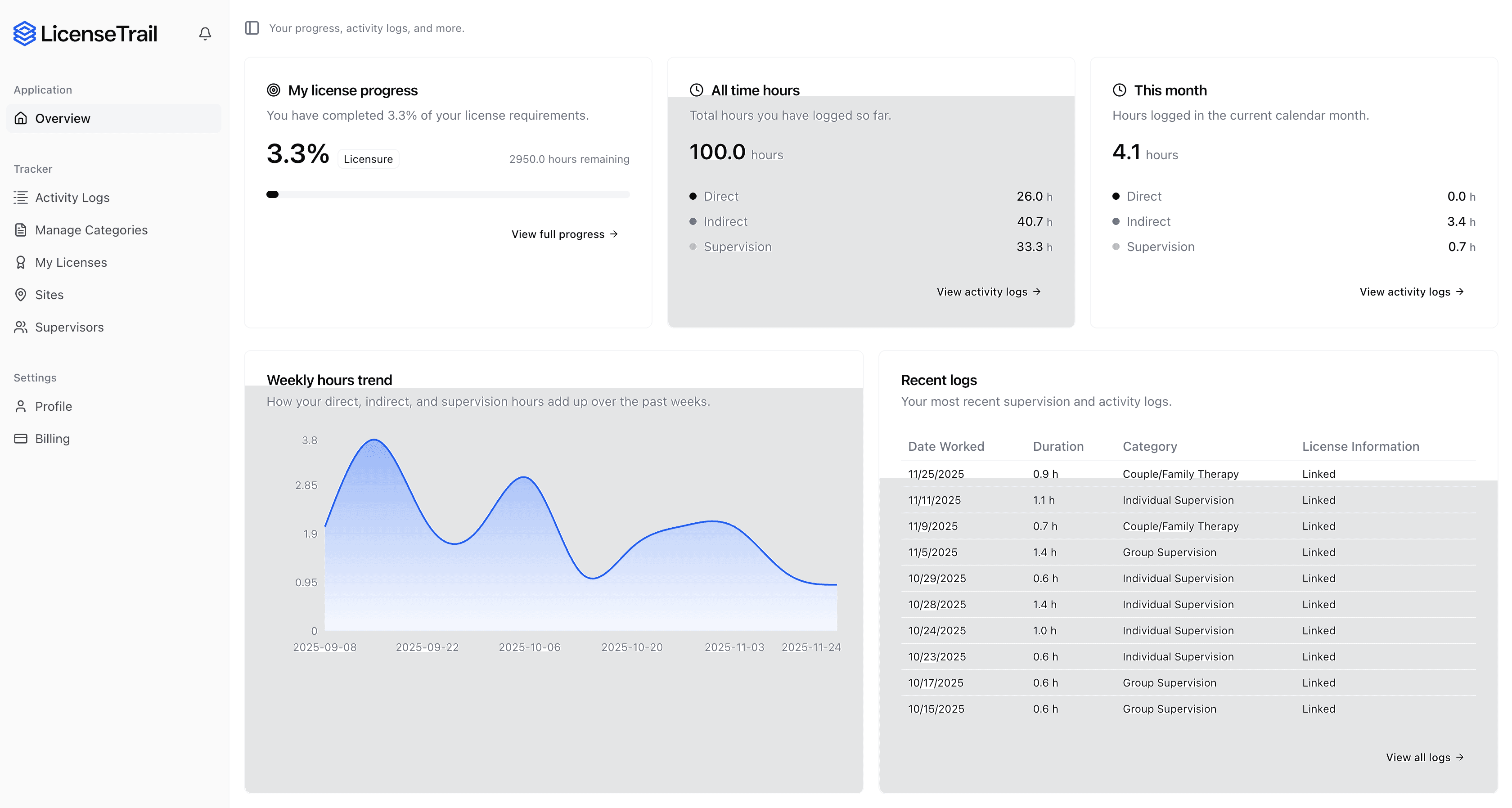
Track your LSWA hours with confidence
License Trail checks your direct, indirect, and supervision hours against New-hampshire LSWA requirements continuously and flags mismatches before you submit.
 Start Tracking for Free
No credit card required · Free plan available
Is your spreadsheet hiding New-hampshire LSWA risks?
Stop guessing if your categories match New Hampshire Board of Mental Health Practice requirements. License Trail checks your direct, indirect, and supervision hours continuously and flags mismatches before you submit.
Import or log
Bring your spreadsheet or start fresh
Upload your existing tracking spreadsheet and we'll map every hour into the right New Hampshire Board of Mental Health Practice categories automatically.
Verify against New-hampshire
Catch mismatches before the board does
License Trail checks your direct, indirect, and supervision hours against New-hampshire LSWA requirements continuously.
Export board-ready
One-click clean reports
Generate professional, board-ready reports for supervision meetings and New Hampshire Board of Mental Health Practice submissions in seconds.
No credit card required · Free plan available