
New-hampshire LSW Requirements: Hours, Exams & Step-by-Step Guide
Stop guessing if your categories match New-hampshire requirements. License Trail checks your direct, indirect, and supervision hours against LSW requirements continuously and flags mismatches before you submit.
No credit card required · Free plan available
Quick Requirements Overview
- CSWE-accredited BSW required
- 300 hours of “social work or mental health education” (in-program or separate)
- 300 hours of supervised practical training (in-program, work experience, or separate)
- 4,000 hours post‑bachelor supervised work experience in a mental health/social service setting, completed in 2–4 years (at least 2 years total)
- Within the 4,000 hours: 100 hours minimum individual supervision (1 hr/week, face-to-face or HIPAA-compliant synchronous virtual)
- Supervisor must be LCSW, LMFT, LCMHC, or licensed pastoral psychotherapist, licensed where supervision occurs
- Pass the ASWB Bachelors national proctored exam
- Fingerprints + criminal history check required for initial licensure (OPLC/Board processing)
License Details
Procedures
Licensed Social Worker (LSW) licensure in New Hampshire is governed by the New Hampshire Board of Mental Health Practice under RSA 330‑A and its administrative rules (Chapter Mhp 300). The LSW is a regulated social worker whose scope of practice includes screening, assessment, treatment planning, and treatment of mental health conditions under specified supervision. (gc.nh.gov)
Below is a step‑by‑step outline focused on the exact types and amounts of hours the Board requires, using the Board’s and statute’s own terminology.
1. Educational foundation
To qualify for an initial LSW license, you must:
-
Hold a bachelor’s degree in social work from a college or university approved by the Council on Social Work Education (CSWE). (gc.nh.gov)
-
Complete 300 hours of “social work or mental health education”
The statute and Board rules state that an applicant must “complete 300 hours of social work or mental health education within the degree‑granting program or separately.” (gc.nh.gov)In practice, these 300 hours are fulfilled through coursework and/or additional structured training focused on social work or mental health content (e.g., human behavior, social policy, practice methods, mental health, ethics). Schools often package most or all of these hours into the BSW curriculum.
2. Supervised practical training (300 hours)
Separate from your general coursework, the Board requires 300 hours of supervised practical training:
-
Statute: The LSW statute requires you to “complete 300 hours of supervised practical training within the degree‑granting program, as part of the supervised work experience or separately.” (gc.nh.gov)
-
Board rule (Mhp 307.01(c)): The rule mirrors this, requiring “300 hours of supervised practical training within the degree granting program as part of the supervised work experience or separately.” (gc.nh.gov)
How this usually looks in practice
These 300 hours are typically satisfied through:
- Field placements or internships during the BSW program; and/or
- Other structured, supervised practicum experiences arranged by the school or employer.
They may also be credited as part of your supervised work experience hours (see Section 3), as long as they meet the supervision and setting requirements.
3. Post‑bachelor supervised work experience (4,000 hours)
The most substantial requirement is your post‑bachelor supervised work experience:
3.1 Total hours and timeframe
The statute and rules require you to:
-
“Complete 4,000 hours of supervised work experience” for the LSW. (gc.nh.gov)
-
Board rule Mhp 307.01(d) adds that these 4,000 hours must be:
- Completed “within 2 but no more than 4 years”, and
- They must be post‑bachelor and in an appropriate setting. (gc.nh.gov)
Mhp 307.02 further clarifies that:
- You must complete at least 2 years of post‑bachelor supervised work experience in a mental health or social service setting to meet the 4,000‑hour requirement. (gc.nh.gov)
In other words, New Hampshire does not split these hours into different buckets (e.g., “1,500 direct” + “1,500 supervised”). Instead, the Board uses a single category:
- 4,000 hours of supervised work experience, with specific supervision conditions described below.
3.2 Nature of the supervised work experience
Board rules define the characteristics of acceptable supervised work experience:
-
The work must occur in a mental health or social service setting (e.g., community mental health, social service agencies, hospitals, schools, etc.). (gc.nh.gov)
-
“Acceptable supervised experience shall require direct contact with a supervisor who is responsible for the professional development and guidance of the supervisee and is familiar with the supervisee’s work and organizational setting.” (gc.nh.gov)
This means your work must be under a supervisor who actually oversees and guides your practice, not just signs forms.
3.3 Required supervision hours within the 4,000 hours
Within the 4,000 hours of supervised work experience, the Board requires a minimum of 100 hours of individual supervision:
- Mhp 307.02(b): “The supervision shall have provided for a minimum of one hour per week of individual face‑to‑face supervision between the supervisor and the applicant for a total of 100 hours.” (gc.nh.gov)
Key implications:
- Frequency: At least 1 hour of individual supervision per week while you are accruing hours.
- Total supervision: At least 100 hours of individual supervision must be documented over the course of your 4,000 hours.
- Format: Supervision may be provided “in the physical presence or via a HIPAA‑compliant synchronous virtual presence.” (gc.nh.gov)
3.4 Who can be your supervisor
The Board specifies acceptable supervisor credentials:
-
Supervision “shall be provided by a licensed clinical social worker, licensed marriage and family therapist, licensed mental health counselor, or licensed pastoral psychotherapist.” (gc.nh.gov)
-
The supervisor must be licensed in the state where the supervision takes place. (gc.nh.gov)
So, if you are working in another state while accruing hours toward a New Hampshire LSW, your supervisor must hold one of these relevant licenses in that other state.
4. Examination requirement
To become an LSW, you must pass a national exam approved by the Board:
-
RSA 330‑A:18‑b requires that the applicant “pass a national proctored examination approved by the board.” (gc.nh.gov)
-
Mhp 307.01(e) specifies this more narrowly as the “National Examination Association of Social Work Board’s (ASWB) bachelors level examination.” (gc.nh.gov)
In practice, this means:
- You sit for the ASWB Bachelors exam, the national exam commonly used for entry‑level social work licensure.
5. Criminal background check and application processing
All applicants for initial licensure under RSA 330‑A must undergo a criminal history check:
- RSA 330‑A:15‑a requires every applicant for initial licensure to submit:
- A criminal history record release form; and
- A complete set of fingerprints taken by law enforcement or an authorized Department of Safety employee. (gc.nh.gov)
The Board must:
- Request any additional documentation within 15 days, and
- Act on a completed license application within 30 days, according to RSA 330‑A:15‑a. (gc.nh.gov)
Applications and fees are processed through the Office of Professional Licensure and Certification (OPLC), under the authority of the Board of Mental Health Practice.
6. Conditional LSW license (while you are accruing hours)
New Hampshire also created a conditional social work license category, which can apply to LSWs who are gaining supervised experience:
-
Under RSA 330‑A:18‑d(c), an applicant for a conditional LSW license must:
- Hold a bachelor’s degree in social work or social welfare from a CSWE‑approved program; and
- Obtain a board‑approved supervisory agreement (referencing RSA 330‑A:18‑b) showing intent to pursue full LSW licensure; and
- Meet any other criteria reasonably established by the Board. (gc.nh.gov)
-
Once the supervisory agreement is approved, the Office of Professional Licensure and Certification issues the conditional license, which allows you to practice under supervision while accruing your 4,000 hours. (gc.nh.gov)
-
Conditional licenses are valid for up to 2 years, with a one‑time renewal available for applicants in good standing. (gc.nh.gov)
This path is intended for practitioners who have the degree but are still working toward the full experience and supervision requirements for the standard LSW license.
7. Scope of practice and supervision at the LSW level
Once fully licensed as an LSW, your legal scope of practice is defined in RSA 330‑A:18‑b:
-
The LSW’s scope includes:
- “Screening, assessment, treatment planning, and treatment of mental health conditions”; and
- Clinical evaluation (screening and assessment of mental health disorders, identifying co‑occurring symptoms, and developing preliminary diagnoses for confirmation by an appropriate professional). (gc.nh.gov)
-
Importantly, the statute specifies that “The supervising clinician shall sign off on any clinical diagnostic assessment and treatment plan established by a licensed social worker.” (gc.nh.gov)
This reinforces that, even after you are fully licensed as an LSW, diagnostic and treatment‑planning authority is subject to supervisory approval.
8. Summary of hour‑based requirements for New Hampshire LSW
Putting the Board’s and statute’s language into a concise breakdown:
-
Education hours
- 300 hours of social work or mental health education (within your BSW program or separately). (gc.nh.gov)
-
Practical training hours
- 300 hours of supervised practical training, usually via internships/field placements; may be counted as part of supervised work experience if conditions are met. (gc.nh.gov)
-
Post‑bachelor supervised work experience
- 4,000 hours of supervised work experience, in a mental health or social service setting, completed within 2 but no more than 4 years, and spanning at least 2 years. (gc.nh.gov)
-
Supervision within those 4,000 hours
- Minimum 100 hours of individual supervision, at a rate of at least 1 hour per week of individual, face‑to‑face (or HIPAA‑compliant virtual) supervision. (gc.nh.gov)
- Supervisor must be an LCSW, LMFT, LCMHC, or licensed pastoral psychotherapist, licensed in the state where supervision occurs. (gc.nh.gov)
-
Exam
- Pass the ASWB Bachelors level exam, the national proctored exam approved by the Board. (gc.nh.gov)
New Hampshire’s framework is therefore built around one main experiential requirement—4,000 hours of supervised work experience with defined supervisory intensity (100 hours) and a specified time window (2–4 years)—plus discrete requirements for 300 education hours and 300 supervised practical training hours, rather than splitting hours into “direct” versus “supervised” categories.
Track your LSW hours with confidence
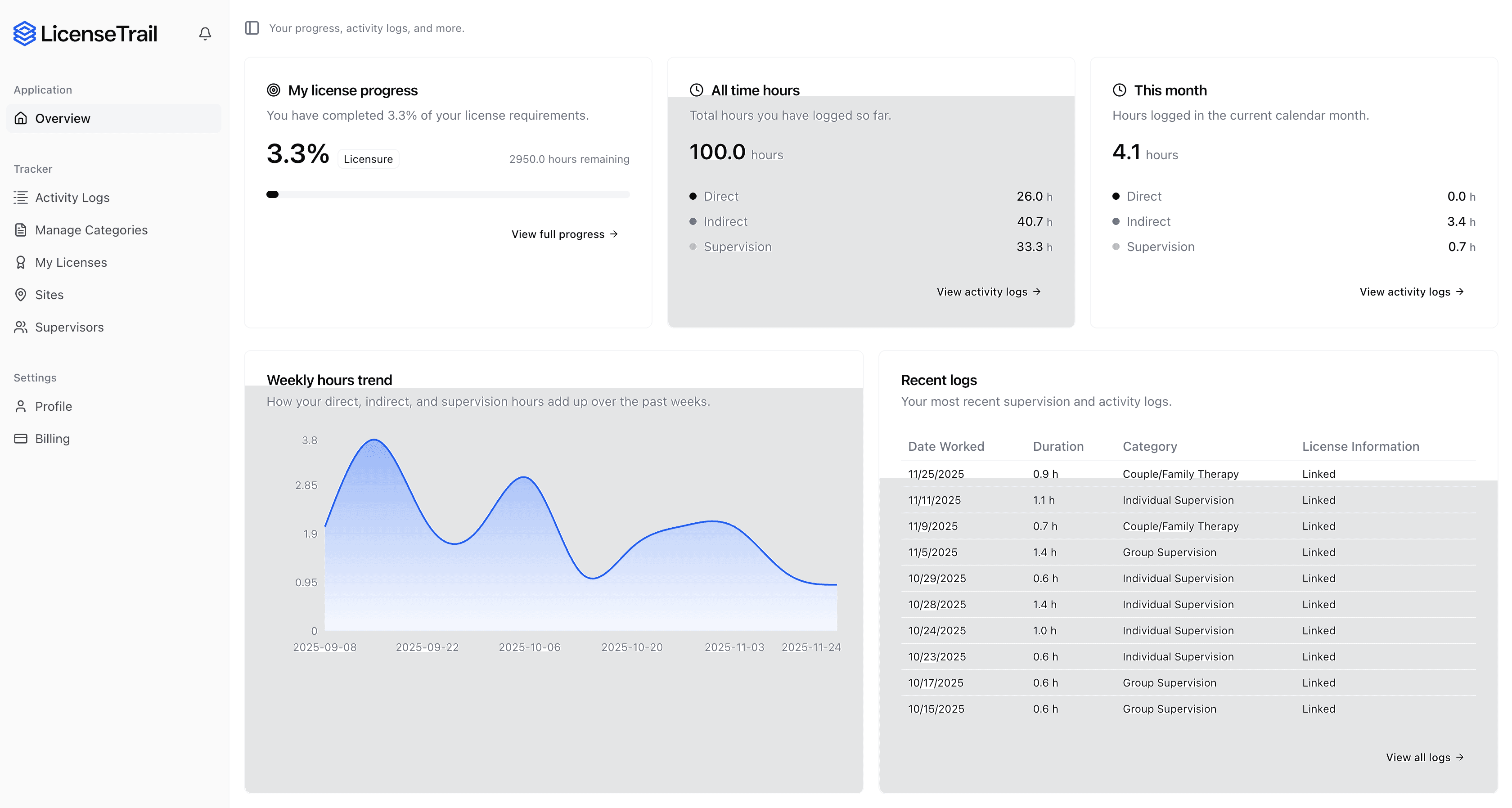
License Trail checks your direct, indirect, and supervision hours against New-hampshire LSW requirements continuously and flags mismatches before you submit.
 Start Tracking for Free
No credit card required · Free plan available
Is your spreadsheet hiding New-hampshire LSW risks?
Stop guessing if your categories match New Hampshire Board of Mental Health Practice requirements. License Trail checks your direct, indirect, and supervision hours continuously and flags mismatches before you submit.
Import or log
Bring your spreadsheet or start fresh
Upload your existing tracking spreadsheet and we'll map every hour into the right New Hampshire Board of Mental Health Practice categories automatically.
Verify against New-hampshire
Catch mismatches before the board does
License Trail checks your direct, indirect, and supervision hours against New-hampshire LSW requirements continuously.
Export board-ready
One-click clean reports
Generate professional, board-ready reports for supervision meetings and New Hampshire Board of Mental Health Practice submissions in seconds.
No credit card required · Free plan available