
New-jersey CADC Requirements: Hours, Exams & Step-by-Step Guide
Stop guessing if your categories match New-jersey requirements. License Trail checks your direct, indirect, and supervision hours against CADC requirements continuously and flags mismatches before you submit.
No credit card required · Free plan available
Quick Requirements Overview
- Hold at least a HS diploma/GED (or higher degree).
- Complete 270 hours of approved alcohol & drug education (5 domains × 54 hours).
- Get Plan of Supervision pre-approved before counting experience hours.
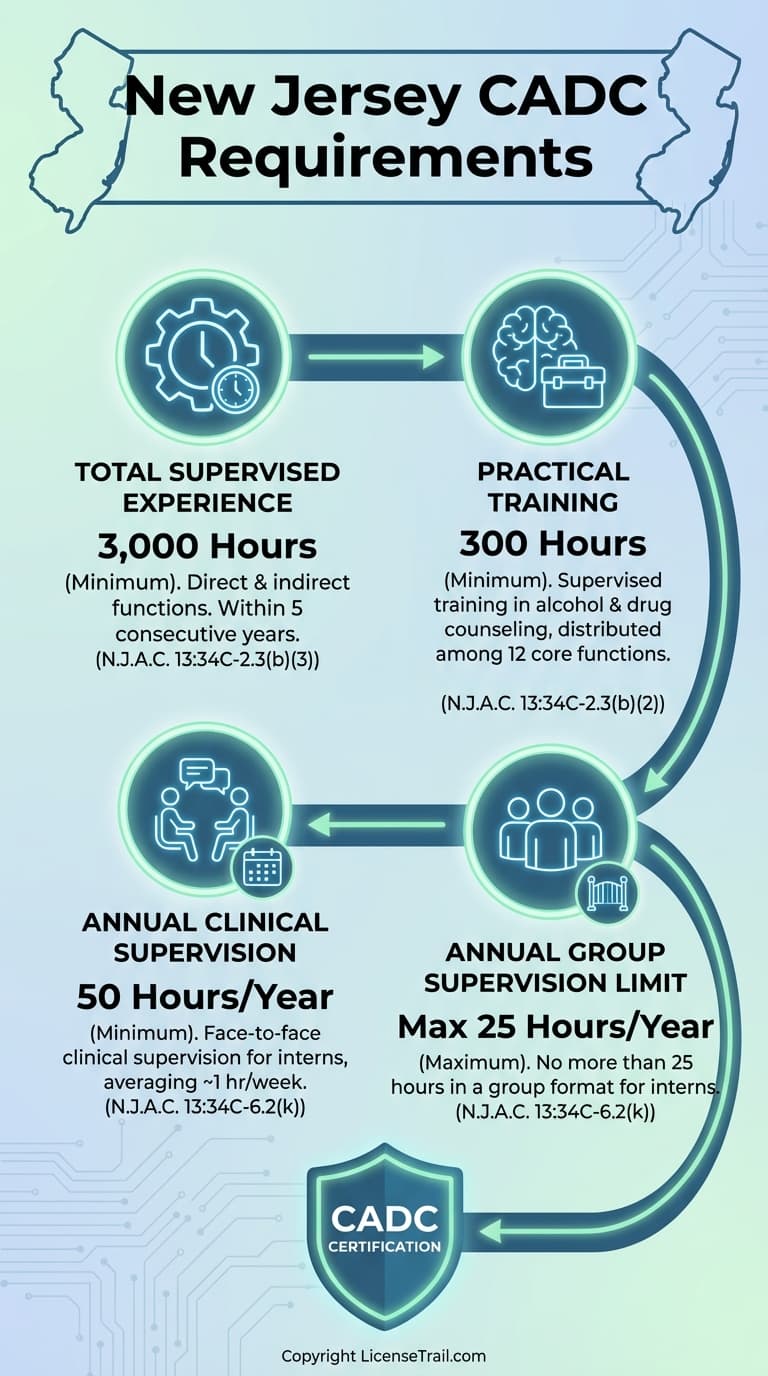
- Complete 3,000 hours of supervised work experience within 5 consecutive years (max 1,500 hours/year; paid or volunteer; 300-hour practicum may count toward 3,000).
- Complete 300 hours of supervised practical training covering the 12 core functions.
- Receive clinical supervision: 50 face-to-face hours/year during internship (≤ 25 group).
- Attend 30 self-help meetings (min 5 AA, 5 NA, 5 Al-Anon).
- Pass the IC&RC written and oral CADC examinations and submit application/documentation to the NJ ADCC.
License Details
Procedures
Requirements to Become a Certified Alcohol and Drug Counselor (CADC) in New Jersey
In New Jersey, the CADC credential is issued by the New Jersey Department of Law and Public Safety, Division of Consumer Affairs, State Board of Marriage and Family Therapy Examiners, Alcohol and Drug Counselor Committee (ADCC).(njpn.org)
The CADC is not a “master’s-level license”; it is a certification that always requires ongoing clinical supervision after you are certified. The Licensed Clinical Alcohol and Drug Counselor (LCADC) is the independent, master’s-level license, but both CADC and LCADC share the same core hour requirements for education and experience.(njpn.org)
Hour Requirements at a Glance
For CADC certification under N.J.A.C. 13:34C-2.3, you must document:
- 300 hours of “supervised practical training in alcohol and drug counseling” across the 12 core functions.(law.cornell.edu)
- Two years of “supervised work experience” totaling at least 3,000 hours, within five consecutive years:
- Full-time is defined as 1,500 hours over a 50‑week period (max that can count per year).(law.cornell.edu)
- Part-time is allowed as long as you reach 3,000 hours within five years.(law.cornell.edu)
- The 300 supervised practical training hours may be counted as part of these 3,000 hours.(law.cornell.edu)
- 270 hours of alcohol and drug education in specified domains.(law.cornell.edu)
- Clinical supervision hours: at least 50 hours of face‑to‑face supervision per year during the internship; no more than 25 of those may be group supervision.(law.cornell.edu)
- 30 alcohol and drug abuse self‑help meetings, with specific minimums for AA, NA, and Al-Anon.(law.cornell.edu)
Separately, you must meet education level, exams, and application requirements (detailed later).
1. Supervised Practical Training – 300 Hours
The Board requires:
“300 hours of supervised practical training in alcohol and drug counseling distributed among all of the following 12 core functions: screening, intake, orientation, assessment, treatment planning, counseling‑individual, group and family, case management, crisis intervention, client education, referral, consultation and recordkeeping.”(law.cornell.edu)
Key points about these 300 supervised practical training hours:
- They must involve the 12 core functions listed above.
- They may be completed under more than one agency or supervisor.(law.cornell.edu)
- The regulation explicitly states that this “practical training may be part of the work experience” required for the 3,000 hours (see below), so there is overlap, not a separate second block of hours.(law.cornell.edu)
These hours are sometimes referred to in practice as practicum or internship hours; in the regulations they are “supervised practical training” or an “alcohol and drug counselor internship.”(law.cornell.edu)
2. Supervised Work Experience – 3,000 Hours
In addition to the 300 hours of supervised practical training, the Board requires:
“Two years of supervised work experience within five consecutive years… The two years of supervised work experience may be paid or voluntary time working directly with alcohol or other drug clients.”(law.cornell.edu)
The regulations then define this in terms of hours:
- Full-time equivalency:
- “A one year full‑time equivalent shall be 1,500 hours over a 50‑week period.”(law.cornell.edu)
- You cannot carry over hours above 1,500 per year to the next year.(law.cornell.edu)
- Total requirement in hours:
- The two-year requirement is satisfied by “completion of at least 3,000 hours within five consecutive years” immediately before application.(law.cornell.edu)
- Part-time is allowed:
- You may complete these hours on a part-time basis, as long as you reach 3,000 hours within the five-year window.(law.cornell.edu)
Type of work that counts
The supervised work experience:
- “May be paid or voluntary time working directly with alcohol or other drug clients.”(law.cornell.edu)
- Must be “directly related to the 12 core functions” described in the practical‑training requirement.(law.cornell.edu)
The statute further clarifies that this experience “may include both direct and indirect functions” but that formal education or unsupervised work cannot be substituted for it.(law.justia.com)
In other words, there is not a split such as “1,500 direct client-contact hours + 1,500 supervision-only hours.”
Instead, the Board’s structure is:
- 3,000 total hours of supervised work experience, which
- must be under qualified clinical supervision,
- must involve work directly with alcohol or other drug clients, and
- includes the 300 hours of supervised practical training if those hours meet the criteria.(law.cornell.edu)
3. Clinical Supervision Hours (Within Those 3,000 Hours)
While the 3,000 hours are about work experience, the Board separately regulates how much face‑to‑face clinical supervision you must receive during your internship.
For alcohol and drug counselor interns (before you are certified):
- “Clinical supervision… shall include at least 50 hours of face‑to‑face supervision per year, averaging one hour per week. No more than 25 hours shall be group supervision.”(law.cornell.edu)
For certified CADCs in supervised practice, ongoing supervision is also regulated (at least 50 hours per year for CADCs, with some flexibility for more experienced counselors).(law.cornell.edu)
These supervision hours are not a separate block of ‘experience hours’; they occur within your employment or internship and are about time spent in supervisory meetings reviewing your work, not direct client service.
Supervisors must meet the qualifications in N.J.A.C. 13:34C‑6.2 (LCADC with CCS certification, certain physicians, APNs, LCSWs, LMFTs, LPCs, etc.).(law.cornell.edu)
4. Alcohol and Drug Education – 270 Hours
The Board requires that you have:
- At least a high school diploma, GED, associate degree, or bachelor’s degree, and
- 270 hours of alcohol and drug education, approved by IC&RC member boards, NAADAC (in certain states), or a regionally accredited college/university.(law.cornell.edu)
Those 270 hours are broken into five 54‑hour domains (assessment, counseling, case management, client education, and professional responsibility), with specific topic minimums in each domain listed in N.J.A.C. 13:34C‑2.3(b)(4).(law.cornell.edu)
These are classroom/education hours, not client-contact hours, and they cannot be substituted for your required work‑experience hours.(law.cornell.edu)
5. Self‑Help Meeting Attendance – 30 Meetings
You must show that you have:
- “Attended 30 alcohol and drug abuse self‑help group meetings of which a minimum of five meetings shall be in Alcoholics Anonymous; a minimum of five meetings shall be in Narcotics Anonymous; and a minimum of five meetings shall be in Alanon.”(law.cornell.edu)
The remaining 15 meetings can be in any self‑help group related to addiction recovery (e.g., other 12‑step fellowships or similar groups).(njpn.org)
These are usually counted as meeting hours, but in the regulations they appear as a meeting count requirement, not as part of the 3,000 work‑experience hours.
6. How the Hour Requirements Fit Into the Overall CADC Pathway
Putting the pieces together, the Board’s process for CADC certification looks like this:
-
Meet basic education and training prerequisites
- Hold at least a high school diploma, GED, associate degree, or bachelor’s degree.(law.cornell.edu)
- Complete 270 hours of approved alcohol and drug education.
-
Obtain pre‑approval of a Plan of Supervision
- Before counting experience hours, you submit a Proposed Plan of Supervision to the Alcohol and Drug Counselor Committee and get it approved.
- Experience hours “cannot be counted until this plan has been approved.”(njpn.org)
-
Accrue supervised practical training and work experience
- Complete 300 hours of supervised practical training in the 12 core functions.(law.cornell.edu)
- Complete at least 3,000 hours of supervised work experience (which may include those 300 practical‑training hours), over no more than five consecutive years, with no more than 1,500 hours counted in any one year towards the two‑year requirement.(law.cornell.edu)
- Ensure your experience involves direct work with alcohol or other drug clients and is directly related to the 12 core functions.
-
Receive required clinical supervision during those hours
- At least 50 hours of face‑to‑face supervision per year, with limits on group supervision, under a qualified clinical supervisor.(law.cornell.edu)
-
Complete self‑help meeting attendance
- Attend 30 self‑help meetings, with the specified distribution among AA, NA, and Al-Anon.(law.cornell.edu)
-
Pass the CADC examinations
- Successfully complete both the written and oral examinations developed and prepared by the IC&RC (or its successor).(law.cornell.edu)
-
Submit the formal application to the Board
- File the application form with the State Board of Marriage and Family Therapy Examiners, Alcohol and Drug Counselor Committee, including: documentation of education, 3,000 hours of supervised work experience (with 300 hours practical training identified), self‑help meetings, supervisor certifications, and the criminal history background check, along with the required fee.(law.cornell.edu)
Clarifying “Direct” vs “Supervised” Hours in New Jersey’s Language
Your example mentioned a possible division such as “1,500 hours of direct experience and 1,500 hours of supervised experience.” That is not how New Jersey’s Board describes or structures the CADC requirement.
The Board uses three main phrases for the hour‑based requirements:
- “Supervised practical training in alcohol and drug counseling” – 300 hours.(law.cornell.edu)
- “Two years… of supervised work experience… A one year full‑time equivalent shall be 1,500 hours… [for] at least 3,000 hours within five consecutive years.”(law.cornell.edu)
- “Clinical supervision… at least 50 hours of face‑to‑face supervision per year” for interns (and similarly regulated for CADCs).(law.cornell.edu)
The statute notes that supervised work experience “may include both direct and indirect functions,” but it does not subdivide hours into fixed “direct” vs “indirect” quotas.(law.justia.com)
Practically speaking:
- All of the 3,000 hours are supervised experience hours.
- At least 300 of those hours must be structured supervised practical training covering all 12 core functions.
- Within those 3,000 hours, you spend most of your time in direct client work and related core functions, plus a smaller subset of time in face‑to‑face clinical supervision meetings (≥ 50 hours/year).
That is the structure and wording used by the New Jersey State Board of Marriage and Family Therapy Examiners, Alcohol and Drug Counselor Committee, for CADC certification.
Track your CADC hours with confidence
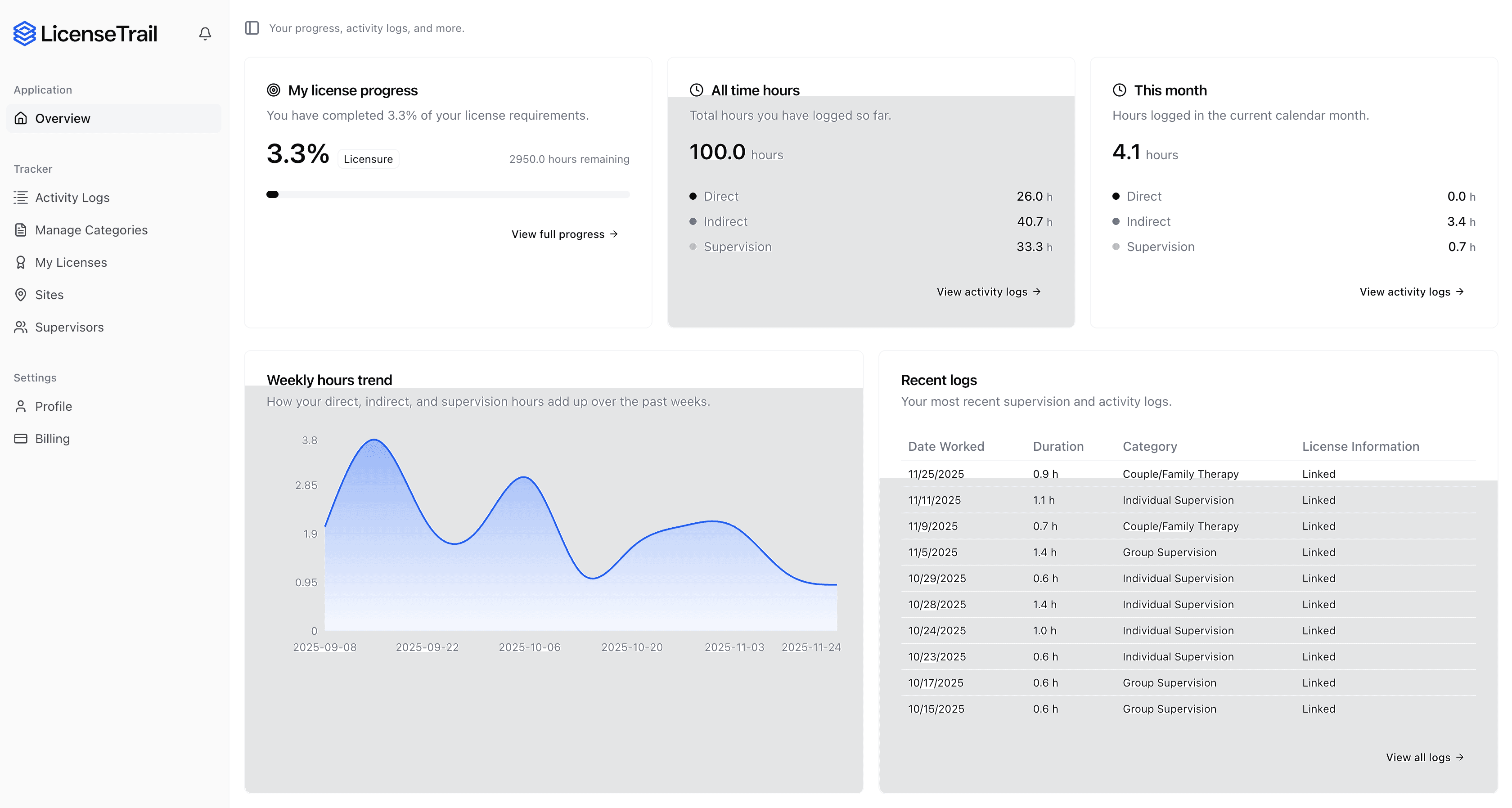
License Trail checks your direct, indirect, and supervision hours against New-jersey CADC requirements continuously and flags mismatches before you submit.
 Start Tracking for Free
No credit card required · Free plan available
Is your spreadsheet hiding New-jersey CADC risks?
Stop guessing if your categories match New Jersey Board of Marriage and Family Therapy Examiners requirements. License Trail checks your direct, indirect, and supervision hours continuously and flags mismatches before you submit.
Import or log
Bring your spreadsheet or start fresh
Upload your existing tracking spreadsheet and we'll map every hour into the right New Jersey Board of Marriage and Family Therapy Examiners categories automatically.
Verify against New-jersey
Catch mismatches before the board does
License Trail checks your direct, indirect, and supervision hours against New-jersey CADC requirements continuously.
Export board-ready
One-click clean reports
Generate professional, board-ready reports for supervision meetings and New Jersey Board of Marriage and Family Therapy Examiners submissions in seconds.
No credit card required · Free plan available