
New-jersey LCADC Requirements: Hours, Exams & Step-by-Step Guide
Stop guessing if your categories match New-jersey requirements. License Trail checks your direct, indirect, and supervision hours against LCADC requirements continuously and flags mismatches before you submit.
No credit card required · Free plan available
Quick Requirements Overview
- Issued by: NJ State Board of Marriage & Family Therapy Examiners – Alcohol & Drug Counselor Committee (ADCC); enables independent practice (SUD assessment/diagnosis)
- Must meet all CADC requirements plus LCADC graduate education requirements (N.J.A.C. 13:34C‑2.2 & 2.3)
- Education (graduate): Master’s in counseling or related master’s with 18 graduate semester hours in counseling across required content areas
- AOD education: 270 hours Board/approved-provider coursework (often 5 domains × 54 hrs); up to 54 hrs distance learning
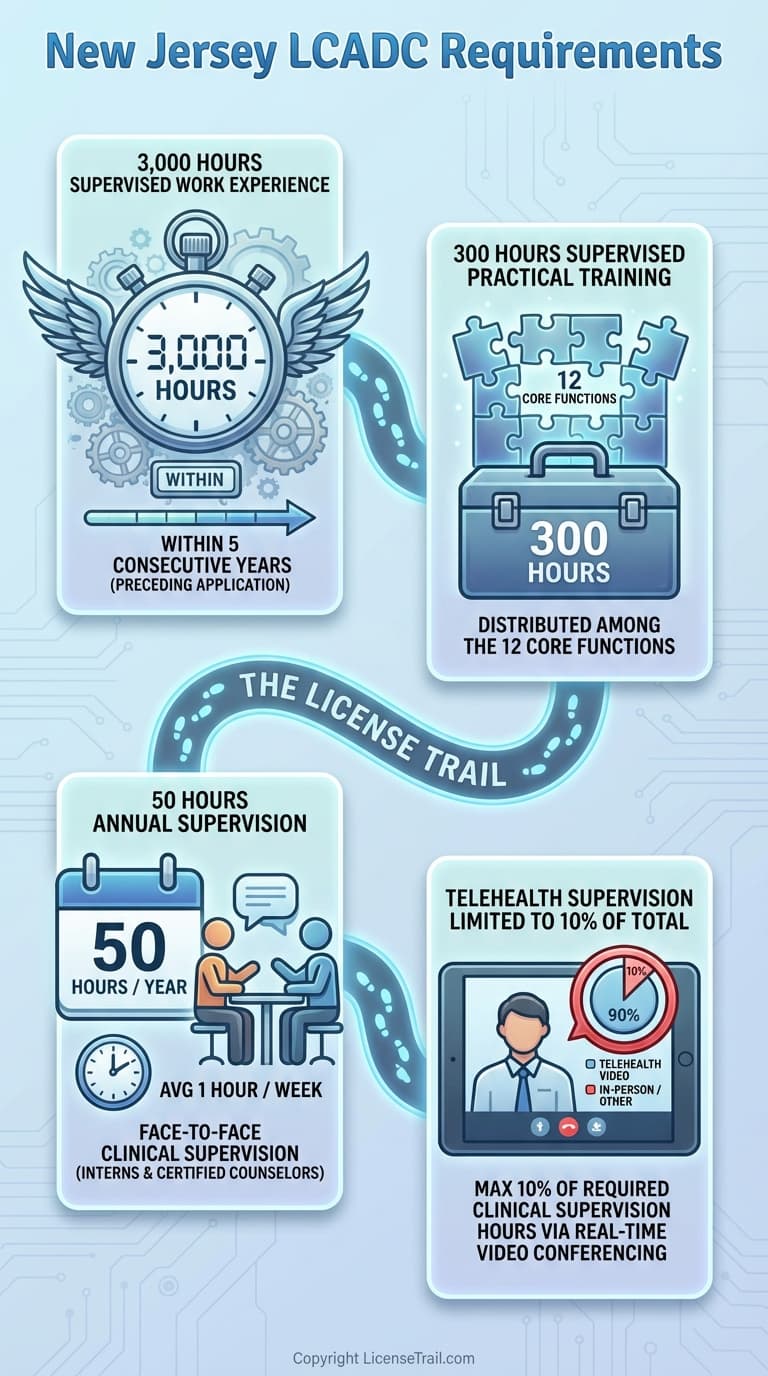
- Practical training: 300 supervised hours covering all 12 core functions (may be under multiple supervisors/agencies)
- Supervised work experience: 3,000 hours within 5 consecutive years (min 2 years; max 1,500 hrs/year; may include the 300 practicum hrs) with ~50 hrs/year face-to-face supervision
- Exams: Pass IC&RC written exam and oral/case presentation exam
- Other: 30 self-help meetings + application/fees + criminal history background check
License Details
Procedures
Licensure Requirements for Licensed Clinical Alcohol and Drug Counselors (LCADC) in New Jersey
In New Jersey, the Licensed Clinical Alcohol and Drug Counselor (LCADC) credential is issued by the New Jersey State Board of Marriage and Family Therapy Examiners, Alcohol and Drug Counselor Committee (ADCC). The LCADC is a license that allows independent practice, including assessment and diagnosis of substance use disorders. (njpn.org)
Under the regulations, eligibility for LCADC requires you to meet all requirements for certification as a Certified Alcohol and Drug Counselor (CADC) plus specific graduate education requirements. Those requirements are set out in N.J.A.C. 13:34C‑2.2 (LCADC) and 13:34C‑2.3 (CADC). (law.cornell.edu)
1. Graduate Degree Requirement
To qualify as an LCADC, you must document appropriate master’s-level education:
- You must have either:
- A master’s degree in counseling from an accredited institution, or
- A master’s degree in an addictions or counseling-related area from an accredited institution that includes at least 18 graduate semester hours in counseling, distributed across defined content areas. (law.cornell.edu)
Those 18 graduate semester hours must cover at least these areas (summarized from the regulation): (law.cornell.edu)
- Counseling theory and practice
- The helping relationship
- Human growth, development, and maladaptive behavior
- Lifestyle and career development
- Group dynamics, processes, counseling, and consulting
- Assessment of individuals
- Social and cultural foundations
- Research and evaluation
- The counseling profession
- Pharmacology and physiology related to substance use
These graduate counseling hours are in addition to the 270 hours of alcohol and drug education described below.
2. Alcohol and Drug Education Hours (270 Hours)
New Jersey requires 270 hours of “alcohol and drug education” for both CADC and LCADC applicants. (njpn.org)
Key points:
- The hours must be approved by:
- IC&RC member boards (e.g., the Addiction Professionals Certification Board of New Jersey),
- NAADAC (in states using that certification), or
- A regionally accredited college or university. (regulations.justia.com)
- The coursework must relate to the functions of an alcohol and drug counselor, and may include:
- Formal classroom courses
- Workshops, seminars, institutes, in‑service training
- Up to 54 hours via distance learning. (njpn.org)
Regulations break these 270 hours into five domains of 54 hours each, such as: assessment, counseling, case management, client education, and professional responsibility (often framed this way by New Jersey training providers, tracking N.J.A.C. 13:34C‑2.3(b)4). (njpn.org)
3. Supervised Practical Training (300 Hours)
Before applying for LCADC, you must complete 300 hours of supervised practical training in alcohol and drug counseling. (regulations.justia.com)
Regulatory details:
- The 300 hours must be distributed across all of the “12 core functions” of alcohol and drug counseling, including:
- Screening, intake, orientation
- Assessment and treatment planning
- Individual, group, and family counseling
- Case management and crisis intervention
- Client education, referral, consultation, and record‑keeping (or reports). (regulations.justia.com)
- The practical training:
- May be part of the required work experience (see below);
- May be completed under more than one supervisor or agency;
- Must be supervised by a qualified clinical supervisor as defined in N.J.A.C. 13:34C‑6.2 (e.g., LCADC, certain physicians, psychologists, LCSWs, LMFTs, LPCs with appropriate supervisory credentialing). (regulations.justia.com)
In practice, these 300 hours are considered structured, closely supervised “hands‑on” training in all aspects of substance use disorder counseling.
4. Supervised Work Experience Hours
(How many hours? How are they counted?)
After and/or alongside the practicum, New Jersey requires substantial supervised work experience in alcohol and drug counseling.
Core Requirement
For CADC (which you must meet to get LCADC), the regulation requires:
- Two years of supervised work experience completed within five consecutive years immediately before you apply. (regulations.justia.com)
That two‑year requirement is defined in hours as:
- Full‑time equivalency = 1,500 hours in a 50‑week year.
- You must accumulate at least 3,000 hours of supervised work experience within those five years. (regulations.justia.com)
In other words, the Board’s structure is:
- 3,000 total supervised work experience hours,
- with a maximum of 1,500 hours per year counting as one year of full‑time experience;
- completed across no less than two years and no more than five years. (regulations.justia.com)
Relationship Between Practical Training and Work Experience
The 3,000 hours of supervised work experience may include the 300 hours of supervised practical training, if all requirements are met:
- The regulation expressly allows the 300 practicum hours to count as part of the 3,000‑hour work experience, provided they are in the 12 core functions and properly supervised. (regulations.justia.com)
So the hour structure is:
- 300 hours of supervised practical training (practicum), and
- 3,000 hours of total supervised work experience, which can include those 300 hours, as long as:
- All hours involve direct work with alcohol or other drug clients, and
- The work is tied to the 12 core functions. (regulations.justia.com)
Nature of the Supervised Work Experience
By rule:
- The experience may be paid or volunteer, as long as you are working directly with alcohol or drug clients in the core functions. (regulations.justia.com)
- Experience may be gained at more than one agency, and may be part‑time, so long as you reach the 3,000 hours within five years. (regulations.justia.com)
- Formal education (other than the 300‑hour practicum) cannot substitute for these 3,000 hours. (regulations.justia.com)
Supervision Hours Within the Experience
Clinical supervision of this supervised practice also has minimums:
- Regulations on supervision (N.J.A.C. 13:34C‑6.3) require at least 50 hours of face‑to‑face clinical supervision per year, averaging about one hour per week, for counselors in supervised practice. (regulations.justia.com)
These supervisory hours are not a separate “block” of client work; they are embedded in and tied to your 3,000 hours of supervised experience.
5. Additional CADC Requirements You Must Meet for LCADC
Because LCADC applicants must have “successfully completed the following requirements to be a certified alcohol and drug counselor” (CADC), you must also meet these items listed in N.J.A.C. 13:34C‑2.2(b)2: (law.cornell.edu)
-
30 self‑help meetings
- Attendance at 30 alcohol and drug abuse self‑help group meetings (e.g., AA/NA or similar fellowship meetings recognized under the rules). (law.cornell.edu)
-
Written examination
- Passage of a written examination developed and prepared by IC&RC (or its successor) that covers the domains and core functions of addiction counseling. (law.cornell.edu)
-
Oral examination
- Passage of an oral examination developed by IC&RC (or its successor) based on your written case presentation. (law.cornell.edu)
-
Criminal history background check and application materials
- A completed LCADC application, fees, and a Certification and Authorization Form for a Criminal History Background Check submitted to the Committee. (law.cornell.edu)
6. Putting the Hours Together: Practical Example
Using the state’s own hour structure, the minimum hour‑based components for an LCADC applicant look like this:
-
Alcohol and drug education:
- 270 hours of AOD-specific coursework.
-
Practicum / supervised practical training:
- 300 hours of closely supervised practical training across all 12 core functions.
-
Supervised work experience:
- At least 3,000 hours of supervised work experience over a minimum of two years,
- With no more than 1,500 hours per year being counted as a full‑time year,
- The 300 practicum hours may be included in the 3,000 hours, if properly structured and supervised.
-
Graduate counseling education:
- A qualifying master’s degree that includes 18 graduate semester hours of counseling coursework in the specified content areas.
-
Other non‑hour requirements:
- 30 self‑help meetings,
- Written and oral IC&RC exams,
- Completed LCADC application, supervisor’s certification of supervision, and background check.
7. Step‑by‑Step Pathway (Summary)
-
Obtain or be in progress toward a qualifying master’s degree
- Ensure your program covers or can be supplemented to cover the 18 counseling graduate credits in the required content areas. (law.cornell.edu)
-
Complete the 270 hours of alcohol and drug education
- Take Board‑approved courses (often organized as five 54‑hour domains) through a college or an approved provider such as NJPN. (njpn.org)
-
Register as an ADC Intern and secure qualified supervision
- Become registered with the Division of Consumer Affairs as required and ensure your supervisor meets the qualifications in N.J.A.C. 13:34C‑6.2. (njpn.org)
-
Complete 300 hours of supervised practical training
- Make sure these hours explicitly cover all 12 core functions and are well documented.
-
Accumulate at least 3,000 hours of supervised work experience
- Work directly with alcohol and drug clients in the 12 core functions;
- Achieve at least 1,500 hours per “full‑time” year, spread over at least two years and no more than five;
- Maintain required supervision (about 50 hours/year face‑to‑face). (regulations.justia.com)
-
Complete 30 self‑help meetings and pass both IC&RC exams
- Written exam and oral/case-presentation exam, as specified in the regulations. (law.cornell.edu)
-
Apply for LCADC licensure
- Submit:
- Completed LCADC application,
- Official transcripts and education certificates,
- Supervisor’s certification documenting your supervised training and experience,
- Criminal history background check authorization,
- Required fee. (law.cornell.edu)
- Submit:
8. Regulatory References and Currency
As of mid‑2025, the controlling rules are in N.J.A.C. Title 13, Chapter 34C, particularly:
- 13:34C‑2.2 – Application procedure: Licensed clinical alcohol and drug counselor (LCADC)
- 13:34C‑2.3 – Application procedure: Certified alcohol and drug counselor (CADC)
- 13:34C‑6.1 to 6.3 – Clinical supervision requirements
The chapter was readopted effective December 28, 2023, and the online versions from Justia and Cornell’s Legal Information Institute reflect text current through 2025. (law.cornell.edu)
Because regulations and forms can change, applicants should always confirm details directly on the New Jersey Division of Consumer Affairs – Alcohol and Drug Counselor Committee site and in the current PDF of Chapter 34C before filing an application. (njaddictionpros.org)
Track your LCADC hours with confidence
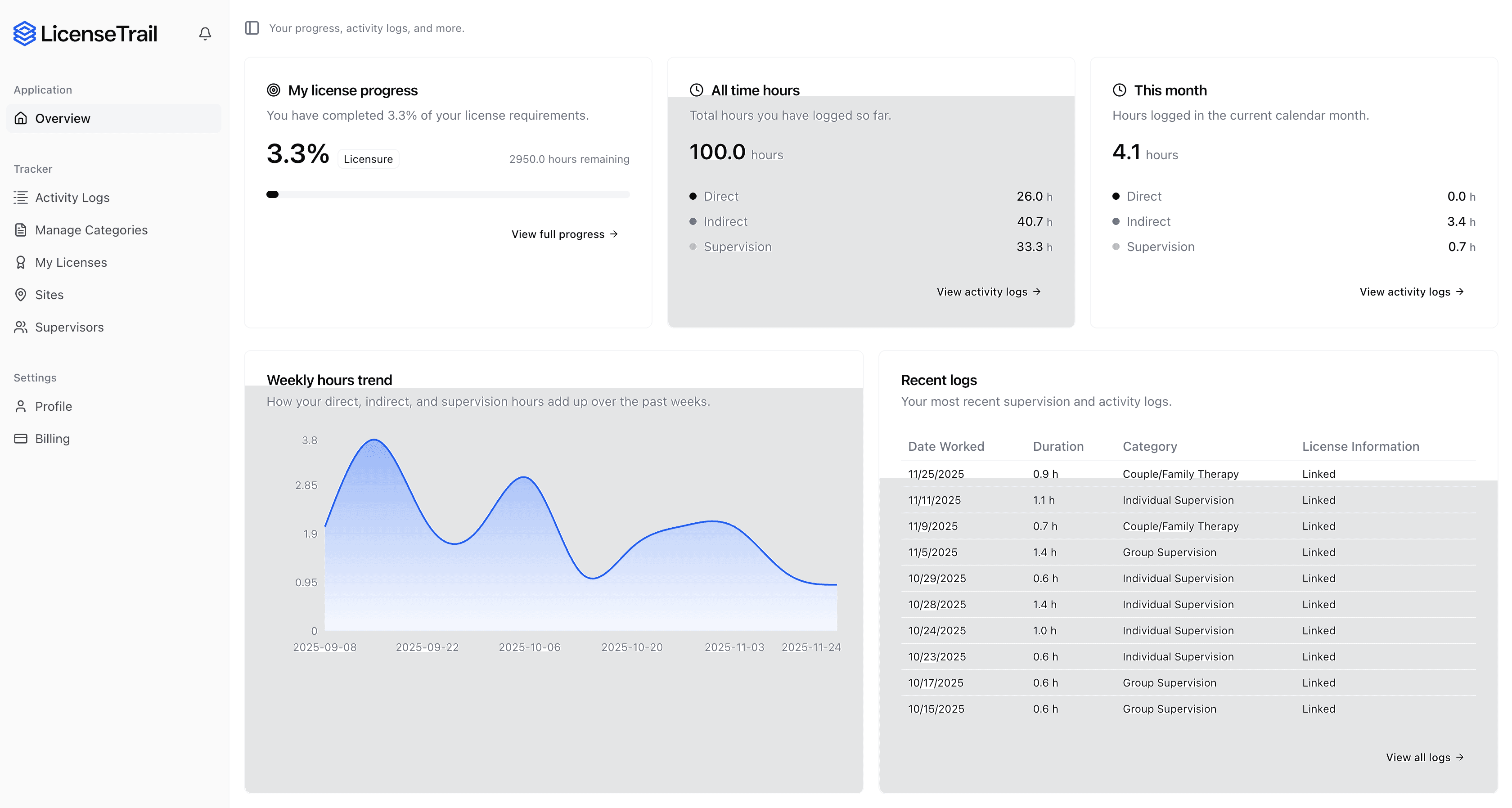
License Trail checks your direct, indirect, and supervision hours against New-jersey LCADC requirements continuously and flags mismatches before you submit.
 Start Tracking for Free
No credit card required · Free plan available
Is your spreadsheet hiding New-jersey LCADC risks?
Stop guessing if your categories match New Jersey Board of Marriage and Family Therapy Examiners requirements. License Trail checks your direct, indirect, and supervision hours continuously and flags mismatches before you submit.
Import or log
Bring your spreadsheet or start fresh
Upload your existing tracking spreadsheet and we'll map every hour into the right New Jersey Board of Marriage and Family Therapy Examiners categories automatically.
Verify against New-jersey
Catch mismatches before the board does
License Trail checks your direct, indirect, and supervision hours against New-jersey LCADC requirements continuously.
Export board-ready
One-click clean reports
Generate professional, board-ready reports for supervision meetings and New Jersey Board of Marriage and Family Therapy Examiners submissions in seconds.
No credit card required · Free plan available