
New-jersey LMFT Requirements: Hours, Exams & Step-by-Step Guide
Stop guessing if your categories match New-jersey requirements. License Trail checks your direct, indirect, and supervision hours against LMFT requirements continuously and flags mismatches before you submit.
No credit card required · Free plan available
Quick Requirements Overview
- Age/character/admin: 21+, good moral character, criminal history check, application + fees (NJ Board of Marriage & Family Therapy Examiners)
- Education: Master’s+ in MFT, social work, or related field (regionally accredited); related-field degrees must be Board-equivalent or completed via COAMFTE/Board-recognized post-grad coursework
- Required coursework (minimums): 8 courses total across Areas I–III (I≥2, II≥4, III≥2) + Ethics/Professional (≥1; MFT-specific) + Research (≥1) + Practicum/Internship (≥2 courses) + Additional elective (≥1)
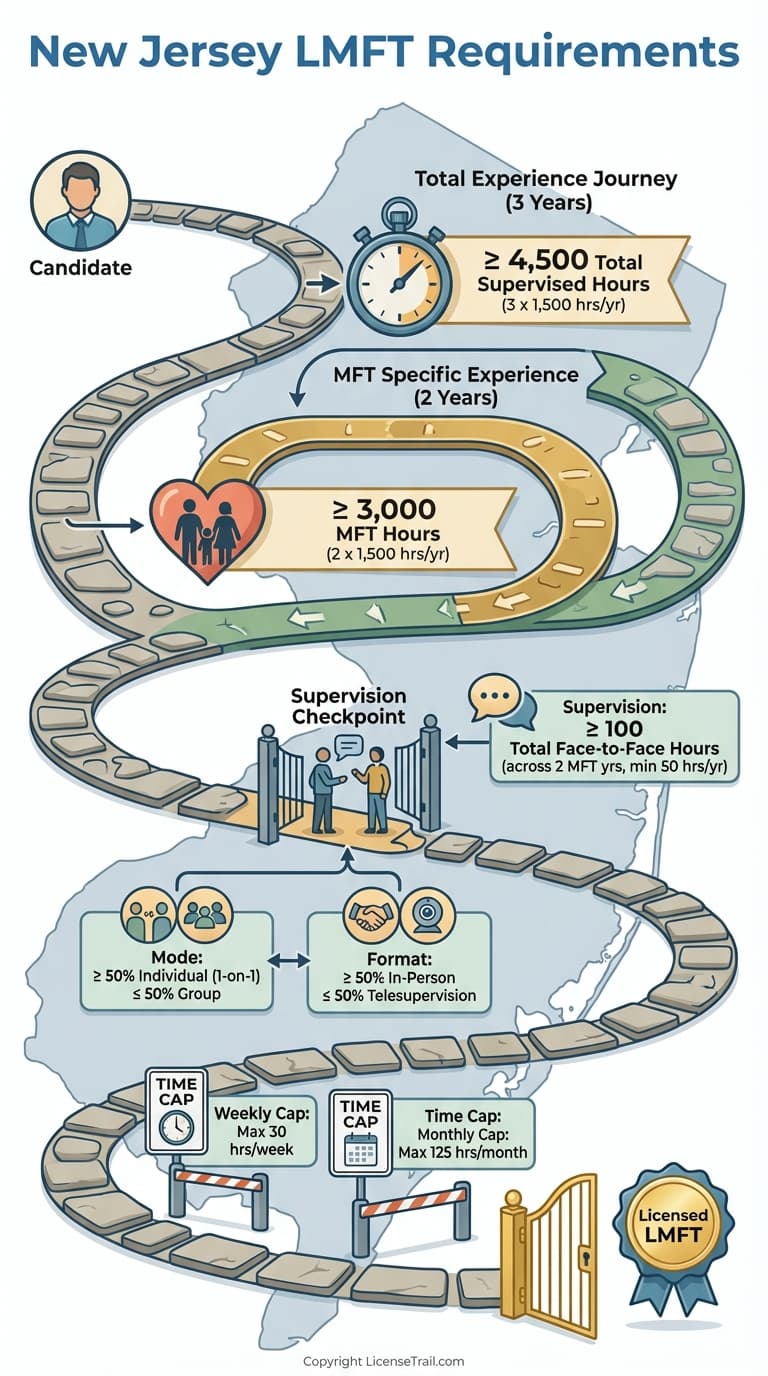
- Experience total: 3 “calendar years” = 4,500 hours (1 calendar year = 1,500 hrs over 50 weeks)
- Experience breakdown: 2 calendar years supervised MFT experience (3,000 hrs) + 1 calendar year counseling experience (1,500 hrs; may be in MFT; grad practicum may count toward this year)
- Per MFT year (1,500 hrs): ≥50 hrs face-to-face supervision (≤½ group; ≤½ telesupervision) + ≤1,150 hrs direct MFT client contact + ≤300 hrs other approved activities
- Hour caps (all experience): max 30 hrs/week and 125 hrs/month countable
- Exam/licensure: Board authorization → pass AMFTRB National MFT Exam → pay initial license fee for LMFT issuance
License Details
Procedures
New Jersey’s Licensed Marriage and Family Therapist (LMFT) credential is regulated by the State Board of Marriage and Family Therapy Examiners under Title 13, Chapter 34 of the New Jersey Administrative Code. The Board defines, in detail, the education, supervised experience, and examination requirements for licensure, and it spells out exactly how hours must be counted. (regulations.justia.com)
Below is a structured guide that follows the Board’s own definitions and numbers.
1. Basic eligibility and overall process
To become licensed as a practicing marriage and family therapist in New Jersey, you must: (regulations.justia.com)
- Be at least 21 years old.
- Submit a completed LMFT application to the Board.
- Demonstrate “good moral character” and not be engaged in conduct that would justify license denial, suspension, or revocation.
- Meet the educational requirements in N.J.A.C. 13:34‑2.3.
- Meet the experiential requirements in N.J.A.C. 13:34‑2.4.
- Submit to a criminal history background check.
- Pay the required fees.
- Once the Board confirms you meet the above, it authorizes you to take the National Marriage and Family Therapy Examination (AMFTRB exam). After you pass and pay the initial license fee, the Board issues your LMFT license. (regulations.justia.com)
2. Educational requirements (what your degree must look like)
2.1. Degree level and type
Under N.J.A.C. 13:34‑2.3, you must hold at least a master’s degree in one of the following: (regulations.justia.com)
- Marriage and family therapy, or
- Social work, or
- A “graduate degree in a related field” from a regionally accredited institution.
If your degree is in a “related field,” you must prove to the Board that your coursework and training are substantially equivalent to what is required for an MFT degree. If it is not substantially equivalent, you can meet the requirement by: (regulations.justia.com)
- Completing a Board‑recognized post‑graduate degree that includes the required coursework, or
- Completing a program accredited by the Commission on Accreditation for Marriage and Family Therapy Education (COAMFTE).
2.2. Required coursework areas
The Board does not simply require “X credits”; it specifies minimum numbers of graduate courses in seven content areas: (regulations.justia.com)
You must complete at least:
-
Eight courses from Areas I–III combined:
- Area I – Theoretical Foundations (minimum 2 courses): historical development, theoretical foundations, and contemporary directions in marriage and family therapy, with conceptual links to clinical concerns.
- Area II – Assessment and Treatment in Marriage and Family Therapy (minimum 4 courses): major models of MFT, assessment, treatment methods, and mental health assessment methods/instruments.
- Area III – Human Development and Family Studies (minimum 2 courses): individual and family development; sexuality; gender and sexual orientation issues; and diversity factors (ethnicity, race, SES, culture) as they relate to MFT.
-
Area IV – Ethics and Professional Development (minimum 1 course): professional identity, licensure, professional organizations, ethics, legal and confidentiality issues, family law, and the social/political context of treatment. “Generic” ethics courses are not considered sufficient.
-
Area V – Research (minimum 1 course): quantitative and qualitative research in MFT, methodology, data analysis, and research evaluation.
-
Area VI – Supervised Clinical Internship/Practicum
- Minimum two graduate courses of supervised clinical internship/practicum.
-
Area VII – Additional Learning
- Minimum one elective graduate course to augment your MFT training (chosen from various disciplines).
These course‑based requirements are how the Board operationalizes the educational content needed for LMFT licensure. (regulations.justia.com)
3. How New Jersey defines your experience and supervision
Before looking at hour totals, it helps to understand how the Board defines key terms in N.J.A.C. 13:34‑2.4(a): (law.cornell.edu)
- “Counseling experience” – client contact where you apply mental health and human development principles to facilitate development and adjustment across the lifespan.
- “Marriage and family therapy experience” – providing professional MFT services under supervision to individuals, couples, and families (individually or in groups), in public or private settings.
- “Marriage and family therapy supervision” / “supervised experience” – ongoing, documented, face‑to‑face consultation, guidance, and instruction by a qualified MFT supervisor, focused on your work with individuals, couples, and families, including monitoring your competencies.
- “One calendar year” – 1,500 hours over a 50‑week period (full‑time), or at least 750 hours in each of two 50‑week periods (part‑time), totaling 1,500 hours.
- “Qualified supervisor” – someone with at least five full‑time years of professional MFT practice (or equivalent) who is:
- A New Jersey‑licensed MFT, or
- Another New Jersey‑licensed professional practicing within their scope, who holds a master’s in MFT, a master’s in social work, or a graduate degree in a related field with Board‑approved equivalent MFT training (or appropriate post‑graduate/COAMFTE program).
- “Telesupervision” – supervision delivered via technology‑assisted media when supervisor and supervisee are in different locations; audio‑only phone, email, texts, etc., by themselves do not count as telesupervision.
These definitions govern which hours the Board accepts and how you must structure your supervised work.
4. Required supervised experience and hour breakdown
4.1. Total experience required
New Jersey requires a minimum of three “calendar years” of experience, defined by N.J.A.C. 13:34‑2.4(b): (law.cornell.edu)
- Two (2) calendar years of supervised marriage and family therapy experience, and
- One (1) calendar year of counseling experience (which may be in marriage and family therapy).
Because one calendar year = 1,500 hours, the Board’s structure works out to:
- 3 calendar years × 1,500 hours/year = 4,500 total hours,
of which at least:- 3,000 hours must be supervised MFT experience (2 calendar years), and
- 1,500 hours must be counseling experience (which can be additional MFT experience if it fits the Board’s definition of “counseling experience”).
The New Jersey Association for Marriage and Family Therapy (NJAMFT) summarizes this the same way: two calendar years of supervised MFT experience (3,000 hours) plus one calendar year (1,500 hours) of counseling experience. (njamft.org)
4.2. Hour breakdown for each year of marriage and family therapy experience
For each of the two calendar years of MFT experience, the Board specifies the internal breakdown of your 1,500 hours as follows: (law.cornell.edu)
Each MFT calendar year must include:
-
Supervision
- At least 50 hours of face‑to‑face supervision,
- At a rate of about one hour per week,
- No more than half of these supervision hours may be in group supervision, and
- No more than half of your supervision hours may be provided through telesupervision, and any telesupervision must meet the rules in N.J.A.C. 13:34‑3.5.
-
Direct MFT client contact
- Up to 1,150 hours of actual marriage and family therapy client contact (individuals, couples, families).
-
Other work‑related activities
- Up to 300 hours in activities such as:
- Preparing and maintaining client records
- Report writing
- Scheduling and administrative tasks related to client care
- Communicating with other professionals
- Preparing for supervision
- Maintaining financial records related to practice
- Other activities the qualified supervisor or Board deems appropriate (as indicated on Board supervision documentation forms).
- Up to 300 hours in activities such as:
These three components (50 + 1,150 + 300) together make up the 1,500 hours that define “one calendar year” of supervised MFT experience under New Jersey’s rules.
Across both required MFT years, that means you will accumulate at least:
- 100 hours of face‑to‑face supervision (50 hours/year × 2 years)
- Up to 2,300 hours of direct MFT client contact (1,150 hours/year × 2 years)
- Up to 600 hours of other work‑related activities (300 hours/year × 2 years)
all under a qualified supervisor as defined above. (law.cornell.edu)
4.3. The one calendar year of counseling experience
In addition to the two MFT years, you must complete one calendar year (1,500 hours) of counseling experience. The regulation states that this year of counseling “may be in marriage and family therapy,” as long as it meets the Board’s definition of counseling experience. (law.cornell.edu)
Key points:
- This third year is still a 1,500‑hour calendar year under the same “one calendar year” definition.
- The regulation does not subdivide this year into specific minimums for direct client hours vs. supervision vs. “other activities” in the same way it does for the strictly defined MFT years, but you must still be working in a counseling setting and under appropriate supervision.
- NJAMFT notes that graduate internship/practicum hours can count toward this one calendar year of counseling experience, which can significantly reduce how many additional post‑graduate hours you must accumulate for that requirement. (njamft.org)
4.4. Weekly and monthly maximums on counting hours
The Board also sets caps on how many hours you can claim across your two MFT years plus your one counseling year:
- No more than 30 hours of experience per week, and
- No more than 125 hours of experience per month
may be counted toward the three required calendar years of experience. (law.cornell.edu)
These caps apply to the combined supervised MFT and counseling experience and help prevent “front‑loading” or inflating hours in short time periods.
4.5. Timing relative to your degree
The Board distinguishes between applicants whose highest degree is a master’s and those with a post‑master’s or doctoral degree:
-
If your highest degree is a master’s:
- At least two of the three required calendar years of marriage and family therapy experience must occur after you have earned the master’s degree. (law.cornell.edu)
-
If you have a post‑master’s or doctoral degree:
- You must complete at least one calendar year of marriage and family therapy experience after earning the post‑master’s or doctoral degree. (law.cornell.edu)
This allows some earlier experience (e.g., pre‑master’s counseling internships) to count, but anchors most of the required MFT experience to post‑degree practice.
5. Supervision: who can supervise you and how it must be documented
Because the Board’s definitions make supervision central to your experience, it is important to structure it correctly:
-
Supervisor qualifications
A “qualified supervisor” must: (law.cornell.edu)- Have at least five full‑time years (or equivalent) of professional MFT practice, and
- Be:
- A New Jersey‑licensed MFT, or
- Another New Jersey‑licensed mental health professional (e.g., social worker, psychologist) acting within their scope and holding the specified graduate degree and MFT‑equivalent training as defined in N.J.A.C. 13:34‑2.4(a).
-
Form of supervision
- Must be regular, documented, face‑to‑face (in‑person or compliant telesupervision).
- For each MFT year: ≥ 50 hours face‑to‑face, with limits on group supervision and telesupervision as described above.
-
Documentation
- The Board requires that your supervised experience be reported on specific Board forms, which specify client contact hours, supervision hours, and other work‑related activities. (law.cornell.edu)
Maintaining accurate logs and ensuring your supervisor qualifies under the rule is essential, because these documents are what the Board uses to verify that you have met the experiential requirements.
6. Examination requirement
After the Board determines that you satisfy:
- The educational requirements (N.J.A.C. 13:34‑2.3), and
- The experiential requirements (N.J.A.C. 13:34‑2.4),
it authorizes you to sit for the National Marriage and Family Therapy Examination administered by the Association of Marital and Family Therapy Regulatory Boards (AMFTRB) or its successor. (regulations.justia.com)
You must pass this national exam and then pay the initial licensing fee for the LMFT license to be issued.
7. Hour requirements at a glance (New Jersey LMFT)
Putting the Board’s numbers together:
-
Total experience
- 3 calendar years = 4,500 hours, broken down as:
- 2 calendar years (3,000 hours) of supervised MFT experience, plus
- 1 calendar year (1,500 hours) of counseling experience (may be in MFT).
- 3 calendar years = 4,500 hours, broken down as:
-
Per MFT calendar year (1,500 hours each) (law.cornell.edu)
- ≥ 50 hours of face‑to‑face supervision (≤ ½ group, ≤ ½ via telesupervision).
- ≤ 1,150 hours direct MFT client contact.
- ≤ 300 hours other approved work‑related activities.
-
Across the two MFT years
- ≥ 100 hours face‑to‑face supervision.
- ≤ 2,300 hours direct client contact.
- ≤ 600 hours other work‑related activities.
-
Counseling year
- 1 calendar year (1,500 hours) of counseling experience (may be MFT), under appropriate supervision, within weekly/monthly caps.
-
Caps on counting hours (all three years combined) (law.cornell.edu)
- Max 30 hours/week.
- Max 125 hours/month.
-
Sequencing
- Master’s‑level applicants: at least 2 of the 3 calendar years must be post‑master’s.
- Post‑master’s/doctoral applicants: at least 1 calendar year must be post‑terminal‑degree. (law.cornell.edu)
These requirements reflect the Board’s rules as updated through the June 16, 2025 register and the latest amendments to N.J.A.C. 13:34‑2.3 and 13:34‑2.4. (regulations.justia.com)
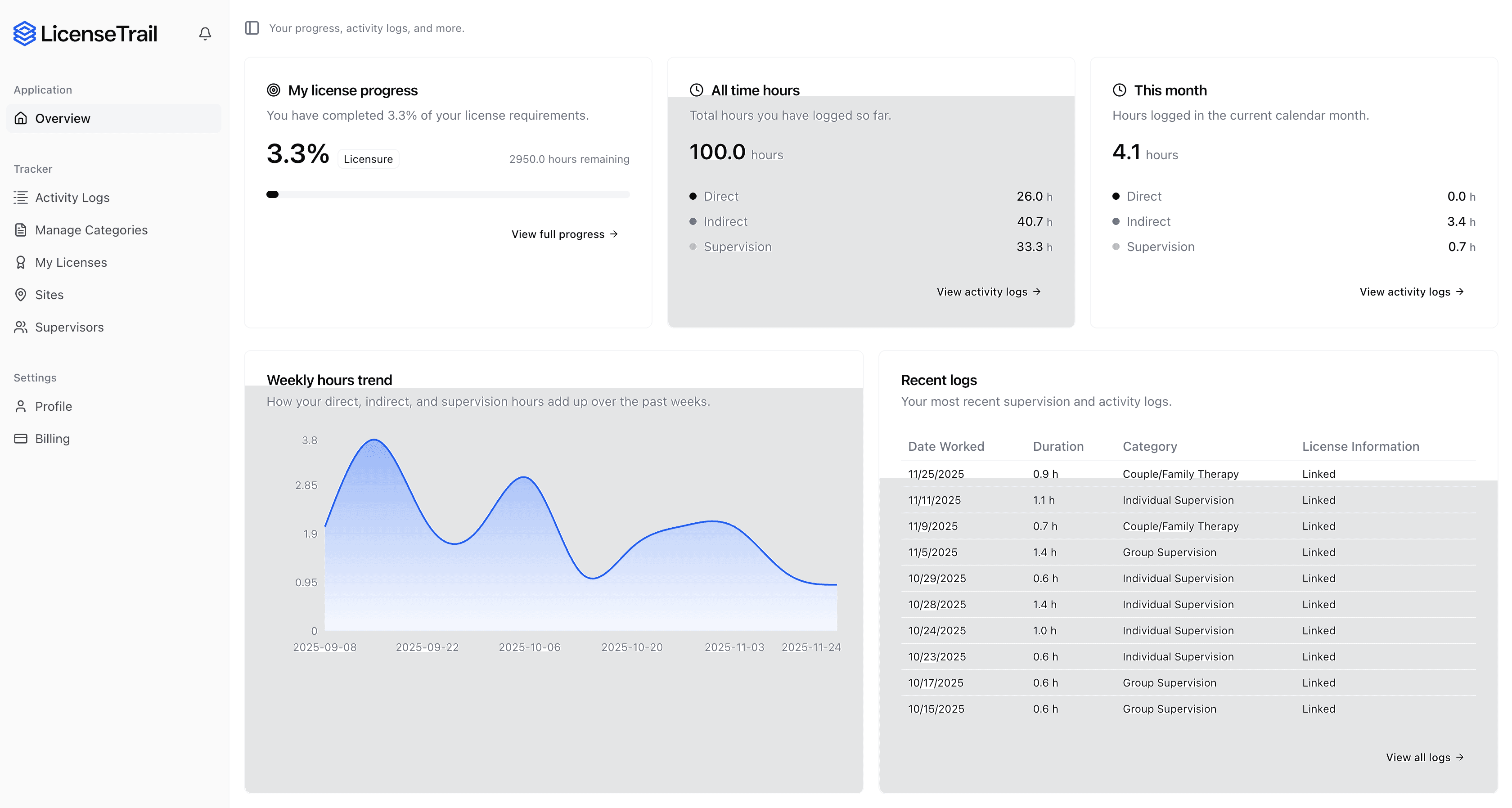
Track your LMFT hours with confidence
License Trail checks your direct, indirect, and supervision hours against New-jersey LMFT requirements continuously and flags mismatches before you submit.
 Start Tracking for Free
No credit card required · Free plan available
Is your spreadsheet hiding New-jersey LMFT risks?
Stop guessing if your categories match New Jersey Board of Marriage and Family Therapy Examiners requirements. License Trail checks your direct, indirect, and supervision hours continuously and flags mismatches before you submit.
Import or log
Bring your spreadsheet or start fresh
Upload your existing tracking spreadsheet and we'll map every hour into the right New Jersey Board of Marriage and Family Therapy Examiners categories automatically.
Verify against New-jersey
Catch mismatches before the board does
License Trail checks your direct, indirect, and supervision hours against New-jersey LMFT requirements continuously.
Export board-ready
One-click clean reports
Generate professional, board-ready reports for supervision meetings and New Jersey Board of Marriage and Family Therapy Examiners submissions in seconds.
No credit card required · Free plan available