
Ohio LPCC-S Requirements: Hours, Exams & Step-by-Step Guide
Stop guessing if your categories match Ohio requirements. License Trail checks your direct, indirect, and supervision hours against LPCC-S requirements continuously and flags mismatches before you submit.
No credit card required · Free plan available
Quick Requirements Overview
- LPCC-S is a training supervision designation added to an active Ohio LPCC (not a separate license class)
- LPCC (master’s path): 3,000 post‑LPC supervised hours over 2 years (max 1,500/12 months); ≥50% face‑to‑face clinical contact incl. diagnosis/treatment
- For LPCC hours accrued in Ohio, supervision must be provided by an LPCC‑S (unless board-approved exception)
- LPCC-S education: 24 hours board‑approved supervision training (6 hours each in 4 areas: assessment/evaluation/remediation; counselor development; management/administration; professional responsibilities)
- LPCC-S experience: 1 year / 1,500 hours post‑LPCC clinical experience incl. diagnosis/treatment
- LPCC-S supervision exposure (within the 1,500 hours): observe 5 LPCC‑S training supervision sessions + ≥1 hour review with that supervisor; initial meeting face‑to‑face (video OK)
- Training supervision ratio requirement: avg 1 hour supervisor contact per 20 hours of supervisee work
- Maintenance: 3 hours board‑approved supervision CE each renewal cycle to keep the designation
License Details
Procedures
In Ohio, the LPCC-S title indicates that a Licensed Professional Clinical Counselor has obtained a formal “training supervision designation” from the Counselor, Social Worker, and Marriage and Family Therapist Board. The designation authorizes you to provide board‑approved training supervision to LPCs and counselor trainees, and, in some situations, to other licensees.
Ohio law and administrative rules spell out both the path to LPCC and the additional steps to become LPCC‑S. This guide walks through the requirements with particular attention to types and amounts of hours.
1. What “LPCC-S” means in Ohio
Ohio rule 4757‑3‑02 defines:
- “LPCC” as “Licensed Professional Clinical Counselor”
- “LPCC-S” as “Licensed Professional Clinical Counselor with training supervision designation” (codes.ohio.gov)
The LPCC-S is therefore not a separate license class, but an additional designation on your LPCC license that confirms you meet the board’s standards to supervise for training.
2. Foundation: Becoming an LPCC in Ohio
You must first qualify for LPCC before you can add the supervision designation.
2.1 Education and LPC license (briefly)
Before LPCC, you are typically licensed as an LPC. At the LPC stage, the board requires (in summary):
- A graduate degree in counseling
- At least 60 semester hours (or 90 quarter hours) of graduate counselor training, including coursework in:
- clinical psychopathology/personality/abnormal behavior
- evaluation of mental and emotional disorders
- diagnosis of mental and emotional disorders
- methods of prevention, intervention, and treatment (codes.ohio.gov)
- Passage of a board‑approved counseling exam to obtain LPC licensure (codes.ohio.gov)
There is no large post‑LPC hour requirement just to maintain LPC, but those hours become crucial when you apply for LPCC.
2.2 Supervised experience required for LPCC
Ohio Revised Code 4757.22 and Ohio Admin. Code 4757‑13‑03 govern LPCC experience requirements. In practice, they convert “two years of supervised experience” into a very specific hour structure. (codes.ohio.gov)
For applicants with a master’s (non‑doctoral) counseling degree:
- You must complete two years of post‑LPC supervised experience in clinical counseling that includes diagnosis and treatment of mental and emotional disorders. (codes.ohio.gov)
Rule 4757‑13‑03 further defines what each “year” of supervised experience must look like:
- At least 1,500 hours of work per year, with:
- A minimum of 50% of those hours as face‑to‑face client contact providing clinical counseling, including diagnosis and treatment of mental and emotional disorders.
- You may not accrue more than 1,500 hours in any 12‑month period toward a “year” of experience. (codes.ohio.gov)
In effect, for a master’s‑level applicant, you must complete:
- Minimum 3,000 hours of supervised clinical counseling work,
- At least 1,500 hours must be direct, face‑to‑face clinical client contact.
For applicants with a doctorate in counseling:
- You must still complete two years of supervised clinical counseling, but:
- At least one year and a minimum of 1,500 hours of supervised experience must be post‑doctoral and as an LPC.
- Up to 1,500 hours of supervised experience may come from a qualified doctoral internship in a board‑approved program. (codes.ohio.gov)
2.3 Who must supervise your LPCC hours
For LPCC experience in Ohio:
- Supervision must be by an independently licensed mental health professional (LPCC, psychologist, psychiatrist, LISW with clinical competence, or IMFT). (codes.ohio.gov)
- “All supervision obtained in Ohio shall be provided by a licensed professional clinical counselor with supervision designation.” (direct language from rule 4757‑13‑03) (codes.ohio.gov)
That last sentence is critical: if your supervised hours are being completed in Ohio for LPCC purposes, your counseling supervisor must already hold the LPCC‑S designation (or you must have a board‑approved exception).
3. Applying for LPCC
Once you have:
- Met education requirements,
- Completed the required supervised experience (as above), and
- Passed the clinical exam and field evaluation required by the board, (codes.ohio.gov)
you can be granted LPCC licensure.
Only after you become an LPCC can you pursue the training supervision designation that changes your title to LPCC‑S.
4. Additional Requirements for the LPCC-S (Training Supervision Designation)
The requirements for LPCC‑S are in Ohio Admin. Code 4757‑17‑01, particularly paragraph (I). They fall into four main categories:
- Supervision‑specific education
- Post‑LPCC clinical experience
- A defined “supervision experience” component
- Ethical and ongoing education requirements
4.1 Supervision‑specific coursework (24 hours)
To apply for a training supervision designation, an LPCC must document: (codes.ohio.gov)
- A minimum of 24 hours of academic preparation or board‑approved continuing education in counselor supervision training, with:
-
At least 6 hours in each of the following four content areas:
-
Assessment, evaluation, and remediation
- How to assess supervisee knowledge, skills, and self‑awareness
- Use of formative and summative evaluation and processes to remediate supervisee performance
-
Counselor development
- Models of supervision
- Developmental stages of both supervisee and supervisor
- Cultural and individual differences in supervision relationships
-
Management and administration
- Recordkeeping, reporting, monitoring of supervisee cases
- Policies on emergencies, case assignment, and multiple roles in institutions/organizations
-
Professional responsibilities
- Legal and ethical issues in supervision (e.g., dual relationships, competence, due process, liability)
- Regulatory matters such as Ohio counseling laws, standards, credentialing, and reimbursement
-
-
The 24 hours can come from graduate coursework, CE, or a combination, as long as it is supervision‑focused and board‑approved in the required content areas.
4.2 Post‑LPCC clinical experience: 1 year / 1,500 hours
In addition to the supervised experience used to qualify for LPCC, an LPCC who wants the supervision designation must complete extra clinical practice as an LPCC:
- Minimum of one year and 1,500 hours of clinical experience
- This experience must be post‑LPCC licensure and must include the diagnosis and treatment of mental and emotional disorders. (codes.ohio.gov)
This is not a second 1,500 hours of supervised experience as LPC; it is clinical work done after you are licensed as an LPCC. By the time you qualify for LPCC‑S, you will have:
- At least 3,000 hours of supervised clinical counseling as an LPC (for LPCC)
- Plus 1,500 hours of post‑LPCC clinical experience
So the typical LPCC‑S has at least 4,500 hours of clinical counseling work, with at least 1,500 of those hours being direct face‑to‑face clinical services.
4.3 Required “supervision experience” (observation and review)
The rule also requires that your 1,500 post‑LPCC hours include at least one structured supervision experience focused on observing supervision itself: (codes.ohio.gov)
- Within those 1,500 hours, you must:
- Observe five training supervision sessions conducted by an LPCC who already holds the supervision designation (LPCC‑S).
- After these observations, you and that supervisor must complete at least one hour of review to process and discuss the supervision sessions you observed.
Other formalities:
- Supervision (in this context) must start with an initial face‑to‑face meeting, which may be via videoconference. After that, contacts can be in person, by videoconferencing, or by phone. (codes.ohio.gov)
This requirement is about learning how to supervise (not just being supervised), which is why it centers on observing a qualified supervisor at work and then reviewing the process.
4.4 Ethical standards and continuing education
Two additional obligations accompany the designation:
-
Ethics requirement
- You must comply with American Counseling Association (ACA) ethical standards related to supervision in your supervisory relationships. (codes.ohio.gov)
-
Ongoing supervision CE to maintain LPCC‑S
- After obtaining the designation, all LPCs and LPCCs with training supervision designation must complete 3 hours of board‑approved continuing education in supervision each renewal cycle to maintain the designation. (codes.ohio.gov)
5. How the Board Defines “Training Supervision” and Supervision Ratios
Ohio’s counseling supervision rule distinguishes “training supervision” (for licensure and new competencies) from “clinical/work supervision” (for day‑to‑day clinical oversight). For training supervision, the rule states that it: (codes.ohio.gov)
- Is provided to individuals gaining experience for:
- LPC licensure
- LPCC licensure
- Counselor trainees in practicum/internship
- Is intended both for licensure and for development of new proficiency areas
- Requires the supervisor to provide direction while the supervisee applies counseling theory and skills in real practice
- Is characterized as an intentional process that demands considerable time and involvement of the supervisor to promote professional growth.
The rule also specifies a minimum supervision ratio:
- Training supervision must “include an average of one hour of contact between the supervisor and supervisee for every twenty hours of work” by the supervisee. (codes.ohio.gov)
This 1:20 ratio governs how much supervisory contact is expected while an LPC or counselor trainee is accruing training supervision hours for licensure.
6. How LPCC-S Must Present Their Role
Once granted the designation, the rules direct how supervisors are to be titled and what they are expected to do:
- LPCCs with the designation “shall be called ‘licensed professional clinical counselor with training supervision designation’” (i.e., LPCC‑S). (codes.ohio.gov)
- They must have adequate training, knowledge, and skills to provide competent clinical supervision, and must meet all criteria for both work and training supervision in rule 4757‑17‑01. (codes.ohio.gov)
7. Summary of Key Hour Requirements
For clarity, here is a condensed view of the relevant hour‑based requirements:
To become LPCC (master’s‑level path)
- 3,000 hours minimum supervised clinical counseling as an LPC:
- 1,500 hours per year for 2 years
- At least 50% of those hours as face‑to‑face clinical contact
- All Ohio supervision must be by an LPCC‑S (or specifically approved alternative). (codes.ohio.gov)
Additional to become LPCC-S (training supervision designation)
- 24 hours of board‑approved supervision training (6 hours in each of four mandated content areas). (codes.ohio.gov)
- 1,500 hours of post‑LPCC clinical experience, over at least one year, including diagnosis and treatment of mental and emotional disorders. (codes.ohio.gov)
- Within those 1,500 hours:
- Observation of 5 training supervision sessions conducted by an LPCC‑S, plus
- A minimum 1‑hour review session with that supervisor. (codes.ohio.gov)
- Ongoing: 3 hours of supervision‑specific CE per renewal period to maintain the LPCC‑S designation. (codes.ohio.gov)
Taken together, the Ohio LPCC‑S requirements ensure that, by the time you are allowed to supervise for licensure, you have:
- Extensive supervised clinical experience yourself,
- Additional independent clinical practice as an LPCC,
- Formal training in supervision models, ethics, and administration, and
- Direct exposure to real‑time supervision being conducted by an experienced LPCC‑S.
Track your LPCC-S hours with confidence
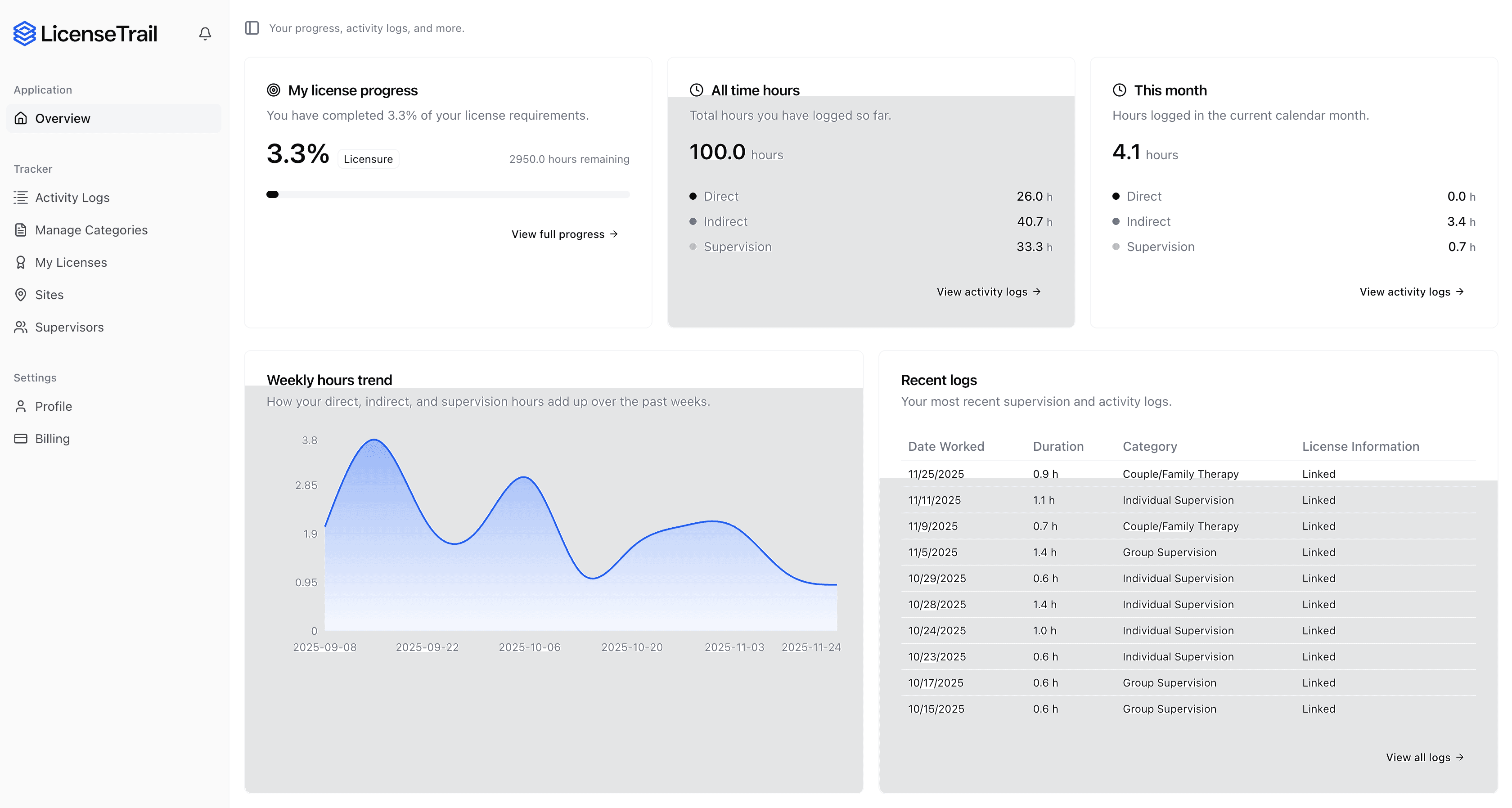
License Trail checks your direct, indirect, and supervision hours against Ohio LPCC-S requirements continuously and flags mismatches before you submit.
 Start Tracking for Free
No credit card required · Free plan available
Is your spreadsheet hiding Ohio LPCC-S risks?
Stop guessing if your categories match Ohio Counselor, Social Worker and Marriage and Family Therapist Board requirements. License Trail checks your direct, indirect, and supervision hours continuously and flags mismatches before you submit.
Import or log
Bring your spreadsheet or start fresh
Upload your existing tracking spreadsheet and we'll map every hour into the right Ohio Counselor, Social Worker and Marriage and Family Therapist Board categories automatically.
Verify against Ohio
Catch mismatches before the board does
License Trail checks your direct, indirect, and supervision hours against Ohio LPCC-S requirements continuously.
Export board-ready
One-click clean reports
Generate professional, board-ready reports for supervision meetings and Ohio Counselor, Social Worker and Marriage and Family Therapist Board submissions in seconds.
No credit card required · Free plan available