
Ohio LPC Requirements: Hours, Exams & Step-by-Step Guide
Stop guessing if your categories match Ohio requirements. License Trail checks your direct, indirect, and supervision hours against LPC requirements continuously and flags mismatches before you submit.
No credit card required · Free plan available
Quick Requirements Overview
- Regulator: Ohio CSWMFT Board issues LPC (entry-level) and LPCC (independent clinical/diagnosis).
- Education: Graduate counseling degree with 60 semester / 90 quarter hours of counselor training.
- Practicum/Internship: Required supervised practicum + clinical internship that meets CACREP standards in effect (Ohio law doesn’t list fixed hour totals).
- Exam: Pass the Board-prescribed licensure exam (must be within 7 years of applying, with limited exceptions).
- Application/Character: Submit required application/docs/fees and have no disqualifying convictions.
- Post-grad hours for LPC: No post-master’s supervised experience hours required to obtain the LPC.
- Practice limits/supervision: LPCs who diagnose/treat must have clinical/work supervision by a qualifying independent MH professional and disclose supervision publicly.
- Supervision contact ratio (when accruing experience): Avg 1 hour supervisor contact per 20 hours of work.
License Details
Procedures
In Ohio, the Counselor, Social Worker, and Marriage and Family Therapist Board (CSWMFT Board) regulates both the entry‑level Licensed Professional Counselor (LPC) license and the independent Licensed Professional Clinical Counselor (LPCC) license. The LPC is the initial counseling license; the LPCC is the independent clinical license you can obtain after additional supervised experience.
Below is a step‑by‑step outline of what the Board itself requires, with a focus on hours and supervision as defined in the Ohio Revised Code (ORC) and Ohio Administrative Code (OAC).
1. Know what the LPC license allows (and what it does not)
The Board defines:
- “Licensed Professional Counselor” as a counselor licensed “to practice professional counseling” under section 4757.01(A) of the Revised Code. (codes.ohio.gov)
- “Licensed Professional Clinical Counselor” as a counselor licensed “to practice professional counseling and the unsupervised diagnosis and treatment of mental and emotional disorders and conditions.” (codes.ohio.gov)
In practice:
- As an LPC, you can practice professional counseling.
- If you diagnose and treat mental and emotional disorders, you must be under work/clinical supervision from an independently licensed mental health professional (such as an LPCC, psychologist, psychiatrist, IMFT, or LISW with a clinical area of competence). (codes.ohio.gov)
- Only an LPCC can perform diagnosis and treatment independently (without required supervision). (codes.ohio.gov)
2. Educational requirements for LPC: degree, coursework, practicum, internship
2.1 Graduate degree in counseling
To be eligible for an LPC license, you must: (codes.ohio.gov)
- Hold a graduate degree in counseling (not psychology, social work, etc.).
- Complete at least 60 semester hours (or 90 quarter hours) of graduate credit in counselor training acceptable to the Counselor Professional Standards Committee.
The statute specifies that those 60 semester hours must include training in, among other things:
- Clinical psychopathology, personality, and abnormal behavior
- Evaluation and diagnosis of mental and emotional disorders
- Methods of prevention, intervention, and treatment of these disorders (codes.ohio.gov)
The Board’s education rule (OAC 4757‑13‑01) adds that your degree must clearly be a counseling degree and that the program must be a recognizable counseling program, not a general human‑services or psychology program. (codes.ohio.gov)
2.2 Required instructional content and practice experiences
The statute requires that your counselor training must include both coursework and applied training: (codes.ohio.gov)
- Instruction in:
- Human growth and development
- Counseling theory and techniques
- Group dynamics and counseling
- Appraisal of individuals
- Research and evaluation
- Professional, legal, and ethical responsibilities
- Social and cultural foundations
- Lifestyle and career development
- Participation in a supervised practicum and clinical internship in counseling
The Board’s rule on education for LPC licensure further specifies: (codes.ohio.gov)
- A practicum consisting of supervised training with bona fide clients and/or groups.
- An internship that is an on‑the‑job counseling experience.
Crucially, Ohio ties the hours for these experiences to CACREP standards:
- Practicum must conform to CACREP standards in place when the practicum is completed.
- Internship must meet CACREP standards, though the Board may waive some internship hours or approve alternative means if the program attests to your competence. (codes.ohio.gov)
So, for initial LPC licensure, the practice hours that matter are:
- Practicum hours – as set by CACREP (and implemented by your program).
- Internship hours – again, set by CACREP and your program, and accepted by the Board.
The exact numeric practicum/internship hours are not spelled out in the Ohio statutes or rules; instead, Ohio requires that your program meet the then‑current CACREP standards.
3. Examination and application requirements for LPC
Once you meet the education and practicum/internship requirements, the Board’s licensure rule for professional counselors (OAC 4757‑13‑02) says all LPC applicants must: (codes.ohio.gov)
- Meet the educational requirements in OAC 4757‑13‑01 (or 4757‑13‑06 for certain doctoral applicants).
- Successfully complete the licensure examination prescribed by the Counselor Professional Standards Committee.
- You must have passed this exam within seven years of the application date (unless you are already licensed in an equivalent capacity in another state and passed the exam as part of that licensure).
- Have no disqualifying criminal convictions.
- Meet all initial application requirements in OAC 4757‑1‑04 (application form, fees, required documentation, etc.).
The Revised Code confirms that the Committee issues an LPC license to applicants who submit a proper application, pay the fee, meet the graduate degree and course hour requirements, and “pass an examination administered by the board for the purpose of determining ability to practice as a licensed professional counselor.” (codes.ohio.gov)
Important: Neither the statute nor the Board’s LPC licensure rule requires any post‑master’s supervised practice hours to obtain the LPC itself. Those post‑LPC hours come into play when you seek the LPCC license.
4. Supervision rules and “hours” that apply while you are an LPC
Once licensed, your hour‑related obligations center on how you practice and how you are supervised, especially if you diagnose and treat mental and emotional disorders.
4.1 Work/clinical supervision for LPCs
The supervision rule (OAC 4757‑17‑01) makes several key points: (codes.ohio.gov)
- The rule applies to:
- LPCs working toward LPCC licensure,
- Counselor trainees (CTs), and
- LPCs who diagnose and treat mental and emotional disorders under work supervision.
- “Clinical supervision” or “work supervision” is required for LPCs whose practice includes diagnosis and treatment of mental and emotional disorders.
- This supervision includes:
- Ongoing review and approval of assessment, diagnosis, treatment plans, revisions, and termination or transfer of clients.
- Supervisor access to the LPC’s client documentation.
- Supervisor responsibility for client welfare.
For LPCs in solo private practice, the rule states:
- An LPC may be in solo private practice, but an LPC who is diagnosing and treating mental and emotional disorders must receive clinical/work supervision. (codes.ohio.gov)
- The clinical/work supervisor may be:
- A Licensed Independent Social Worker (LISW),
- Licensed Professional Clinical Counselor (LPCC),
- Independent Marriage and Family Therapist (IMFT),
- Psychologist, or
- Psychiatrist. (codes.ohio.gov)
LPCs must also disclose on all printed and electronic materials that they are under the supervision of an appropriately licensed mental health professional and identify the supervisor by name. (codes.ohio.gov)
4.2 Training supervision ratio: supervision hours vs. work hours
The same rule defines “training supervision” as supervision of individuals gaining experience for LPC or LPCC licensure, including counselor trainees and LPCs under LPCC‑S supervision. (codes.ohio.gov)
A key quantitative requirement is the supervision ratio:
Training supervision must include an average of one hour of contact between the supervisor and supervisee for every twenty hours of work by the supervisee. (codes.ohio.gov)
This is the Board’s primary hour‑based requirement for supervision contact while you are accruing qualifying experience (whether as a counselor trainee or as an LPC working toward LPCC).
5. Post‑LPC supervised experience to become an LPCC (independent license)
Although your question focuses on LPC licensure, the hour breakdown you mention (e.g., “1,500 hours of direct experience and 1,500 hours of supervised experience”) actually lines up with the LPCC requirements. Those are spelled out in OAC 4757‑13‑03.
5.1 Overall supervised experience requirement
For a master’s‑level applicant seeking LPCC licensure, the Board requires: (codes.ohio.gov)
- Two years of post‑LPC supervised experience in clinical counseling,
- The experience must include diagnosis and treatment of mental and emotional disorders, and
- It must be in clinical settings whose primary focus is diagnosis and treatment of mental and emotional disorders.
The rule gives the detailed hour structure:
- Each required year of supervised experience must include at least 1,500 hours of work.
- Of that work, at least 50% must be face‑to‑face client contact involving delivery of clinical counseling services that include diagnosis and treatment of mental and emotional disorders. (codes.ohio.gov)
- You cannot accrue more than 1,500 hours in any 12‑month period; if you work fewer than 1,500 hours that year, you receive proportional credit.
Because you must complete two such years, this yields a total of:
- 3,000 hours of post‑LPC supervised clinical counseling experience,
- Of which at least 1,500 hours are face‑to‑face client contact (50% of the total), and
- All 3,000 hours are under qualifying supervision.
For doctoral‑level applicants, at least one year and a minimum of 1,500 hours must be completed after the doctoral degree is awarded and while licensed as an LPC; up to 1,500 hours may come from a qualifying doctoral internship. (codes.ohio.gov)
5.2 Supervision requirements tied to those hours
The LPCC rule requires that each year’s supervised experience: (codes.ohio.gov)
- Be under direct supervision by:
- An LPCC (in Ohio, with training supervision designation),
- Psychologist,
- Psychiatrist,
- Independent Social Worker with a clinical area of competence,
- Or another independently licensed mental health professional acceptable to the Counselor Professional Standards Committee.
- For experience obtained in Ohio, all supervision must be provided by an LPCC with supervision designation.
Additionally, the Board requires supervision evaluations:
- You must submit supervision evaluations to the Board:
- Once you complete the first 1,500 hours of supervised experience, and
- Again at the completion of the full 3,000 hours. (codes.ohio.gov)
This is where the Board explicitly refers to “the full three thousand hours of supervised experience.”
5.3 Distinguishing “direct” vs. “supervised” hours in Ohio terms
The Board does not divide these LPCC hours into separate categories called “direct” and “supervised” hours; instead it describes:
- Total supervised work hours: 3,000 hours of supervised experience (1,500 hours per year for two years).
- Direct client contact within those hours: At least 50% of the work each year must be face‑to‑face client contact—so at least 1,500 of the 3,000 hours must be direct client work. (codes.ohio.gov)
This is the closest match to the example you gave (1,500 direct and 1,500 “other” hours), but all 3,000 are supervised; the Board’s wording pulls out the subset that must be face‑to‑face clinical contact.
6. Summary of key “hours” requirements from the Ohio Board
Putting this together in a concise checklist:
-
To become an LPC (initial license)
- Complete a graduate degree in counseling with at least 60 semester / 90 quarter hours of counseling coursework. (codes.ohio.gov)
- Complete a supervised practicum and clinical internship in counseling that meets CACREP standards in effect at the time (hour counts are determined by CACREP and your program, not spelled out by Ohio law). (codes.ohio.gov)
- Pass the Board‑prescribed licensure examination (within 7 years of application). (codes.ohio.gov)
- Meet application and character requirements (no disqualifying convictions). (codes.ohio.gov)
There is no post‑master’s supervised hour requirement just to obtain the LPC license.
-
Supervision while practicing as an LPC
- If you diagnose and treat mental and emotional disorders, you must be under clinical/work supervision from a qualifying independently licensed mental health professional. (codes.ohio.gov)
- Training supervision (for LPC or LPCC experience) must average 1 hour of supervisor contact per 20 hours of work. (codes.ohio.gov)
-
To move from LPC to LPCC (independent practice)
- Complete two years of post‑LPC supervised clinical practice in settings focused on diagnosis and treatment of mental and emotional disorders. (codes.ohio.gov)
- Accrue 3,000 total hours of supervised work (maximum 1,500 per 12‑month period).
- Ensure at least 50% of those hours (≥1,500) are face‑to‑face client contact (direct clinical services). (codes.ohio.gov)
- Have your supervision provided (in Ohio) by an LPCC with training supervision designation, and submit required supervision evaluations at 1,500 and 3,000 hours. (codes.ohio.gov)
If your primary concern is entry into the profession, your hour‑related focus is on meeting CACREP‑compliant practicum/internship hours during your master’s program and then obtaining LPC licensure. If your goal is independent clinical practice, you must plan for the additional 3,000 supervised hours (with at least 1,500 direct client hours) required for the LPCC.
Track your LPC hours with confidence
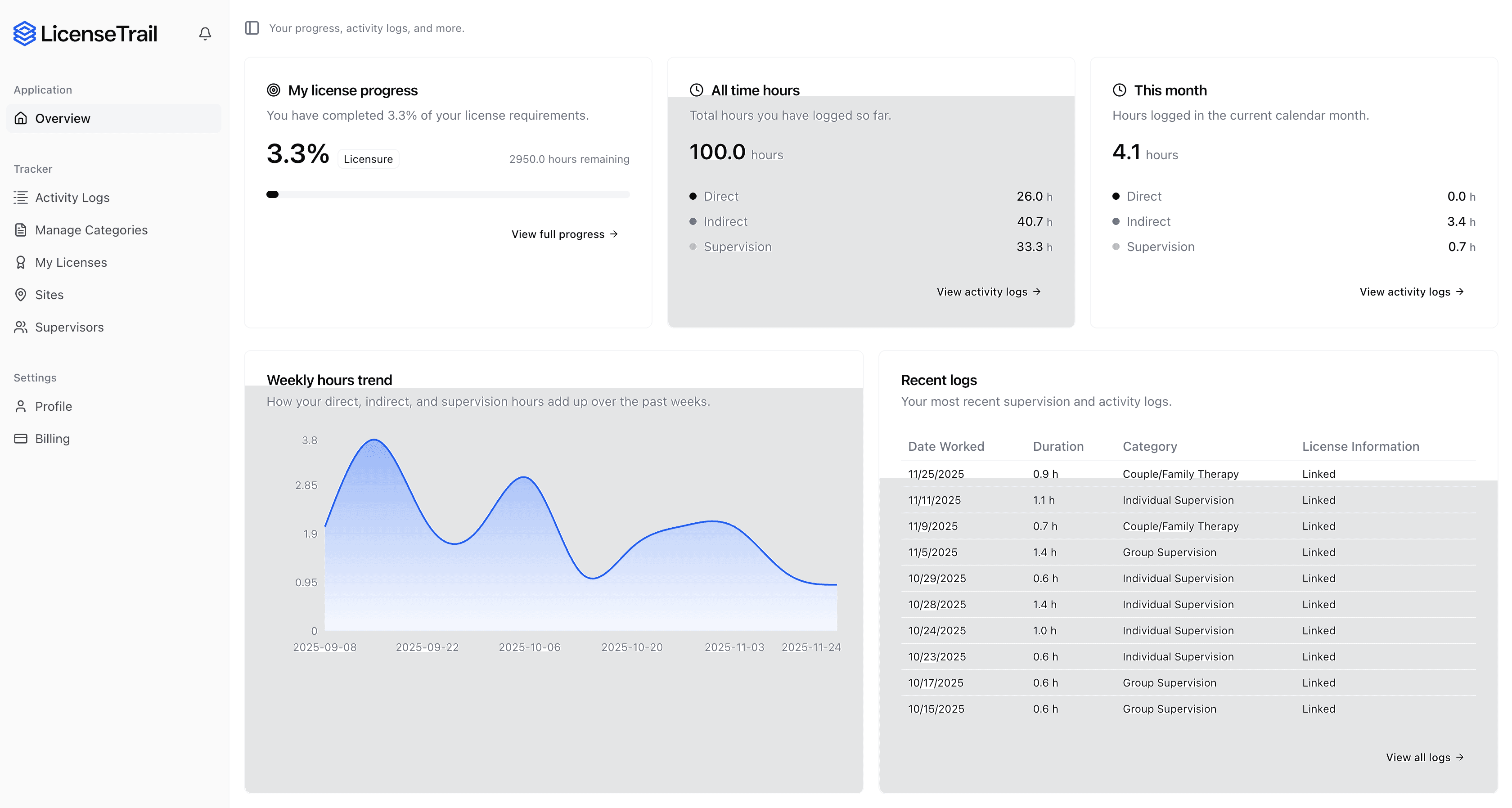
License Trail checks your direct, indirect, and supervision hours against Ohio LPC requirements continuously and flags mismatches before you submit.
 Start Tracking for Free
No credit card required · Free plan available
Is your spreadsheet hiding Ohio LPC risks?
Stop guessing if your categories match Ohio Counselor, Social Worker and Marriage and Family Therapist Board requirements. License Trail checks your direct, indirect, and supervision hours continuously and flags mismatches before you submit.
Import or log
Bring your spreadsheet or start fresh
Upload your existing tracking spreadsheet and we'll map every hour into the right Ohio Counselor, Social Worker and Marriage and Family Therapist Board categories automatically.
Verify against Ohio
Catch mismatches before the board does
License Trail checks your direct, indirect, and supervision hours against Ohio LPC requirements continuously.
Export board-ready
One-click clean reports
Generate professional, board-ready reports for supervision meetings and Ohio Counselor, Social Worker and Marriage and Family Therapist Board submissions in seconds.
No credit card required · Free plan available