
Ohio LPC-TEMP Requirements: Hours, Exams & Step-by-Step Guide
Stop guessing if your categories match Ohio requirements. License Trail checks your direct, indirect, and supervision hours against LPC-TEMP requirements continuously and flags mismatches before you submit.
No credit card required · Free plan available
Quick Requirements Overview
- LPC‑TEMP is the standard Ohio LPC issued in temporary status while the Board completes processing; no separate license level
- Must already meet all LPC requirements; temporary status mainly bridges missing/awaited items (e.g., final transcript)
- Education: Master’s/graduate degree in counseling (CACREP or Board‑approved) with 60 semester hours / 90 quarter hours incl. advanced clinical content areas (psychopathology, evaluation, diagnosis, treatment)
- Training: completed supervised practicum + clinical internship meeting CACREP standards (commonly 100 practicum hrs/40 direct; 600 internship hrs/240 direct)
- Exam: must pass the required LPC exam before a temporary license is issued (exam generally must be within 7 years of application)
- Application: submit Board application + fee, official transcripts, and BCI/FBI criminal background checks; no disqualifying convictions
- Issuance pathways: temporary LPC may be issued pending transcripts/final Board action, or up to 90 days while awaiting degree conferral with a school letter (renewable once for good cause)
- Ends on earliest of: permanent LPC issued, 90 days (unless renewed under the school‑letter pathway), or application withdrawal
License Details
Procedures
In Ohio, a Licensed Professional Counselor with a temporary license (LPC‑TEMP) is not a separate level of counselor; it is the standard LPC license held in temporary status while the Board finishes processing the permanent license. The Board defines:
- “LPC‑TEMP” as “a ‘Licensed Professional Counselor’ with a temporary license.” (codes.ohio.gov)
To qualify for an LPC‑TEMP, you must already meet all substantive requirements for full LPC licensure; the temporary license exists only to bridge short gaps (for example, while the Board waits for your final transcript).
Below is a step‑by‑step breakdown focused on what Ohio law and rules actually say, including how hours are handled.
1. Understand what LPC‑TEMP allows
Ohio law authorizes the counselors professional standards committee of the Counselor, Social Worker, and Marriage and Family Therapist Board to issue a “temporary license to practice as a licensed professional counselor” to an applicant who otherwise meets all requirements for LPC licensure. (codes.ohio.gov)
The temporary license:
- Lets you legally practice as an LPC in Ohio for a short, defined period.
- Uses the title “LPC‑TEMP” after your name during that temporary period. (codes.ohio.gov)
There is no separate, additional hour requirement unique to the LPC‑TEMP. The underlying requirements are the regular LPC education and exam requirements, which already include supervised practicum and internship hours.
2. Meet the educational requirements for LPC
2.1 Graduate degree and total credit hours
Ohio Revised Code (ORC) §4757.23 requires that an LPC applicant:
- Hold a graduate degree in counseling, from either:
- A CACREP‑accredited counseling program, or
- A counseling program approved by the Board under its rules. (codes.ohio.gov)
- Complete at least 60 semester hours (90 quarter hours) of graduate counselor training acceptable to the counselors professional standards committee. (codes.ohio.gov)
That training must include coursework in all of the following advanced clinical areas:
- Clinical psychopathology, personality, and abnormal behavior
- Evaluation of mental and emotional disorders
- Diagnosis of mental and emotional disorders
- Methods of prevention, intervention, and treatment of mental and emotional disorders (codes.ohio.gov)
Ohio Administrative Code (OAC) 4757‑13‑01 further details what counts as a “graduate degree in counseling,” including that the program must be clearly identified as a counseling program and include an organized sequence of study in core counseling areas (counseling theory, techniques, group work, appraisal, research, ethics, etc.). (codes.ohio.gov)
2.2 Required practicum and internship (hours and types of hours)
Ohio law does not spell out fixed practicum/internship hour numbers in the current rule text. Instead, it requires:
- “Participation in a supervised practicum and clinical internship in counseling.” (codes.ohio.gov)
- A practicum that is “a supervised training experience… consisting of the provision of counseling to bona fide clients and/or groups,” which “must conform to CACREP standards in place at the time the practicum is completed.” (codes.ohio.gov)
- An internship that is “an on‑the‑job experience in professional counseling,” which “must meet CACREP standards” (with limited authority for the committee to waive specific hours or approve alternatives if competence is demonstrated). (codes.ohio.gov)
Because Ohio incorporates CACREP rather than writing its own numbers, the practical hour requirements come from CACREP standards. Under current CACREP (2016/2024) standards:
-
Practicum
- Minimum 100 clock hours over a full academic term.
- At least 40 hours of direct service with actual clients (face‑to‑face or live‑interactive counseling work). (cacrep.org)
-
Internship
- Minimum 600 clock hours of supervised counseling internship.
- At least 240 hours of direct service with actual clients. (cacrep.org)
All of these hours must be supervised; CACREP also specifies weekly individual/triadic supervision and group supervision requirements.
In other words, for LPC (and therefore LPC‑TEMP) in Ohio, you should expect, at minimum:
- 100 supervised practicum hours
- 40+ direct client hours (counseling actual clients)
- 600 supervised internship hours
- 240+ direct client hours
The remainder of practicum/internship hours are indirect (documentation, case conferences, professional development, etc.) but still supervised.
3. Pass the required counselor licensure examination
For LPC licensure, Ohio requires:
- Successful completion of “the licensure examination prescribed by the counselor professional standards committee.” (codes.ohio.gov)
Key points from OAC 4757‑13‑02:
- You must have passed the required exam within seven years of the application date, unless you are already licensed in another state in an equivalent capacity and passed that exam as part of that state’s licensure. (codes.ohio.gov)
For issuance of a temporary LPC license, the Board’s temporary‑license rule adds:
- “The applicant shall have passed the examination for the license which they seek prior to the issuance of the temporary license.” (law.cornell.edu)
So, you cannot receive LPC‑TEMP status until after you pass the LPC exam.
4. Complete the initial licensure application and background check
Ohio’s general licensure‑application rule (OAC 4757‑1‑04) requires that all first‑time applicants for a professional license:
- File an application on the form prescribed by the Board and pay the required non‑refundable fee. (codes.ohio.gov)
- Arrange for official graduate transcripts to be sent directly to the Board. (codes.ohio.gov)
- Provide, if relevant, statements documenting any required professional employment experience (for LPC this is not typically applicable, but it is required for LPCC and some other licenses). (codes.ohio.gov)
- Undergo state and FBI criminal records checks, with results sent directly to the Board; the Board will not issue any initial license until it receives and reviews those results. (codes.ohio.gov)
For LPC specifically, OAC 4757‑13‑02 also requires that you:
- Meet the education rule 4757‑13‑01,
- Have no disqualifying criminal convictions, and
- Meet all initial application requirements in rule 4757‑1‑04. (codes.ohio.gov)
Once the Board determines that you appear to meet all LPC requirements, you are eligible for a temporary LPC license under the circumstances below.
5. How to obtain the LPC‑TEMP (temporary LPC license)
5.1 Legal authority and definition
Ohio law and rules frame the temporary LPC license as follows:
- ORC §4757.23(D) states that the committee may issue a temporary license to practice as a licensed professional counselor to an applicant who meets all LPC licensing requirements, in two specific situations (below). (codes.ohio.gov)
- OAC 4757‑3‑02 defines “LPC‑TEMP” as a “Licensed Professional Counselor with a temporary license.” (codes.ohio.gov)
- OAC 4757‑13‑10 spells out the “Requirements for a temporary counselor license,” which apply to LPC‑TEMP and other temporary counselor licenses. (law.cornell.edu)
5.2 Application steps for the temporary license
Under OAC 4757‑13‑10:
-
Submit a completed licensure application for LPC
- “An applicant who wishes to obtain a temporary license shall submit a completed licensure application, as prescribed by the board,” together with the required fee. (law.cornell.edu)
-
Board staff review your eligibility
- A Board staff member reviews your application to determine whether you “appear to have the appropriate degrees and/or experience to meet the requirements for the actual license [you] seek.” (law.cornell.edu)
- If you meet LPC requirements and have passed the exam, a temporary license may be issued.
-
Two statutory pathways to LPC‑TEMP
ORC §4757.23(D) allows the committee to issue an LPC temporary license in these situations: (codes.ohio.gov)
- Pending transcripts or final Board action
- A temporary license may be issued “pending the receipt of transcripts or action by the committee to issue a license as a licensed professional counselor.”
- Awaiting degree conferral and transcript, up to 90 days
- For a period not to exceed 90 days, to an applicant who provides a statement from the academic institution confirming:
- All academic requirements for the degree have been met, and
- The projected date the transcript showing the conferred degree will be issued.
- For a period not to exceed 90 days, to an applicant who provides a statement from the academic institution confirming:
On application, a temporary license issued under the 90‑day provision may be renewed for good cause shown. (codes.ohio.gov)
OAC 4757‑13‑10 also reiterates that a temporary license may be issued for up to 90 days to someone who has completed educational requirements but is “awaiting the actual awarding of the degree,” and that such a license may be renewed once for another 90‑day period. (law.cornell.edu)
- Pending transcripts or final Board action
-
Duration and automatic termination
Under OAC 4757‑13‑10, an LPC temporary license is valid from the date of issuance until the earliest of: (law.cornell.edu)
- The date the permanent LPC license is issued,
- 90 days after issuance, or
- The date you withdraw the LPC application.
At no point do the statute or rules add extra supervised practice hours on top of the practicum/internship and educational requirements just to qualify for LPC‑TEMP.
6. How hours are handled in Ohio (and what does not apply to LPC‑TEMP)
Because your example mentioned something like “1,500 hours of direct experience and 1,500 hours of supervised experience,” it is important to distinguish LPC from LPCC:
6.1 Hours that do apply to LPC and LPC‑TEMP
For LPC (and thus LPC‑TEMP), the hour‑based requirements are:
-
Graduate academic credit hours
- At least 60 semester hours / 90 quarter hours of graduate counselor training. (codes.ohio.gov)
-
Supervised practicum and internship hours
- Practicum: minimum 100 hours, including 40 hours of direct client service, all supervised. (cacrep.org)
- Internship: minimum 600 hours, including 240 hours of direct client service, all supervised. (cacrep.org)
These numbers come from the CACREP standards that Ohio’s rules incorporate by reference; current Ohio rules do not restate the numbers themselves.
There is no separate “X hours of post‑degree supervised experience” requirement to receive the LPC or LPC‑TEMP license. Those kinds of post‑master’s hours apply to the clinical license (LPCC), not the general LPC license.
6.2 Hours that apply only if you later upgrade to LPCC (not needed for LPC‑TEMP)
If you later pursue the Licensed Professional Clinical Counselor (LPCC) license, Ohio imposes a significant supervised clinical experience requirement after you are licensed as an LPC. Under OAC 4757‑13‑03 and ORC 4757.22: (codes.ohio.gov)
-
Total supervised clinical experience:
- Generally two years as a licensed professional counselor, in a clinical setting focused on diagnosis and treatment of mental and emotional disorders.
- The rules break this down as:
- At least 1,500 hours of work per year, and
- At least 50% of those hours (750 per year) must be face‑to‑face client contact delivering clinical counseling services (diagnosis and treatment).
- You may not accrue more than 1,500 hours in any 12‑month period toward this requirement.
-
Supervision:
- This experience must be under the direct supervision of an LPCC with supervision designation (LPCC‑S) or another independently licensed mental health professional acceptable to the committee, with special rules if supervision is obtained in Ohio (must be by LPCC‑S). (codes.ohio.gov)
-
Evaluation milestones:
- The Board requires supervision evaluations at 1,500 hours and again at 3,000 total hours of supervised experience (i.e., halfway and at completion). (codes.ohio.gov)
These 3,000 supervised clinical hours (with at least 1,500 face‑to‑face) are often what people have in mind when they talk about Ohio “hour requirements,” but they are LPCC requirements, not LPC‑TEMP requirements.
7. Summary of key requirements specifically for LPC‑TEMP in Ohio
Putting it all together:
-
Degree and coursework
- Graduate degree in counseling from a CACREP‑accredited or Board‑approved counseling program.
- At least 60 semester hours of acceptable graduate counselor training in specified content areas. (codes.ohio.gov)
-
Practicum and internship (education‑level hours)
- Practicum: minimum 100 supervised hours, at least 40 direct client hours.
- Internship: minimum 600 supervised hours, at least 240 direct client hours.
- These must meet current CACREP standards and be acceptable to the Board. (cacrep.org)
-
Exam
- Pass the LPC licensure examination prescribed by the counselor professional standards committee within 7 years of application.
- You must have passed this exam before any temporary LPC license can be issued. (codes.ohio.gov)
-
Application and background check
- Submit the LPC application and pay the required fee.
- Provide official transcripts.
- Undergo Ohio BCI and FBI criminal records checks; have no disqualifying criminal convictions. (codes.ohio.gov)
-
Temporary LPC (LPC‑TEMP) issuance
- The committee may issue a temporary LPC license once you otherwise qualify for LPC, in either of two situations:
- While waiting for the Board’s final action or receipt of your official transcript; or
- For up to 90 days based on a letter from your school confirming degree completion and the upcoming conferral date (renewable once for good cause). (codes.ohio.gov)
- The LPC‑TEMP ends when:
- Your permanent LPC license is issued,
- 90 days have elapsed (unless lawfully renewed in the limited school‑letter situation), or
- You withdraw your LPC application. (law.cornell.edu)
- The committee may issue a temporary LPC license once you otherwise qualify for LPC, in either of two situations:
There is no additional numeric “experience hours” requirement beyond the CACREP practicum/internship hours for obtaining an LPC‑TEMP in Ohio. The larger clinical hour requirements (1,500 hours per year, 3,000 total, with at least 50% direct client contact) belong to the LPCC license that you may pursue later, not to the LPC‑TEMP itself.
Track your LPC-TEMP hours with confidence
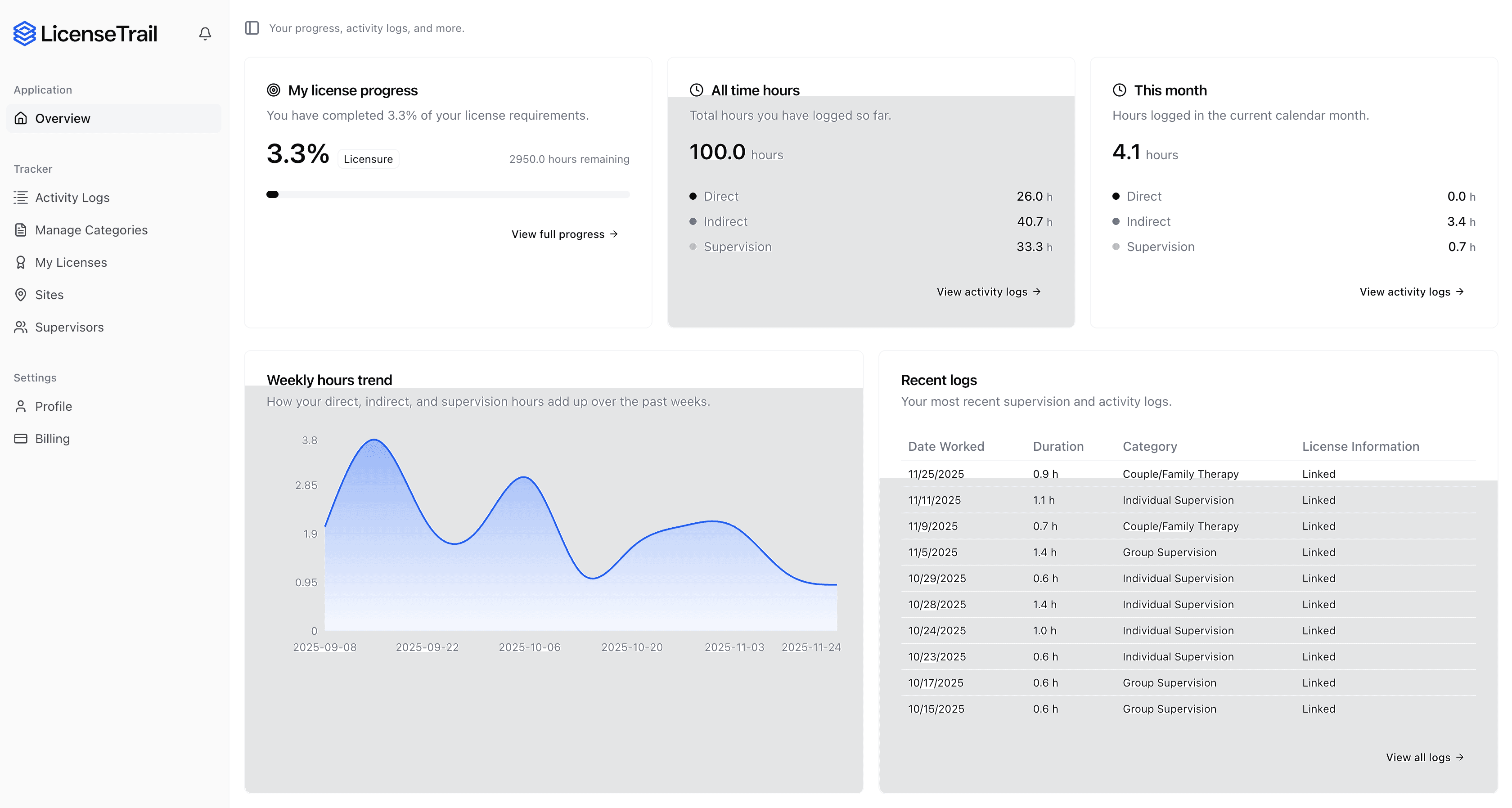
License Trail checks your direct, indirect, and supervision hours against Ohio LPC-TEMP requirements continuously and flags mismatches before you submit.
 Start Tracking for Free
No credit card required · Free plan available
Is your spreadsheet hiding Ohio LPC-TEMP risks?
Stop guessing if your categories match Ohio Counselor, Social Worker and Marriage and Family Therapist Board requirements. License Trail checks your direct, indirect, and supervision hours continuously and flags mismatches before you submit.
Import or log
Bring your spreadsheet or start fresh
Upload your existing tracking spreadsheet and we'll map every hour into the right Ohio Counselor, Social Worker and Marriage and Family Therapist Board categories automatically.
Verify against Ohio
Catch mismatches before the board does
License Trail checks your direct, indirect, and supervision hours against Ohio LPC-TEMP requirements continuously.
Export board-ready
One-click clean reports
Generate professional, board-ready reports for supervision meetings and Ohio Counselor, Social Worker and Marriage and Family Therapist Board submissions in seconds.
No credit card required · Free plan available