
Ohio LPC-S Requirements: Hours, Exams & Step-by-Step Guide
Stop guessing if your categories match Ohio requirements. License Trail checks your direct, indirect, and supervision hours against LPC-S requirements continuously and flags mismatches before you submit.
No credit card required · Free plan available
Quick Requirements Overview
- Regulator: Ohio CSWMFT Board (OAC 4757-17-01); “LPC‑S/LPCC‑S” = training supervision designation
- New designations are only awarded to LPCCs (i.e., LPCC‑S); new LPC‑S not issued after 1/1/2013 (grandfathered only)
- Prereq: Hold an Ohio LPCC in good standing
- Training: 24 hours supervision-specific education with ≥6 hours each in (1) assessment/evaluation/remediation (2) counselor development (3) management/administration (4) professional responsibilities (ethics/law)
- Experience: ≥1 year and 1,500 hours post‑LPCC clinical experience including diagnosis & treatment of mental/emotional disorders
- Supervision experience (within the 1,500 hours): observe 5 LPCC‑S supervision sessions + ≥1 hour review with the LPCC‑S; initial meeting face‑to‑face (video allowed)
- Ethics: Must comply with ACA ethical standards for supervision
- Maintenance: 3 hours Board‑approved supervision CE each renewal period
License Details
Procedures
In Ohio, the “LPC‑S” style title is formally called “licensed professional counselor with training supervision designation” and “licensed professional clinical counselor with training supervision designation.” Both are regulated by the Ohio Counselor, Social Worker, and Marriage & Family Therapist (CSWMFT) Board in rule 4757‑17‑01 and related rules.(codes.ohio.gov)
As of the current rules (effective August 18, 2025), new supervision designations for counselors are awarded only to Licensed Professional Clinical Counselors (LPCC). Licensed Professional Counselors (LPC) who already held a supervision designation before January 1, 2013 can keep it, but new LPCs cannot newly become “LPC‑S.”(codes.ohio.gov)
Below is a step‑by‑step guide focused on what you need to become an LPCC‑S (LPCC with training supervision designation) and how the Board defines the required hours.
1. Titles and abbreviations the Board uses
Ohio law defines the supervision designations and their abbreviations this way:(codes.ohio.gov)
-
“Licensed Professional Counselor with training supervision designation”
- Abbreviation: LPC‑S
- Definition: A counselor licensed as an LPC who has been awarded a training supervision designation under rule 4757‑17‑01.
- New LPC‑S designations are not issued after 1/1/2013; only existing LPC‑S counselors are “grandfathered.”(codes.ohio.gov)
-
“Licensed Professional Clinical Counselor with training supervision designation”
- Abbreviation: LPCC‑S
- Definition: A counselor licensed as an LPCC who has been awarded a training supervision designation under rule 4757‑17‑01.(codes.ohio.gov)
In practice, when people in Ohio say “LPC‑S” or “LPC‑S / LPCC‑S,” they are usually referring to the LPCC‑S path, because that is the only route currently open to new applicants.
2. Big‑picture prerequisites
Before you can apply for the training supervision designation, you must:
- Be licensed as an LPCC in Ohio (not just LPC).
- Be in good standing with the CSWMFT Board (no unresolved discipline, renewal current, etc.).
The supervision designation requirements build on top of your LPCC license; they do not replace the LPCC clinical experience and examination requirements in Revised Code 4757.22.(codes.ohio.gov)
3. Required supervision training coursework (24 hours)
Ohio requires 24 hours of specific academic or Board‑approved continuing education in supervision. These hours must be formally documented and spread across four content areas, with at least 6 hours in each area:(codes.ohio.gov)
-
Assessment, evaluation, and remediation (≥ 6 hours)
Content includes:- Initial, formative, and summative assessment of supervisee knowledge, skills, and self‑awareness
- Evaluation criteria and expectations, procedures, and methods for monitoring supervisee performance (direct and indirect)
- Feedback methods and processes for remediating supervisee skills and professional effectiveness
-
Counselor development (≥ 6 hours)
Content includes:- Models of supervision and learning
- Stages of supervisee and supervisor development
- Supervision interventions, learning styles, cultural differences, and multicultural competencies
- Relational dynamics and the developmental process of the supervisory relationship
-
Management and administration (≥ 6 hours)
Content includes:- Recordkeeping, reporting, monitoring of supervisee cases, collaboration, research and evaluation
- Policies/procedures for emergencies, case assignment and management
- Roles and responsibilities of supervisor and supervisee and institutional expectations
- Managing multiple roles and conducting summative and formative evaluations
-
Professional responsibilities (≥ 6 hours)
Content includes:- Ethical and legal issues in supervision (e.g., dual relationships, competence, due process, informed consent, supervisor liability, privileged communication, consultation)
- Ohio laws and regulations governing counseling and supervision
- Professional standards and credentialing, reimbursement, and institutional procedures
These 24 hours can be satisfied through graduate coursework or Board‑approved continuing education offerings, but they must explicitly be supervision training, not general clinical CE.(codes.ohio.gov)
4. Required clinical experience hours (post‑LPCC)
To qualify for the training supervision designation, you must complete a block of post‑licensure clinical experience as an LPCC:(codes.ohio.gov)
-
Minimum time:
- One (1) year of clinical experience after you are licensed as an LPCC.
-
Minimum hours:
- 1,500 hours of clinical experience post‑LPCC licensure.
-
Type of hours:
- The rule states that this must be “clinical experience, post licensed professional clinical counselor licensure, which shall include the diagnosis and treatment of mental and emotional disorders.”(codes.ohio.gov)
In other words, the 1,500 hours must be true clinical work as an LPCC, not just administrative or educational duties. Within those 1,500 hours, you must be actively diagnosing and treating mental and emotional disorders under your independent practice authority.
The Board does not break this into separate categories like “1,500 direct” and “1,500 supervised” hours for the supervision designation itself. The controlling requirement is 1,500 total clinical hours post‑LPCC, including diagnosis and treatment.
5. Required “supervision experience” within the 1,500 hours
Within those 1,500 post‑LPCC clinical hours, Ohio requires at least one structured supervision experience focused on learning supervision skills:(codes.ohio.gov)
The rule spells this out as:
-
Observation requirement
- You, as the LPCC in training for supervision, must observe five (5) training supervision sessions conducted by a licensed professional clinical counselor who already holds the supervision designation (an LPCC‑S).
-
Review session requirement
- After observing the five supervision sessions, you and the LPCC‑S must conduct a minimum one‑hour review session to process and review what you observed.
-
Contact format
- The supervisory relationship must start with an initial face‑to‑face meeting, which can be by videoconference, and subsequent contact can be in person, by videoconference, or by phone.(codes.ohio.gov)
This “one supervision experience” is in addition to the 24 hours of supervision coursework and is embedded within the 1,500 hours of clinical practice.
6. Ethical requirements
The Board explicitly requires that LPCCs seeking the supervision designation:
- Comply with the American Counseling Association (ACA) Ethical Standards as they apply to supervisory relationships.(codes.ohio.gov)
This expectation applies both while you are being trained as a supervisor and once you are providing training supervision to LPCs, LPCC candidates, or counselor trainees.
7. How the Board defines “training supervision” and hour ratios
Once you hold the training supervision designation (LPCC‑S), the kind of supervision you provide to supervisees is regulated under the definition of “training supervision” in rule 4757‑17‑01:(codes.ohio.gov)
-
Who is covered:
Training supervision is for:- Counselor trainees in practicum or internship
- LPCs gaining experience toward LPCC
- Others gaining board‑required counseling experience
-
Purpose:
It is for obtaining a license and/or developing new areas of proficiency, and it is an intentional process that requires substantial time and involvement from the supervisor. -
Minimum supervision‑to‑work ratio:
The Board requires that training supervision “shall include an average of one hour of contact between the supervisor and supervisee for every twenty hours of work by the supervisee.”(codes.ohio.gov)For example:
- 20 hours of client‑related work by the supervisee → at least 1 hour of training supervision
- 40 hours of work → at least 2 hours of supervision, and so on
This ratio is important when you later calculate and document the supervision hours you provide as an LPCC‑S for your supervisees’ licensure applications.
8. Maintaining the supervision designation (ongoing CE)
After the Board grants you the training supervision designation, you must complete ongoing continuing education in supervision to keep it:(codes.ohio.gov)
-
Who:
- All LPCs and LPCCs who hold the training supervision designation (LPC‑S or LPCC‑S).
-
Requirement per renewal cycle:
- 3 hours of counselor professional standards committee‑approved continuing professional education (CPE) in supervision every license renewal period.
The 3 supervision‑specific CE hours are in addition to your general CE requirements for license renewal.
9. Practical “at‑a‑glance” checklist for becoming LPCC‑S in Ohio
Putting the Board’s language and hour requirements into a single checklist:
- Hold an LPCC license in good standing.(codes.ohio.gov)
- Complete 24 documented hours of supervision training, with:(codes.ohio.gov)
- ≥ 6 hours: Assessment, evaluation, remediation
- ≥ 6 hours: Counselor development
- ≥ 6 hours: Management and administration
- ≥ 6 hours: Professional responsibilities (ethics, law, regulatory issues)
- Accrue at least 1 year and 1,500 hours of post‑LPCC clinical experience, which:(codes.ohio.gov)
- Occurs after you are licensed as an LPCC
- Includes diagnosis and treatment of mental and emotional disorders
- Complete at least one supervision experience within those 1,500 hours:(codes.ohio.gov)
- Observe 5 training supervision sessions conducted by an LPCC‑S
- Meet with that LPCC‑S for a minimum 1‑hour review of the observations
- Adhere to ACA ethical standards for supervision.(codes.ohio.gov)
- Apply to the CSWMFT Board for the “training supervision designation” using the Board’s forms and procedures, documenting:
- LPCC licensure
- 24 supervision training hours
- 1,500 post‑LPCC clinical hours (including diagnosis and treatment)
- Required supervision observation/review experience
- Maintain the designation by completing 3 hours of Board‑approved supervision CE every renewal period.(codes.ohio.gov)
Following these steps yields the formal Ohio title “Licensed Professional Clinical Counselor with training supervision designation”, abbreviated LPCC‑S, which is the active path equivalent of what many refer to generically as “LPC‑S” in other states.
Track your LPC-S hours with confidence
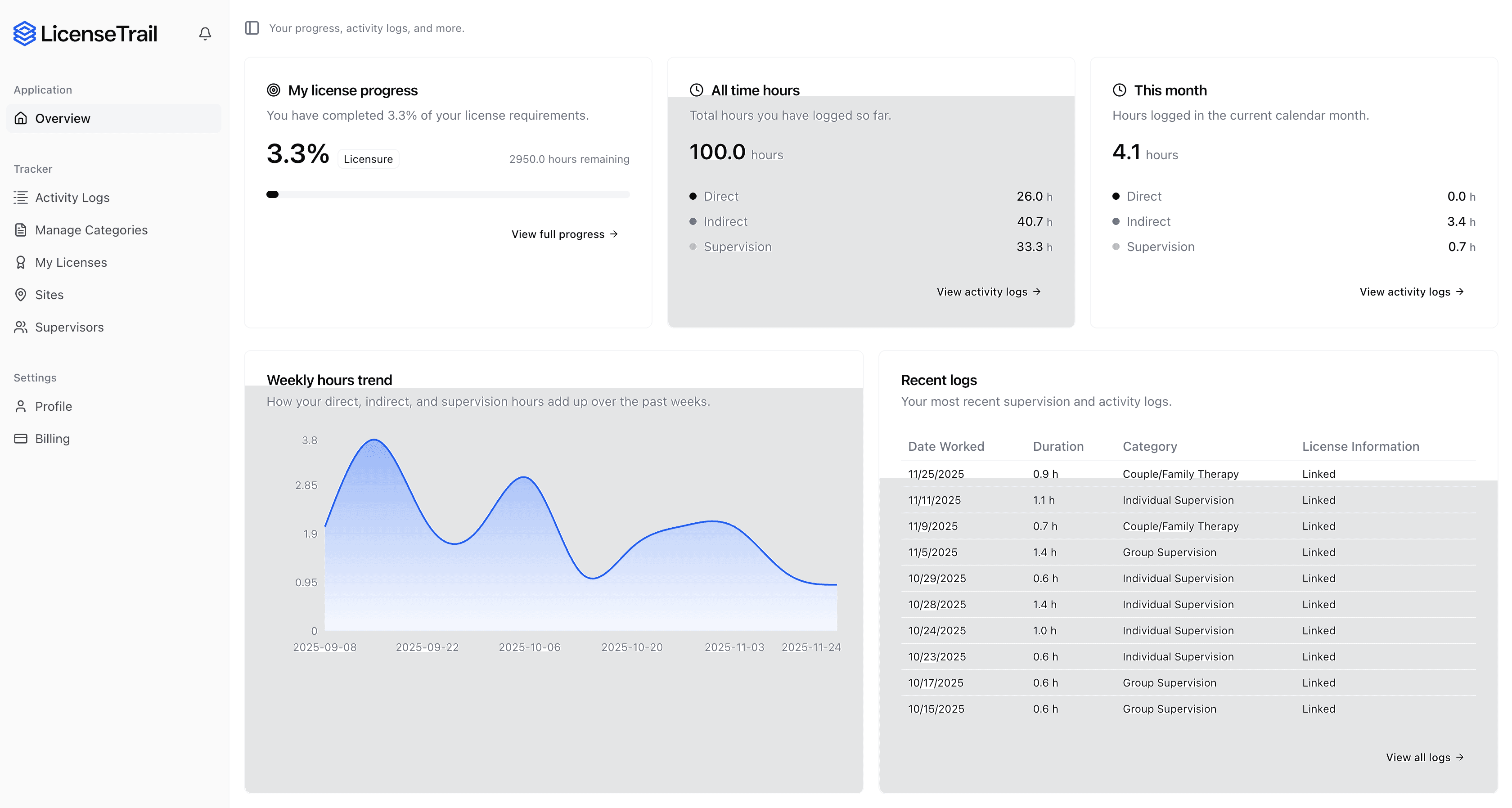
License Trail checks your direct, indirect, and supervision hours against Ohio LPC-S requirements continuously and flags mismatches before you submit.
 Start Tracking for Free
No credit card required · Free plan available
Is your spreadsheet hiding Ohio LPC-S risks?
Stop guessing if your categories match Ohio Counselor, Social Worker and Marriage and Family Therapist Board requirements. License Trail checks your direct, indirect, and supervision hours continuously and flags mismatches before you submit.
Import or log
Bring your spreadsheet or start fresh
Upload your existing tracking spreadsheet and we'll map every hour into the right Ohio Counselor, Social Worker and Marriage and Family Therapist Board categories automatically.
Verify against Ohio
Catch mismatches before the board does
License Trail checks your direct, indirect, and supervision hours against Ohio LPC-S requirements continuously.
Export board-ready
One-click clean reports
Generate professional, board-ready reports for supervision meetings and Ohio Counselor, Social Worker and Marriage and Family Therapist Board submissions in seconds.
No credit card required · Free plan available