
Ohio CT Requirements: Hours, Exams & Step-by-Step Guide
Stop guessing if your categories match Ohio requirements. License Trail checks your direct, indirect, and supervision hours against CT requirements continuously and flags mismatches before you submit.
No credit card required · Free plan available
Quick Requirements Overview
- Credential type: Voluntary registration (not a license) as Registered Counselor Trainee (CT) with the Ohio CSWMFT Board; used during grad practicum/internship.
- Eligibility: Must be a graduate counseling student enrolled in a practicum or internship and in a program meeting Ohio education standards (CACREP-aligned).
- Application basics: Apply via eLicense Ohio, meet background check/criminal standards, provide proof of enrollment, and file a Board training agreement.
- Practicum hours: ≥100 total hours, including ≥40 direct client service hours.
- Internship hours: ≥600 total hours, including ≥240 direct service hours (includes diagnosis/treatment activities under proper supervision).
- Supervision minimum: Avg 1 hour supervisor contact per 20 hours worked (e.g., ~5 hrs/100; ~30 hrs/600).
- Supervisor requirements: Must have training supervision designation; LPCC-S required when diagnosing/treating mental & emotional disorders.
- Limits/duration: Valid only for approved site(s) and dates on Board verification; can be extended up to 6 months post‑graduation; CT is not required by the Board for graduation but may be required by sites/schools.
License Details
Procedures
In Ohio, “CT” is not a full license but a voluntary registration as a Counselor Trainee with the Counselor, Social Worker and Marriage and Family Therapist Board (CSWMFT Board). It is used while you are in your graduate practicum and/or internship and allows you to use the title Registered Counselor Trainee (CT) and provide counseling services under supervision.
Below is a structured explanation of what the Board itself requires and how the hours are defined.
1. Legal definition and title
Ohio law and rules define a counselor trainee this way:
-
The Board’s definitions rule states that a “counselor trainee” is a graduate student who:
- is seeking voluntary registration under R.C. 4757.10,
- has filed a training agreement with the Board under rule 4757‑13‑09, and
- is currently enrolled in a practicum or internship in a counselor education program that meets the Board’s education rule. (codes.ohio.gov)
-
In the abbreviations rule, the Board specifies that “CT” means a “Registered Counselor Trainee.” (codes.ohio.gov)
So, Ohio uses the term registration rather than “license” for this status, but employers and schools often call it “CT licensure” informally.
2. When CT registration is used (and when it isn’t required)
The counselor‑trainee registration rule (Ohio Admin. Code 4757‑13‑09) says:
-
Who is eligible: “Counseling students enrolled in a practicum or internship in Ohio prior to receiving their counseling degree are eligible to register as a ‘counselor trainee.’” (codes.ohio.gov)
-
Not mandatory for graduation: The Board explicitly says students are not required by the Board to have CT status in order to complete their practicum or internship, even when those include supervised counseling services. Agencies or universities may still require CT registration as a condition of placement, and students may choose to apply voluntarily. (codes.ohio.gov)
In practice, many sites in Ohio expect practicum/internship students to have CT registration.
3. Educational setting and type of program
To be eligible, your practicum or internship must be in a graduate counseling program that meets the Board’s education standards for Licensed Professional Counselor (LPC):
- The education rule (4757‑13‑01) requires a graduate degree in counseling and specifies that:
- Practicum must be a supervised training experience providing counseling to bona fide clients.
- “A practicum must conform to CACREP standards in place at the time the practicum is completed.”
- Internship must be an on‑the‑job counseling experience acceptable to the Board, and “the internship must meet CACREP standards” (with limited waiver authority). (codes.ohio.gov)
Because the Board incorporates CACREP standards, the hour requirements below are effectively the Ohio standard for practicum and internship used with CT registration.
4. Hour requirements and types of experience
4.1 Practicum hours (pre‑internship)
Ohio’s CT application instructions (originally published by the CSWMFT Board and quoted in official guidance) spell out the practicum minimums:
-
Total practicum hours:
A practicum “consists of no less than 100 hours”. -
Direct service requirement:
Of those, “40 hours are direct service … with clients and/or groups.” (yumpu.com)
This aligns with current CACREP standards (minimum 100 hours practicum with at least 40 hours of direct service to actual clients). (nap.nationalacademies.org)
Direct service / direct client contact generally means:
- Face‑to‑face counseling or psychotherapy with individuals, couples, families, or groups.
- Activities that directly use counseling skills (assessment, intervention, treatment planning) rather than purely administrative tasks.
The remaining practicum hours (up to 60) are typically indirect activities such as case notes, case conferences, treatment planning, trainings, and observation.
4.2 Internship hours
The same Board‑originated CT instructions and CACREP standards define the internship minimums:
-
Total internship hours:
Internship is “no less than 600 … hours” of supervised counseling work. -
Direct service requirement:
Of those 600 hours, “240 hours shall be in direct services”, which “include diagnosis and treatment of mental and emotional disorders and conditions” (those diagnostic/treatment activities must be under appropriate clinical supervision—see supervision section below). (yumpu.com)
Again, this matches CACREP’s baseline: a minimum 600‑hour internship with at least 240 hours of direct service to clients. (nap.nationalacademies.org)
So, for the fieldwork associated with CT status, the Board‑linked requirements are:
- Practicum:
- ≥ 100 total hours, with
- ≥ 40 hours of direct client service.
- Internship:
- ≥ 600 total hours, with
- ≥ 240 hours of direct client service (including diagnosis/treatment tasks under appropriate supervision).
There is no separate CT‑only requirement like “1,500 hours of direct experience and 1,500 hours of supervised experience.” Numbers of that size apply later to post‑master, post‑LPC supervised experience for LPCC, not to the counselor‑trainee stage.
4.3 Required supervision hours while you are a CT
The supervision rule (4757‑17‑01, updated August 18, 2025) sets a minimum supervision ratio for all “training supervision,” which includes counselor trainees:
- Training supervision requirement:
“Training supervision shall include an average of one hour of contact between the supervisor and supervisee for every twenty hours of work by the supervisee.” (codes.ohio.gov)
Applied to your hours:
- In a 100‑hour practicum, you should receive about 5 hours of documented supervision.
- In a 600‑hour internship, you should receive about 30 hours of documented supervision.
This is in addition to any group supervision required by your university; from the Board’s perspective, what matters is that the 1:20 supervision contact ratio is met and documented.
5. Supervisor qualifications and scope of practice as a CT
The Board rules address both who may supervise you and what your scope of practice is as a CT.
5.1 Who can supervise a Counselor Trainee
Two rules are key:
-
The CT registration rule says a counselor trainee “shall be supervised by a licensed professional clinical counselor” and, in internships, must have duties that include diagnosis and treatment of mental and emotional disorders, with supervision under the counseling‑supervision rule. (codes.ohio.gov)
-
The updated supervision rule (4757‑17‑01) clarifies this more precisely:
- All counselor trainees seeking LPC licensure must be under “a licensed professional counselor with training supervision designation or a licensed professional clinical counselor with training supervision designation.”
- However, “a licensed professional clinical counselor with supervision designation shall supervise the counselor trainee when diagnosing and treating mental and emotional disorders.” (codes.ohio.gov)
In practical terms:
-
For general counseling practice (non‑diagnostic, non‑treatment tasks), your training supervisor may be:
- LPC‑S (Licensed Professional Counselor with supervision designation), or
- LPCC‑S (Licensed Professional Clinical Counselor with supervision designation).
-
For any diagnosis and treatment of mental and emotional disorders (which are required parts of internship direct hours), you must be under an LPCC‑S.
Your supervisor must also meet the Board’s training‑supervision education and experience criteria (supervision coursework, clinical experience, etc.). (codes.ohio.gov)
5.2 Scope of practice as a CT
The CT rule states that counselor trainees:
- “Have the same scope of practice as a licensed professional counselor” (LPC) under the LPC scope rule, **“but require much closer supervision during the training process.” (codes.ohio.gov)
Put simply:
- With proper supervision, a CT can engage in:
- Intake and assessment,
- Counseling/psychotherapy with individuals, couples, families, and groups,
- Diagnosis and treatment planning (under LPCC‑S when diagnosing/treating disorders),
- Documentation and case management within the LPC scope.
- BUT every aspect of that work must be overseen under the training supervision framework, and you may not function independently.
6. Formal requirements to register as a Counselor Trainee (CT)
The CT registration rule (4757‑13‑09) lists what applicants must do. Summarized:
-
Meet criminal‑conviction standards
- You must “meet the board’s requirements for criminal convictions as established under section 9.79 of the Revised Code” and
- Complete criminal records checks under the Board’s background‑check rule (4757‑1‑04). (codes.ohio.gov)
-
Apply on the Board’s form via eLicense Ohio
- You must apply on a form specified by the Board and comply with application procedures and fees in rule 4757‑1‑04. (codes.ohio.gov)
-
Show proof of enrollment in the correct course
- You must provide proof of enrollment in a master’s or doctoral‑level practicum or internship course in counseling.
- Acceptable proof includes a university enrollment printout or a letter/email/fax from the professor, counseling office, or registrar verifying your enrollment. (codes.ohio.gov)
-
Training agreement and extensions
- You must file a training agreement (this is part of the Board’s definition of “counselor trainee”) that identifies:
- your site(s),
- your supervisor(s),
- and the dates of your practicum or internship. (codes.ohio.gov)
- To extend your CT registration through additional terms (e.g., from practicum to internship), you must again provide proof of enrollment for the new course; the Board may require a separate application for practicum and for internship. (codes.ohio.gov)
- You must file a training agreement (this is part of the Board’s definition of “counselor trainee”) that identifies:
-
Registration is site‑ and date‑limited
- CT status “is only valid at the school approved field placement site(s) where the student is completing his or her field placement, and through the dates listed on the board’s online license verification system.”
- CT status is active only within those dates. (codes.ohio.gov)
-
Post‑graduation extension
- CT status may be extended for up to six months following the trainee’s date of graduation, if needed while you complete remaining internship or transition. (codes.ohio.gov)
-
Responsibility for being properly registered
- The rule makes clear that ensuring you are properly registered and listed on the state licensure website is “the responsibility of the counselor trainee,” though the workplace supervisor/agency is expected to monitor this at placement and at extensions. (codes.ohio.gov)
7. How the CT hour requirements differ from later licensure hours
The numbers you often hear at the LPC/LPCC level—3,000 total hours, 1,500 direct client hours, 150 hours of supervision, over at least two years—are for post‑master supervised practice leading to the Licensed Professional Clinical Counselor (LPCC) credential, not for counselor‑trainee registration. (humanservicesedu.org)
For CT registration, the Board‑linked hour expectations are:
-
Practicum:
- ≥ 100 hours total
- ≥ 40 hours direct client contact
-
Internship:
- ≥ 600 hours total
- ≥ 240 hours direct client contact (including diagnosis/treatment tasks under LPCC‑S supervision)
-
Supervision during practicum & internship:
- Average 1 hour of supervisor contact for every 20 hours of work (training supervision). (codes.ohio.gov)
Those are the key hour and supervision benchmarks that attach specifically to being registered as a CT with the Ohio CSWMFT Board.
Track your CT hours with confidence
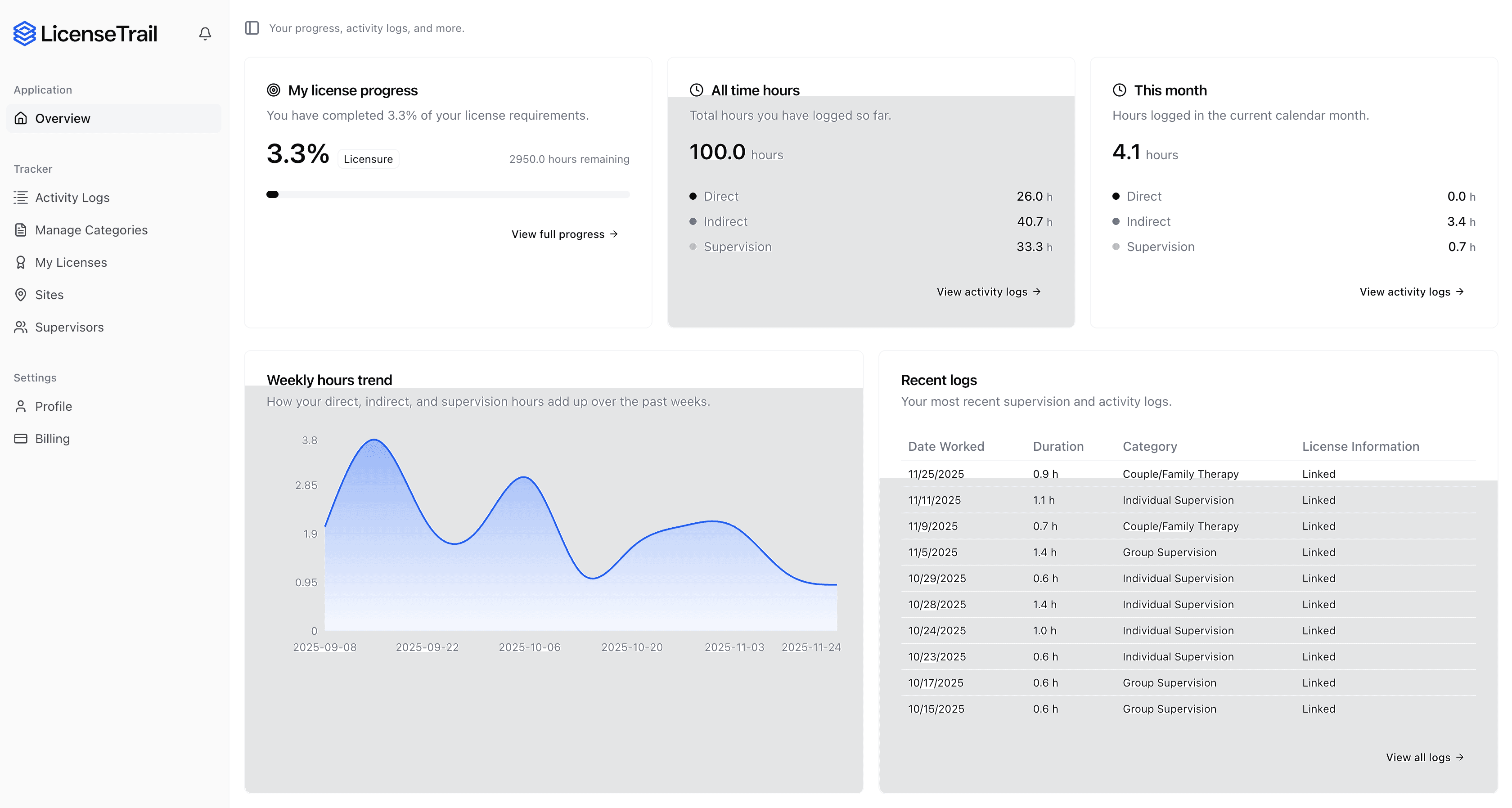
License Trail checks your direct, indirect, and supervision hours against Ohio CT requirements continuously and flags mismatches before you submit.
 Start Tracking for Free
No credit card required · Free plan available
Is your spreadsheet hiding Ohio CT risks?
Stop guessing if your categories match Ohio Counselor, Social Worker and Marriage and Family Therapist Board requirements. License Trail checks your direct, indirect, and supervision hours continuously and flags mismatches before you submit.
Import or log
Bring your spreadsheet or start fresh
Upload your existing tracking spreadsheet and we'll map every hour into the right Ohio Counselor, Social Worker and Marriage and Family Therapist Board categories automatically.
Verify against Ohio
Catch mismatches before the board does
License Trail checks your direct, indirect, and supervision hours against Ohio CT requirements continuously.
Export board-ready
One-click clean reports
Generate professional, board-ready reports for supervision meetings and Ohio Counselor, Social Worker and Marriage and Family Therapist Board submissions in seconds.
No credit card required · Free plan available