
Ohio LSW Requirements: Hours, Exams & Step-by-Step Guide
Stop guessing if your categories match Ohio requirements. License Trail checks your direct, indirect, and supervision hours against LSW requirements continuously and flags mismatches before you submit.
No credit card required · Free plan available
Quick Requirements Overview
- Qualifying degree: BSW, MSW, or doctoral degree in social work from an accredited institution (CSWE-accredited programs generally satisfy coursework review)
- Education must include a supervised practicum/field experience meeting CSWE requirements, focused on social intervention and coordinated by an individual with an advanced social work degree
- No post-degree employment/experience hours or supervision-hour totals are required to obtain the LSW (those apply to LISW)
- Submit completed application under oath, required fee, and official transcripts
- Complete required criminal records checks (BCI/FBI) as part of initial licensure
- Obtain Board approval to test, then pass the Board-administered social worker examination; exam must be passed within 7 years of application (with limited exceptions)
License Details
Procedures
In Ohio, the Licensed Social Worker (LSW) is the entry‑level social work license issued by the Counselor, Social Worker and Marriage and Family Therapist Board (CSWMFT Board). It is distinct from the Licensed Independent Social Worker (LISW), which is the independent/clinical level and is where the well‑known “3,000 hours” requirement appears.
For LSW licensure specifically, Ohio law and the Board’s rules focus on:
- Having the right degree in social work (with required coursework and field education),
- Completing an application and background checks, and
- Passing an examination administered by the Board.
They do not set a specific number of post‑degree practice or supervision hours to obtain the LSW.
Below is a step‑by‑step guide, keyed directly to the Ohio Revised Code (ORC) and Ohio Administrative Code (OAC), with the Board’s own wording where it defines hours and supervision.
1. What the LSW License Is, in Ohio Law
The LSW is simply the “social worker” license in Ohio:
- The Board defines “Social Worker” as a license type in its definitions rule.(codes.ohio.gov)
- The Board’s title/abbreviation rule states that “LSW” means a “Social Worker”, and “LSW‑TEMP” means a “Social Worker with a temporary license.”(codes.ohio.gov)
In statute, ORC 4757.28 governs the social worker license. The law requires that:
- The Social Worker Professional Standards Committee shall issue a license as a social worker to each applicant who:
- Submits a properly completed application and pays the fee, and
- Meets specified degree and examination requirements.(codes.ohio.gov)
There is no post‑degree experience‑hours requirement in ORC 4757.28.
2. Educational Requirements (Degree and Coursework)
The Board’s primary LSW rule is OAC 4757‑19‑01, “Requirements for licensure as a social worker.”(codes.ohio.gov)
2.1 Qualifying degrees
The rule states that the applicant must have:
“a bachelor’s degree in social work or a master’s degree in social work, or a doctoral degree in social work from an appropriately accredited educational institution” (codes.ohio.gov)
This mirrors ORC 4757.28(B)(1), which requires a baccalaureate, master’s, or doctorate in social work from an accredited institution.(codes.ohio.gov)
2.2 CSWE‑accredited degrees vs. “show your coursework”
In the same rule, the Board says that your degree must show certain coursework unless it is from a CSWE‑accredited program:
- The rule provides a set of required coursework areas (human development and behavior, social work practice courses, social welfare and policy, social work theory, research, etc.).(codes.ohio.gov)
- Then it states that if the degree is accredited by the Council on Social Work Education (CSWE), it “is recognized as a qualifying degree in social work,” and the detailed coursework breakdown is not re‑evaluated.(codes.ohio.gov)
For most applicants from CSWE‑accredited BSW/MSW programs, this means the program itself demonstrates that the curriculum (including field) meets the Board’s standard.
3. Practicum / Field Experience Requirements for LSW
The Board’s only “hours‑type” requirement tied directly to LSW preparation is your practicum/field education as part of the degree.
Under OAC 4757‑19‑01(C)(5), the Board requires that your degree include:
“A supervised practicum and/or field experience that meets CSWE requirements, with a primary focus on social intervention coordinated by an individual with an advanced degree in social work.” (codes.ohio.gov)
Key points:
- The Board does not set a specific numeric hour total for practicum/field in its own rules (no “400 hours,” “900 hours,” etc.).
- Instead, it adopts CSWE standards by reference (“meets CSWE requirements”), and requires that the field experience focus on social intervention and be coordinated by someone with an advanced social work degree.(codes.ohio.gov)
- The rule allows the committee, at its discretion, to waive certain field experience hours or approve alternative means if the program can attest to the applicant’s competence after field experience.(codes.ohio.gov)
So, for LSW licensure, there is no Board‑mandated fixed number of practicum hours. The actual hour total is whatever your CSWE‑accredited program requires to comply with CSWE’s standards.
4. Application, Documentation, and Background Checks
OAC 4757‑19‑01(B) lays out the core application requirements for LSW:(codes.ohio.gov)
-
Application under oath
- The applicant must submit a completed official application form made under oath and all requested information.
-
Official transcripts
- “The applicant’s education shall be documented by official college transcripts” and educational requirements must be from “accredited colleges or universities.”
-
Fees
- The required fee must be submitted as set in the Board’s fee rule (OAC 4757‑1‑05).
-
Exam approval documentation
- The applicant must submit documentation needed for examination approval under the Board’s exam policy rule (OAC 4757‑19‑04).(codes.ohio.gov)
-
Examination timing
- Applicants must have passed the required exam within seven years of the application date, unless currently licensed in an equivalent capacity in another state and previously passed the exam as part of that state’s licensure.(codes.ohio.gov)
-
Board review and notification
- Applications are reviewed once all information is received, and applicants are notified of the action taken.(codes.ohio.gov)
In addition, the Board’s general first‑licensure rule (OAC 4757‑1‑04) requires all new license applicants to file an application with the executive director and to complete criminal records checks (BCI/FBI) as specified.(codes.ohio.gov)
5. Examination Requirement for LSW
The examination requirement comes from statute and rule:
-
ORC 4757.28(B)(2) requires that an LSW applicant:
“must pass an examination administered by the board for the purpose of determining ability to practice as a social worker.” (codes.ohio.gov)
-
OAC 4757‑19‑04, the Board’s “Social worker examination policy,” says that:
- Applicants must have applied for licensure under the LSW rule (4757‑19‑01),
- Must be approved by the Board before sitting for the exam, and
- Once approved, receive an approval letter (or email) that is valid for up to 12 months for exam admission.(codes.ohio.gov)
In practice, this exam is an ASWB social work exam at the level specified by the Board’s current policy, but the controlling legal language is simply that it is “an examination administered by the board” to determine competence as a social worker.
6. What “Hours” the Ohio Board Does – and Does Not – Require for LSW
Because your question specifically asks about “type of hours required” and Board verbiage, it’s important to separate LSW requirements from the LISW (independent) requirements, which often cause confusion.
6.1 Hours for LSW licensure
For the LSW itself, Ohio law and the Board’s rules:
-
Do require:
- Completion of a supervised practicum/field experience that “meets CSWE requirements” and focuses on social intervention, coordinated by someone with an advanced social work degree.(codes.ohio.gov)
-
Do NOT require:
- Any specified number of post‑degree employment hours;
- Any specified number of supervised practice hours after graduation to obtain the LSW;
- Any ratio (e.g., “1 hour of supervision for every 20 hours of work”) for LSW licensure.
All numerical experience/supervision hour requirements in Ohio’s social work rules appear only in connection with independent (LISW) licensure and its training supervision, not with the initial LSW license.
6.2 How “employment experience” is defined
To make the distinction explicit, the Board defines “employment” and “experience” in its definitions rule:
- OAC 4757‑3‑01(M) states that “employee,” “employed,” “employment,” and “experience” all refer to work for a fee or salary,
- And do not include “practicum and/or internship experiences taken as part of an educational program.” (codes.ohio.gov)
So, practicum/field hours in your degree program are categorically different from the “employment experience” hours required later for independent licensure.
7. The 3,000‑Hour and 1,500‑Per‑Year Rules (for LISW, Not LSW)
Your example mentioned “1,500 hours of direct experience and 1,500 hours of supervised experience.” Ohio’s Board does not use that exact breakdown for any social work license. What it does have is:
7.1 LISW experience hours
For the Licensed Independent Social Worker (LISW), OAC 4757‑19‑02(D)(2) defines the required supervised employment experience:
- The rule requires “two years of supervised social work experience.”
- It then defines “two years employment experience” as supervised experience that:
- Includes “three thousand hours of work for a fee, salary or other consideration”,
- During which the applicant was practicing social work and held LSW licensure, and
- “no applicant may be credited with more than fifteen hundred hours of experience during any twelve‑month period.” (codes.ohio.gov)
These 3,000 hours (with a 1,500‑per‑year cap) are entirely about qualifying for LISW, not for the initial LSW license.
7.2 LISW training supervision hours
In OAC 4757‑23‑01(F)(1), the Board sets the training supervision requirement that accompanies those LISW experience hours:
- It requires “one hour of individual and/or group supervision for each twenty hours of work by the supervisee with no less than one hundred fifty hours total.” (codes.ohio.gov)
Again, this is only for LSWs who are seeking LISW. It is not required to obtain or maintain the LSW itself.
8. Optional: Social Worker Trainee (SWT) During Master’s Field
While not required for LSW licensure, the Board has a Social Worker Trainee (SWT) status for master’s students in field:
- OAC 4757‑19‑05 explains that SWT registration is for master’s‑level CSWE students who are not yet licensed and are in a field education course (practicum/internship/field work).(codes.ohio.gov)
- The purpose is to help students secure field placements; students are not required by law to obtain SWT status to complete field but may need it if required by an agency.(law.cornell.edu)
SWTs “have the same scope of practice as a licensed social worker” at the field site (with supervision), but SWT hours are educational field hours, not counted as LISW employment experience under the Board’s definitions.(law.cornell.edu)
9. Putting It All Together: Path to LSW in Ohio
In practical sequence, based on current law and Board rules:
-
Complete a qualifying social work degree
- BSW, MSW, or DSW/PhD in social work from an accredited institution.
- If CSWE‑accredited, it is automatically recognized as a qualifying degree.(codes.ohio.gov)
- Includes a supervised practicum/field experience that meets CSWE requirements and focuses on social intervention.(codes.ohio.gov)
-
(Optional) Become a Social Worker Trainee during MSW field
- Register as SWT if your field site requires it, while enrolled in a CSWE‑accredited master’s field course.(codes.ohio.gov)
-
Apply for the LSW
- File the official application under oath with the Board, per OAC 4757‑19‑01 and 4757‑1‑04.(codes.ohio.gov)
- Submit official transcripts and pay required fees.
-
Complete background checks and any Board‑required jurisprudence components
- Under the general first‑licensure rule, complete BCI/FBI checks as required; most licensees also complete a Board laws/rules review as part of the process.(codes.ohio.gov)
-
Obtain exam approval and pass the LSW exam
- Receive exam approval from the Board under OAC 4757‑19‑04.(codes.ohio.gov)
- Pass the social worker exam administered by or through the Board, as required by ORC 4757.28(B)(2).(codes.ohio.gov)
-
Receive LSW (or LSW‑TEMP pending transcripts)
- Once all requirements are met, the Board issues the LSW. A temporary LSW license can be issued in limited circumstances pending degree posting or final paperwork, under OAC 4757‑19‑06 and ORC 4757.28(C).(codes.ohio.gov)
Throughout this process, there is no additional Board‑mandated hour count beyond the practicum/field requirement embedded in your CSWE‑compliant degree. All numerical hour requirements (3,000 work hours, 1,500‑per‑year cap, 150 hours of training supervision, 1:20 supervision ratio) belong to the post‑LSW supervision and experience required for LISW, not to becoming an LSW.
Track your LSW hours with confidence
License Trail checks your direct, indirect, and supervision hours against Ohio LSW requirements continuously and flags mismatches before you submit.
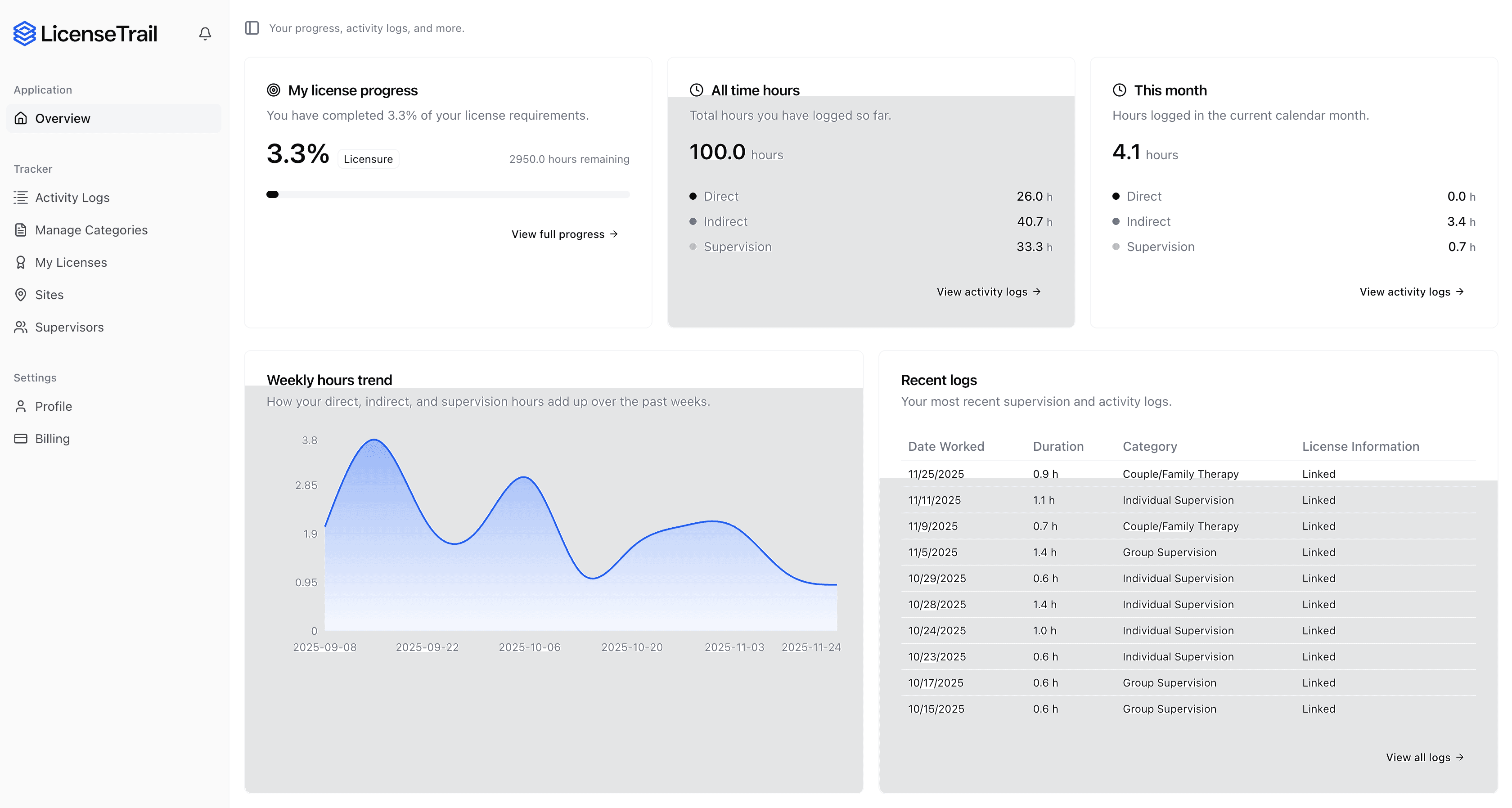 Start Tracking for Free
No credit card required · Free plan available
Is your spreadsheet hiding Ohio LSW risks?
Stop guessing if your categories match Ohio Counselor, Social Worker and Marriage and Family Therapist Board requirements. License Trail checks your direct, indirect, and supervision hours continuously and flags mismatches before you submit.
Import or log
Bring your spreadsheet or start fresh
Upload your existing tracking spreadsheet and we'll map every hour into the right Ohio Counselor, Social Worker and Marriage and Family Therapist Board categories automatically.
Verify against Ohio
Catch mismatches before the board does
License Trail checks your direct, indirect, and supervision hours against Ohio LSW requirements continuously.
Export board-ready
One-click clean reports
Generate professional, board-ready reports for supervision meetings and Ohio Counselor, Social Worker and Marriage and Family Therapist Board submissions in seconds.
No credit card required · Free plan available