
Ohio SWT Requirements: Hours, Exams & Step-by-Step Guide
Stop guessing if your categories match Ohio requirements. License Trail checks your direct, indirect, and supervision hours against SWT requirements continuously and flags mismatches before you submit.
No credit card required · Free plan available
Quick Requirements Overview
- Credential type: SWT is a registration (not a license) for master’s-level social work students in field placement.
- Eligibility: Enrolled in a CSWE-accredited/candidate MSW program and currently in practicum/internship/field work.
- Not for already-licensed: Must not already hold an Ohio social work license (e.g., LSW/LISW).
- Application: Submit the Board online application and provide proof of current field-course enrollment.
- Background check: Ohio BCI + FBI fingerprint-based criminal records check required; results must go directly to the Board.
- Fees: Non-refundable fee required (confirm current SWT fee with the Board).
- Practice limits: Valid only at school-approved field placement site(s) and only for the dates shown in online verification; not a substitute for licensure.
- Supervision & hours: Must be supervised (LSW MSW, LISW, or LISW-S; psychotherapy/diagnosis requires LISW-S); no fixed hour minimums required for SWT registration; can extend up to 6 months post-graduation.
License Details
Procedures
In Ohio, “Social Worker Trainee” (SWT) is a registration, not a full license. It is issued by the Counselor, Social Worker, and Marriage and Family Therapist Board to master’s‑level social work students so they can hold a recognized status while completing field placement. The Board’s rules are in Chapter 4757 of the Ohio Administrative Code and are quite specific about who can be an SWT, where they can practice, and who must supervise them—but they do not set a required number of hours (such as 1,500 or 3,000) for SWT registration. (codes.ohio.gov)
Below is a step‑by‑step guide based directly on the Board’s rules and wording.
1. How Ohio Defines a Social Worker Trainee (SWT)
Under the Board’s definitions rule, a “social worker trainee” is:
- A graduate student seeking voluntary registration under section 4757.10 of the Revised Code,
- Who is currently enrolled in a master’s-level practicum, internship, or field work course in a social work program accredited by the Council on Social Work Education (CSWE) or a program in candidate status for CSWE accreditation. (codes.ohio.gov)
The abbreviations rule further states: “‘SWT’ means a registered ‘Social Worker Trainee.’” (codes.ohio.gov)
Key implications:
- SWT status is only for master’s‑level MSW students.
- You must be in a CSWE‑accredited (or candidate) MSW program and actively in a field education course (practicum/internship/field work).
2. Overall Purpose of SWT Status
The SWT rule explains that:
- Registration of training supervision is only for master’s‑level students from CSWE‑accredited programs who are not licensed as social workers.
- The purpose is to “aid non‑licensed master’s level social work students to acquire field placement at an agency.” (codes.ohio.gov)
- Students are not required to have SWT status in order to complete field placement (including providing supervised psychosocial interventions), but an agency may require SWT registration as a condition for accepting a student. (codes.ohio.gov)
So SWT is:
- Optional under state law, but
- Often required by agencies as part of placement or employment.
3. Core Eligibility Requirements
To qualify for SWT registration, the Board requires the following (Rule 4757‑19‑05): (codes.ohio.gov)
-
Be a qualifying MSW student
- You must be enrolled in a master’s‑level field education course (practicum, internship, or field work) in a CSWE‑accredited or candidate program.
-
Meet the Board’s criminal‑conviction standards
- You must meet the Board’s requirements for criminal convictions as established under section 9.79 of the Revised Code. (codes.ohio.gov)
-
Complete a criminal records check
- Per the general applications rule (4757‑1‑04), all applicants for an initial license or registration, including social worker trainees, must complete an Ohio and FBI criminal records check, with fingerprints sent directly to the Board by the Bureau of Criminal Identification and Investigation. (codes.ohio.gov)
-
Not already be licensed as a social worker
- SWT status is only for students who are not currently licensed as social workers (LSW or LISW). (codes.ohio.gov)
4. Step‑by‑Step Application Process
Step 1 – Confirm enrollment in field education
You must be currently enrolled in a master’s‑level field education course (practicum/internship/field work). The SWT rule requires you to:
- Provide proof of enrollment, such as:
- A copy of the university’s online enrollment document, or
- A letter, email, or fax from a professor, the social work office, or the registrar confirming that you are enrolled. (codes.ohio.gov)
Step 2 – Complete the Board’s SWT application online
Under the SWT rule and the general application rule: (codes.ohio.gov)
- You must file an application with the Board using its online system.
- You will create a user ID and password; this functions as your legal signature on the application.
- You must provide all required information, including any transcripts or enrollment documentation requested.
Step 3 – Undergo the required criminal records check
Rule 4757‑1‑04 requires for SWT registration: (codes.ohio.gov)
- An Ohio BCI and FBI background check with fingerprints.
- The results must be sent directly to the Board.
- The Board will not issue the SWT registration until the background check results are received and reviewed.
Step 4 – Pay any required fee (if applicable)
The Board’s general fee rule states that: (codes.ohio.gov)
- The appropriate non‑refundable fee must accompany the application for licensure or registration.
- Exact SWT registration fees are not itemized separately in the fee table, so applicants should confirm the current SWT fee amount on the Board’s website or with Board staff.
Step 5 – Maintain ongoing proof of enrollment
To extend or keep SWT status active as you continue through additional semesters of field education, you must:
- Provide updated proof of enrollment each new quarter or semester of your field education course, as specified in paragraph (E) of the SWT rule. (codes.ohio.gov)
5. Scope of Practice as an SWT
The SWT rule explicitly states that a social worker trainee will:
- “Have the same scope of practice as a licensed social worker” as defined in rule 4757‑21‑02. (codes.ohio.gov)
“Social work” in the definitions rule includes: (codes.ohio.gov)
- Applying specialized knowledge of human development and behavior and social, economic, and cultural systems,
- Providing counseling, psychosocial interventions, and social psychotherapy,
- Assisting individuals, families, and groups to improve or restore social functioning.
However, SWT status does not make you independently licensed:
- The rule states that “social worker trainee status is not a substitute for licensure” and is only valid at the school‑approved field placement site(s) during the dates listed in the Board’s online license verification system. (codes.ohio.gov)
6. Supervision Requirements
Supervision is tightly defined for SWTs. The SWT rule requires that you: (codes.ohio.gov)
-
Be supervised at your field placement by one of the following:
- A licensed social worker with a master’s degree in social work,
- A licensed independent social worker (LISW), or
- A licensed independent social worker with training supervision designation (LISW‑S).
-
Have psychotherapy supervision specifically from an LISW‑S:
- Only a licensed independent social worker with a supervision designation may supervise an SWT who is engaged in “the practice of social psychotherapy, which includes the diagnosis and treatment of mental and emotional disorders.”
This means:
- Routine casework, psychosocial interventions, and many counseling tasks can be supervised by an MSW‑level LSW or any LISW.
- If you are doing diagnosis and treatment of mental and emotional disorders, you must be under a LISW‑S.
7. Time Limits and Duration of SWT Status
The SWT rule sets clear limits on when SWT status is valid: (codes.ohio.gov)
- SWT status:
- Is valid only at the specific school‑approved field placement site(s) listed for you, and
- Is active only for the dates shown on the Board’s online license verification system.
- Extension after graduation:
- SWT status may be extended for up to, but no more than, six months following your date of graduation.
After that extension period ends, you would move toward appropriate licensure (e.g., LSW) or other status; SWT status cannot be used indefinitely.
8. Hour Requirements: What the Board Does and Does Not Require for SWT
You asked specifically about “the type of hours required” and whether the Board has requirements like “1,500 hours of direct experience and 1,500 hours of supervised experience.”
For SWT status
A close reading of the SWT rule (4757‑19‑05), the definitions rule (4757‑3‑01), and the general application rule (4757‑1‑04) shows:
- The Board does not specify any minimum number of total practice hours, direct client hours, or supervision hours to obtain or maintain SWT registration. (codes.ohio.gov)
- Instead, the SWT requirements are:
- Being a qualifying MSW student in field education,
- Completing the background check and application,
- Being supervised by appropriately licensed social workers, and
- Staying within the approved dates and sites of your field placement.
Your field placement hours are governed primarily by:
- CSWE accreditation standards, and
- Your university’s program requirements,
not by an SWT‑specific hour count in Board rules.
For comparison: hour requirements for later independent licensure (LISW)
The Board does impose specific hour requirements after graduation for applicants seeking a Licensed Independent Social Worker (LISW) license:
- Rule 4757‑19‑02 defines two years of supervised social work experience as:
- “Three thousand hours of work”,
- During which the applicant is engaged in social work and holds a social worker license,
- And no applicant can be credited with more than “fifteen hundred hours of experience during any twelve‑month period.” (codes.ohio.gov)
These 3,000/1,500‑hour thresholds do not apply to SWT registration; they are only relevant when you later pursue independent (LISW) licensure.
9. Title Use and Abbreviation
The abbreviations rule clarifies that: (codes.ohio.gov)
- “SWT” is the proper abbreviation for Social Worker Trainee.
- Licensees and registrants must use only titles and abbreviations that correspond to licenses or registrations they actually hold.
- Using an abbreviation for a license/registration you do not hold can be treated as unauthorized title use under section 4757.02 of the Revised Code.
So once your SWT registration is granted and visible in the online license verification system, you may properly sign documents with “SWT” after your name (e.g., “Jane Doe, SWT”), but you may not use “LSW” or “LISW” unless and until you hold those licenses.
10. Quick Checklist for Becoming an SWT in Ohio
-
Be an MSW student
- Enrolled in a CSWE‑accredited (or candidate) MSW program.
- Currently taking a master’s‑level practicum/internship/field work course.
-
Secure a field placement
- Site approved by your school.
- Willing to host you as an SWT and provide supervision by an MSW‑level LSW, LISW, or LISW‑S.
-
Prepare your documentation
- Proof of current enrollment in the specific field education course.
- Any academic records the Board requests.
-
Complete the Board’s SWT application
- Use the Board’s online system and fill out the SWT application form.
- Pay any required fee.
-
Complete the criminal background check
- Arrange for Ohio BCI + FBI fingerprinting and have results sent directly to the Board.
-
Monitor your status and dates
- Confirm your SWT registration and dates via the Board’s online license verification system.
- Submit updated proof of enrollment each new term of field education.
- Be aware that SWT status can be extended up to six months after graduation, but not beyond.
-
Work only under proper supervision and within scope
- Follow your supervisor’s direction.
- Ensure that any psychotherapy/diagnosis work is supervised by an LISW‑S.
- Remember: SWT is not a substitute for licensure and is limited to your approved placement site(s) and dates.
In summary, Ohio’s Counselor, Social Worker and Marriage and Family Therapist Board treats SWT as a time‑limited, supervised student registration tied to your MSW field placement. The Board’s rules focus on enrollment, supervision, criminal background checks, and practice setting and dates, and they do not impose any fixed hour minimums for SWT the way they do for later independent licensure.
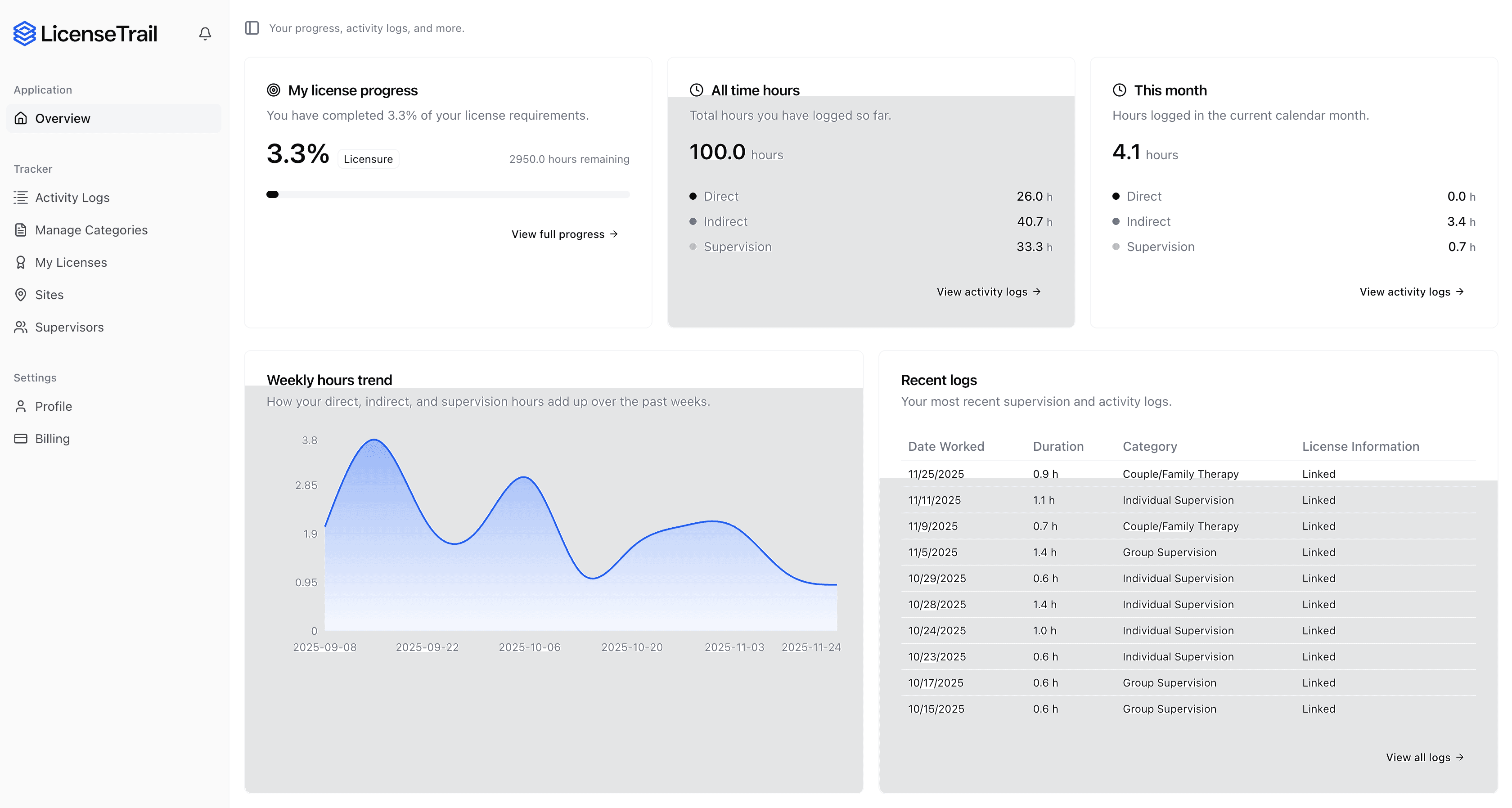
Track your SWT hours with confidence
License Trail checks your direct, indirect, and supervision hours against Ohio SWT requirements continuously and flags mismatches before you submit.
 Start Tracking for Free
No credit card required · Free plan available
Is your spreadsheet hiding Ohio SWT risks?
Stop guessing if your categories match Ohio Counselor, Social Worker and Marriage and Family Therapist Board requirements. License Trail checks your direct, indirect, and supervision hours continuously and flags mismatches before you submit.
Import or log
Bring your spreadsheet or start fresh
Upload your existing tracking spreadsheet and we'll map every hour into the right Ohio Counselor, Social Worker and Marriage and Family Therapist Board categories automatically.
Verify against Ohio
Catch mismatches before the board does
License Trail checks your direct, indirect, and supervision hours against Ohio SWT requirements continuously.
Export board-ready
One-click clean reports
Generate professional, board-ready reports for supervision meetings and Ohio Counselor, Social Worker and Marriage and Family Therapist Board submissions in seconds.
No credit card required · Free plan available