
Wisconsin MFT-TC Requirements: Hours, Exams & Step-by-Step Guide
Stop guessing if your categories match Wisconsin requirements. License Trail checks your direct, indirect, and supervision hours against MFT-TC requirements continuously and flags mismatches before you submit.
No credit card required · Free plan available
Quick Requirements Overview
- Governed by Wis. Stat. ch. 457 and Wis. Admin. Code ch. MPSW 16 (DSPS MFT/PC/SW Examining Board); “MFT‑TC” functions as the MFT training credential
- Apply + pay fee; eligible if you meet LMFT education or are enrolled (or will enroll) in a COAMFTE-accredited/board-approved MFT program (incl. certain mental-health grad degree + MFT enrollment paths)
- Must have a supervised MFT position or job offer (or board-deemed equivalent) documented for training credential issuance
- Credential term: valid 48 months; renewal discretionary
- Hours toward LMFT (while credential is valid): 3,000 supervised MFT practice hours, incl. 1,000 face-to-face client contact hours
- Supervision ratio: 1 hour face-to-face supervision per 10 client-contact hours
- Qualified supervisors: LMFT (doctorate or 5 yrs equiv.), psychiatrist, WI psychologist, AAMFT approved supervisor/candidate, or board pre-approval
- Group supervision: max 8 supervisees per supervisor; only case-related time counts; credit cannot exceed clock time
License Details
Procedures
In Wisconsin, the pre‑licensure credential for marriage and family therapists is governed by Chapter 457 of the Wisconsin Statutes and Chapter MPSW 16 of the Wisconsin Administrative Code, under the Marriage and Family Therapy, Professional Counseling, and Social Work Examining Board. The current legal term is “marriage and family therapist training license,” but DSPS’ credential system also lists a “Marriage and Family Therapist Training Certificate (MFT‑TC)” as credential type 128.(law.justia.com) In practice, when people refer to MFT‑TC, they mean this training‑level credential that allows you to accrue supervised hours toward full LMFT licensure.
What follows is a structured overview of:
- What the training credential is and how it fits into the licensure path
- Exact supervised‑practice hour requirements and how the board defines them
- Step‑by‑step requirements, grounded in the language of the Wisconsin statutes and administrative code
1. Training credential vs. full LMFT license in Wisconsin
Governing law and rules
- Statutory authority: Wis. Stat. § 457.10 (LMFT license) and § 457.11 (marriage and family therapist training license).(law.justia.com)
- Administrative rules: Wis. Admin. Code ch. MPSW 16, especially:
- MPSW 16.015 – Application for a marriage and family therapist training license(law.cornell.edu)
- MPSW 16.01 & 16.02 – education requirements for full licensure(regulations.justia.com)
- MPSW 16.04 – Supervised practice (defines hours and supervision structure)(regulations.justia.com)
Credential types you’ll see
-
Marriage and Family Therapist Training License
- Defined in statute and code; this is the credential you must hold in order to accrue post‑degree supervised hours toward LMFT licensure.(law.cornell.edu)
-
Marriage and Family Therapist Training Certificate (MFT‑TC)
- Appears as profession code 128 in DSPS’s credential lookup (“Marriage and Family Therapist Training Certificate (128)”).(online.drl.wi.gov)
- There is no separate, current rule chapter that lays out different hour requirements for “certificate” vs. “training license”; the controlling requirements for supervised practice are in MPSW 16.04 and apply to anyone pursuing LMFT under a training‑level MFT credential.(regulations.justia.com)
For purposes of hours and supervision, you can treat “MFT‑TC” as referring to the same supervised‑practice framework that now lives under the training license rules.
2. Educational groundwork
2.1. Education for the training credential
Under MPSW 16.015, the marriage and family therapist section must grant a marriage and family therapist training license if you:(law.cornell.edu)
-
Submit a completed, signed application and
-
Pay the fee specified in Wis. Stat. § 440.05(6), and
-
Show one of the following educational statuses:
- You already meet the full LMFT education requirements in Wis. Stat. § 457.10(2); or
- You are enrolled or will be enrolled in an institute for marriage and family therapy that is approved by:
- COAMFTE (the Commission on Accreditation for Marriage and Family Therapy Education), or
- The Wisconsin marriage and family therapist section itself; or
- You hold a graduate degree in a mental health field approved by the section and are enrolled or will be enrolled in a master’s or doctoral marriage and family therapy program that is:
- Accredited by COAMFTE, or
- Approved by the marriage and family therapist section.(law.cornell.edu)
This is why current Wisconsin guidance notes that students in a COAMFTE‑accredited MFT master’s program can apply for the training license before graduating.(networks.aamft.org)
2.2. Education for the full LMFT license
When you later apply for full licensure, MPSW 16.01 requires evidence of one of the following degrees:(regulations.justia.com)
- A master’s or doctorate degree in marriage and family therapy from a COAMFTE‑accredited program, or
- A master’s or doctorate in marriage and family therapy, psychology, sociology, social work, professional counseling, or another mental health field, that includes coursework meeting MPSW 16.02, or
- A foreign degree that an approved evaluation body determines is equivalent to a COAMFTE‑accredited master’s or doctoral degree.
Those education standards are what Wis. Stat. § 457.10(2) cross‑references when it talks about the degree required for LMFT licensure.(law.justia.com)
3. Practice setting and supervision for the training credential
To receive the training license, you must also show that you are in – or have an offer for – an appropriate supervised MFT position. Under MPSW 16.015(1)(d) and Wis. Stat. § 457.11(1)(d), you must provide evidence that:(law.cornell.edu)
- You are in a position or have an offer for a position as a marriage and family therapist in a supervised marriage and family therapist practice, or
- You are in a position (or have an offer) where, in the opinion of the marriage and family therapist section, you will receive training and supervision equivalent to that received in a supervised MFT practice.
Practically, DSPS operationalizes this through:
- Form 2571 – Employment Form for Supervised Marriage and Family Therapy Practice, which documents your supervised role and practice setting for the training license, and
- Form 2574 – Marriage and Family Therapist Supervised Practice Experience Form, which documents your accumulated supervised hours toward full licensure.(dsps.wi.gov)
4. How long the training credential lasts and what it allows you to do
By rule and statute:
- A marriage and family therapist training license is valid for 48 months and may be renewed at the discretion of the marriage and family therapist section.(law.cornell.edu)
- It authorizes you to use the titles allowed under Wis. Stat. § 457.04(5) and to practice marriage and family therapy within the practice scope of your training or supervision while the license is valid.(law.cornell.edu)
On the DSPS website, this appears under “MFT Training License” with its own “Key Steps” and renewal forms (for example, Form 2921MFT to renew a training license).(dsps.wi.gov)
5. Supervised‑practice hour requirements: what the board actually requires
To move from the training‑level credential (MFT‑TC / training license) to full LMFT licensure, your supervised practice must satisfy MPSW 16.04 – Supervised Practice. This is where the detailed hour requirements are found.
5.1. Total hours and “direct” hours
Under MPSW 16.04(1), an applicant for LMFT licensure must complete:
“3,000 hours of supervised marriage and family therapy practice, including at least 1,000 hours of face‑to‑face client contact,” all while holding a valid marriage and family therapist training license.(regulations.justia.com)
In other words:
-
Total supervised practice hours required:
- 3,000 hours of supervised marriage and family therapy practice
-
Within those 3,000 hours, a required subset of direct service:
- At least 1,000 hours must be “face‑to‑face client contact” with individuals, couples, or families.
The code does not split this into “1,500 hours direct + 1,500 hours supervised” as two separate categories. Instead, it is one 3,000‑hour pool of supervised MFT practice, and within that pool, at least 1,000 hours must be direct, face‑to‑face client contact.
Every hour of practice counted toward the 3,000 must occur after you have:
- The required degree (or the combination described: a mental health graduate degree plus enrollment in an MFT program), and
- A valid MFT training license in effect.(regulations.justia.com)
Hours obtained before the training license is issued, or outside the conditions described in MPSW 16.04(1), do not count toward the 3,000‑hour requirement.
6. Who can supervise you and what supervision must look like
6.1. Supervisor qualifications
Under MPSW 16.04(2), your supervised MFT practice can be overseen by:(regulations.justia.com)
- An individual licensed as a marriage and family therapist who has a doctorate degree in marriage and family therapy; or
- An individual licensed as a marriage and family therapist who has completed the equivalent of 5 years of full‑time MFT practice; or
- A psychiatrist; or
- A psychologist licensed under ch. 455, Stats.; or
- A person who is an American Association for Marriage and Family Therapy (AAMFT) “approved supervisor” or supervisor candidate; or
- An individual, other than those listed above, whom the marriage and family therapist section approves in advance, based on evidence of experience in marriage and family therapy systems.
6.2. Supervisor responsibilities and supervision ratio
MPSW 16.04(3) lists the supervisor’s responsibilities. Key requirements include:(regulations.justia.com)
-
Supervision ratio: The supervisor must provide “one hour of face‑to‑face supervision for each 10 client contact hours.”
- This supervision may be individual or in qualifying group formats (see below), but non‑case‑related time cannot be counted toward this requirement.
-
Scope of practice: The supervisor may permit you to engage only in marriage and family therapy services the supervisor can competently perform.
-
Availability and responsibility:
- The supervisor must be legally and ethically responsible for your supervised activities.
- They must be available, or make appropriate provision, for emergency consultation and intervention.
-
Authority to intervene:
- The supervisor must be able to interrupt or stop your practice in specific cases, or recommend to your employer that they do so.
- They must also be able to terminate the supervisory relationship if necessary.
6.3. Group supervision rules
If some of your supervision occurs in groups, MPSW 16.04(4) sets these conditions:(regulations.justia.com)
- Group size: No more than 8 supervisees per 1 supervisor in a supervision group.
- Credit: Each person receiving supervision in the group gets one hour of supervision credit for each hour the group meets, but time that is not directly case‑related may not be counted toward the supervision requirement.
- Multiple supervisors: If a group or individual session includes more than one supervisor, you cannot claim more credit than the elapsed clock time of the session.
7. Putting it together: step‑by‑step path focused on the MFT‑TC / training credential
The practical path to becoming a fully licensed LMFT in Wisconsin, centered on the training credential, looks like this:
-
Complete (or enroll in) appropriate graduate education
- Enroll in or complete a COAMFTE‑accredited MFT program, or
- Hold an approved graduate degree in a mental health field and enroll in an approved/accredited MFT program.(law.cornell.edu)
-
Secure a supervised MFT position
- Obtain a position (or written job offer) in a supervised marriage and family therapist practice or another position where the board would regard the training and supervision as equivalent, and line up a supervisor who meets the qualifications in MPSW 16.04(2).(regulations.justia.com)
-
Apply for the marriage and family therapist training license (MFT‑TL / MFT‑TC‑equivalent)
- Submit the required application via DSPS’s LicensE portal using the “MFT Training License” path.(dsps.wi.gov)
- Provide:
- Completed, signed application and fees (including the fee under Wis. Stat. § 440.05(6)).(law.cornell.edu)
- Evidence of your education/enrollment status as outlined in MPSW 16.015(1)(c).(law.cornell.edu)
- Form 2571 (Employment Form for Supervised MFT Practice) or its current equivalent, documenting your supervised practice position.(dsps.wi.gov)
-
Accrue supervised practice while holding the training credential
- After your training license is issued, begin logging hours.
- You must accumulate:
- 3,000 hours of supervised marriage and family therapy practice, and
- Within those, at least 1,000 hours of face‑to‑face client contact,
- All while your MFT training license is valid.(regulations.justia.com)
- Ensure you are receiving one hour of face‑to‑face supervision for every 10 client‑contact hours, with supervisors and groups structured as required.(regulations.justia.com)
- Use Form 2574 (MFT Supervised Practice Experience Form) or its current DSPS equivalent to document these hours for the board.(dsps.wi.gov)
-
Apply for full LMFT licensure
- Once education and supervised‑practice requirements are met:
- Submit the LMFT licensure application under MPSW 16.01,
- Provide transcripts and curriculum documentation that show you meet MPSW 16.02 coursework if you did not graduate from a COAMFTE‑accredited MFT program, and
- Ensure all supervised experience documentation is complete and signed by qualifying supervisors.(regulations.justia.com)
- Once education and supervised‑practice requirements are met:
-
Maintain and, if necessary, renew your training credential during this process
- Remember that the training license is valid for 48 months and may be renewed at the section’s discretion; if your hours are not complete within the initial 48‑month period, you may need to go through the MFT Training License Renewal process that DSPS provides.(law.cornell.edu)
8. How Wisconsin’s requirements compare to your example
Using your example framework:
- Wisconsin does not break things into “1,500 hours of direct experience” and “1,500 hours of supervised experience” as two separate, additive categories.
- Instead, current rules require:
- 3,000 total hours of “supervised marriage and family therapy practice,”
- Within which at least 1,000 hours must be “face‑to‑face client contact,”
- All accrued while holding a valid MFT training license (or its training‑certificate equivalent).(regulations.justia.com)
The controlling phrases from the board’s own regulations are “3,000 hours of supervised marriage and family therapy practice” and “at least 1,000 hours of face‑to‑face client contact,” which together define how your experience must be structured in Wisconsin.(regulations.justia.com)
Because statutes and administrative rules can change, it is wise to confirm your plans against the latest versions of Wis. Stat. ch. 457 and Wis. Admin. Code ch. MPSW 16, and the current DSPS “MFT” profession page, before you apply or count on any specific interpretation.
Track your MFT-TC hours with confidence
License Trail checks your direct, indirect, and supervision hours against Wisconsin MFT-TC requirements continuously and flags mismatches before you submit.
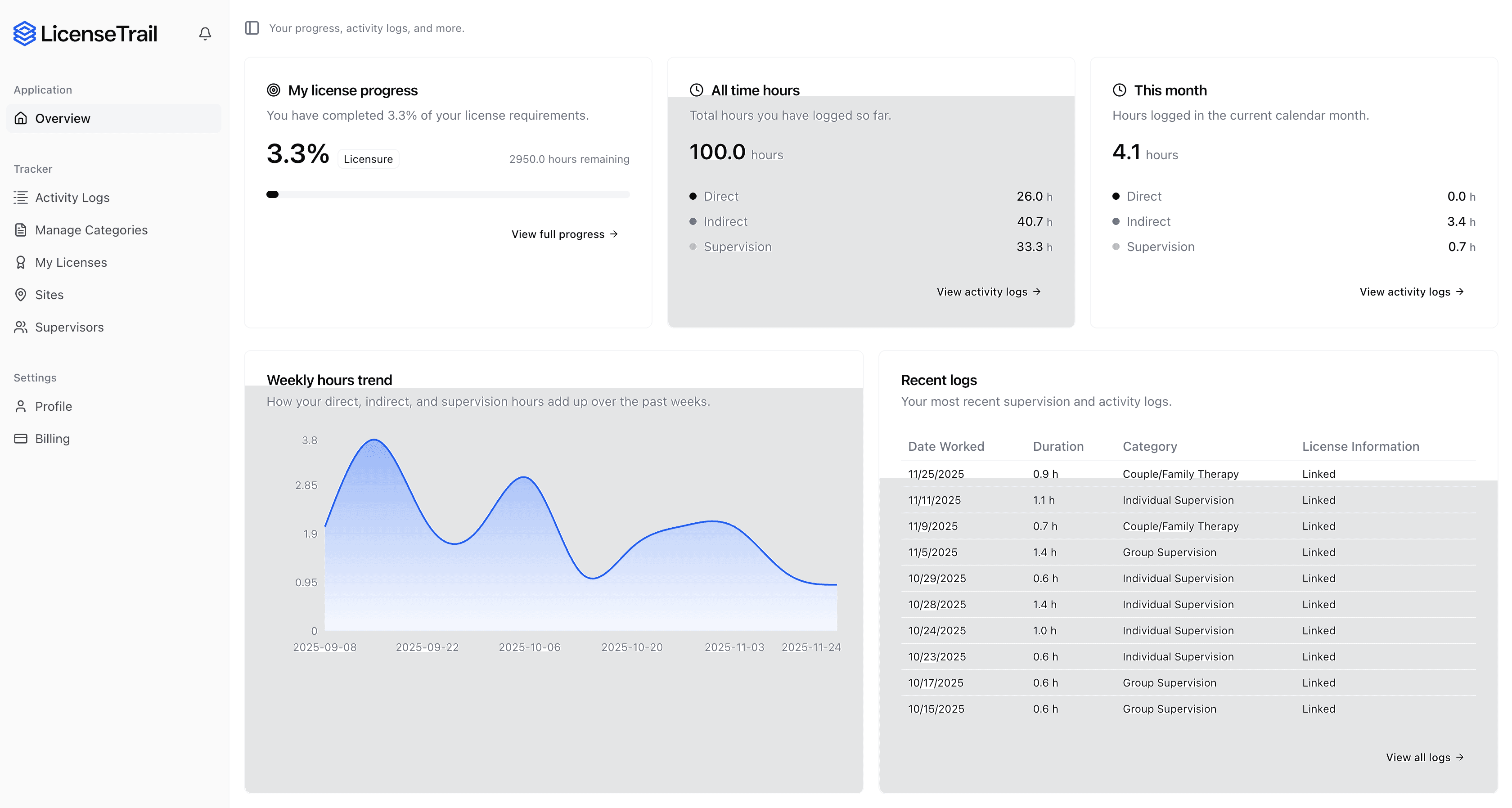 Start Tracking for Free
No credit card required · Free plan available
Is your spreadsheet hiding Wisconsin MFT-TC risks?
Stop guessing if your categories match Wisconsin Marriage and Family Therapy, Professional Counseling, and Social Work Examining Board requirements. License Trail checks your direct, indirect, and supervision hours continuously and flags mismatches before you submit.
Import or log
Bring your spreadsheet or start fresh
Upload your existing tracking spreadsheet and we'll map every hour into the right Wisconsin Marriage and Family Therapy, Professional Counseling, and Social Work Examining Board categories automatically.
Verify against Wisconsin
Catch mismatches before the board does
License Trail checks your direct, indirect, and supervision hours against Wisconsin MFT-TC requirements continuously.
Export board-ready
One-click clean reports
Generate professional, board-ready reports for supervision meetings and Wisconsin Marriage and Family Therapy, Professional Counseling, and Social Work Examining Board submissions in seconds.
No credit card required · Free plan available