
Wisconsin LPC-IT Requirements: Hours, Exams & Step-by-Step Guide
Stop guessing if your categories match Wisconsin requirements. License Trail checks your direct, indirect, and supervision hours against LPC-IT requirements continuously and flags mismatches before you submit.
No credit card required · Free plan available
Quick Requirements Overview
- Must hold WI Professional Counselor Training License (LPC‑IT) to legally accrue supervised hours toward full LPC
- Apply to DSPS/MPSW Board: submit signed application (LicensE) + $60 fee
- Education: Master’s or doctorate in Professional Counseling (or equivalent) from board‑approved/CACREP program (or submit curriculum review forms, descriptions, and transcripts)
- Must have a supervised counseling position or offer (or board‑accepted equivalent training/supervision setting)
- Validity: 48 months; renewal discretionary (board may request progress/supervisor report and explanation)
- Practice authority: may practice only within scope of training and supervision; supervision required
- Hours toward full LPC: Master’s—3,000 total supervised practice incl. 1,000 face‑to‑face client contact (typically ≥2 years); Doctorate—1,000 hours full‑time practice
- Supervisor must be board‑qualified (e.g., eligible LPC with doctorate/5 yrs, psychiatrist, WI psychologist); out‑of‑state hours may count if WI‑equivalent and properly supervised
License Details
Procedures
In Wisconsin, anyone who wants to become a Licensed Professional Counselor (LPC) must first practice under a Professional Counselor Training License. In the field, this credential is commonly referred to as “LPC‑IT” (Licensed Professional Counselor‑In‑Training).(oneida-nsn.gov)
This license is issued by the Marriage and Family Therapy, Professional Counseling, and Social Work Examining Board (the MPSW Board) and is the credential you hold while accumulating the supervised hours required for full LPC licensure.
Below is a step‑by‑step guide grounded in the actual Wisconsin statutes and administrative code, with a focus on hours and official wording.
1. What the LPC‑IT / Professional Counselor Training License Is
Wisconsin statutes call this credential the “professional counselor training license.” Under Wis. Stat. § 457.13, the Board:
“shall grant a professional counselor training license to any individual who does all of the following”
and then lists the specific requirements discussed below.(law.justia.com)
The Board’s own quick‑guide form emphasizes that:
“A professional counselor training license is required to accrue supervised practice hours for full professional counselor licensure.” (dsps.wi.gov)
So:
- You do not need post‑graduate experience hours to get the LPC‑IT.
- You do need the LPC‑IT in order to legally accrue the supervised hours that lead to full LPC licensure (unless those hours were earned under another qualifying state/license).
2. Core Legal Requirements to Obtain LPC‑IT
The governing language appears in both Wis. Stat. § 457.13 and Wis. Admin. Code MPSW 11.015. An applicant must do all of the following:
2.1. Submit an application and pay the fee
The MPSW Board’s rule states that the section shall grant a training license to any individual who:
- “Submits a completed, signed application form,” and
- “Pays the fee specified in s. 440.05 (6), Stats.” (law.cornell.edu)
The DSPS “Licensed Professional Counselor Training License” Key Steps form shows this as a $60 application via the LicensE online system.(dsps.wi.gov)
2.2. Meet the education requirement
MPSW 11.015 requires that an applicant:
- “Satisfies the requirements in s. 457.12 (1m) (b), Stats.” (law.cornell.edu)
Wis. Stat. § 457.12(1m)(b) then defines that requirement as evidence that the person:
“has received a master’s or doctorate degree in professional counseling or its equivalent from a program approved by the professional counselor section.” (law.justia.com)
In practice, DSPS recognizes several pathways that prove this, including:(dsps.wi.gov)
- A master’s degree actually titled “Professional Counseling” (official transcript only);
- A 60‑credit board‑approved program in professional counseling;
- A CACREP‑accredited counseling program listed on DSPS Form 1960; or
- A non‑pre‑approved/non‑CACREP program where you submit:
- Form 2239 (Professional Counselor Curriculum Requirements Form),
- course descriptions, and
- official transcripts for board review.
2.3. Have (or be offered) a supervised counseling position
Both the statute and code use nearly identical wording. You must submit evidence that you are either:
- “in a position or has an offer for a position as a professional counselor in a supervised clinical professional counseling practice,” or
- in a position/offer where, in the Board’s opinion, you will “receive training and supervision equivalent to the training and supervision received in a supervised clinical professional counseling practice.” (law.cornell.edu)
In other words, to get LPC‑IT you need at least one employer or placement lined up that will provide Board‑acceptable supervision and training.
2.4. Good‑character and related forms
The main LPC page and forms list additional items that may be required, such as:(dsps.wi.gov)
- Convictions and Pending Charges forms (Form 2252/2254) if applicable;
- Malpractice suits/claims form (Form 2829) if applicable;
- Optional application for fee reduction or predetermination.
These do not change the hour requirements but can affect whether your application is complete or reviewable.
3. Duration and Renewal of LPC‑IT
Under Wis. Stat. § 457.13 and MPSW 11.015:
- A professional counselor training license is valid for 48 months.(law.justia.com)
- It may be renewed at the discretion of the professional counselor section, typically in two‑year intervals.(law.cornell.edu)
When deciding whether to renew, the Board may request:(law.cornell.edu)
- A statement explaining why you need more time to complete required practice hours;
- Documentation of any continuing education or graduate courses taken since obtaining the training license;
- A report from your supervisor demonstrating “satisfactory progress towards completion of the professional counselor practice experience” required for full licensure.
4. What You Can Do While LPC‑IT — Scope and Supervision
4.1. Authorized practice
Wis. Stat. § 457.13(2) provides that a training license:
authorizes the holder “to use any title specified in s. 457.04 (6) and to practice professional counseling within the scope of his or her training or supervision.” (law.justia.com)
In plain terms:
- You may deliver professional counseling services (psychotherapy, assessment within your competence, treatment planning, etc.),
- but only within the scope of:
- your education/training, and
- what your supervisor is overseeing.
4.2. Mandatory supervision
The professional counseling supervised‑practice chapter says:
- “A person with a training license must be supervised.” (regulations.justia.com)
The Board also defines “supervision” in its general rules as an ongoing evaluative relationship in which the supervisor:
- transmits the profession’s “skills, knowledge, and attitudes,”
- monitors the quality of services offered by the counselor‑in‑training, and
- provides clinical oversight to ensure ethical practice and protection of the public. (law.cornell.edu)
Supervision may be provided face‑to‑face in person or remotely, as long as it meets the Board’s standards.(law.cornell.edu)
5. Post‑Master Supervised Practice Hours Required While LPC‑IT
This is where the “types of hours” matter most. Wisconsin does not use a 1,500‑direct / 1,500‑supervised split for professional counselors. Instead, both the statute and rules set out the following:
5.1. If you have a master’s degree
Wis. Stat. § 457.12 and the supervised‑practice rule require that, after receiving your master’s degree, you must:
- Complete “at least 3,000 hours of professional counseling practice, including at least 1,000 hours of face‑to‑face client contact”;
- Under supervision by a qualified supervisor (see below). (law.justia.com)
Key points:
- Total supervised experience required:
- 3,000 hours of professional counseling practice.
- Direct client contact requirement (a subset of the above):
- At least 1,000 hours must be face‑to‑face client contact (direct counseling/psychotherapy sessions).
- Minimum time frame:
- The older but still widely cited MPSW 12.01 text specifies these 3,000 hours are to be completed in no less than 2 years; this remains consistent with how the statutory standard is implemented.(wirules.elaws.us)
The Board does not break the remaining 2,000 hours into separate named categories in the statute or rule (e.g., there is no “1,500 direct / 1,500 indirect” split for counselors). Instead, the law simply differentiates between:
- “face‑to‑face client contact” (minimum 1,000 hours), and
- the rest of the professional counseling practice hours (up to 2,000 hours), which can include:
- assessment, diagnosis, treatment planning,
- case consultation, clinical documentation,
- phone or collateral contacts related to counseling,
- and other counseling duties carried out under supervision, as allowed by agency policy and your supervisor.
5.2. If you have a doctorate in professional counseling
For doctoral‑level applicants, the requirement is lower but still substantial. The statute requires that you must have:
- “at least 1,000 hours of full‑time professional counseling practice”
- completed either during or after the doctoral program,
- supervised by a qualifying supervisor. (law.justia.com)
(This 1,000‑hour requirement for doctoral graduates is separate from, and less than, the 3,000‑hour requirement for master’s‑only graduates.)
5.3. Supervisor qualifications
Under Wis. Admin. Code MPSW 12.02(1), your post‑graduate supervised practice may be overseen by any of the following:(regulations.justia.com)
- An LPC who has a doctorate in professional counseling;
- An LPC who has engaged in the equivalent of 5 years of full‑time professional counseling;
- A psychiatrist;
- A psychologist licensed under ch. 455;
- Certain Division of Vocational Rehabilitation supervisors who are also LPCs or have 5 years of full‑time counseling.
Your supervisor must be able to document and attest to your supervised hours and competencies on DSPS forms (e.g., Form 2456 for supervisor approval, Form 2464 documenting clinical experience).(dsps.wi.gov)
5.4. Hours completed in another state
If you completed some supervised professional counseling hours in another state, MPSW 12.01 provides for credit as long as those hours:(regulations.justia.com)
- meet Wisconsin’s requirements (including the 1,000 face‑to‑face minimum for master’s‑level applicants), and
- were supervised by someone acceptable to the Professional Counselor Section.
6. Distinguishing LPC‑IT Requirements from Other Wisconsin Credentials
Your example of “1,500 hours of direct experience and 1,500 hours of supervised experience” actually mirrors social work regulations more than professional counseling. For example, the clinical social work rule allows an alternative route involving 1,500 hours of supervised clinical social work experience with specified breakdowns of face‑to‑face hours and DSM diagnosis.(law.cornell.edu)
For Professional Counselors (LPC/LPC‑IT), however, the MPSW Board’s controlling language is:
- 3,000 hours total professional counseling practice,
- with 1,000 of those hours required to be face‑to‑face client contact for master’s‑level applicants,
- or 1,000 hours total for doctoral graduates.
There is no 1,500/1,500 split in the counselor rules.
7. Practical Summary of “Type of Hours” for Wisconsin LPC‑ITs
While holding an LPC‑IT and working toward full LPC licensure, the Board’s hour requirements can be summarized as:
- Total post‑master hours:
- 3,000 hours of professional counseling practice (or 1,000 hours if you have a doctorate).(law.justia.com)
- Direct client hours (within the total):
- At least 1,000 hours of face‑to‑face client contact (direct counseling sessions) for master’s‑level applicants.(law.justia.com)
- Supervision:
- All practice hours must be supervised by a Board‑qualified supervisor (as defined in MPSW 12.02).(regulations.justia.com)
- Time frame:
- 3,000 hours are expected to be completed over no less than 2 years of supervised practice following the master’s degree, consistent with longstanding MPSW 12.01 language and Board practice.(wirules.elaws.us)
Once those supervised hours are completed, along with passing the required examination(s) under Wis. Stat. § 457.16, you can apply under the “LPC Initial License by Exam” pathway to convert your LPC‑IT training license into full LPC licensure.(dsps.wi.gov)
Because statutes and administrative rules can change, it is wise to cross‑check the current text of Wis. Stat. ch. 457 and Wis. Admin. Code chs. MPSW 10–14, as well as the latest DSPS application forms, when you are ready to apply.
Track your LPC-IT hours with confidence
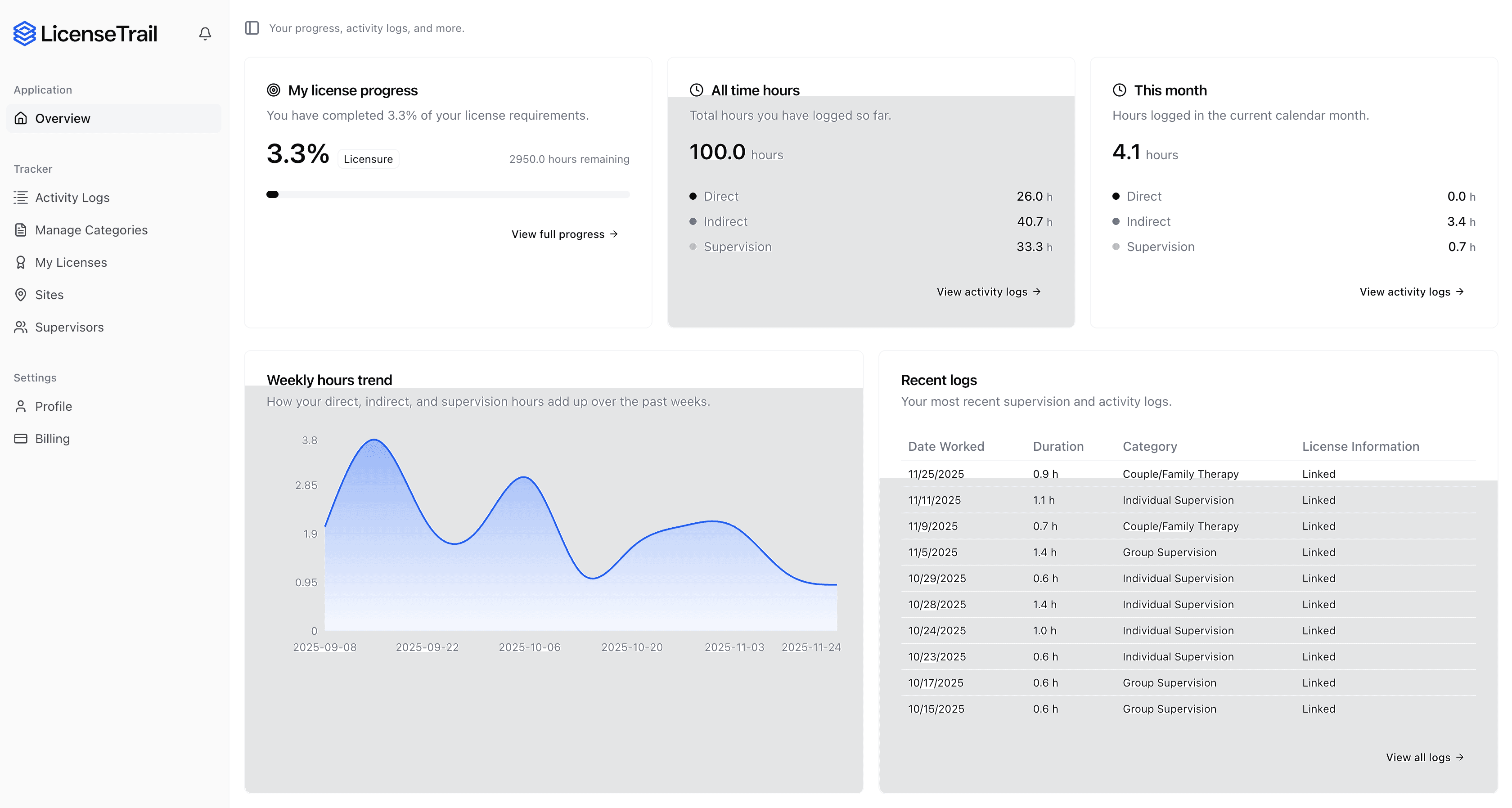
License Trail checks your direct, indirect, and supervision hours against Wisconsin LPC-IT requirements continuously and flags mismatches before you submit.
 Start Tracking for Free
No credit card required · Free plan available
Is your spreadsheet hiding Wisconsin LPC-IT risks?
Stop guessing if your categories match Wisconsin Marriage and Family Therapy, Professional Counseling, and Social Work Examining Board requirements. License Trail checks your direct, indirect, and supervision hours continuously and flags mismatches before you submit.
Import or log
Bring your spreadsheet or start fresh
Upload your existing tracking spreadsheet and we'll map every hour into the right Wisconsin Marriage and Family Therapy, Professional Counseling, and Social Work Examining Board categories automatically.
Verify against Wisconsin
Catch mismatches before the board does
License Trail checks your direct, indirect, and supervision hours against Wisconsin LPC-IT requirements continuously.
Export board-ready
One-click clean reports
Generate professional, board-ready reports for supervision meetings and Wisconsin Marriage and Family Therapy, Professional Counseling, and Social Work Examining Board submissions in seconds.
No credit card required · Free plan available