
Wisconsin LPC-TL Requirements: Hours, Exams & Step-by-Step Guide
Stop guessing if your categories match Wisconsin requirements. License Trail checks your direct, indirect, and supervision hours against LPC-TL requirements continuously and flags mismatches before you submit.
No credit card required · Free plan available
Quick Requirements Overview
- Credential: Professional Counselor Training License (informally “LPC‑TL/LPC‑IT”); issued by WI DSPS Professional Counselor Section
- Education prerequisite: Board‑approved master’s or doctorate in professional counseling (or equivalent) (typically 60 credits/equivalent)
- Position required to apply: Must be in (or have an offer for) a supervised clinical professional counseling practice (or Board‑deemed equivalent)
- Application essentials: DSPS application + fee + proof of education + evidence of supervised position/supervisor
- License term: Valid 48 months; renewable in 2‑year intervals at Board discretion (may require explanation + supervisor progress)
- Supervised practice (Master’s route to LPC): 3,000 hours total, incl. ≥1,000 face‑to‑face client contact, completed in ≥2 years under qualified supervision
- Supervision rules: Average 1 hour/week face‑to‑face supervision; group supervision max 6 supervisees; “face‑to‑face” includes in‑person or real‑time video
- To transition to full LPC: Complete required hours under training license + pass approved national counseling exam + submit DSPS experience/supervisor documentation forms
License Details
Procedures
In Wisconsin, the credential commonly called “LPC‑IT” or “LPC‑TL” is officially the Professional Counselor Training License. It is issued by the Professional Counselor Section of the Marriage and Family Therapy, Professional Counseling, and Social Work Examining Board.
This training license is the credential you hold while you complete the supervised experience that leads to a full Licensed Professional Counselor (LPC) license. The experience and hour requirements are laid out primarily in Wis. Stat. § 457.12 and § 457.13 and Wis. Admin. Code chs. MPSW 11 and 12. (law.justia.com)
Below is a step‑by‑step guide focused on (1) how to qualify for the training license itself and (2) exactly what kinds of hours you must complete under that license to become fully licensed.
1. Terminology and big picture
Official credential name
- The Board’s term is “professional counselor training license”, issued by the Professional Counselor Section. (law.justia.com)
- DSPS (the Department of Safety and Professional Services) lists this as the “LPC Training License” and describes it as required to accumulate supervised practice hours for full licensure. (dsps.wi.gov)
- Many programs and employers will still call this LPC‑IT or LPC‑TL, but those are informal labels.
Purpose of the training license
- The training license allows you to work in “supervised clinical professional counseling practice” and to complete the supervised hours required for an LPC. (law.justia.com)
2. Educational prerequisite for the Professional Counselor Training License
To be granted a Professional Counselor Training License, you must first meet the education requirement that the Board uses for LPC licensure.
Under Wis. Stat. § 457.12(1m)(b), an LPC applicant must show evidence of a master’s or doctorate degree in professional counseling or its equivalent from a program approved by the Professional Counselor Section. (law.justia.com)
The training‑license rules explicitly require you to satisfy that same education provision:
- MPSW 11.015(1)(c) and Wis. Stat. § 457.13(1)(c) both require that an applicant for a professional counselor training license “satisfies the requirements in s. 457.12 (1m) (b)”—that is, the approved master’s or doctoral degree (or equivalent). (law.justia.com)
In practice, this means:
- You must have completed a board‑approved 60‑credit (or equivalent) graduate program in professional counseling or a closely related field that meets the Board’s curriculum rules in MPSW 14 (for “equivalent” programs). (law.cornell.edu)
You do not need to have completed your 3,000 hours or passed the national counseling exam before obtaining the training license; those come later, under the training license.
3. Employment/position requirement for the training license
To receive the Professional Counselor Training License, the Board also requires proof that you are going into an appropriately supervised counseling role.
Both Wis. Stat. § 457.13(1)(d) and MPSW 11.015(1)(d) require the applicant to submit evidence that they:
- Are in a position or have an offer for a position
- As a professional counselor in a “supervised clinical professional counseling practice”, or in a position where, in the Board’s opinion, the training and supervision will be equivalent. (law.justia.com)
Practically, you must:
- Have a job offer or current position that involves providing professional counseling services.
- Have supervision that meets Wisconsin’s supervised‑practice rules (see Section 6 below).
- Be ready to document this arrangement in your application (often with a supervisor approval form).
4. Application steps and license duration
Application requirements
Under MPSW 11.015(1) and Wis. Stat. § 457.13(1), the Professional Counselor Section will grant a training license to an individual who does all of the following: (law.justia.com)
- Submits an application on the department’s form, completed and signed.
- Pays the fee specified in Wis. Stat. § 440.05(6).
- Meets the education requirement in § 457.12(1m)(b) (approved master’s or doctorate degree).
- Provides evidence of a qualifying supervised counseling position or offer (as described above).
DSPS’s LPC page lists the training license under “Application for Licensure” and notes that it is required for accumulating supervised hours; the corresponding “Key Steps” list the forms (such as proof of education and supervisor documentation). (dsps.wi.gov)
Duration and renewal of the training license
Under MPSW 11.015(2): (regulations.justia.com)
- A professional counselor training license is valid for 48 months (4 years).
- It may be renewed in two‑year intervals at the discretion of the Professional Counselor Section.
- When deciding whether to renew, the Section may require:
- A written explanation of why you need more time to complete your practice hours.
- Documentation of any continuing education or graduate study you have done since obtaining the training license.
- A progress report from your supervisor showing that you are making satisfactory progress toward the required practice experience.
DSPS also notes that a Professional Counselor Training License is valid for 48 months and that renewal is discretionary. (dsps.wi.gov)
5. Supervised practice requirement: hours and time frame
The core supervised‑experience requirements that you must complete while holding the Professional Counselor Training License are defined in Wis. Admin. Code MPSW 12.01 and mirrored in the statute at Wis. Stat. § 457.12(1m)(c). (wirules.elaws.us)
5.1. Must be completed under the training license
MPSW 12.01(1) states that, except for certain out‑of‑state cases, an LPC applicant must complete a period of supervised practice while holding a training license before being eligible for licensure. The supervision must average one hour of supervision per week over the supervised practice period (the supervisor chooses the exact frequency and duration to meet that average). (wirules.elaws.us)
5.2. Master’s‑level applicants
For an applicant who has received a master’s degree:
- Total hours: at least 3,000 hours of professional counseling practice.
- Minimum direct (face‑to‑face) hours: at least 1,000 hours of face‑to‑face client contact within those 3,000 hours.
- Time frame: these hours must be completed in no less than 2 years.
- Supervision: all of this practice must be under a qualified supervisor as defined in MPSW 12.02(1). (wirules.elaws.us)
Put in the type‑of‑hours language you asked for, the Board effectively requires:
- 3,000 hours of supervised professional counseling practice, of which
- At least 1,000 hours must be direct, face‑to‑face client contact, and
- Up to 2,000 hours may be other professional counseling practice activities (documentation, treatment planning, consultation, indirect services, etc.), as long as they fall within “professional counseling practice” and are under supervision.
All 3,000 hours are supervised; Wisconsin does not split them into “supervised vs. unsupervised” categories—the split is between face‑to‑face client contact and other counseling practice activities.
5.3. Doctoral‑level applicants
For an applicant who has received a doctorate in professional counseling or its equivalent:
- Total hours: at least 1,000 hours of professional counseling practice.
- When: these hours may be completed during or after the doctoral program.
- Supervision: must be under a qualified supervisor (same categories as for master’s‑level applicants). (wirules.elaws.us)
5.4. Out‑of‑state supervised experience
MPSW 12.01 also allows some credit for supervised practice hours completed in another state, provided that:
- For master’s‑level applicants, out‑of‑state hours must include at least 1,000 hours of face‑to‑face client contact (or a proportional amount) and be under a supervisor acceptable to the Professional Counselor Section. (wirules.elaws.us)
- For doctoral‑level applicants, out‑of‑state hours must be under a supervisor acceptable to the Section. (wirules.elaws.us)
6. What counts as supervision and who can supervise
6.1. Supervisor qualifications
Under MPSW 12.02(1), supervision of your practice may be provided by any of the following: (regulations.justia.com)
- A Licensed Professional Counselor (LPC) with a doctorate in professional counseling.
- An LPC with the equivalent of 5 years of full‑time professional counseling experience.
- A psychiatrist.
- A psychologist licensed under ch. 455.
- A vocational rehabilitation supervisor employed by the Division of Vocational Rehabilitation who is an LPC or who has 5 years of full‑time professional counseling experience.
- Another individual with at least 5 years of counseling practice experience, if approved in advance by the Professional Counselor Section.
The applicant is responsible for demonstrating that the supervisor met these qualifications.
6.2. Supervisor responsibilities and supervision frequency
MPSW 12.02(2) sets out the supervisor’s responsibilities, which include: (regulations.justia.com)
- Exercising discretion over supervision frequency and duration so that you average one hour of face‑to‑face supervision per week during the supervised practice period.
- Allowing you to provide only those professional counseling services that the supervisor can competently perform.
- Being legally and ethically responsible for your supervised activities.
- Being available (or arranging for coverage) for emergency consultation or intervention.
- Having the authority to interrupt or stop your practice in certain cases and to terminate the supervisory relationship if needed.
6.3. Group supervision
If you receive supervision in a group format, MPSW 12.02(3) adds that: (regulations.justia.com)
- The group may include no more than 6 supervisees per supervisor.
- Each supervisee receives one hour of supervision credit per hour of group supervision, but time that is primarily social cannot be counted.
- Even if multiple supervisors are present, you cannot claim more hours than the actual time of the session.
7. What “face‑to‑face” means
The Board defines “face‑to‑face” more broadly than just in‑person. In MPSW 15.01(1m), “face‑to‑face” includes in‑person or real‑time video conferencing where all parties can communicate simultaneously by audio, video, telephone, or data. (law.cornell.edu)
This definition applies to:
- Your 1,000+ hours of face‑to‑face client contact, and
- The supervision sessions that must average one hour per week.
8. Transition from training license to full LPC
Once you have:
- Held a Professional Counselor Training License,
- Completed the required supervised practice hours (3,000 with at least 1,000 face‑to‑face client hours for master’s‑level applicants; 1,000 hours for doctoral‑level applicants) under a qualified supervisor, and
- Passed an approved national counseling examination under Wis. Stat. § 457.16,
you can apply for full LPC licensure under Wis. Stat. § 457.12(1m). (law.justia.com)
DSPS requires an Affidavit of Applicant’s Competencies – Documentation of Clinical Experience Gained Under Training License Supervisor (Form #2464) and a Post‑Graduate Supervisor Approval Form (Form #2456) to document that your supervised practice meets the statutory and rule requirements. (dsps.wi.gov)
9. Hour breakdown summary for Wisconsin LPC supervised experience
For a master’s‑level applicant working under a Professional Counselor Training License:
- Total supervised professional counseling practice:
- 3,000 hours minimum
- Within those 3,000 hours:
- At least 1,000 hours must be direct, face‑to‑face client contact.
- Up to 2,000 hours may consist of other supervised professional counseling practice (e.g., assessment, documentation, treatment planning, consultation, indirect services).
- All hours must be supervised by a qualified supervisor under MPSW 12.02, with supervision averaging one hour per week.
- Time frame: at least two years to accumulate these hours. (wirules.elaws.us)
For a doctoral‑level applicant under the same Board:
- Total supervised professional counseling practice:
- 1,000 hours minimum, completed during or after the doctoral program.
- Supervision and supervisor qualifications are the same as for master’s‑level applicants. (wirules.elaws.us)
These are the official, board‑defined hour and supervision requirements that apply while you hold the Professional Counselor Training License in Wisconsin and work toward full LPC licensure.
Track your LPC-TL hours with confidence
License Trail checks your direct, indirect, and supervision hours against Wisconsin LPC-TL requirements continuously and flags mismatches before you submit.
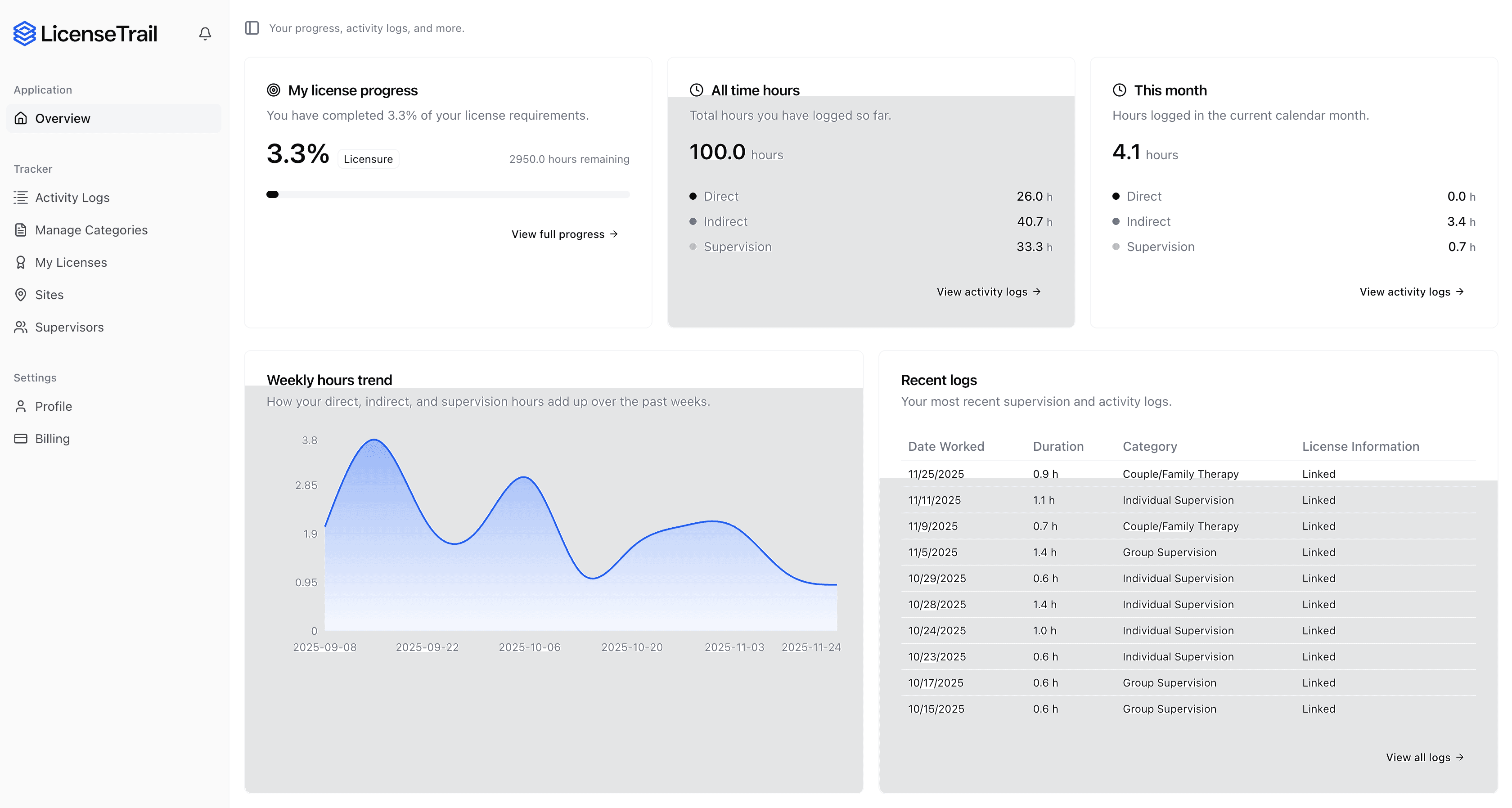 Start Tracking for Free
No credit card required · Free plan available
Is your spreadsheet hiding Wisconsin LPC-TL risks?
Stop guessing if your categories match Wisconsin Marriage and Family Therapy, Professional Counseling, and Social Work Examining Board requirements. License Trail checks your direct, indirect, and supervision hours continuously and flags mismatches before you submit.
Import or log
Bring your spreadsheet or start fresh
Upload your existing tracking spreadsheet and we'll map every hour into the right Wisconsin Marriage and Family Therapy, Professional Counseling, and Social Work Examining Board categories automatically.
Verify against Wisconsin
Catch mismatches before the board does
License Trail checks your direct, indirect, and supervision hours against Wisconsin LPC-TL requirements continuously.
Export board-ready
One-click clean reports
Generate professional, board-ready reports for supervision meetings and Wisconsin Marriage and Family Therapy, Professional Counseling, and Social Work Examining Board submissions in seconds.
No credit card required · Free plan available