
Wisconsin APSW Requirements: Hours, Exams & Step-by-Step Guide
Stop guessing if your categories match Wisconsin requirements. License Trail checks your direct, indirect, and supervision hours against APSW requirements continuously and flags mismatches before you submit.
No credit card required · Free plan available
Quick Requirements Overview
- Education: MSW (CSWE-accredited/preaccredited) or DSW; submit school “certificate of professional education”
- Application: Apply via DSPS LicensE on department form(s) and pay required fees (APSW processed with underlying CSW)
- Exams: Pass WI Statutes & Rules (jurisprudence) exam + ASWB Masters exam
- Background/discipline: Disclose convictions/pending charges and malpractice claims (if applicable); provide license verifications from all jurisdictions ever credentialed
- Hours (APSW): No pre-licensure practice-hour requirement to obtain APSW
- ISW pathway (after APSW): 3,000 supervised social work practice hours over ≥2 years under board-approved supervision (MPSW 4.01)
- LCSW pathway (after APSW/ISW): 3,000 supervised clinical hours incl. 1,000 face-to-face (diagnosis/treatment; DSM component as required) under approved supervisor; plus clinical field training or substitute 1,500 supervised clinical hours (≥1 year) incl. 500 face-to-face in a primary clinical setting
License Details
Procedures
In Wisconsin, the Advanced Practice Social Worker (APSW) credential is the master’s‑level social work license administered by the Social Worker Section of the Marriage and Family Therapy, Professional Counseling, and Social Work Examining Board under ch. 457, Wis. Stats.(dsps.wi.gov) It is the standard license for MSW graduates and is also the platform from which you earn the supervised hours required for independent and clinical social work credentials.
Below is a breakdown of:
- What is legally required to obtain the APSW.
- Where, and at what stage, the hour requirements come in (for ISW and LCSW) and the exact types of hours the Board describes.
1. Legal and Regulatory Framework
The APSW credential is governed primarily by:
- Wis. Stat. § 457.08(2) – “Advanced practice social worker certificate.”(law.justia.com)
- Wis. Admin. Code MPSW 3.05 – “Application for certification as an advanced practice social worker.”(law.cornell.edu)
- DSPS Social Worker – Advanced Practice program page (Department of Safety and Professional Services).(dsps.wi.gov)
- Wis. Admin. Code MPSW 6.02 – Scope of practice for a certified advanced practice social worker.(law.cornell.edu)
A key point from the outset: neither the statute nor MPSW 3.05 imposes any numeric pre‑licensure practice‑hour requirement to obtain the APSW itself. All specific hour counts (3,000 hours, 1,000 face‑to‑face, etc.) come later, when you move to Independent Social Worker (ISW) or Licensed Clinical Social Worker (LCSW).
2. Core Requirements to Become an APSW in Wisconsin
2.1. General application requirements
Under Wis. Stat. § 457.06, no certificate or license under ch. 457 can be granted unless the applicant:
- Submits an application on a department form, and
- Pays the required fee under s. 440.05(1).(law.justia.com)
DSPS implements this via the online LicensE system; APSW applicants use the profession‑specific application package (Form 1992 and related materials).(dsps.wi.gov)
In addition, Wis. Stat. § 457.08(2) requires that individuals granted an APSW certificate are also certified under § 457.08(1) as social workers (CSW) and meet the education and exam requirements described below.(law.justia.com) In practice, DSPS processes these together when you apply for APSW.
2.2. Educational requirement (no explicit hour count at APSW level)
Under both statute and DSPS rules, an APSW must have a graduate‑level social work degree:
- Wis. Stat. § 457.08(2)(b) requires the applicant to submit evidence that they have “received a master’s degree in social work from a program accredited by, or a preaccreditation program of, the council on social work education or a doctorate degree in social work.”(law.justia.com)
- Wis. Admin. Code MPSW 3.05(1)–(2) mirror this, requiring a certificate of professional education from the MSW/DSW program and verification that the program was CSWE‑accredited or equivalent at the time of graduation.(law.cornell.edu)
- DSPS’s APSW page repeats this as the “Pre‑Credential Education” requirement.(dsps.wi.gov)
While CSWE‑accredited MSW programs themselves include substantial field placement hours, Wisconsin’s APSW law does not specify a numeric practicum or field‑placement hour minimum as a separate licensing requirement. The Board focuses on the accreditation status of the degree.
2.3. Examinations (no practice‑hour prerequisites)
To be certified as an APSW, you must pass:
- A state jurisprudence exam on Wisconsin statutes and administrative code governing social work, and
- A national ASWB exam at the Master’s level.
The statute describes this generically as passing “one or more examinations” to determine minimum competence:
- Wis. Stat. § 457.08(2)(c) states that the social worker section shall grant an APSW certificate to an individual who “passes one or more examinations approved by the social worker section to determine minimum competence to practice as an advanced practice social worker as specified in the rules promulgated under s. 457.03(2).”(law.justia.com)
In practice, DSPS and UW‑Madison’s licensure guidance specify that:
- The national exam for APSW is the ASWB Masters Examination.(dsps.wi.gov)
- The Wisconsin Statutes and Rules Exam is an open‑book jurisprudence exam on ch. 457 and related code provisions, required for social work credentials and retaken only if more than 5 years have passed since the last attempt.(socwork.wisc.edu)
Again, there is no requirement in statute, rule, or DSPS guidance that you document any specific number of practice hours before sitting for the APSW exams.
2.4. Character / criminal‑record and credential history review
The Board also reviews character and criminal history:
- MPSW 3.05(5) requires “documentation necessary for the section to determine” whether the applicant has certain pending charges or convictions “substantially related to the practice of an advanced practice social worker.”(law.cornell.edu)
- DSPS application materials call for a Convictions and Pending Charges form (Form #2252) and, where applicable, a Malpractice Suits or Claims form (Form #2829) for APSW applicants.(dsps.wi.gov)
- MPSW 3.05(4) requires “verification of the applicant’s credential in all jurisdictions in which the applicant has ever been credentialed.”(law.cornell.edu)
These requirements do not involve hour counts; they are suitability and background checks.
2.5. No direct practice‑hour requirement for initial APSW certification
Putting the pieces together:
-
Wis. Stat. § 457.08(2) (APSW) and MPSW 3.05 focus on:
- An MSW/DSW from a CSWE‑accredited program,
- Application and fee,
- Passing Board‑approved exams (jurisprudence + ASWB Masters),
- Background/character review, and
- Credential verifications.
-
Neither the statute nor the administrative rule includes language such as “1,500 hours of direct experience” or “3,000 hours of supervised experience” as a prerequisite to being granted the APSW credential.
Hour‑based requirements begin after you are already an APSW (or ISW) and are working toward independent or clinical licensure, as described next.
3. Hour Requirements That Apply After You Become an APSW
Once you hold the APSW, it functions as the platform from which you accumulate supervised experience for:
- Independent Social Worker (ISW) certification, and
- Licensed Clinical Social Worker (LCSW) licensure.
These are the places where the Board uses precise hour language.
3.1. Hours for Certified Independent Social Worker (ISW)
Under Wis. Admin. Code MPSW 3.07 and corresponding DSPS guidance, an applicant for ISW must document supervised post‑degree practice hours after becoming an APSW:
- MPSW 3.07(3) requires an affidavit that the applicant,
“after receiving a master’s or doctoral degree and after receiving certification as an advanced practice social worker, has obtained at least 3,000 hours of social work practice in no less than 2 years under the supervision of a supervisor approved by the social worker section. Pre-certification supervised practice shall meet the criteria under s. MPSW 4.01.”(wirules.elaws.us)
DSPS’s ISW page summarizes this as:
- “Complete 2 years of supervised practice” and,
- “upon completion of education and after receiving certification as an APSW, engage in at least 3000 hours of supervised social work practice approved by the Social Worker Section.”(dsps.wi.gov)
Key points about these hours:
- Total hours required: 3,000 hours of supervised social work practice.
- Time frame: Not less than 2 years.
- Nature of hours: General social work practice (not limited to clinical work), as long as supervision and activities meet the criteria of MPSW 4.01 (which sets standards for supervision, scope of practice under supervision, and documentation).(law.cornell.edu)
- Supervision: Must be under a supervisor approved by the Social Worker Section.
3.2. Hours for Licensed Clinical Social Worker (LCSW)
For LCSW, the Board imposes two distinct hour‑related requirements:
- Educational clinical training (or an hour‑based substitute).
- Post‑graduate supervised clinical practice hours.
Both must be completed after you have your MSW and are certified as an APSW or ISW.
3.2.1. Educational clinical training or 1,500‑hour substitute
Wis. Admin. Code MPSW 3.09(1) governs the clinical education piece for LCSW applicants. It requires:
- A master’s or doctoral degree in social work “with a concentration in clinical social work, including completion of supervised clinical field training.”
- In lieu of that supervised clinical field training, an applicant may submit an affidavit showing they have completed **1,500 hours of supervised clinical social work experience in not less than one year within a primary clinical setting, including at least 500 hours of face‑to‑face client contact, supervised as provided in MPSW 4.01.(law.cornell.edu)
So, for the education/clinical concentration requirement at the LCSW level, the Board’s explicit hour language is:
- 1,500 hours of supervised clinical social work experience (as an alternative to a formal supervised clinical field placement),
- In not less than one year,
- In a primary clinical setting,
- With at least 500 hours of face‑to‑face client contact,
- Supervised consistent with MPSW 4.01.(law.cornell.edu)
This 1,500‑hour figure is not required for APSW; it only arises if you are substituting experience for formal clinical field training when applying for LCSW.
3.2.2. Post‑graduate supervised clinical practice hours: 3,000 total, 1,000 face‑to‑face
The main hour requirement that most APSWs eventually encounter is the post‑degree LCSW supervised clinical practice requirement.
From Wis. Stat. § 457.08(4)(c) (current as of 2024), an LCSW applicant must submit evidence that, after their MSW or DSW, they have completed:
- “at least 3,000 hours of clinical social work practice, including at least 1,000 hours of face-to-face client contact that includes the diagnosis and treatment of individuals”, supervised by a qualifying supervisor (licensed clinical social worker with a doctorate or with at least 5 years’ full‑time experience, a psychiatrist, a psychologist, or another individual approved by the Social Worker Section).(law.justia.com)
The Board has authority to require up to 600 of those hours to involve DSM‑based diagnosis and treatment.(law.justia.com)
Administrative rule MPSW 3.09(3) and DSPS’s LCSW program page reinforce and clarify this by stating that:
- After receiving the master’s or doctoral degree and after receiving certification as an advanced practice social worker or an independent social worker, the applicant must complete at least 3,000 hours of clinical social work practice,
- Including at least 1,000 hours of face‑to‑face client contact,
- With a portion of those face‑to‑face hours dedicated to DSM diagnosis and treatment,
- All hours obtained under a supervisor approved by the Social Worker Section, and
- Supervision must meet the “pre‑licensed supervised practice” criteria in MPSW 4.01.(law.cornell.edu)
DSPS’s own LCSW guidance summarizes this as:
- “engage in at least 3000 hours of supervised clinical social work practice, including at least 1,000 hours of face-to-face client contact and including DSM diagnosis and treatment of individuals,” after you have completed your education and are certified as an APSW or ISW.(dsps.wi.gov)
In practice, DSPS requires:
- Documentation from supervisors of the 3,000 total supervised hours and 1,000 face‑to‑face hours (and DSM‑focused hours, if specified),
- Use of forms such as Form 2560 (Documentation of Post‑Graduate Clinical Experience – Supervisor’s Affidavit) and Form 2771 (Summary of Post‑graduate Experience Hours), which explicitly track dates and hours of supervised clinical social work experience.(pdf4pro.com)
Relationship of these hours to APSW
The important link back to APSW is that:
- The Board and DSPS will only accept LCSW supervised clinical experience hours that were accrued while you already held APSW or ISW certification, and
- The LCSW information sheet specifies that supervised clinical experience “will be accepted only if the applicant was certified at the time as an Advanced Practice Social Worker or an Independent Social Worker.”(pdf4pro.com)
So the APSW is the gateway credential: you must become an APSW before you start accumulating the 3,000 supervised clinical hours that will later qualify you for the LCSW.
4. What an APSW Is Legally Allowed to Do (and Under What Supervision)
The scope of practice for a certified APSW is laid out in Wis. Admin. Code MPSW 6.02:
- An APSW may “evaluate and intervene in complex difficulties in psychosocial functioning” through counseling, advocacy, referral, and organizational change based on psychosocial evaluation.
- However, “a certified advanced practice social worker may engage in psychotherapeutic activities only under the supervision of a person authorized by the board or by the department of health services to supervise the practice of clinical social work.”(law.cornell.edu)
This dovetails with Wis. Stat. § 457.04(4), which forbids anyone from practicing clinical social work or using the “clinical social worker” title unless licensed as an LCSW or unless the person is certified as an APSW or ISW and practices clinical social work under the supervision of an LCSW.(wi.elaws.us)
So in terms of hours:
- While APSW practice hours you accumulate under appropriate supervision can later be applied toward ISW or LCSW hour requirements,
- The APSW credential itself is not conditioned on having a specific number of prior hours.
5. Step‑by‑Step Summary Focused on Hours and Requirements
Step 1 – Complete your education
- Earn an MSW or DSW from a CSWE‑accredited program (or a foreign equivalent approved by CSWE).(law.cornell.edu)
- There is no separate Board‑specified minimum number of practicum hours for the APSW; the Board relies on accreditation standards.
Step 2 – Apply for APSW and underlying CSW
- Create a LicensE account with DSPS and apply as “Social Worker – Advanced Practice” (licensure by examination).(dsps.wi.gov)
- Have your school send the Certificate of Professional Education directly to DSPS (Form 1978 or successor).(law.cornell.edu)
- Submit background and convictions documentation, if applicable.(law.cornell.edu)
Step 3 – Complete required exams
- Take and pass the Wisconsin Statutes and Rules Exam for social workers (open‑book jurisprudence exam).(socwork.wisc.edu)
- Take and pass the ASWB Masters exam (national exam for APSW level).(dsps.wi.gov)
At this point, you can be granted the APSW (and underlying CSW) credential. Up to this stage, no numeric practice‑hour threshold is imposed.
Step 4 – If you pursue ISW (Independent Social Worker)
After you are an APSW:
- Accumulate at least 3,000 hours of supervised social work practice
- Over no less than 2 years,
- Under a supervisor approved by the Social Worker Section, meeting MPSW 4.01 standards.(wirules.elaws.us)
Step 5 – If you pursue LCSW (Licensed Clinical Social Worker)
In addition to the clinical education requirement (or its 1,500‑hour substitute), after you are an APSW or ISW you must:
- Complete at least 3,000 hours of supervised clinical social work practice after the degree and after APSW/ISW certification.
- Ensure at least 1,000 of those hours are face‑to‑face client contact, with a significant portion involving DSM‑based diagnosis and treatment.
- Complete these hours under a board‑approved supervisor, as detailed in § 457.08(4)(c) and MPSW 4.01.(law.justia.com)
Only these post‑APSW supervised hours, properly documented, can be applied toward the ISW and LCSW requirements.
Bottom line in hour‑focused terms
-
To obtain the APSW itself in Wisconsin, the statutes, administrative code, and DSPS guidance do not require any particular number of practice hours.
-
Hour requirements begin only after APSW, and they are:
-
ISW:
- 3,000 hours of supervised social work practice
- In no less than 2 years
- Under board‑approved supervision.
-
LCSW (clinical) – two separate hour components:
- Educational clinical training requirement, which may be met either by:
- Board‑approved supervised clinical field training as part of your degree, or
- 1,500 hours of supervised clinical social work in at least one year, including 500 hours of face‑to‑face client contact, under MPSW 4.01 supervision.
- Post‑graduate supervised clinical practice:
- 3,000 hours of clinical social work practice after the degree and after APSW/ISW certification,
- Including at least 1,000 hours of face‑to‑face client contact involving diagnosis and treatment,
- Under a qualifying supervisor approved by the Social Worker Section.
- Educational clinical training requirement, which may be met either by:
-
All of those hours are defined and enforced by the Wisconsin Marriage and Family Therapy, Professional Counseling, and Social Work Examining Board through ch. 457, Wis. Stats., and chs. MPSW 3–4 and 6, Wis. Admin. Code, plus DSPS program policies.
Track your APSW hours with confidence
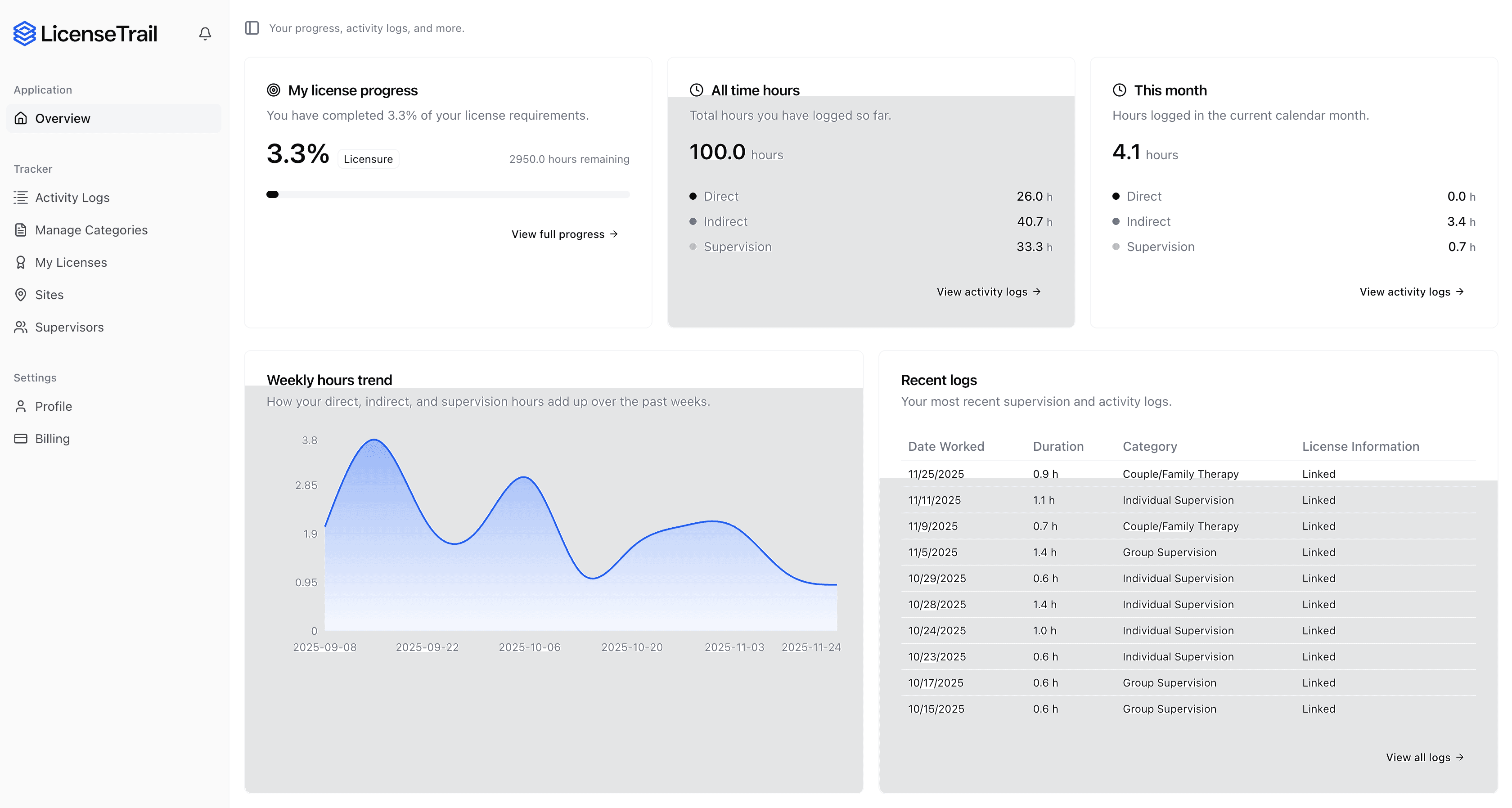
License Trail checks your direct, indirect, and supervision hours against Wisconsin APSW requirements continuously and flags mismatches before you submit.
 Start Tracking for Free
No credit card required · Free plan available
Is your spreadsheet hiding Wisconsin APSW risks?
Stop guessing if your categories match Wisconsin Marriage and Family Therapy, Professional Counseling, and Social Work Examining Board requirements. License Trail checks your direct, indirect, and supervision hours continuously and flags mismatches before you submit.
Import or log
Bring your spreadsheet or start fresh
Upload your existing tracking spreadsheet and we'll map every hour into the right Wisconsin Marriage and Family Therapy, Professional Counseling, and Social Work Examining Board categories automatically.
Verify against Wisconsin
Catch mismatches before the board does
License Trail checks your direct, indirect, and supervision hours against Wisconsin APSW requirements continuously.
Export board-ready
One-click clean reports
Generate professional, board-ready reports for supervision meetings and Wisconsin Marriage and Family Therapy, Professional Counseling, and Social Work Examining Board submissions in seconds.
No credit card required · Free plan available