
Maryland CSC-AD Requirements: Hours, Exams & Step-by-Step Guide
Stop guessing if your categories match Maryland requirements. License Trail checks your direct, indirect, and supervision hours against CSC-AD requirements continuously and flags mismatches before you submit.
No credit card required · Free plan available
Quick Requirements Overview
- Scope/setting: Alcohol & drug counseling only; must be employed by a state certified/licensed agency/facility; no independent practice and cannot supervise others
- Degree: Associate’s in a health/human services counseling field or associate’s + Board‑deemed equivalent studies with ≥30 counseling credits
- A&D coursework: 24 semester credits (37 quarter) in alcohol/drug counselor training from an accredited institution
- Required content (within 24 credits): 3 sem (5 qtr) credits each in pharmacology, addictions treatment delivery, and ethics (A&D-specific)
- Additional content: Complete ≥3 areas (e.g., counseling theories, co‑occurring disorders, family/individual/group counseling, abnormal psych, etc.)
- Clinical experience (choose 1): 6 sem (10 qtr) credit A&D internship OR 1,000 hours A&D counseling work as an A&D trainee, verified by a Board‑approved supervisor
- Supervision while accruing hours: Face‑to‑face individual/group supervision; minimum 1 documented hour per 40‑hour workweek (or ≥2 hours/month if less than full‑time) by a Board‑approved A&D counselor supervisor
- Exams + admin: Pass NCAC I + Maryland law/regs exam; submit application with transcripts, supervision/hour verification, fingerprint background check, and fees; renew every 2 years (CE/ethics per COMAR)
License Details
Procedures
Certified Supervised Counselor–Alcohol and Drug (CSC‑AD) is Maryland’s associate‑degree–level credential for substance use counseling, regulated by the Maryland Board of Professional Counselors and Therapists. This article walks through the exact requirements, with special attention to the clinical hour requirements and how the Board defines supervision.
All requirements and terminology below are taken from COMAR 10.58.07.08 (Certified Supervised Counselor–Alcohol and Drug), related COMAR supervision rules, and the Board’s own CSC‑AD page, current as of late 2025. (law.cornell.edu)
1. What a CSC‑AD is allowed (and not allowed) to do
Maryland describes a CSC‑AD as the Board’s associate‑level alcohol and drug counselor credential. The Board states that a CSC‑AD:
- May provide only alcohol and drug counseling
- Must work as an employee of an agency or facility that is certified or licensed by the State
- Must work under the close supervision of a Board‑approved alcohol and drug counselor supervisor
- May not provide supervision to others
- May not practice independently (law.cornell.edu)
In practice, CSC‑ADs participate in activities such as:
- Screening and brief intervention for substance use
- Biopsychosocial evaluations (as permitted by the supervisor)
- Participating in diagnostic impressions and treatment planning for substance use and co‑occurring disorders
- Individual and group counseling for substance use disorders
- Case coordination, education, and documentation, under supervision (law.cornell.edu)
2. Educational foundation: the degree requirement
To qualify for CSC‑AD, you must meet one of the following degree pathways:
- Associate’s degree in a health and human services counseling field from an accredited educational institution
- An associate’s degree plus a program of studies that the Board determines is “substantially equivalent in subject matter”, with at least 30 credit hours in counseling that also include the required alcohol and drug coursework for this level of certification (law.cornell.edu)
In practice, this usually means an associate’s in addictions counseling, human services, psychology, social work, or a closely related field, taken at a regionally accredited college.
3. Alcohol and drug–specific coursework
Beyond simply holding an associate’s degree, you must complete a defined block of addiction‑focused coursework:
- Minimum of 24 semester credits (or 37 quarter credits) in alcohol and drug counselor training from an accredited institution (law.cornell.edu)
Within those 24 credits, COMAR requires:
3.1 Core required content (all three areas)
You must complete 3 semester credits (or 5 quarter credits) in each of these:
- Pharmacology (focus on psychoactive substances and their effects)
- Addictions treatment delivery
- Ethics that includes alcohol and drug counseling issues (law.cornell.edu)
3.2 Choose at least three additional areas
You must then complete at least three of the following content areas (again, typically 3 semester credits or 5 quarter credits in each):
- Human development
- Theories of counseling
- Treatment of co‑occurring disorders
- Family counseling
- Individual counseling
- Group counseling
- Abnormal psychology
- Topics in substance‑related and addictive disorders (law.cornell.edu)
Many community college addictions programs are structured specifically to cover these COMAR content areas.
4. Clinical experience: internship or 1,000 hours as a trainee
For the CSC‑AD, the Board does not use a “2,000 hours / 1,500 direct hours” breakdown (that structure applies to the master’s‑level Licensed Clinical Alcohol and Drug Counselor). (law.cornell.edu)
Instead, CSC‑AD applicants must complete one of two experience options:
Option A – Academic internship route
- Complete an internship in alcohol and drug counseling that totals:
- 6 semester credits, or
- 10 quarter credits
This internship must be in alcohol and drug counseling and be part of your accredited academic program. (law.cornell.edu)
Option B – Hour‑based trainee route
If you do not have the 6‑credit internship, you can qualify with:
- A minimum of 1,000 hours of alcohol and drug counseling work, and
- Those hours must be “completed as an alcohol and drug trainee”, and
- They must be verified by an approved alcohol and drug counselor supervisor (law.cornell.edu)
What those 1,000 hours must consist of
The regulation calls them “alcohol and drug counseling work” performed in the role of an alcohol and drug trainee. Typical qualifying activities mirror the CSC‑AD scope of practice, for example: (law.cornell.edu)
- Screening, SBIRT, and biopsychosocial assessments (as permitted by your supervisor)
- Participating in diagnostic impressions for substance use and co‑occurring disorders
- Treatment planning, including relapse‑prevention planning, with supervisory oversight
- Individual and group counseling for substance use disorders
- Case management/service coordination related to substance use treatment
- Client, family, and community education for substance use disorders
- Documentation in the clinical record
The Board also requires that this work be paid/compensated supervised experience when you’re accruing hours toward certification under the broader supervision chapter. (mdrules.elaws.us)
So, summarized:
- If you do the internship: you meet the experience requirement by completing 6 credits of A&D internship.
- If you do not do the internship: you must log at least 1,000 hours of supervised alcohol and drug counseling work as a Board‑recognized alcohol and drug trainee, with appropriate supervision and verification.
5. How Maryland defines “under the supervision of an approved alcohol and drug counselor supervisor”
The regulations are very specific about what “under supervision” means and who qualifies as a supervisor.
5.1 Qualifying supervisors
For CSC‑AD trainees and certified counselors, supervision must be provided by:
- A Licensed Clinical Alcohol and Drug Counselor (LCADC)
- A Certified Professional Counselor–Alcohol and Drug (CPC‑AD)
- Or, in certain cases, other Board‑approved clinical professionals such as:
- Certified Associate Counselor–Alcohol and Drug (CAC‑AD)
- Licensed Clinical Professional Counselor
- Licensed Clinical Marriage and Family Therapist
- Licensed Clinical Professional Art Therapist
- Other mental health providers licensed under the Health Occupations Article who meet Board criteria and have documented alcohol and drug counseling experience (mdrules.elaws.us)
The supervisor must be approved by the Board as an alcohol and drug counselor supervisor.
5.2 Structure and dosage of supervision
The Board’s definition of being “under the supervision of an approved alcohol and drug counselor supervisor” includes two key elements: (health.maryland.gov)
-
Format
- Ongoing supervision with direct, on‑site, face‑to‑face individual or group meetings
- Focused on the quality of alcohol and drug counseling services and improvement of counseling skills
-
Minimum amount of supervision
- At least 1 documented hour of supervision for each 40‑hour work week, or
- Not less than 2 documented hours per month if working less than full‑time
Those minimums apply while you are working as an alcohol and drug trainee and accruing hours toward CSC‑AD.
5.3 Documentation expectations
While COMAR does not prescribe an exact form, it expects:
- Supervisors to document supervision sessions (dates, times, format, and content)
- Verification of your hours and duties on Board‑approved forms when you apply for certification (law.cornell.edu)
6. Examinations: national A&D exam plus Maryland law exam
Before the Board will issue the CSC‑AD certification, you must pass two exams:
- A national alcohol and drug counselor examination approved by the Board
- The Board’s CSC‑AD page specifies that applicants must pass the NCAC I (National Certified Addiction Counselor, Level I) exam. (health.maryland.gov)
- A Maryland law and regulations exam, covering:
- Health Occupations Article, Title 17 (Maryland law for this Board), and
- COMAR 10.58 (Board regulations) (law.cornell.edu)
If you fail one or both exams, COMAR allows re‑examination, but you may need to submit a new application and fee or obtain a waiver if outside the testing authority’s time frame. (law.cornell.edu)
7. Application process and background check
The Board outlines the CSC‑AD application process as follows: (health.maryland.gov)
- Complete the Board’s CSC‑AD application
- You may optionally first submit a Pre‑Application Credential Evaluation for CSC‑AD to confirm you are on track.
- Obtain a criminal history background check
- Submit your fingerprints via an approved channel.
- Include a copy of the background check receipt with your application.
- Submit all supporting documents, including:
- Official transcripts showing your associate’s degree and the required coursework
- Internship evaluation or forms verifying your 1,000 trainee hours (if you used the hour‑based route)
- Any required supervision verification forms
- Pay all applicable fees (non‑refundable) as listed in COMAR 10.58.02. (law.cornell.edu)
Once the Board has:
- Reviewed and approved your application, and
- Cleared your criminal history background check,
it will send you written authorization to sit for the NCAC I and Maryland law exams. After the Board receives official notice that you passed both exams, it issues your CSC‑AD certificate. (health.maryland.gov)
8. Renewal and ongoing status
Key ongoing requirements:
- Renewal frequency: Every 2 years for CSC‑AD certificates.
- Renewal method: Online through the Board’s website.
- You must comply with any continuing education and ethics requirements set in COMAR 10.58.07.07 and COMAR 10.58.03. (health.maryland.gov)
- You may request inactive status or reinstatement under the rules described in COMAR 10.58.07. (law.cornell.edu)
During practice as a CSC‑AD you must:
- Continue to work under close supervision
- Confine your work to alcohol and drug counseling in State‑certified or State‑licensed agencies/facilities
- Refrain from providing supervision or practicing independently (law.cornell.edu)
9. Hour requirements at a glance (CSC‑AD only)
To summarize the hour‑related requirements that matter most for CSC‑AD applicants:
- Academic training:
- 24 semester credits (or 37 quarter credits) of alcohol and drug counselor training, including specific required content areas.
- Clinical experience (choose one):
- 6‑credit internship in alcohol and drug counseling
OR - At least 1,000 hours of alcohol and drug counseling work as an alcohol and drug trainee, under and verified by a Board‑approved supervisor. (law.cornell.edu)
- 6‑credit internship in alcohol and drug counseling
- Supervision dosage while accruing hours:
- Minimum 1 documented supervision hour per 40‑hour workweek,
- Or at least 2 documented supervision hours per month if working less than full‑time. (health.maryland.gov)
There is no separate requirement for “1,500 hours direct client contact plus 1,500 hours additional supervised experience” at the CSC‑AD level; that sort of breakdown appears at higher licensure levels (e.g., LCADC) rather than for this associate‑level credential. (law.cornell.edu)
Track your CSC-AD hours with confidence
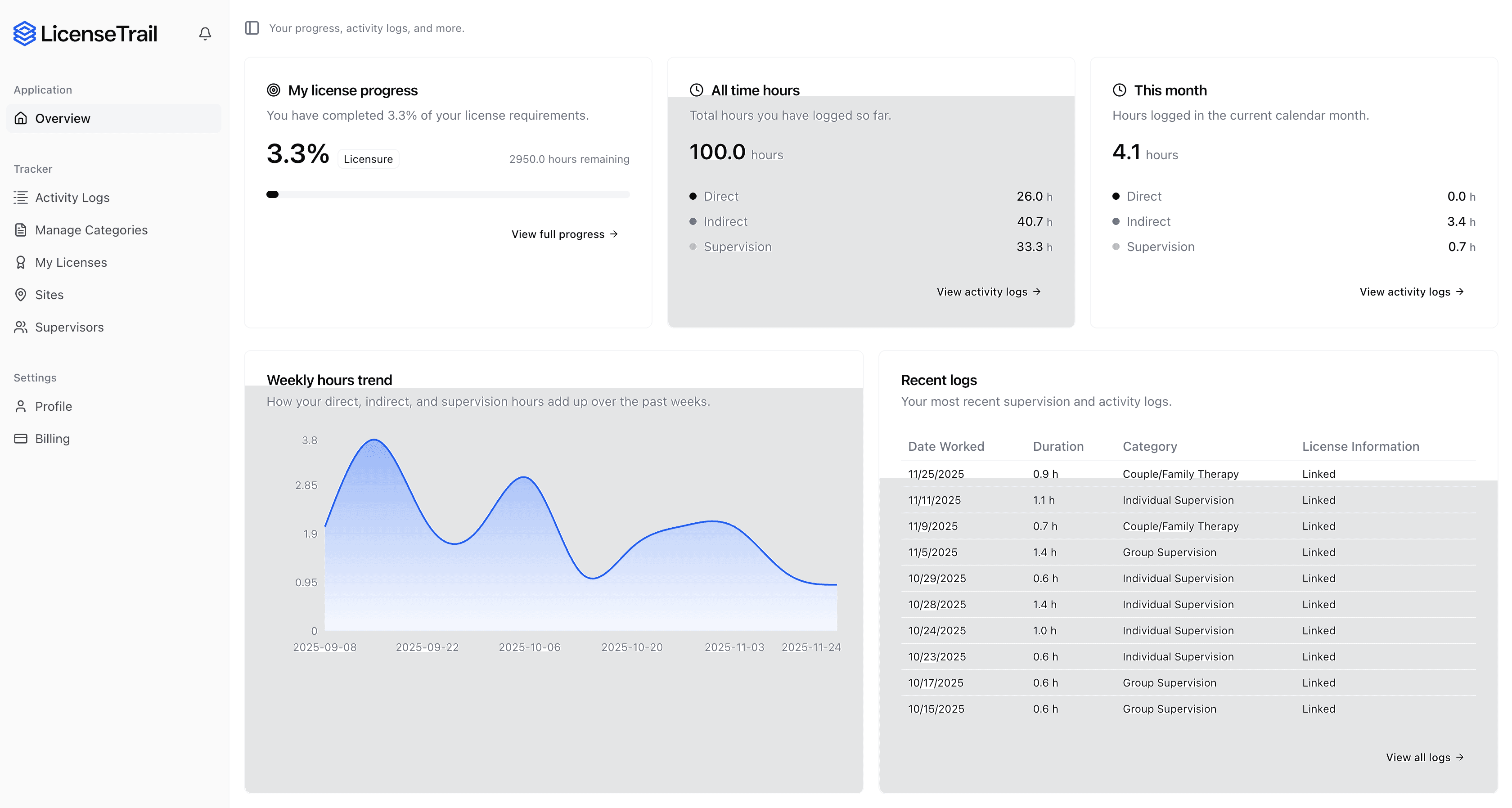
License Trail checks your direct, indirect, and supervision hours against Maryland CSC-AD requirements continuously and flags mismatches before you submit.
 Start Tracking for Free
No credit card required · Free plan available
Related Licenses
Certified professional counselor
CPC
Certified professional counselor — alcohol and drug
CPC-AD
Certified professional counselor—marriage and family therapist
CPC-MFT
Licensed clinical alcohol and drug counselor
LCADC
Licensed clinical marriage and family therapist
LCMFT
Licensed Clinical Professional Art Therapist
LCPAT
Licensed clinical professional counselor
LCPC
Is your spreadsheet hiding Maryland CSC-AD risks?
Stop guessing if your categories match Maryland Board of Professional Counselors and Therapists requirements. License Trail checks your direct, indirect, and supervision hours continuously and flags mismatches before you submit.
Import or log
Bring your spreadsheet or start fresh
Upload your existing tracking spreadsheet and we'll map every hour into the right Maryland Board of Professional Counselors and Therapists categories automatically.
Verify against Maryland
Catch mismatches before the board does
License Trail checks your direct, indirect, and supervision hours against Maryland CSC-AD requirements continuously.
Export board-ready
One-click clean reports
Generate professional, board-ready reports for supervision meetings and Maryland Board of Professional Counselors and Therapists submissions in seconds.
No credit card required · Free plan available