
Maryland LGADC Requirements: Hours, Exams & Step-by-Step Guide
Stop guessing if your categories match Maryland requirements. License Trail checks your direct, indirect, and supervision hours against LGADC requirements continuously and flags mismatches before you submit.
No credit card required · Free plan available
Quick Requirements Overview
- Scope: May provide graduate alcohol & drug counseling only under Board‑approved clinical supervision; no independent practice and no supervising others
- Degree: Master’s (≥60 grad semester credits/90 quarter) in a Board‑acceptable health/human services counseling field (or doctoral equivalent / substantially equivalent studies)
- A&D training: ≥39 semester credits (65 quarter) in alcohol & drug counselor training, including required content (e.g., pharmacology, group/individual counseling, treatment delivery, ethics, abnormal psych) + electives (3 of specified areas)
- Additional coursework: 3 credits in diagnosis/psychopathology and 3 credits in psychotherapy/treatment of mental & emotional disorders
- Pre‑licensure practice requirement (either): 6‑credit A&D internship or 1,000 hours A&D counseling work as CAC‑AD/CSC‑AD/ADT under/verified by a Board‑approved supervisor
- Exams & checks: Pass Board‑approved national A&D exam + Maryland law exam (Title 17 & COMAR 10.58); complete criminal background check
- Supervision admin: Must have written supervision contract, maintain supervision records, and provide client disclosure identifying supervisor/contact info
- License term: Expires in 2 years; extensions available (up to ~6 years total; CEUs generally required for later extensions)
License Details
Procedures
Maryland’s Licensed Graduate Alcohol and Drug Counselor (LGADC) credential is the master’s‑level license that lets you practice alcohol and drug counseling under supervision while you complete the supervised clinical experience required for the full clinical license (LCADC). (health.maryland.gov)
Below is a breakdown of exactly what Maryland’s Board of Professional Counselors and Therapists requires, with a focus on hours, supervision, and the Board’s own terminology.
1. Role of the LGADC in Maryland
Under COMAR 10.58.07.04, a licensed graduate alcohol and drug counselor is approved by the Board to provide “graduate alcohol and drug counseling” only under the clinical supervision of a Board‑approved alcohol and drug counselor supervisor. LGADCs: (dsd.maryland.gov)
- May perform clinical evaluation, treatment planning, counseling/therapy, case management, client and family education, and documentation, but
- May not practice independently and may not supervise others. (dsd.maryland.gov)
The purpose of this license is to let you practice and accrue the supervised clinical experience you need later for the Licensed Clinical Alcohol and Drug Counselor (LCADC) license. (health.maryland.gov)
2. Core Eligibility: Education and Coursework
2.1 Graduate degree requirement
To qualify for LGADC, you must have completed one of the following at a regionally accredited institution: (dsd.maryland.gov)
-
Master’s degree in a health or human services counseling field with
- At least 60 graduate semester credits (or 90 quarter credits), or
-
Doctoral degree in a health or human services counseling field with
- At least 90 graduate semester credits (or 135 quarter credits), or
-
A master’s degree plus a Board‑approved “substantially equivalent” program of studies totaling at least 60 graduate credits in counseling, including all required alcohol and drug coursework specified for the license.
“Health or human services counseling field” includes areas such as human services, behavioral health or behavioral sciences, rehabilitation counseling, counselor education, counseling psychology, and other related programs the Board accepts. (health.maryland.gov)
2.2 Alcohol and drug counselor training (minimum 39 credits)
You must complete at least 39 semester credits (65 quarter credits) in alcohol and drug counselor training from an accredited institution. Within those 39 credits, the Board requires: (dsd.maryland.gov)
A. Required 3‑credit (or 5‑quarter‑credit) courses in each of these areas:
- Pharmacology
- Group counseling
- Individual counseling
- Addictions treatment delivery
- Ethics that include alcohol and drug counseling issues
- Abnormal psychology
B. Plus any three of the following 3‑credit (or 5‑quarter‑credit) courses:
- Human development
- Theories of counseling
- Treatment of co‑occurring disorders
- Topics in substance‑related and addictive disorders
- Family counseling
The Board expects these courses to be clearly identifiable on your transcript as related to alcohol and drug counselor training.
2.3 Additional graduate mental health coursework
On top of the 39 credits above, you must also complete 3 graduate semester credits (or 5 quarter credits) in each of the following: (dsd.maryland.gov)
- Diagnosis and psychopathology
- Psychotherapy and treatment of mental and emotional disorders
These are separate, graduate‑level courses specifically covering diagnosis and treatment of mental and emotional disorders (not just substance use).
3. Required Internship or 1,000 Hours of Alcohol & Drug Counseling Work
Before the Board will issue the LGADC license, you must show either a qualifying internship or a block of documented work hours in alcohol and drug counseling.
Under COMAR 10.58.07.04(B)(3), you must complete one of the following: (dsd.maryland.gov)
Option 1 – Academic internship
- An internship in alcohol and drug counseling that totals 6 semester credits or 10 quarter credits.
This is usually a structured graduate practicum or internship course sequence in your counseling program.
Option 2 – 1,000 hours of counseling work
- A minimum of 1,000 hours of alcohol and drug counseling work,
- Completed as one of the following:
- Certified Associate Counselor – Alcohol and Drug (CAC‑AD)
- Certified Supervised Counselor – Alcohol and Drug (CSC‑AD)
- Alcohol and Drug Trainee (ADT)
- Under and verified by a Board‑approved alcohol and drug counselor supervisor. (dsd.maryland.gov)
These 1,000 hours are described by the Board as “alcohol and drug counseling work” rather than broken into specific categories (e.g., direct vs supervision) at the LGADC stage. They must, however, be performed under approved supervision and documented by that supervisor.
4. Examinations and Background Check
To be licensed as an LGADC, you must: (dsd.maryland.gov)
-
Pass a national alcohol and drug counselor examination approved by the Board.
- In practice, this is often the Masters Addiction Counseling (MAC) exam or another Board‑approved national exam.
-
Pass the Maryland law examination, which tests knowledge of:
- Health Occupations Article, Title 17, Annotated Code of Maryland, and
- COMAR 10.58 (the Board’s counseling regulations).
- This is commonly called the Maryland Law Assessment.
-
Submit to a criminal background check.
You must also complete the Board’s official LGADC application (or pre‑application credential evaluation, if you choose) and pay the required fees through the Maryland Board of Professional Counselors and Therapists. (health.maryland.gov)
5. What “Supervision” and “Supervised Experience” Mean in Maryland
The Board uses specific terms:
-
“Licensed graduate alcohol and drug counselor” – an individual approved by the Board to practice graduate alcohol and drug counseling under the supervision of an approved alcohol and drug counselor supervisor while fulfilling the supervised clinical experience for licensure as a clinical alcohol and drug counselor. (health.maryland.gov)
-
“Supervised experience in alcohol and drug counseling” – alcohol and drug counseling services provided under close or moderate supervision of an approved licensed or certified alcohol and drug counselor supervisor. (health.maryland.gov)
-
“Supervision” – a formal professional relationship in which the supervisor directs, guides, monitors, instructs, and evaluates the supervisee’s alcohol and drug counseling practice, and accepts direct responsibility for services rendered by the supervisee. The supervisor must be readily available in person, by written instruction, by phone, or by other electronic means (including having designated back‑up supervisors). (health.maryland.gov)
LGADCs are considered “supervisees” under the supervision regulations and must:
- Work only under an approved supervisor,
- Have a written supervision contract,
- Keep detailed records of supervision sessions, and
- Provide clients with a professional disclosure statement that explicitly states services are provided under clinical supervision and identifies the supervisor with contact information. (dsd.maryland.gov)
6. Who Can Supervise an LGADC and What Counts as “Clinical Alcohol and Drug Supervisor”
Under COMAR 10.58.13.03 and 10.58.07.14, supervised clinical experience hours for LGADCs must be obtained under a Board‑approved clinical alcohol and drug supervisor. This may include: (mdrules.elaws.us)
- A Licensed Clinical Alcohol and Drug Counselor (LCADC)
- A Licensed Clinical Professional Counselor (LCPC)
- A Licensed Clinical Marriage and Family Therapist (LCMFT)
- A Licensed Clinical Professional Art Therapist (LCPAT)
- Another licensed clinical mental health provider approved by the Board
Supervisor qualifications include, among other things: (dsd.maryland.gov)
- At least 3 years of documented experience in alcohol and drug counseling,
- At least 3,000 hours of direct client contact in that work, and
- Specific training in clinical supervision (graduate coursework, Board‑approved CEUs, or a national clinical supervisor credential).
7. Supervised Clinical Experience Hours Needed for the LCADC (While You Hold LGADC)
Although your question is about the LGADC license, the Board explicitly defines LGADC as the status under which you fulfill the supervised clinical experience for licensure as an LCADC. So it is important to understand that hour requirement, because it dictates what you must accumulate while licensed as LGADC. (health.maryland.gov)
To qualify later as a Licensed Clinical Alcohol and Drug Counselor (LCADC), you must complete:
- At least 2 years of supervised clinical experience in alcohol and drug counseling,
- With a minimum of 2,000 hours total,
- Obtained after award of your qualifying master’s or doctoral degree, and
- Under an approved clinical alcohol and drug counselor supervisor. (health.maryland.gov)
The Board breaks down those 2,000 hours as follows: (health.maryland.gov)
-
Total supervised clinical experience:
- 2,000 hours minimum
-
Direct clinical counseling services:
- At least 1,500 hours must be direct clinical counseling services (face‑to‑face client contact).
-
Clinical supervision within those hours:
- At least 100 hours of face‑to‑face clinical supervision, of which:
- A minimum of 50 hours must be individual, face‑to‑face supervision, and
- A maximum of 50 hours may be face‑to‑face group supervision.
- At least 100 hours of face‑to‑face clinical supervision, of which:
These hours are what the Board calls “supervised clinical experience in alcohol and drug counseling” and they are, in practice, the hours you accumulate while you are an LGADC (or a qualifying trainee/graduate‑level role) on your way to full clinical licensure.
So, to directly answer your example:
- Maryland does not require “1,500 hours of direct experience and 1,500 hours of supervised experience.”
- Instead, Maryland requires 2,000 total supervised clinical hours, of which 1,500 are direct clinical counseling and 100 are supervision hours (within the 2,000). (health.maryland.gov)
8. License Term, Renewal, and Time Limits for LGADC
Under COMAR 10.58.07.04(G): (dsd.maryland.gov)
- An LGADC license expires 2 years after the date it is issued.
- If you have not yet accumulated the required supervised clinical hours for LCADC within those 2 years, you may apply for a 2‑year extension on a Board‑approved form.
- You can receive extensions up to a maximum of 6 years total as an LGADC, with possible additional extension only if you submit a written request and the Board approves it “in certain circumstances.”
- For the first 2‑year extension, continuing education units (CEUs) are not required. Subsequent extensions require CEUs per COMAR 10.58.05.
If your license lapses or goes inactive, there are specific reinstatement rules; after 5 years from expiration or from going inactive, you may have to re‑apply and meet current licensure requirements. (dsd.maryland.gov)
9. Step‑by‑Step Summary to Become an LGADC in Maryland
-
Complete a qualifying graduate degree
- Master’s or doctorate in a Board‑acceptable health or human services counseling field, with at least 60 graduate credits (or the required doctoral equivalent). (dsd.maryland.gov)
-
Ensure you have the required coursework
- At least 39 credits of alcohol and drug counselor training with the specified content areas, plus 3 credits each in diagnosis/psychopathology and psychotherapy/treatment of mental and emotional disorders. (dsd.maryland.gov)
-
Complete either an internship or 1,000 hours of work
- 6‑credit internship or
- 1,000 hours of alcohol and drug counseling work as CAC‑AD, CSC‑AD, or ADT under an approved supervisor. (dsd.maryland.gov)
-
Obtain and verify supervision
- Make sure your supervisor is Board‑approved and meets the Board’s supervisor qualifications; execute a written supervision contract and maintain documentation. (dsd.maryland.gov)
-
Pass the required exams
- National alcohol and drug counselor exam (e.g., MAC or other Board‑approved national exam).
- Maryland law exam covering Title 17 and COMAR 10.58. (dsd.maryland.gov)
-
Complete the Board’s LGADC application
- Optionally request a pre‑application credential evaluation if you are unsure about your education and credits.
- Submit transcripts, exam scores, supervision verifications (if applicable), and pay fees; undergo a criminal background check. (health.maryland.gov)
-
Receive LGADC license and practice under supervision
- Practice only under clinical supervision, with proper disclosure to clients and documentation of supervision sessions. (dsd.maryland.gov)
-
Accumulate supervised clinical experience for LCADC
- While licensed as LGADC, complete 2 years / 2,000 hours of supervised clinical experience in alcohol and drug counseling, including 1,500 direct clinical hours and 100 hours of clinical supervision (50 individual, up to 50 group), under an approved clinical alcohol and drug supervisor. (health.maryland.gov)
-
Move on to LCADC when hours and other requirements are met
- Once you have met the supervised clinical experience requirement and any remaining criteria, you can apply for full clinical licensure (LCADC). (regulations.justia.com)
This framework reflects the current requirements in COMAR 10.58.07 and 10.58.13 and the Maryland Board’s own LGADC and alcohol and drug counselor guidance as of mid‑2025.
Track your LGADC hours with confidence
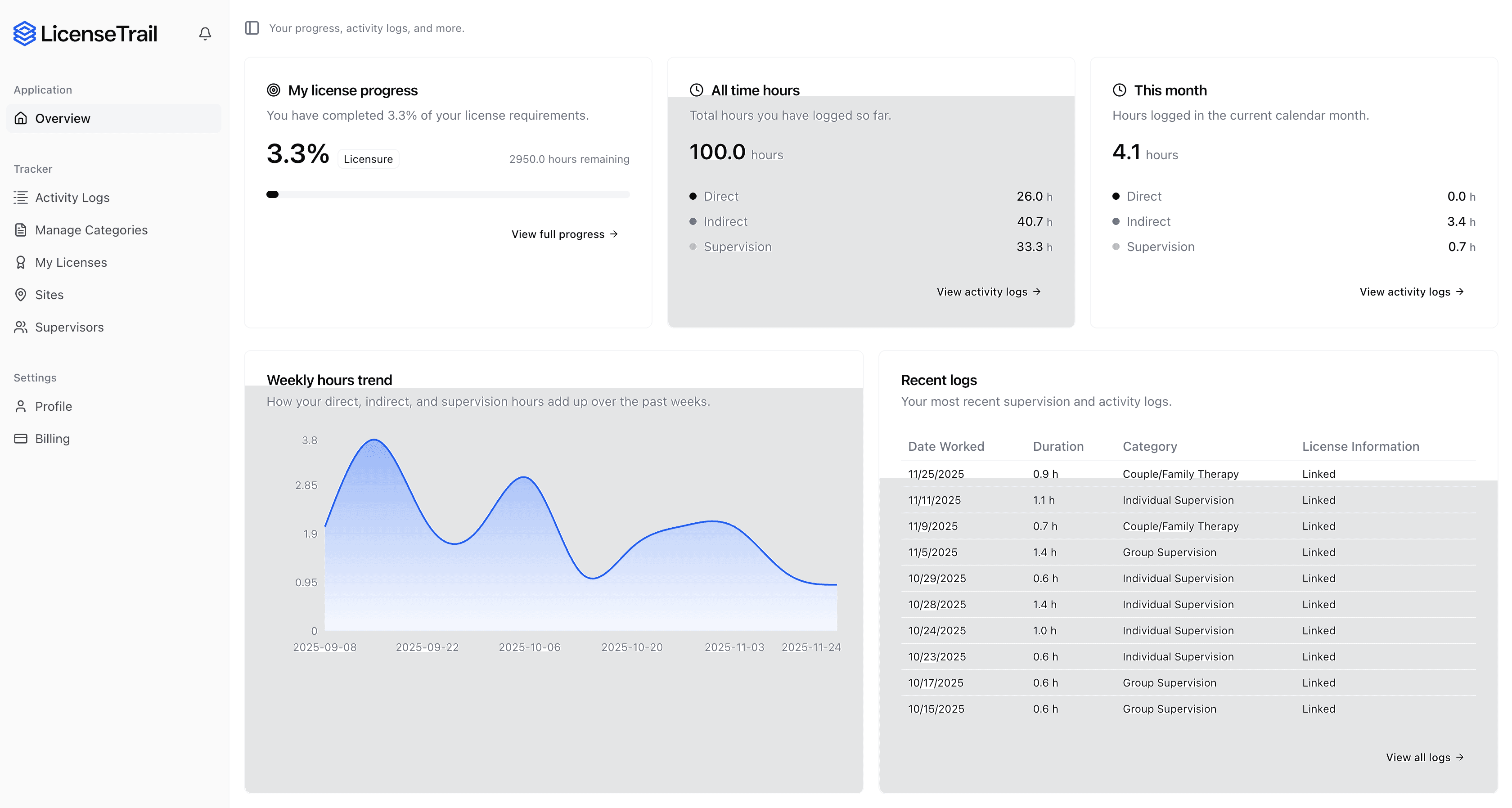
License Trail checks your direct, indirect, and supervision hours against Maryland LGADC requirements continuously and flags mismatches before you submit.
 Start Tracking for Free
No credit card required · Free plan available
Related Licenses
Certified professional counselor
CPC
Certified professional counselor — alcohol and drug
CPC-AD
Certified professional counselor—marriage and family therapist
CPC-MFT
Licensed clinical alcohol and drug counselor
LCADC
Licensed clinical marriage and family therapist
LCMFT
Licensed Clinical Professional Art Therapist
LCPAT
Licensed clinical professional counselor
LCPC
Is your spreadsheet hiding Maryland LGADC risks?
Stop guessing if your categories match Maryland Board of Professional Counselors and Therapists requirements. License Trail checks your direct, indirect, and supervision hours continuously and flags mismatches before you submit.
Import or log
Bring your spreadsheet or start fresh
Upload your existing tracking spreadsheet and we'll map every hour into the right Maryland Board of Professional Counselors and Therapists categories automatically.
Verify against Maryland
Catch mismatches before the board does
License Trail checks your direct, indirect, and supervision hours against Maryland LGADC requirements continuously.
Export board-ready
One-click clean reports
Generate professional, board-ready reports for supervision meetings and Maryland Board of Professional Counselors and Therapists submissions in seconds.
No credit card required · Free plan available