
Maryland LGMFT Requirements: Hours, Exams & Step-by-Step Guide
Stop guessing if your categories match Maryland requirements. License Trail checks your direct, indirect, and supervision hours against LGMFT requirements continuously and flags mismatches before you submit.
No credit card required · Free plan available
Quick Requirements Overview
- Practice only under Board‑approved MFT supervision; no independent practice and no supervising others
- Degree/credits: MFT (or equivalent) from Board‑approved accredited school — Master’s 60 sem/90 qtr (Doctorate 90 sem/135 qtr); ≥45 sem/68 qtr in required MFT content areas
- Practicum/internship (pre‑LGMFT): 300 direct client contact hrs (≥100 relational couples/families) + 60 supervision hrs by Board‑approved supervisor
- Exams: pass AMFTRB National MFT Exam + Maryland law/regulations exam (Health Occupations Title 17 + COMAR 10.58)
- Application: submit Board application, official transcripts, exam verification, and pay required fees; attest to supervised practice/ethics compliance
- License term: valid 2 years; extensions in 2‑year blocks (generally up to 6 years, limited exceptions beyond)
- Toward LCMFT while LGMFT: 2,000 post‑master’s hrs over ≥2 years (≥1,000 direct + up to 1,000 indirect) + 100 face‑to‑face supervision hrs (≥50 individual; ≤50 group)
- Supervisor mix (post‑master’s): ≥80% of hours under Board‑approved LCMFT supervisor; ≤20% under other Board‑approved qualified MH providers (with ≥5 yrs MFT experience)
License Details
Procedures
In Maryland, the Licensed Graduate Marriage and Family Therapist (LGMFT) credential is the first clinical license on the marriage and family therapy (MFT) track. It allows you to practice graduate marriage and family therapy only under supervision while you accumulate the post‑graduate hours required for full Licensed Clinical Marriage and Family Therapist (LCMFT) status.
Below is a step‑by‑step breakdown of what the Maryland Board of Professional Counselors and Therapists requires, with a focus on the exact hour types and how they are defined in regulation.
1. Understand the Role of the LGMFT
Maryland law defines a “licensed graduate marriage and family therapist” as someone approved by the Board to practice graduate marriage and family therapy under the supervision of a Board‑approved marriage and family therapy supervisor while completing the supervised clinical experience required for clinical licensure. (regs.maryland.gov)
Key limits on the LGMFT license:
- You must practice under supervision of a Board‑approved MFT supervisor.
- You may not practice independently and may not provide supervision to others. (regs.maryland.gov)
- The LGMFT license expires 2 years after the date issued. You may request Board‑approved extensions in 2‑year blocks (generally up to 6 years total, with limited exceptions) if you need more time to complete your clinical hours for LCMFT. (regs.maryland.gov)
2. Educational Requirements for LGMFT
To qualify for licensure as an LGMFT, you must have a qualifying graduate degree in a marriage and family therapy field and specific coursework as outlined in COMAR 10.58.08.04 and the Board’s “Graduate Marriage & Family Therapy (LGMFT)” page. (regs.maryland.gov)
2.1 Degree and Total Credit Hours
You must have one of the following from an accredited institution approved by the Board: (regs.maryland.gov)
- Master’s degree in marriage and family therapy (or substantially equivalent)
- Minimum 60 graduate semester credit hours or 90 graduate quarter credit hours
- Doctoral degree in marriage and family therapy (or substantially equivalent)
- Minimum 90 graduate semester credit hours or 135 graduate quarter credit hours
Within those credits, you must have at least 45 graduate semester credits (or 68 quarter credits) distributed in specific MFT content areas described below. (regs.maryland.gov)
2.2 Required Content Areas (Including Practicum)
Of the required graduate credit hours (above), you must complete a minimum of 45 credit hours covering all of the following areas (summarized from COMAR): (regs.maryland.gov)
-
Supervised clinical internship or practicum
- Must include at least:
- 60 hours of supervision by a Board‑approved supervisor, and
- 300 hours of direct client contact with couples, families, and individuals,
- Of these, at least 100 hours must be “relational therapy” (i.e., therapy with couples/families). (regs.maryland.gov)
- Must include at least:
-
Normal and abnormal personality development, including individual development across the life span and the family life cycle. (regs.maryland.gov)
-
Psychopathology, with emphasis on standard diagnostic manuals and family systems models. (regs.maryland.gov)
-
Diagnosis and treatment of mental and emotional disorders in family systems. (regs.maryland.gov)
-
Family therapy theory and models, including:
- A comprehensive survey of major family therapy models, and
- At least two courses focusing on a minimum of three marriage and family therapy models. (regs.maryland.gov)
-
Couples therapy theory and models, including:
- A comprehensive survey of major couples therapy models, and
- An intensive study of at least three different models of couples therapy. (regs.maryland.gov)
-
Gender and ethnicity in MFT practice
- Either one course addressing both gender and ethnicity as they relate to MFT theory and practice, or
- Two separate courses, one focused on gender issues and one on ethnicity. (regs.maryland.gov)
-
Sexual issues in marriage and family therapy, covering:
- Sexual normality
- Sexual dysfunction
- Sexual orientation
- Sexual identity (regs.maryland.gov)
-
Ethical, legal, and professional issues in marriage and family therapy. (regs.maryland.gov)
These coursework and practicum requirements must be met before you can qualify for the LGMFT license.
3. Practicum/Internship Hour Types (Pre‑LGMFT)
The Board and COMAR are explicit about how your pre‑licensure practicum hours must be structured. The key numbers are:
-
300 hours of direct client contact
- Direct client contact is face‑to‑face clinical work (at least 45 minutes per “client contact hour”) with a client present. (regs.maryland.gov)
- These hours must be with couples, families, and individuals, with at least 100 hours specifically in relational therapy (i.e., with couples and/or families). (regs.maryland.gov)
-
60 hours of supervision during that practicum
- A “clinical supervision hour” is at least 45 minutes of direct supervision time with the supervisee present. (regs.maryland.gov)
- Supervision must be provided by a Board‑approved marriage and family therapy supervisor. (regs.maryland.gov)
These practicum hours are part of your graduate program and are required for eligibility to apply for LGMFT.
4. Examination Requirements for LGMFT
To be licensed as an LGMFT, you must pass:
-
National MFT Examination
- The Board specifies the “Examination in Marital and Family Therapy” developed by the Association of Marital and Family Therapy Regulatory Boards (AMFTRB). (health.maryland.gov)
-
Maryland law and regulations exam
- This covers Health Occupations Article, Title 17 (Maryland’s professional counselors and therapists statute) and the applicable Board regulations (COMAR 10.58). (regs.maryland.gov)
You must earn passing scores on both before the Board will issue an LGMFT license.
5. Applying for the LGMFT License
While the question focuses on hours, it is useful to note the procedural pieces as the Board frames them:
- Submit a Board‑approved application form with:
- Official transcripts documenting the degree and required coursework/practicum hours. (regs.maryland.gov)
- Verification of passing the AMFTRB national MFT exam and the Maryland law/regulations exam. (regs.maryland.gov)
- Pay the required non‑refundable application and licensing fees (set in COMAR 10.58.02). (regs.maryland.gov)
- Attest that you will practice only under Board‑approved MFT supervision and comply with the Board’s code of ethics. (regs.maryland.gov)
Once approved, the Board issues the LGMFT license, which starts the supervised post‑graduate practice period.
6. Supervised Practice as an LGMFT and Hours Toward LCMFT
Although your question is about becoming an LGMFT, Maryland’s regulations explicitly tie the LGMFT period to building the supervised hours required for LCMFT. Those hours and their types are defined very specifically.
6.1 Total Post‑Graduate Clinical Hours Required for LCMFT
To progress from LGMFT to Licensed Clinical Marriage and Family Therapist (LCMFT), the Board requires that you complete a minimum of 2 years and 2,000 hours of clinical experience in marriage and family therapy, under supervision, after the award of the master’s degree. (regs.maryland.gov)
The 2,000 hours must be broken down as follows:
- 1,000 hours minimum – direct clinical therapy services
- Up to 1,000 hours – indirect clinical therapy services
So, unlike some counseling tracks that require 3,000 hours (e.g., LCPC with 1,500 direct and 1,500 indirect), the MFT track in Maryland specifies 2,000 hours total: 1,000 direct + up to 1,000 indirect. (regs.maryland.gov)
6.2 How “Direct” vs. “Indirect” Hours Are Defined
Maryland gives precise regulatory definitions for marriage and family therapy hours. (regs.maryland.gov)
Direct clinical marriage and family therapy services (count toward the 1,000 direct hours) include face‑to‑face services such as:
- Individual counseling
- Couples counseling
- Family counseling
- Group counseling
- Evaluation and intake/assessment (with the client present)
- Diagnosis
- Treatment planning with the client
- Crisis management/intervention
These must be face‑to‑face (in‑person or real‑time video) with the client or their significant others; each “client contact hour” is at least 45 minutes with the client present. (regs.maryland.gov)
Indirect clinical marriage and family therapy services (may count toward the remaining 1,000 hours) include activities such as: (regs.maryland.gov)
- Case management
- Intake/assessment when the client is not face‑to‑face (e.g., phone intake)
- Individual and group supervision received
- Consultation with other professionals
- Treatment planning with other professionals
- Case staffing and staff meetings
- Related trainings and seminars
- Record keeping, report writing, case notes
- Telephone triage
- Program development and other clinical administrative duties related to MFT services
6.3 Supervision Structure for Post‑Graduate Hours
Maryland also regulates who can supervise and how many supervision hours are required: (regs.maryland.gov)
- Supervised clinical experience must be completed as a licensed graduate marriage and family therapist (or otherwise Board‑approved equivalent), after the master’s degree.
- At least 80% of your direct + indirect clinical hours must be under a Board‑approved marriage and family therapy supervisor who is a licensed clinical marriage and family therapist (LCMFT).
- No more than 20% of those supervised hours may be under other Board‑approved licensed mental health providers (e.g., LCPC, LCADC, LCPAT, LCSW‑C, psychiatrist, psychologist, psychiatric nurse practitioner) who have at least 5 years’ experience delivering MFT services and are approved as supervisors by the Board. (regs.maryland.gov)
In addition to the 2,000 clinical hours, you must complete:
- 100 hours of face‑to‑face clinical supervision within 2 years of the master’s degree, including:
- At least 50 hours of individual face‑to‑face supervision, and
- Up to 50 hours of group face‑to‑face supervision. (regs.maryland.gov)
A “clinical supervision hour” is at least 45 minutes of direct supervision time with the supervisee present; “face‑to‑face” can include in‑person or live video that allows synchronous visual and auditory communication, but not telephone alone or text‑only internet communication. (regs.maryland.gov)
7. Time Limits and Extensions During the LGMFT Period
The LGMFT is a time‑limited license intended for this supervised phase:
- Initial LGMFT license term: 2 years from the issuance date.
- If you cannot complete the required supervised clinical hours for LCMFT within 2 years, you may apply for a 2‑year extension on a Board‑approved form before your current LGMFT license expires, for up to a maximum of 6 years. (regs.maryland.gov)
- In certain documented circumstances, the Board may grant an extension beyond the 6‑year maximum. (regs.maryland.gov)
During all of this time, you must remain under Board‑approved supervision and may not practice independently.
8. Clarifying the “1,500 Hours Direct / 1,500 Hours Supervised” Example
Your example (1,500 hours of direct experience and 1,500 hours of supervised experience) matches the LCPC (Licensed Clinical Professional Counselor) standards in Maryland, which require 3,000 hours total: 1,500 direct + 1,500 indirect clinical counseling hours, with 2,000 of those as supervised post‑master’s experience as an LGPC. (regs.maryland.gov)
For the MFT track, the Board’s language is different:
- LCMFT requirement: 2,000 hours total clinical experience in marriage and family therapy
- 1,000 hours minimum direct clinical therapy services
- Up to 1,000 hours indirect clinical therapy services
- 2,000 supervised hours completed post‑master’s as an LGMFT (or equivalent), with 80/20 supervisor rules and 100 hours of face‑to‑face supervision (50 individual / 50 group). (regs.maryland.gov)
So, for marriage and family therapists in Maryland, the key numbers to remember are 300/60 (practicum), then 2,000/1,000/1,000 + 100 (post‑graduate supervised hours and supervision).
Summary of Core Hour Requirements on the LGMFT Pathway in Maryland
-
Graduate practicum (during your degree, required to get LGMFT)
- 300 hours direct client contact (at least 100 relational hours)
- 60 hours of supervision by a Board‑approved MFT supervisor (regs.maryland.gov)
-
Post‑graduate supervised experience (while holding LGMFT, required to become LCMFT)
- 2,000 hours total clinical experience in marriage and family therapy
- 1,000 hours minimum direct clinical therapy services
- Up to 1,000 hours indirect clinical therapy services
- 100 hours face‑to‑face clinical supervision (≥ 50 individual; ≤ 50 group)
- At least 80% of all supervised hours under a Board‑approved LCMFT supervisor; up to 20% under other qualified Board‑approved mental health supervisors with sufficient MFT experience (regs.maryland.gov)
- 2,000 hours total clinical experience in marriage and family therapy
All of these requirements are governed by the Maryland Board of Professional Counselors and Therapists under COMAR 10.58.08 and 10.58.15 and the Board’s Graduate Marriage & Family Therapy (LGMFT) webpage.
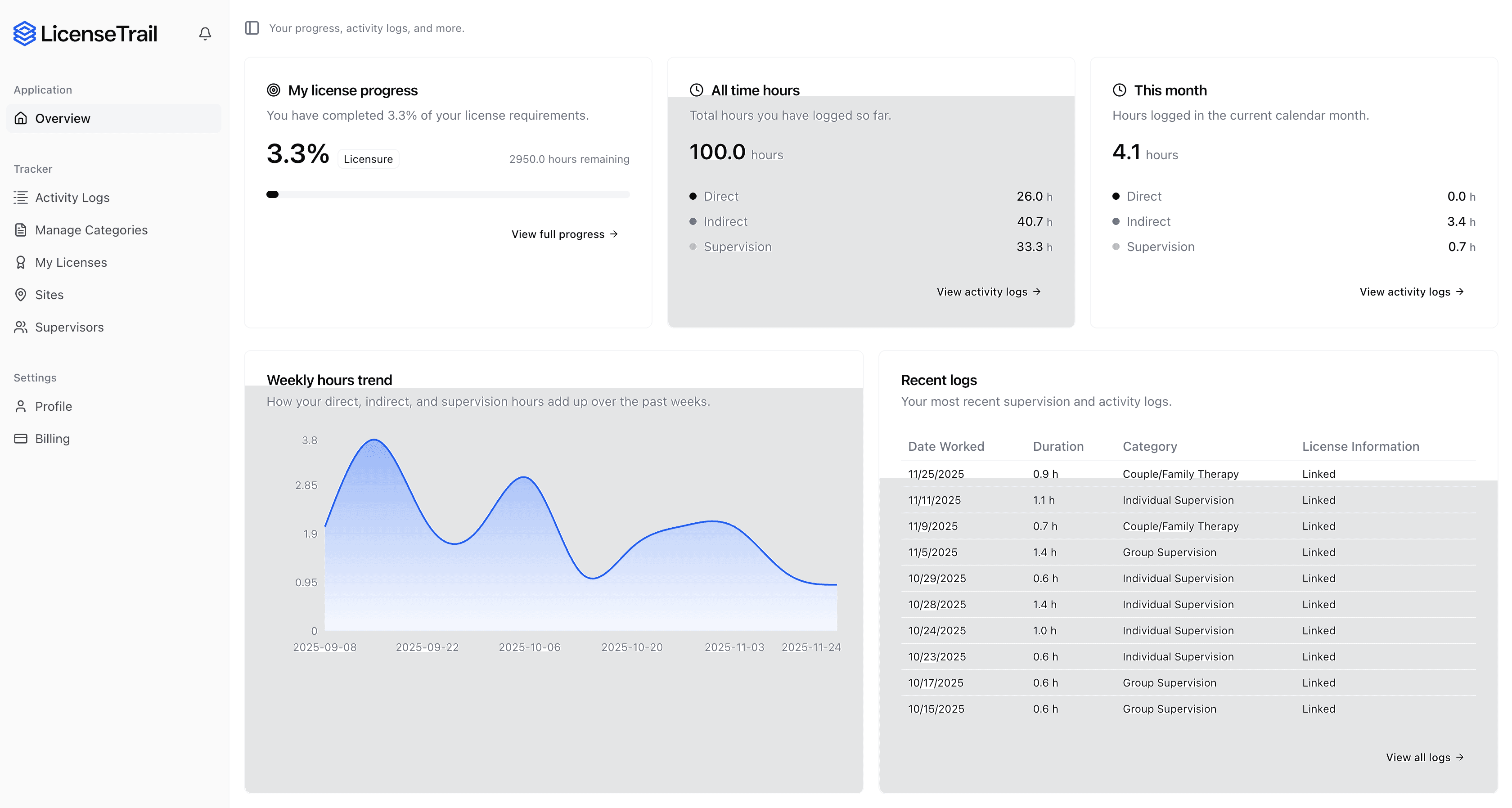
Track your LGMFT hours with confidence
License Trail checks your direct, indirect, and supervision hours against Maryland LGMFT requirements continuously and flags mismatches before you submit.
 Start Tracking for Free
No credit card required · Free plan available
Related Licenses
Certified professional counselor
CPC
Certified professional counselor — alcohol and drug
CPC-AD
Certified professional counselor—marriage and family therapist
CPC-MFT
Licensed clinical alcohol and drug counselor
LCADC
Licensed clinical marriage and family therapist
LCMFT
Licensed Clinical Professional Art Therapist
LCPAT
Licensed clinical professional counselor
LCPC
Is your spreadsheet hiding Maryland LGMFT risks?
Stop guessing if your categories match Maryland Board of Professional Counselors and Therapists requirements. License Trail checks your direct, indirect, and supervision hours continuously and flags mismatches before you submit.
Import or log
Bring your spreadsheet or start fresh
Upload your existing tracking spreadsheet and we'll map every hour into the right Maryland Board of Professional Counselors and Therapists categories automatically.
Verify against Maryland
Catch mismatches before the board does
License Trail checks your direct, indirect, and supervision hours against Maryland LGMFT requirements continuously.
Export board-ready
One-click clean reports
Generate professional, board-ready reports for supervision meetings and Maryland Board of Professional Counselors and Therapists submissions in seconds.
No credit card required · Free plan available