
New-jersey LAC Requirements: Hours, Exams & Step-by-Step Guide
Stop guessing if your categories match New-jersey requirements. License Trail checks your direct, indirect, and supervision hours against LAC requirements continuously and flags mismatches before you submit.
No credit card required · Free plan available
Quick Requirements Overview
- Must be 18+ and of good moral character
- Earn a master’s/doctorate in counseling from a regionally accredited school
- Complete 60 graduate semester credits, incl. 45 credits in at least 8 of 9 required counseling content areas
- Pass the NBCC National Counselor Examination (NCE) (committee permission may be required to sit)
- Submit application + fee + official transcripts + criminal history background check authorization
- No pre-licensure clinical hour requirement to obtain the LAC
- Practice only under direct supervision; no independent practice and no direct client billing (paid via supervisor/employer)
- If counting hours toward LPC: max 1,500 hrs per 52-week “calendar year” (caps 30 hrs/week, 125 hrs/month) and ≥50 hrs/year face-to-face supervision (≤10 group)
License Details
Procedures
Becoming a Licensed Associate Counselor (LAC) in New Jersey means working under the Professional Counselor Examiners Committee of the State Board of Marriage and Family Therapy Examiners. The LAC is New Jersey’s entry‑level counseling license and is required before you can accrue post‑master’s experience toward the full Licensed Professional Counselor (LPC) credential.
Below is a structured walkthrough of what the law and regulations actually say, with special attention to “hours” and the board’s own terminology.
1. Governing law and agencies
Two main authorities are involved:
- Statute: New Jersey Professional Counselor Licensing Act (e.g., N.J. Stat. § 45:8B‑36 to 45:8B‑48).
- Regulations: New Jersey Administrative Code (N.J.A.C.) Title 13, Chapter 34, especially:
- Subchapter 10 – Definitions and scope of practice
- Subchapter 11 – Application and educational requirements
- Subchapter 13 – Supervision for associate counselors (regulations.justia.com)
The Professional Counselor Examiners Committee operates under the State Board of Marriage and Family Therapy Examiners.
2. What a Licensed Associate Counselor is allowed to do
The statute defines a “licensed associate counselor” as someone who holds a current LAC license and “practices counseling under the direct supervision of a licensed professional counselor or a supervisor acceptable to the committee.” (law.justia.com)
Key points:
- You may provide counseling and related services, but always under direct supervision of a qualified supervisor.
- You cannot practice independently or without supervision.
- You cannot bill clients directly; you must be paid through your supervisor or employer. (regulations.justia.com)
The LAC is explicitly a supervised status.
3. Statutory minimum requirements for LAC licensure
New Jersey statute § 45:8B‑41 lays out four baseline requirements for licensure as an associate counselor. You must show evidence that you: (law.justia.com)
- Are at least 18 years of age.
- Are of good moral character.
- Have completed the required graduate education (see Section 4).
- Have passed the National Counselor Examination (NCE) of the National Board for Certified Counselors (NBCC).
There is no pre‑licensure clinical “hours” requirement in statute to obtain the LAC itself. The hours come into play when you begin working as an LAC and later seek LPC licensure.
4. Educational requirements in detail
Both the statute and regulations agree on the core structure of your graduate training.
4.1 Degree and semester‑hour requirements
Under N.J.S.A. 45:8B‑41 and N.J.A.C. 13:34‑11.5, you must have: (law.justia.com)
- A master’s degree or doctorate in counseling from a regionally accredited institution.
- A minimum of 60 graduate semester hours in a planned educational program designed to prepare students for the professional practice of counseling.
- At least 45 of those 60 credits must be distributed in at least 8 of 9 specific content areas.
4.2 Required content areas
Those 9 areas, as spelled out in statute and elaborated in the regulations, are: (law.justia.com)
- Counseling theory and practice
- The helping relationship
- Human growth and development and maladaptive behavior
- Lifestyle and career development
- Group dynamics, processes, counseling, and consulting
- Appraisal of individuals
- Social and cultural foundations
- Research and evaluation
- The counseling profession
Your transcript must clearly show:
- The degree title is in counseling (e.g., “M.A. in Counseling”).
- At least 60 semester hours, with 45 spread across at least eight of those nine content areas. (law.cornell.edu)
If your program was not CACREP‑accredited at the time you graduated, the regulations require additional documentation (course descriptions, syllabi, etc.) so the Committee can verify that your curriculum matches these requirements. (law.cornell.edu)
5. Examination requirement (NCE)
Regulations for associate counselors are explicit about the examination:
- N.J.A.C. 13:34‑11.6 states that an applicant for LAC must provide proof of successfully passing the National Counselor Examination (NCE), or its successor, administered by NBCC. (law.cornell.edu)
- You may sit for the NCE as part of your graduate program or afterward. If it is not taken as part of your program or another state’s licensing process, you must first obtain written permission from the Committee before registering. (law.cornell.edu)
At the LAC level there is only one exam: the NCE.
6. Application components for the LAC
N.J.A.C. 13:34‑11.5 explains what must be submitted to the Committee for LAC licensure: (law.cornell.edu)
- Completed application form describing your educational and experiential background.
- Application fee (amount specified in the fee rule, N.J.A.C. 13:34‑17.1).
- Official graduate transcript(s) showing:
- Master’s or doctoral degree in counseling.
- At least 60 graduate semester hours.
- At least 45 credits in at least 8 of the 9 statutorily required content areas.
- Criminal History Background Check form (Certification and Authorization Form).
The Committee reviews the materials, and if you meet statutory and regulatory requirements (including the NCE), they issue your LAC license.
7. Important clarification: “Hours” required to become an LAC
New Jersey does not require a set number of counseling practice hours (such as 1,500 direct client hours) before issuing an LAC license.
- The law focuses on semester‑hour education and passing the NCE for LAC eligibility. (law.justia.com)
- Practicum and internship hours are governed by your graduate program and may later be counted toward LPC experience (within limits), but they are not listed as a separate numeric requirement to obtain the LAC.
This is confirmed by both the regulations and academic summaries that note: “The LAC does not require prior supervised counseling experience.” (counselored.tcnj.edu)
So if you are asking, “Do I need something like 1,500 direct hours plus 1,500 supervised hours just to get an LAC?” the answer in New Jersey is no. Those kinds of hour counts apply to the LPC stage, not to initial LAC licensure.
8. How the Board defines “hours” and supervision once you are an LAC
Even though no pre‑LAC clinical hours are required, the regulations are very specific about how hours are counted once you hold the LAC and begin accruing supervised professional counseling experience toward LPC licensure.
8.1 Definitions that control hour counting
N.J.A.C. 13:34‑10.2 sets the key definitions: (law.cornell.edu)
-
“One calendar year” means:
- A maximum of 1,500 hours of supervised counseling experience over a 52‑week period (full‑time), or
- At least 750 hours in each of two 52‑week periods for a total of 1,500 hours (part‑time).
- No more than 30 hours per week and 125 hours per month can be counted.
-
“Professional counseling experience” means rendering professional counseling services while under the direct supervision of a qualified supervisor.
-
“Supervision” or “supervised” means weekly interaction with a qualified supervisor, with:
- Documented, face‑to‑face consultation, guidance and instruction about your counseling skills.
- At least 50 hours of face‑to‑face supervision per calendar year, at about one hour per week,
- No more than 10 of those hours in group supervision.
-
“Direct supervision” means your qualified supervisor is immediately available to assist you.
These definitions are what turn “three calendar years” of supervised experience into a specific number of hours.
8.2 Responsibilities and limits while practicing as an LAC
N.J.A.C. 13:34‑13.2 lays out LAC responsibilities under supervision, including: (regulations.justia.com)
- You must maintain documentation of your supervised experience for each 52‑week period until you become an LPC.
- You may not practice in areas for which you lack “appropriate education and training.”
- You may not engage in unsupervised or independent practice.
- You may not receive professional fees directly from clients; you are paid only through the supervisor or employing entity.
9. How many supervised hours you will ultimately need (for LPC)
Although your question is about the LAC, the issue of hours makes the most sense when connected to what you’re working toward: the LPC.
9.1 The board’s terminology: “supervised professional counseling experience”
For LPC licensure, N.J.A.C. 13:34‑11.3 uses the term “supervised professional counseling experience.” The rule offers two main pathways: (regulations.justia.com)
-
Standard route (master’s degree only)
- Three calendar years of supervised professional counseling experience in a professional counseling setting.
- Only one calendar year (up to 1,500 hours) may be earned before your master’s degree (via qualifying practicums/internships that are not double‑counted toward the 45‑credit educational core).
- Two calendar years (up to 3,000 hours) must be obtained after your master’s and after you are licensed as an LAC.
Given the definition of “one calendar year” as up to 1,500 hours, this route equals:
- Up to 4,500 hours of supervised professional counseling experience total
- With at least 3,000 hours completed post‑master’s while you are an LAC.
-
Alternative route (with 30 additional graduate credits)
- If, after obtaining your 60 graduate credits and master’s degree, you complete an additional 30 graduate semester hours clearly related to counseling, you may qualify with:
- Two calendar years of supervised professional counseling experience as a licensed associate counselor in a professional counseling setting.
Two “calendar years” as defined by the Board equals up to:
- 3,000 hours of supervised professional counseling experience after your master’s and LAC licensure.
9.2 Direct hours vs. indirect hours
A point that often causes confusion:
- New Jersey’s regulations do not split these hours into “direct client contact” vs. “indirect” the way some other states do.
- Instead, the Board uses the broader category “professional counseling experience”, which is simply professional counseling services delivered under qualified supervision. (law.cornell.edu)
Some third‑party summaries will describe most of these hours as direct client work and a smaller share as supervision, but that breakdown is interpretive. The controlling legal language is “supervised professional counseling experience,” capped by the “one calendar year” definition.
10. Supervisor qualifications (why they matter to your hours)
Because your hours count only if you are under a qualified supervisor, the supervisor rules are part of the hour requirements.
Under N.J.A.C. 13:34‑10.2 and 13:34‑13.1, a “qualified supervisor” must: (law.cornell.edu)
- Hold a clinical license (LPC, LMFT, psychologist, psychiatrist, LCSW, etc.) for at least three years in the state where services are provided.
- Have one of:
- A clinical supervisor’s certificate from NBCC’s Center for Credentialing and Education, or equivalent, or
- At least three graduate credits in clinical supervision from a regionally accredited institution.
That supervisor must:
- Develop a written supervision plan with you, approved by the Committee before you begin counseling.
- Provide the weekly, documented, face‑to‑face supervision required (at least 50 hours per year).
- Attest to your hours and competence on Committee forms.
If your experience is not supervised by someone who meets these requirements, you risk those hours not counting toward LPC.
11. Practical summary
Putting this all together from the Board’s own language:
-
To become an LAC in New Jersey you must:
- Be 18 or older and of good moral character. (law.justia.com)
- Complete a 60‑credit master’s or doctoral degree in counseling from a regionally accredited institution, with 45 credits in at least eight of nine specified counseling content areas. (law.justia.com)
- Pass the NCE and obtain Committee permission to sit for it when required. (law.cornell.edu)
- Submit a complete application, fees, transcripts, and a criminal background check authorization. (law.cornell.edu)
-
There is no pre‑LAC requirement like “1,500 hours of direct client work plus 1,500 supervised hours.” Those kinds of numeric hour requirements apply to LPC, not to initial LAC licensure.
-
Once licensed as an LAC, your post‑master’s supervised experience toward LPC must be:
- 3 calendar years (up to 4,500 hours) of supervised professional counseling experience in a professional counseling setting (standard route), at least two years/3,000 hours of which must be post‑degree and post‑LAC;
- Or 2 calendar years (up to 3,000 hours) of supervised professional counseling experience as an LAC if you also complete 30 extra graduate credits in counseling beyond the 60. (regulations.justia.com)
-
During those years, “one calendar year” is legally defined as up to 1,500 supervised hours, with caps of 30 hours/week, 125 hours/month, and at least 50 hours of face‑to‑face supervision annually. (law.cornell.edu)
That is the exact framework, terminology, and hour structure the New Jersey Board and its Professional Counselor Examiners Committee use for the LAC and the supervised experience that follows it.
Track your LAC hours with confidence
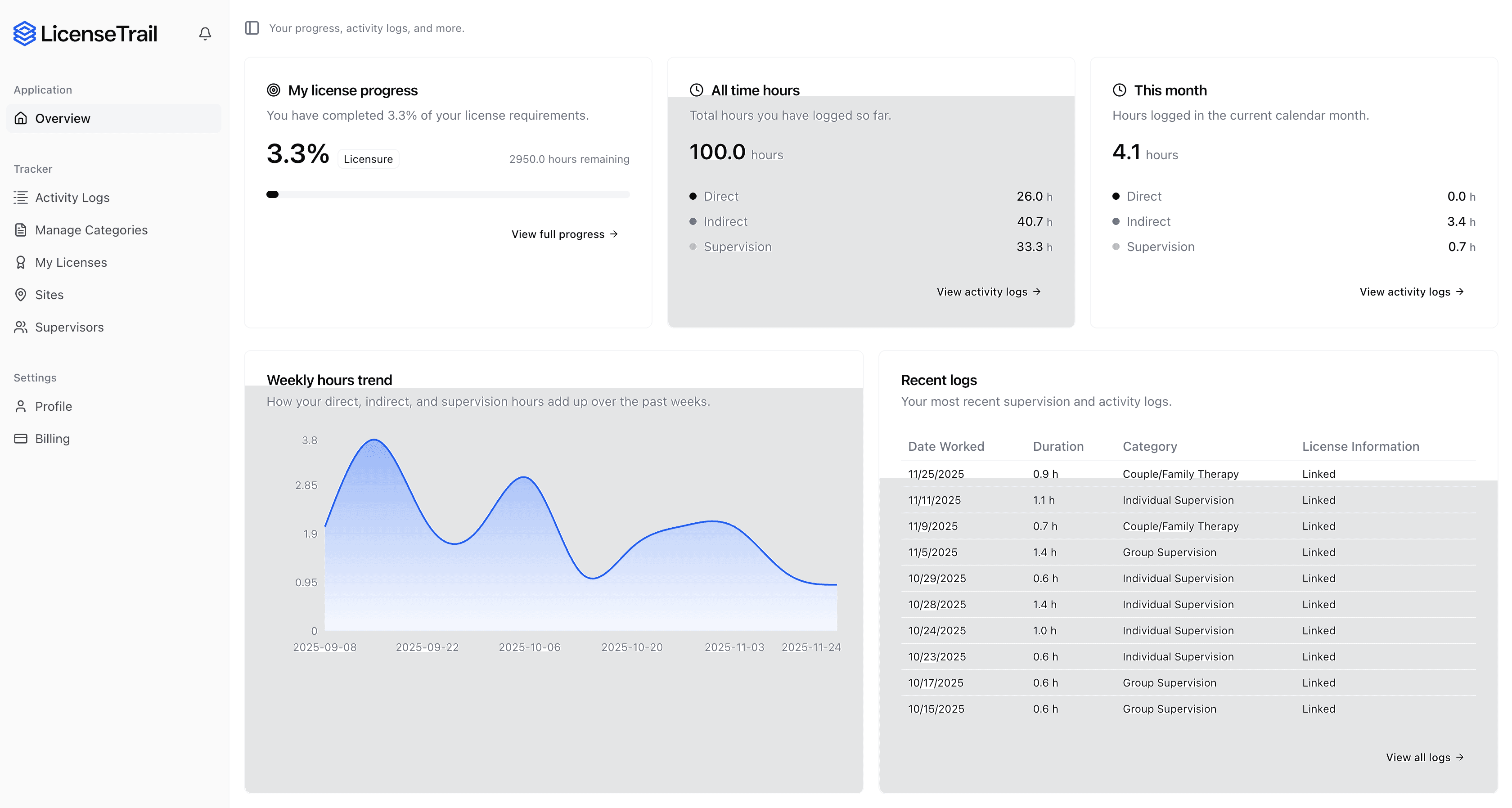
License Trail checks your direct, indirect, and supervision hours against New-jersey LAC requirements continuously and flags mismatches before you submit.
 Start Tracking for Free
No credit card required · Free plan available
Is your spreadsheet hiding New-jersey LAC risks?
Stop guessing if your categories match New Jersey Board of Marriage and Family Therapy Examiners requirements. License Trail checks your direct, indirect, and supervision hours continuously and flags mismatches before you submit.
Import or log
Bring your spreadsheet or start fresh
Upload your existing tracking spreadsheet and we'll map every hour into the right New Jersey Board of Marriage and Family Therapy Examiners categories automatically.
Verify against New-jersey
Catch mismatches before the board does
License Trail checks your direct, indirect, and supervision hours against New-jersey LAC requirements continuously.
Export board-ready
One-click clean reports
Generate professional, board-ready reports for supervision meetings and New Jersey Board of Marriage and Family Therapy Examiners submissions in seconds.
No credit card required · Free plan available