
New-jersey LAMFT Requirements: Hours, Exams & Step-by-Step Guide
Stop guessing if your categories match New-jersey requirements. License Trail checks your direct, indirect, and supervision hours against LAMFT requirements continuously and flags mismatches before you submit.
No credit card required · Free plan available
Quick Requirements Overview
- Eligibility: Age 21+, good moral character, no disqualifying conduct; submit complete application
- Education: Master’s in MFT/MSW/related (regionally accredited) plus required MFT coursework/practicum; official transcript sent directly to Board
- Supervision required to start: Secure a qualified supervisor (generally NJ LMFT + 5 years or equivalent) and obtain Board-approved written supervision plan BEFORE any counseling
- Admin items: Criminal history background check + required application/licensing fees
- Practice limits (LAMFT): No independent practice; clients pre-approved by supervisor; paid only via supervisor/employer (no direct client fees); advertising must state LAMFT + license # + supervisor name(s)
- Post-licensure hours toward LMFT: 4,500 hours total = 3,000 supervised MFT (2 calendar years) + 1,500 counseling (1 calendar year); caps: ≤30 hrs/week and ≤125 hrs/month
- Supervision/hour structure (per MFT year): ≥50 hrs face-to-face supervision (≤50% group; ≤50% telesupervision), ≤1,150 direct client hours, ≤300 other work activities; supervision documentation filed every 6 months
- Renewal/limits: No CE for first biennial renewal; thereafter 20 CE/2 years (incl. 5 ethics, 3 cultural competence, 1 opioid, 10 face-to-face); LAMFT issued 2 years, renewable max 2 times (up to 6 years)
License Details
Procedures
Licensed Associate Marriage and Family Therapist (LAMFT) Requirements in New Jersey
New Jersey treats the Licensed Associate Marriage and Family Therapist (LAMFT) as a transitional license: it allows you to practice only under supervision while you complete the experience required for full Licensed Marriage and Family Therapist (LMFT) status. The Board of Marriage and Family Therapy Examiners sets the rules in statute and in the New Jersey Administrative Code.
Below is a structured summary using the Board’s own terminology and hour definitions.
1. Overview of the Path
- Step 1 – Earn qualifying graduate education (master’s in MFT, MSW, or related field with specified coursework). (regulations.justia.com)
- Step 2 – Obtain LAMFT licensure
- Meet age/character requirements
- Show you’ve met the educational requirements
- Secure a qualified supervisor and have a Board‑approved written plan for supervision
- Complete application, background check, and pay fees (law.cornell.edu)
- Step 3 – While LAMFT, complete the Board’s experiential requirements for LMFT
- Two calendar years of “supervised marriage and family therapy experience”
- One calendar year of “counseling experience”
- Hours are defined and capped as described in Section 3 below (law.cornell.edu)
- Step 4 – Pass the national MFT exam and apply for LMFT licensure (after experience requirements are met). (aamft.org)
2. Requirements to Obtain the Initial LAMFT License
2.1 Basic eligibility
Under N.J.A.C. 13:34‑2.2, an applicant for licensure as an associate marriage and family therapist must: (law.cornell.edu)
- Be at least 21 years of age.
- Submit a completed application for licensure.
- Provide “evidence of good moral character,” which remains an ongoing requirement.
- Not be engaged in any conduct that would allow the Board to refuse, suspend, or revoke a license under N.J.S.A. 45:1‑21 (e.g., fraud, criminal convictions relevant to practice).
2.2 Educational requirements
To qualify for either LAMFT or LMFT, New Jersey requires that you meet the educational standard in N.J.A.C. 13:34‑2.3: (regulations.justia.com)
- Minimum degree:
- A master’s degree in marriage and family therapy,
- or a master’s in social work,
- or a graduate degree in a related field,
- From a regionally accredited institution.
If the degree is in a “related field,” you must show that your coursework and training are substantially equivalent to an MFT degree or complete additional approved post‑graduate training. (regulations.justia.com)
The Board also requires specific graduate coursework:
- Area I – Theoretical Foundations (minimum 2 courses)
- Area II – Assessment and Treatment in Marriage and Family Therapy (minimum 4 courses)
- Area III – Human Development and Family Studies (minimum 2 courses)
- Area IV – Ethics and Professional Development (minimum 1 course)
- Area V – Research (minimum 1 course)
- Area VI – Supervised clinical internship/practicum (minimum 2 courses)
- Area VII – Additional learning/elective (minimum 1 course) (regulations.justia.com)
Professional associations also note that completion of an internship of at least 12 months (during the program or post‑degree) is expected, though this is summarized guidance rather than verbatim Code. (aamft.org)
The Board requires your official transcript to be sent directly from the institution, showing the degree awarded, field of study, and all relevant coursework. (law.cornell.edu)
2.3 Supervisor and supervision plan
To receive a LAMFT license you must already have a supervision arrangement and plan:
-
You must submit your supervisor’s résumé or CV, documenting that the supervisor has at least five full‑time years of professional marriage and family therapy practice (or equivalent) and either:
- holds a current New Jersey LMFT license; or
- holds another New Jersey professional license and has at least a master’s in MFT, MSW, or a related field with MFT‑equivalent training, as defined in N.J.A.C. 13:34‑2.4. (law.cornell.edu)
-
Written plan for supervision:
New Jersey statute requires that “the plan for supervision of the licensed associate marriage and family therapist shall be approved by the board prior to any actual performance of counseling” by the associate. (codes.findlaw.com)
In practice, this means you must have:
- A qualified supervisor (as defined in Section 3.1 below); and
- A Board‑approved written supervision plan on file before you begin providing counseling as a LAMFT.
2.4 Background check and fees
- You must submit a Certification and Authorization Form for a Criminal History Background Check. (law.cornell.edu)
- You must pay the application fee and, once approved, the licensing fee set in N.J.A.C. 13:34‑1.1. (law.cornell.edu)
3. Experience and Hour Requirements While You Are a LAMFT
The LAMFT license itself does not require you to have already completed post‑graduate clinical hours. Instead, the State uses LAMFT status as the vehicle under which you complete the experience required for full LMFT licensure.
Those experiential requirements—and the precise definition of hours—are in N.J.A.C. 13:34‑2.4 and are written explicitly for LMFT applicants. As an LAMFT, these are the standards you are working toward.
3.1 Board terminology for experience
N.J.A.C. 13:34‑2.4 defines several key terms used in counting hours: (law.cornell.edu)
- “Counseling experience” – client‑contact work applying mental health and human development principles to support adjustment and development across the lifespan.
- “Marriage and family therapy experience” – providing professional marriage and family therapy services, under supervision, to individuals, couples, and families, individually or in groups.
- “Marriage and family therapy supervision” / “supervised experience” – ongoing monitoring by a qualified marriage and family therapy supervisor who provides regular, documented, face‑to‑face consultation, guidance, and instruction and monitors the LAMFT’s competencies.
- “One calendar year” – 1,500 hours over a 50‑week period (full‑time), or no less than 750 hours over two separate 50‑week periods (part‑time), totaling 1,500 hours.
- “Qualified supervisor” – someone with at least five full‑time years of professional MFT practice (or equivalent) who either:
- holds a New Jersey LMFT license; or
- holds another New Jersey professional license and has at least a master’s in MFT, MSW, or a qualifying related degree with MFT‑equivalent coursework or recognized post‑graduate MFT training.
- “Telesupervision” – supervision delivered using technology when supervisor and LAMFT are at different sites; audio‑only phone, email, texts, and fax alone do not qualify.
3.2 Total experience required for LMFT (earned while LAMFT)
To qualify for LMFT, the Board requires that you document the following experience: (law.cornell.edu)
- Two calendar years of “supervised marriage and family therapy experience”
- One calendar year of “counseling experience” (which may be in MFT)
Because one calendar year is defined as 1,500 hours, this means:
- Supervised MFT experience:
- 2 calendar years × 1,500 hours/year = 3,000 hours
- Counseling experience:
- 1 calendar year × 1,500 hours/year = 1,500 hours
Total minimum experience = 4,500 hours across three calendar years.
Most or all of these hours are typically accumulated while holding the LAMFT license, under supervision.
3.3 Detailed breakdown of supervised MFT experience hours
For each of the two MFT calendar years, N.J.A.C. 13:34‑2.4(b)(1) requires that your supervised marriage and family therapy experience be composed of: (law.cornell.edu)
-
Supervision hours
- Minimum 50 hours of face‑to‑face supervision per calendar year, at roughly one hour per week.
- No more than half of the supervision hours can be in group supervision.
- No more than half of the supervision hours may be delivered via telesupervision; telesupervision must comply with N.J.A.C. 13:34‑3.5.
-
Direct client contact
- Maximum 1,150 hours per calendar year of actual marriage and family therapy client contact.
- These are direct sessions where you are providing MFT services to individuals, couples, or families.
-
Other work‑related activities
- Maximum 300 hours per calendar year in “other work‑related activities,” such as:
- preparing and maintaining client records;
- report writing;
- maintaining appointment schedules;
- communicating with other professionals;
- preparing for supervision;
- maintaining financial records;
- other activities the supervisor or Board deems appropriate.
- Maximum 300 hours per calendar year in “other work‑related activities,” such as:
Together, these categories add up to the 1,500 hours that make up one calendar year of MFT experience.
3.4 Weekly and monthly caps on countable experience
For all three calendar years of experience (2 MFT years + 1 counseling year), the Board imposes caps on how much experience can be counted in a given period: (law.cornell.edu)
- No more than 30 hours of experience may be earned in any one week.
- No more than 125 hours of experience may be earned in any one month.
This prevents “front‑loading” large numbers of hours into a short period.
3.5 Counseling experience year
The regulation states that you need one calendar year of “counseling experience” (which may be in MFT) but does not, in that paragraph, restate the 50/1,150/300 breakdown. It does, however, apply the same 1,500‑hours‑per‑calendar‑year definition and the 30‑hour/week, 125‑hour/month caps. (law.cornell.edu)
The American Association for Marriage and Family Therapy’s summary for New Jersey, based on Board materials, reflects this in practice by describing the counseling year as: (aamft.org)
- 1,500 hours over a 50‑week period,
with:- maximum 1,150 hours of direct client contact,
- 50 hours of direct supervision, and
- up to 300 hours of other work‑related activities.
That summary aligns with how the Board structures the supervised MFT years and is a reasonable template for planning your counseling year as a LAMFT.
4. Practice and Supervision Rules While You Are LAMFT
The Board has specific rules governing what you can and cannot do while licensed as a LAMFT, primarily in N.J.A.C. 13:34‑3.4 and related advertising rules. (law.cornell.edu)
4.1 Supervision documentation
- Every six months, you must ensure that documentation of supervision is filed with the Board for evaluation of your progress.
4.2 No independent practice
- A LAMFT “shall not engage in unsupervised or independent practice.”
- Your clients must be approved in advance by your qualified supervisor(s).
All clinical work as a LAMFT must occur within the framework of the Board‑approved supervision plan and under actual ongoing supervision.
4.3 How you may be paid
- A LAMFT may be compensated only through the qualified supervisor or the employing entity.
- You may not personally receive a professional fee from a client, though you may accept payment on behalf of the supervisor or employer.
4.4 Scope of practice under supervision
- You may not practice, even under supervision, in any area for which you lack appropriate education and training.
4.5 Advertising and public representations
If a LAMFT advertises professional services (e.g., website, cards, directory listings), the Board requires that: (law.cornell.edu)
- You include your name and the name(s) of your qualified supervisor(s).
- You identify yourself with the exact title “Licensed Associate Marriage and Family Therapist” or “LAMFT” followed by your 12‑digit license number.
- You must not advertise that you engage in independent practice.
5. Continuing Education (CE) Hours for LAMFT Renewal
These are continuing education contact hours, not client hours.
Under N.J.A.C. 13:34‑5.2A and N.J.S.A. 45:8B‑24.1: (law.cornell.edu)
-
Initial licensure period:
- An associate MFT is not required to obtain CE hours before the first biennial renewal.
-
For each subsequent two‑year renewal period:
- You must complete at least 20 contact hours of continuing education related to MFT, including:
- At least 10 hours obtained through face‑to‑face instruction (i.e., not solely online/independent).
- At least 5 hours in ethical and legal standards related to marriage and family therapy.
- At least 3 hours in social and cultural competence (topics such as cultural context of relationships, diversity issues, identity development, social justice roles, etc.).
- At least 1 hour in programs concerning prescription opioid drugs, including risks and signs of abuse, addiction, and diversion (this single opioid‑related credit cannot be carried over).
- You must complete at least 20 contact hours of continuing education related to MFT, including:
-
Carry‑over:
- If you earn more than 20 CE hours in a biennium, you may carry up to 5 hours into the next period, as long as those extra hours were earned in the last 6 months of the prior period. (law.cornell.edu)
6. Time Limits on LAMFT Status
New Jersey statute limits how long you can remain an associate:
- LAMFT licenses are issued for a two‑year period.
- A LAMFT license “shall be renewed no more than two times.” (law.justia.com)
In other words, you can hold LAMFT for up to three consecutive two‑year terms (maximum of six years), assuming you meet renewal and CE requirements. After that, you are expected to have progressed to LMFT or otherwise cease practice under the associate license.
7. Condensed Checklist
To become—and successfully function as—a LAMFT in New Jersey, you must:
- Obtain qualifying graduate education that meets N.J.A.C. 13:34‑2.3. (regulations.justia.com)
- Secure a qualified supervisor and draft a supervision plan that the Board will approve. (law.cornell.edu)
- Apply for LAMFT licensure: age 21+, good moral character, no disqualifying conduct, transcripts sent directly to the Board, supervisor CV, background check form, fees. (law.cornell.edu)
- After licensure, practice only under supervision, within the approved plan, document supervision every six months, and follow compensation/advertising rules. (law.cornell.edu)
- Accumulate 4,500 total hours of Board‑defined experience while LAMFT:
- Two years (3,000 hours) of supervised marriage and family therapy experience, each year including:
- ≥ 50 hours of face‑to‑face supervision (with limits on group and telesupervision),
- up to 1,150 hours direct client contact,
- up to 300 hours other work‑related activities.
- One year (1,500 hours) of counseling experience (often structured with similar hour types and caps), with no more than 30 hours/week and 125 hours/month counted. (law.cornell.edu)
- Two years (3,000 hours) of supervised marriage and family therapy experience, each year including:
- Complete required continuing education (20 contact hours per two‑year renewal after the first period, with required ethics, cultural competence, and opioid‑related content). (law.cornell.edu)
This captures the Board’s defined terms and hour structures relevant to becoming and working as a LAMFT in New Jersey.
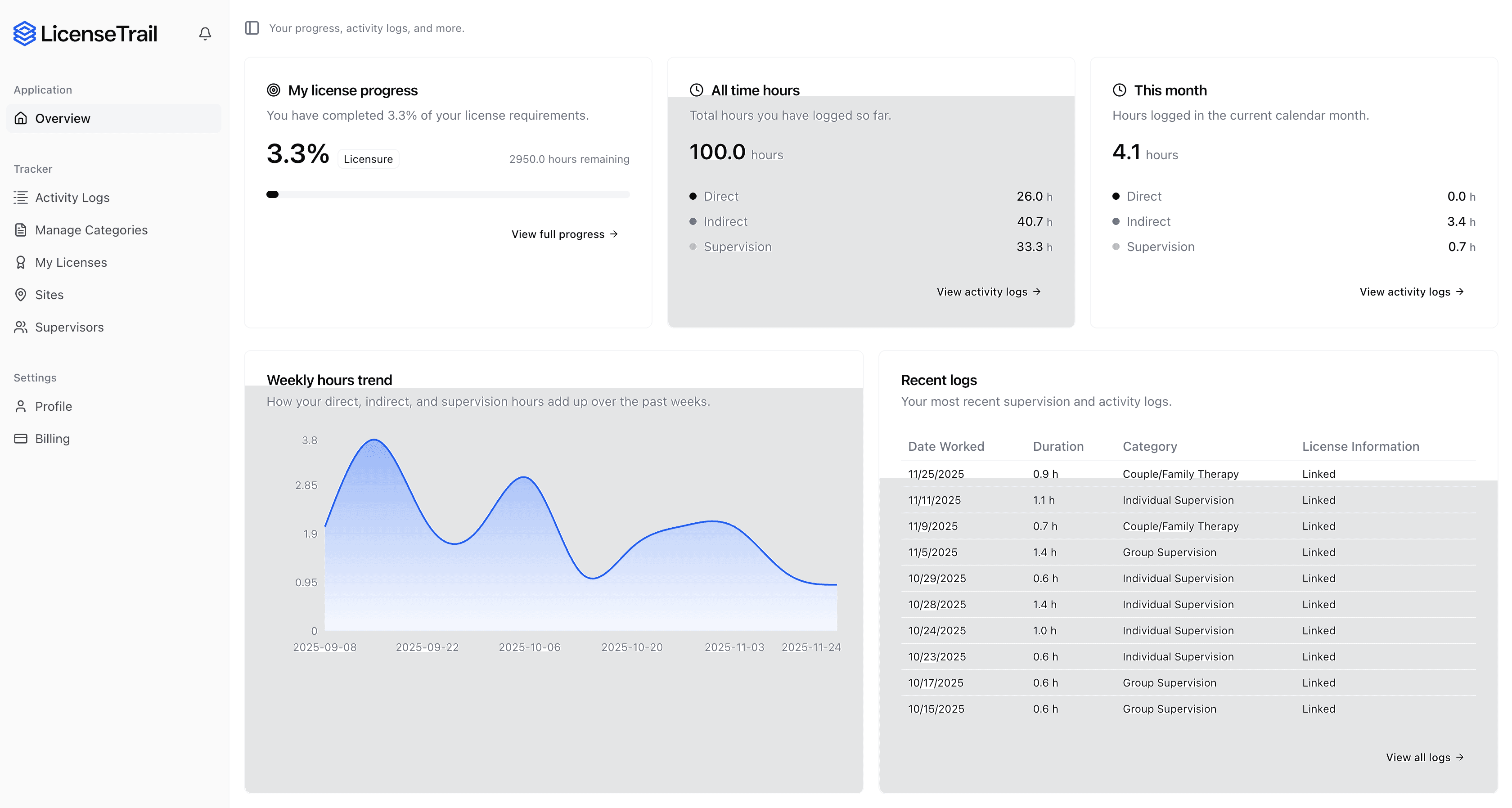
Track your LAMFT hours with confidence
License Trail checks your direct, indirect, and supervision hours against New-jersey LAMFT requirements continuously and flags mismatches before you submit.
 Start Tracking for Free
No credit card required · Free plan available
Is your spreadsheet hiding New-jersey LAMFT risks?
Stop guessing if your categories match New Jersey Board of Marriage and Family Therapy Examiners requirements. License Trail checks your direct, indirect, and supervision hours continuously and flags mismatches before you submit.
Import or log
Bring your spreadsheet or start fresh
Upload your existing tracking spreadsheet and we'll map every hour into the right New Jersey Board of Marriage and Family Therapy Examiners categories automatically.
Verify against New-jersey
Catch mismatches before the board does
License Trail checks your direct, indirect, and supervision hours against New-jersey LAMFT requirements continuously.
Export board-ready
One-click clean reports
Generate professional, board-ready reports for supervision meetings and New Jersey Board of Marriage and Family Therapy Examiners submissions in seconds.
No credit card required · Free plan available