
Kansas LMAC Requirements: Hours, Exams & Step-by-Step Guide
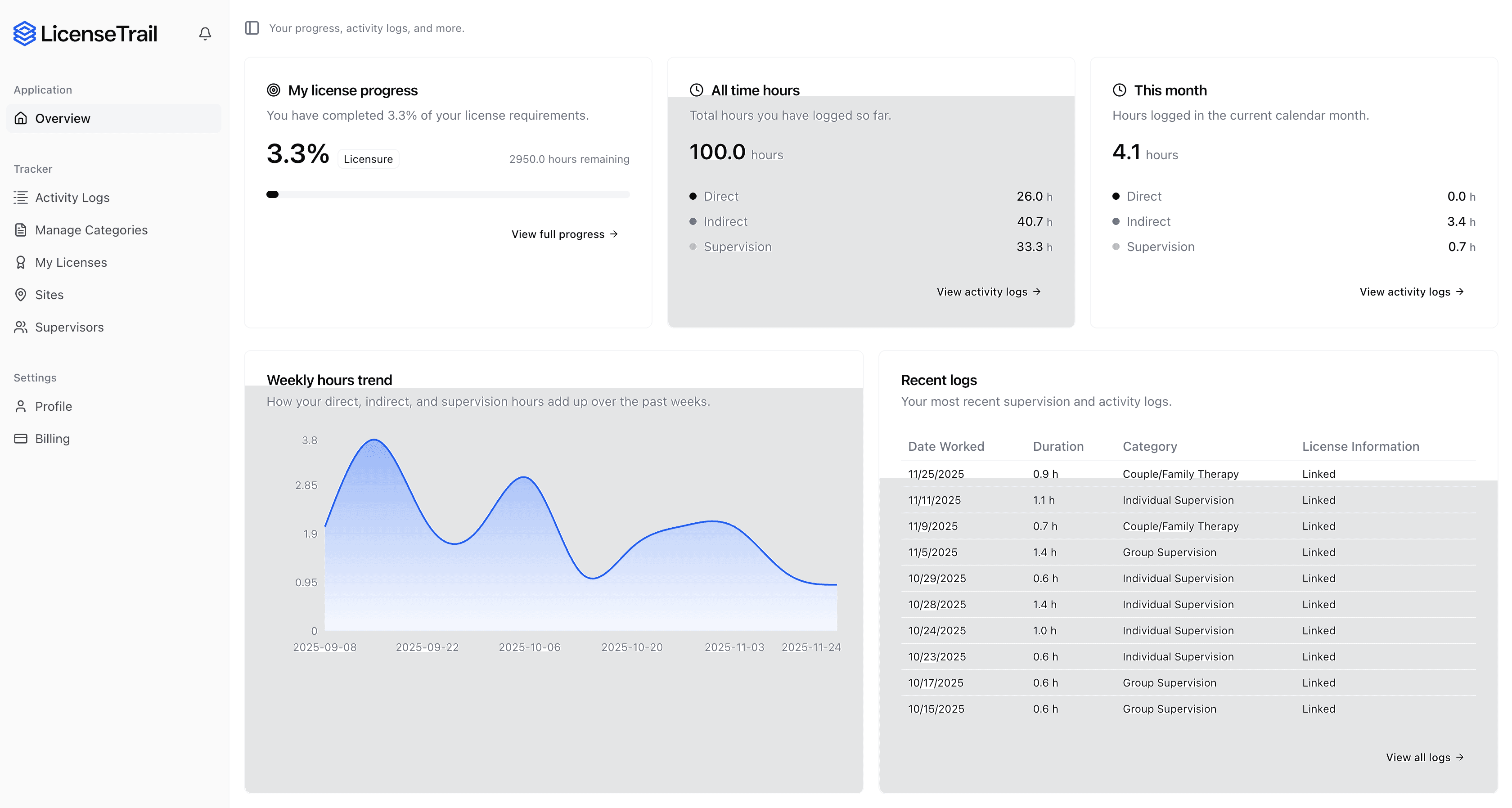
Stop guessing if your categories match Kansas requirements. License Trail checks your direct, indirect, and supervision hours against LMAC requirements continuously and flags mismatches before you submit.
No credit card required · Free plan available
Quick Requirements Overview
- Age: 21+
- Education: Master’s in addiction counseling or other board-approved master’s + 30 graduate semester hours in SUD diagnosis/treatment content areas (per K.A.R. 102-7-3)
- Practicum (hours): Graduate practicum/equivalent with ≥300 hours client contact + supervision ≥1 hour per 10 client-contact hours (supervisor licensed at/above level pursued)
- Exam: Pass a BSRB-approved national standardized written exam
- References: 2 professional references (master’s level+; non-relatives) + 1 practicum supervisor/program reference (per K.A.R. 102-7-4)
- Character/Fitness: Must “merit the public trust”
- Fees: Pay application fee and initial license fee (2-year license period)
- Post-grad hours: No separate quantified post-graduate supervised-hour requirement for LMAC (LCAC’s 3,000 hours is separate)
License Details
Procedures
In Kansas, the “Licensed Master’s Addiction Counselor” (LMAC) is a master’s‑level license that allows practice of addiction counseling focused on substance use disorders. It is distinct from the “Licensed Clinical Addiction Counselor” (LCAC), which requires 3,000 hours of supervised post‑graduate clinical experience. For LMAC, the key hour‑based requirement is an academic practicum, not a post‑graduate supervised hour requirement.
Below is a step‑by‑step guide based directly on Kansas statutes and regulations as of June 21, 2024.
1. Understand what the LMAC license allows
Kansas statute defines a LMAC as a person who:
- Engages “in the practice of addiction counseling limited to substance use disorders,” and
- May diagnose substance use disorders only under the direction of an LCAC, licensed psychologist, physician, or another independently licensed mental health professional whose scope includes diagnosing and treating substance use or mental disorders. (sos.ks.gov)
So this is a non‑independent, master’s‑level addiction counseling license.
2. Meet the basic statutory eligibility for LMAC
Under K.S.A. 65‑6610(b), an applicant for licensure as a master’s addiction counselor must show, in summary, that they: (sos.ks.gov)
- Are at least 21 years of age.
- Have an appropriate master’s degree (or qualifying existing license) – details in the next section.
- Have passed an examination approved by the Behavioral Sciences Regulatory Board (BSRB).
- Have “satisfied the board that the applicant is a person who merits the public trust.”
- Have paid the application fee set by the board.
The statute also contains a now‑expired “grandparenting” pathway for certain addiction counselors who met requirements by July 1, 2016; that route is essentially closed to new applicants today. (sos.ks.gov)
3. Choose an educational pathway that qualifies for LMAC
Path A: Master’s in addiction counseling (or equivalent program)
Kansas regulation K.A.R. 102‑7‑3(e)–(f) sets the education standard for both master’s addiction counselor (LMAC) and clinical addiction counselor (LCAC). To qualify as LMAC you must either: (sos.ks.gov)
- Hold a master’s degree in addiction counseling from a program that met board standards when the degree was granted; or
- Hold another master’s degree from a program approved by the board and, as part of or in addition to that degree, complete at least 30 graduate semester hours (or equivalent) supporting the diagnosis and treatment of substance use disorders, distributed across specific content areas.
Those required graduate‑level content areas include (summarized from K.A.R. 102‑7‑3(f)): (sos.ks.gov)
- Addiction and recovery services (theories and models of addiction, prevention, treatment, recovery).
- Advanced individual and group counseling methods related to addiction.
- Advanced pharmacology of psychoactive substances and medication‑assisted treatment.
- Integrative treatment of co‑occurring disorders.
- Assessment and diagnosis of substance use disorders.
- Professional ethics and practice (including supervision‑related legal responsibilities).
- Applied research (methods, data analysis, outcome evaluation, use of research in practice).
- A graduate practicum or its equivalent (this is where the concrete hours come in; see Section 4).
- Six additional graduate credit hours in advanced addiction counseling, supervision, or research.
Path B: Already licensed Kansas master‑level mental health professional
K.S.A. 65‑6610(b)(1)(B)(iii) provides another route. An applicant may qualify for LMAC if they: (sos.ks.gov)
- Are at least 21, and
- Are already licensed in Kansas as a:
- Licensed master social worker (LMSW),
- Licensed professional counselor (LPC),
- Licensed marriage and family therapist (LMFT), or
- Licensed master’s level psychologist (LMLP),
and then meet the remaining LMAC requirements (exam, public trust, fee). The statute does not explicitly restate the 30 semester‑hour addiction coursework requirement in this path, but the board still applies its education regulations, so applicants from this route usually must show adequate addiction‑specific training under K.A.R. 102‑7‑3.
4. Graduate practicum: the main “hours” requirement for LMAC
The only specifically quantified hour requirement for LMAC itself is built into the master’s‑level practicum described in K.A.R. 102‑7‑3(f)(8). For the master’s addiction counselor / clinical addiction counselor track, the regulation requires that the practicum or its equivalent: (sos.ks.gov)
- Be a clinical experience that integrates didactic learning supporting the diagnosis and treatment of substance use disorders.
- Include at least 300 hours of client contact.
- Provide at least one hour of supervision for every 10 hours of client contact, with supervision provided by program faculty and agency supervisors, at least one of whom must be licensed at or above the level of licensure being pursued.
In other words, for LMAC you must complete a minimum of 300 hours of direct client contact in your graduate practicum, plus 30 or more hours of documented supervision tied to those contacts, within an approved graduate program or its equivalent.
This is different from the LCAC (clinical) license: LCAC requires 3,000 hours of post‑graduate supervised professional experience, including 1,500 hours of direct client contact and at least 100 hours of clinical supervision, as spelled out in K.A.R. 102‑7‑6 and K.S.A. 65‑6610(c). (sos.ks.gov)
Those 3,000/1,500‑hour figures do not apply to the LMAC license; they apply only when you step up to the clinical level.
5. Make sure your program itself is board‑acceptable
K.A.R. 102‑7‑3(h)–(i) sets program‑level requirements for any addiction counseling or related‑field program whose graduates will seek LMAC/LCAC licensure. Among other things, the program must: (sos.ks.gov)
- Offer education and training in addiction counseling with the explicit goal of preparing students for practice.
- Provide at least two academic years of study for a master’s degree.
- Have identified core faculty and clear administrative authority.
- Require students to complete a board‑conforming practicum in addiction counseling or a related field, with supervision primarily from a professional licensed at or above the level being pursued.
Choosing a program that already advertises BSRB compatibility or NAADAC/related accreditation can make this step straightforward, but the board looks to the specific regulation rather than marketing language.
6. Prepare your documentation for BSRB
Once your degree and practicum are complete, you move into the licensure application process governed by K.A.R. 102‑7‑4(c). An applicant for licensure as a master’s addiction counselor must: (sos.ks.gov)
- Pay the LMAC application fee listed in K.A.R. 102‑7‑2.
- Submit two professional references on board‑approved forms:
- Not related to you.
- Authorized by law to practice addiction counseling or another behavioral science at the master’s level or above.
- Able to address your professional conduct, competence, and whether you “merit the public trust.”
- Submit a third professional reference, if not already on file, from:
- Your on‑site graduate practicum supervisor who is authorized by law to practice addiction counseling; or
- If that supervisor is unavailable, the program director or another individual with knowledge of your graduate practicum experience based on your practicum records.
- Show that you either:
- Already hold a board‑issued master’s‑level license (LMSW, LPC, LMFT, LMLP, etc.); or
- Have completed the educational requirements of K.A.R. 102‑7‑3, with official graduate transcripts sent directly from each institution to the BSRB (foreign degrees must also be evaluated for equivalency).
The board will not finalize a decision on your eligibility until it has all application materials and you have completed all procedures. (sos.ks.gov)
7. Pass the required national examination
Under K.A.R. 102‑7‑4(f)(1) and 102‑7‑5(b), all LMAC applicants (other than those qualifying through specific reciprocity rules) must: (sos.ks.gov)
- Pass a “nationally administered, standardized written examination” approved by the board for master’s addiction counselors.
- You may register for the examination once you are within four months of completing your master’s degree requirements and you have satisfied the board that you merit the public trust.
The specific test vendor and cut score can change, so current details must always be confirmed on the BSRB addiction counseling page or directly with the board.
8. Temporary licensure option while finalizing requirements
K.A.R. 102‑7‑4(g)(1) allows the board to grant a temporary license as an addiction counselor or master’s addiction counselor to applicants who meet the statutory age, degree, examination, and public‑trust requirements in K.S.A. 65‑6610(a)(1), (2), (4), (5) or (b)(1)(A), (B), (D), and (E). (sos.ks.gov)
- The temporary license is typically valid for 24 months, with a possible one‑time extension of up to six months in documented extenuating circumstances.
- This can allow you to work under appropriate limitations while completing examination and final paperwork.
9. Issuance of the LMAC license and renewal expectations
Once the board determines that you meet the educational, examination, and character requirements, K.A.R. 102‑7‑4(f)(3) directs that you must: (sos.ks.gov)
- Pay the fee for the original two‑year license period, after which the board issues your LMAC license.
For renewal, K.A.R. 102‑7‑7 and 102‑7‑9 (not fully quoted here) require: (sos.ks.gov)
- Periodic renewal every two years, with:
- A renewal application,
- A continuing education reporting form, and
- The renewal fee.
The detailed continuing‑education hour requirements are in K.A.R. 102‑7‑9 and can change, so they should be checked directly on the BSRB site when you approach renewal.
10. Summary of hour‑based requirements for LMAC vs LCAC
To directly address the kind of numbers in your example:
-
LMAC (Licensed Master’s Addiction Counselor – non‑clinical)
- Graduate practicum hours (education requirement):
- At least 300 hours of client contact, with at least one hour of supervision for each 10 hours of client contact during the master’s practicum. (sos.ks.gov)
- Post‑graduate hours:
- No separate, quantified post‑graduate hour requirement in regulation or statute just to obtain the LMAC license itself.
- Other requirements: Master’s degree meeting K.A.R. 102‑7‑3(f), national exam, age ≥21, public trust, fees, references.
- Graduate practicum hours (education requirement):
-
LCAC (Licensed Clinical Addiction Counselor – independent clinical level, for context)
- Post‑graduate supervised professional experience:
- 3,000 hours total professional addiction counseling experience.
- Of these, at least 1,500 hours must be direct client contact conducting substance abuse assessment and treatment.
- At least 100 hours of clinical supervision, with a minimum of 50 hours of individual supervision; supervision generally at a 1:15 ratio of supervision to direct client contact and at least two supervision sessions per month. (sos.ks.gov)
- Post‑graduate supervised professional experience:
Those 3,000/1,500‑hour numbers are what you might see quoted in examples, but they belong to the clinical license (LCAC), not to the LMAC.
11. Practical next steps for someone planning to become LMAC in Kansas
- Identify a qualifying master’s program in addiction counseling or a closely related field that clearly meets K.A.R. 102‑7‑3(f) requirements and includes the mandated 300‑hour practicum with 1:10 supervision.
- Confirm with the program that it is designed to meet Kansas BSRB LMAC/LCAC educational standards, including all nine content areas and practicum structure.
- Complete the degree and practicum, tracking your client‑contact and supervision hours in case the board or your future LCAC application requires detailed documentation.
- Apply to the BSRB for LMAC, arranging for:
- Official graduate transcripts,
- Two professional references and one practicum‑supervisor (or equivalent) reference, and
- Payment of the application fee.
- Register for and pass the required national exam once the board confirms your educational eligibility.
- Obtain your initial two‑year license, then follow the board’s continuing‑education and renewal rules to keep the LMAC current.
Because statutory and regulatory language can change (and Kansas addiction counseling regulations were amended as recently as June 21, 2024), always verify current requirements on the Kansas BSRB’s Addiction Counselors “Statutes & Regulations” page or by contacting the board directly before making major decisions. (ksbsrb.ks.gov)
Track your LMAC hours with confidence
License Trail checks your direct, indirect, and supervision hours against Kansas LMAC requirements continuously and flags mismatches before you submit.
 Start Tracking for Free
No credit card required · Free plan available
Related Licenses
Licensed Addiction Counselor
LAC
Licensed Behavior Analyst
LBA
Licensed Clinical Addiction Counselor
LCAC
Licensed Clinical Marriage and Family Therapist
LCMFT
Licensed Clinical Psychotherapist
LCP
Licensed Clinical Professional Counselor
LCPC
Licensed Marriage and Family Therapist
LMFT
Licensed Psychologist
LP
Licensed Specialist Clinical Social Worker
LSCSW
Is your spreadsheet hiding Kansas LMAC risks?
Stop guessing if your categories match Kansas Behavioral Sciences Regulatory Board requirements. License Trail checks your direct, indirect, and supervision hours continuously and flags mismatches before you submit.
Import or log
Bring your spreadsheet or start fresh
Upload your existing tracking spreadsheet and we'll map every hour into the right Kansas Behavioral Sciences Regulatory Board categories automatically.
Verify against Kansas
Catch mismatches before the board does
License Trail checks your direct, indirect, and supervision hours against Kansas LMAC requirements continuously.
Export board-ready
One-click clean reports
Generate professional, board-ready reports for supervision meetings and Kansas Behavioral Sciences Regulatory Board submissions in seconds.
No credit card required · Free plan available