
Kansas LMLP Requirements: Hours, Exams & Step-by-Step Guide
Stop guessing if your categories match Kansas requirements. License Trail checks your direct, indirect, and supervision hours against LMLP requirements continuously and flags mismatches before you submit.
No credit card required · Free plan available
Quick Requirements Overview
- Regulator: Kansas Behavioral Sciences Regulatory Board (BSRB)
- Eligibility: 21+ and demonstrate good character/public trust
- Education: Master’s in psychology with 60 graduate semester credit hours meeting K.A.R. 102-4-3a (incl. required core content)
- Experience (choose one): 750 clock hours academically supervised practicum within the master’s program OR 1,500 hours postgraduate supervised work experience
- Practicum supervision: 1 hour face-to-face individual supervision per 10 hours of direct client contact (qualified supervisor)
- Postgrad hours specifics: Of 1,500 hours, 500 must be direct client contact (assessment/diagnosis/treatment); supervision per K.A.R. 102-4-7a (incl. 1 hr supervision per 15 direct-contact hrs and ≥50 hrs individual supervision)
- Exam: Pass BSRB-approved national standardized written exam with ≥60% (waiver possible if equivalent exam already passed)
License Details
Procedures
Kansas regulates master’s‑level psychologists through the Behavioral Sciences Regulatory Board (BSRB). The license title is “licensed master’s level psychologist,” abbreviated LMLP. The requirements are set out primarily in K.S.A. 74‑5363 and BSRB regulations in K.A.R. 102‑4‑3a and 102‑4‑6a/b.
Below is a step‑by‑step outline of how you qualify, with the key hour requirements and the board’s own wording highlighted.
1. Baseline statutory requirements for LMLP
Under K.S.A. 74‑5363(b), the BSRB “shall license as a licensed master’s level psychologist” an applicant who meets all of the following: (law.justia.com)
-
Age and character
- At least 21 years of age.
- Has “satisfied the board that the applicant is a person who merits public trust.”
-
Minimum graduate education
- Has “received at least 60 graduate hours including a master’s degree in psychology based on a program of studies in psychology” from an institution with a graduate psychology program consistent with Kansas state universities (or meets an equivalent older pathway or qualifying doctoral program route). (law.justia.com)
-
Practically oriented training – TWO main options
The statute explicitly gives a practicum OR post‑degree supervised‑experience path:
- Either:
- “750 clock hours of academically supervised practicum in the master’s degree program”,
OR - “1,500 clock hours of postgraduate supervised work experience.” (law.justia.com)
- “750 clock hours of academically supervised practicum in the master’s degree program”,
- Either:
-
Examination
- Has “passed an examination approved by the board with a minimum score set by the board by rules and regulations.” (law.justia.com)
- Regulation K.A.R. 102‑4‑5a adds that LMLP applicants must pass a nationally administered, standardized written examination with a minimum score of 60% correct for the master’s‑level license. (law.cornell.edu)
Those four elements—age/character, qualifying master’s degree, practicum or supervised hours, and exam—are the core statutory requirements for LMLP.
2. Educational requirements in more detail (what “60 graduate hours” means)
K.A.R. 102‑4‑3a sets out how those “60 graduate hours” in psychology must look in practice. In summary: (law.cornell.edu)
- You must complete at least 60 discrete and unduplicated graduate semester credit hours of formal, didactic academic coursework in psychology or a related field.
- At least 36 of those 60 hours must fall into defined psychological foundation and professional core areas (e.g., psychotherapy, psychological testing, psychopathology, personality theories, developmental psychology, research methods, social psychology).
- The program and institution must meet specific criteria (regionally accredited, identifiable psychology faculty and student body, organized sequence of study, residency requirements for certain courses, etc.).
These rules are what the board uses to decide whether your master’s program “qualifies” for LMLP.
3. Pathway A: 750‑hour “academically supervised practicum” (during the master’s program)
If you satisfy the experience requirement through your graduate practicum, K.A.R. 102‑4‑6a defines what that must look like to count toward the “750 clock hours of academically supervised practicum” required by K.S.A. 74‑5363(b)(4). (law.cornell.edu)
3.1. Total hours and setting
To meet the requirement by practicum, all of the following must be true:
- The practicum:
- Is completed as part of the master’s degree in psychology or clinical psychology from a qualifying institution. (law.cornell.edu)
- Is a “formal and integrated component” of the academic psychology training program (not an add‑on the school doesn’t officially recognize). (law.cornell.edu)
- “Consisted of at least 750 clock‑hours of academically supervised experience acceptable to the board.” (law.cornell.edu)
- Occurs after you complete prerequisite psychology coursework (i.e., not an early observational placement). (law.cornell.edu)
- Takes place in a cooperating agency that:
- Identifies you as a student/intern (not staff), and
- Provides a broad range of supervised experiences including:
- Diagnosis
- Measuring and testing personality, intelligence, aptitudes, attitudes, skills
- Interdisciplinary collaboration and consultation
- Treatment interventions with clients presenting diverse problems and backgrounds. (law.cornell.edu)
3.2. Supervision of the practicum hours
The same regulation gives specific supervision requirements:
-
Supervisor qualifications
- The supervisor must be “licensed, registered, or certified to practice psychology” or qualify as an alternate psychology supervisor under K.A.R. 102‑4‑1a. (law.cornell.edu)
- Must have professional responsibility for your supervised practice,
- Must avoid dual relationships (e.g., family member),
- Must be available at decision points for diagnosis and treatment, etc. (law.cornell.edu)
-
Supervision ratio and format
- The board requires “a minimum of one hour of face‑to‑face, individual supervision for each 10 hours of the applicant's direct patient or client contact.” (law.cornell.edu)
This means:
- Supervision is individual (one‑to‑one) at minimum for that ratio.
- The regulation does not give a fixed minimum number of direct‑contact hours inside the 750, but it does require enough client contact that this 1:10 supervision ratio makes sense.
-
Non‑countable activities
- The board will not give practicum credit toward the 750 hours for:
- Post‑master’s work experience
- Job orientation/on‑the‑job training
- Research or thesis work
- Teaching activities
- Didactic classroom coursework
- Simulated or purely observational field experiences
- Any practicum hours where the supervisor’s evaluation is determined unacceptable. (law.cornell.edu)
- The board will not give practicum credit toward the 750 hours for:
In other words, the 750 hours must be true, supervised clinical practicum hours embedded in your graduate program, not generic work experience.
4. Pathway B: 1,500 hours of “postgraduate supervised work experience” (in lieu of practicum)
If your master’s program did not include a qualifying 750‑hour practicum, K.A.R. 102‑4‑6b explains how you can instead satisfy K.S.A. 74‑5363(b)(4) with post‑degree supervised work. (regulations.justia.com)
4.1. Total hours and composition
The regulation is very explicit:
“each applicant who has not completed a qualifying practicum … shall complete 1,500 hours of postgraduate supervised work experience.” (regulations.justia.com)
Those 1,500 hours must meet all of the following:
-
Direct client contact requirement
- “Of the required 1,500 postgraduate supervised hours, 500 hours shall consist of direct client contact,” which must include:
- Assessment
- Diagnosis of mental disorders
- Treatment intervention directed at interpersonal interactions, intrapsychic dynamics, and life management issues. (regulations.justia.com)
So, the 1,500 hours break down as:
- 500 hours – direct, face‑to‑face clinical work with clients (assessment, diagnosis, treatment interventions).
- 1,000 hours – other supervised professional activities (documentation, consultation, case conferences, indirect services), as allowed by the board.
- “Of the required 1,500 postgraduate supervised hours, 500 hours shall consist of direct client contact,” which must include:
-
Supervision standards
- “The supervision of these postgraduate hours shall meet the requirements in K.A.R. 102‑4‑7a.” (regulations.justia.com)
K.A.R. 102‑4‑7a (which primarily governs supervision for the clinical psychotherapist level) includes these core supervision rules, which the board explicitly applies to your 1,500 hours as well: (regulations.justia.com)
-
Ratio: “One hour of clinical supervision shall be provided … for each 15 hours of direct client contact.”
-
Format: Unless the board approves extenuating circumstances:
- Supervision must be face‑to‑face, either in person or via confidential synchronous videoconferencing.
- At least 50 hours must be individual supervision (one supervisor–one supervisee).
- Some supervision hours can be group (up to six supervisees per supervisor).
- Supervisor and supervisee must meet at least one hour at least twice per month, with at least one of those meetings being individual supervision.
-
Supervisor qualifications and role: The supervisor must:
- Be a licensed psychologist or licensed clinical psychotherapist (or have substantially equivalent qualifications with two years’ post‑licensure practice acceptable to the board). (regulations.justia.com)
- Have professional authority over and responsibility for your clinical work.
- Avoid dual relationships and not be under discipline (unless the board grants a waiver).
- Document supervision and ultimately provide attestation of your hours and competence to the board.
-
No “double‑counting” for clinical licensure
-
K.A.R. 102‑4‑6b(c) states that “These 1,500 postgraduate supervised hours shall be in addition to the 4,000 hours required for clinical licensure.” (regulations.justia.com)
The statute governing the clinical psychotherapist license (LCP) has since been amended to require at least 3,000 hours (including 1,500 direct client hours and 100 hours of clinical supervision). (law.justia.com)
The key point for planning is that:- Your 1,500 “in lieu of practicum” hours are separate from, and not counted toward, the postgraduate hours needed later for the independent Clinical Psychotherapist (LCP) level.
-
5. Additional postgraduate hours for the clinical level (LCP), after you are LMLP
This part goes beyond basic LMLP licensure, but it often matters for long‑term planning.
Once you hold (or qualify for) the LMLP, you may later apply to become a licensed clinical psychotherapist (LCP). For that license, K.S.A. 74‑5363(c)(1)(D) requires:
- “not less than two years of postgraduate supervised professional experience” in master’s‑level psychology,
- totaling “not less than 3,000 hours of supervised professional experience”,
- including at least 1,500 hours of direct client contact providing psychotherapy and assessment, and
- not less than 100 hours of clinical supervision, at least 50 of which must be individual supervision. (law.justia.com)
These 3,000+ hours are in addition to the 1,500 hours you may have completed in lieu of practicum to qualify for the initial LMLP.
6. Examination requirement and application process
6.1. Examination
As noted earlier, K.A.R. 102‑4‑5a provides that: (law.cornell.edu)
- Every applicant for LMLP must:
- Take a nationally administered, standardized written examination approved by the board.
- Obtain a score of at least 60% correct on the exam to qualify for LMLP.
- The same regulation allows the board to waive the written exam if you have already passed an equivalent national exam at or above the required passing score.
The BSRB also charges a $600 examination fee for both levels (LMLP and LCP) according to its fee schedule. (ksbsrb.ks.gov)
In practice, the board uses a national competency exam plus a Kansas‑specific jurisprudence component; the exact examination name and registration steps are detailed in the current LMLP application packet on the BSRB website and can change over time.
6.2. Application and license type
Through the BSRB Master’s Level Psychologists page and statutes: (ksbsrb.ks.gov)
- You submit an LMLP application packet with:
- Documentation of your master’s degree and coursework (meeting K.A.R. 102‑4‑3a).
- Verification of either:
- 750 hours of qualifying academically supervised practicum, or
- 1,500 hours of postgraduate supervised work experience that meets K.A.R. 102‑4‑6b and 102‑4‑7a.
- Documentation of passing the required examination.
- The board may instead issue:
- A temporary master’s level psychology license (or community‑based or provisional license) under K.S.A. 74‑5367 and 74‑5377, which have their own supervisory and title‑usage restrictions (you cannot independently present yourself as “LMLP” under these temporary statuses). (ksrevisor.gov)
Once fully licensed, you may use the protected title “licensed master’s level psychologist” and abbreviation LMLP, but not “psychologist” or “licensed psychologist” (those are reserved for doctoral‑level LP licensure). (ksrevisor.gov)
7. Summary of hour requirements for LMLP
Putting it all together for Kansas:
-
Graduate coursework
- At least 60 graduate semester hours, in a qualifying psychology program that meets detailed content and accreditation rules in K.A.R. 102‑4‑3a. (law.cornell.edu)
-
Practical experience – one of two main options
Option A – Practicum during the master’s program
- 750 clock hours of “academically supervised practicum”, embedded in the master’s program and meeting all of K.A.R. 102‑4‑6a:
- Formal, integrated part of the program.
- Broad clinical experiences (diagnosis, assessment/testing, interdisciplinary collaboration, treatment).
- Supervised by a qualified psychologist or alternate, including at least 1 hour of face‑to‑face individual supervision per 10 hours of direct client contact. (law.cornell.edu)
Option B – Post‑degree supervised work in lieu of practicum
- 1,500 hours of postgraduate supervised work experience in master’s‑level psychology, per K.A.R. 102‑4‑6b, with:
- 500 hours of direct client contact involving assessment, diagnosis of mental disorders, and treatment intervention.
- 1,000 hours of additional supervised professional activities.
- Supervision that meets K.A.R. 102‑4‑7a (1 hour supervision per 15 hours of direct client contact; primarily face‑to‑face; at least 50 hours individual; minimum twice‑monthly meetings).
- These 1,500 hours are separate from the postgraduate hours later required for independent clinical licensure. (regulations.justia.com)
- 750 clock hours of “academically supervised practicum”, embedded in the master’s program and meeting all of K.A.R. 102‑4‑6a:
-
Examination
- Pass a nationally administered, standardized exam approved by the BSRB, with a minimum passing score of 60% for LMLP. (law.cornell.edu)
Meeting those requirements—education, one of the two experience pathways, and the examination—qualifies you for licensure as a Licensed Master’s Level Psychologist (LMLP) in Kansas under the Behavioral Sciences Regulatory Board.
Track your LMLP hours with confidence
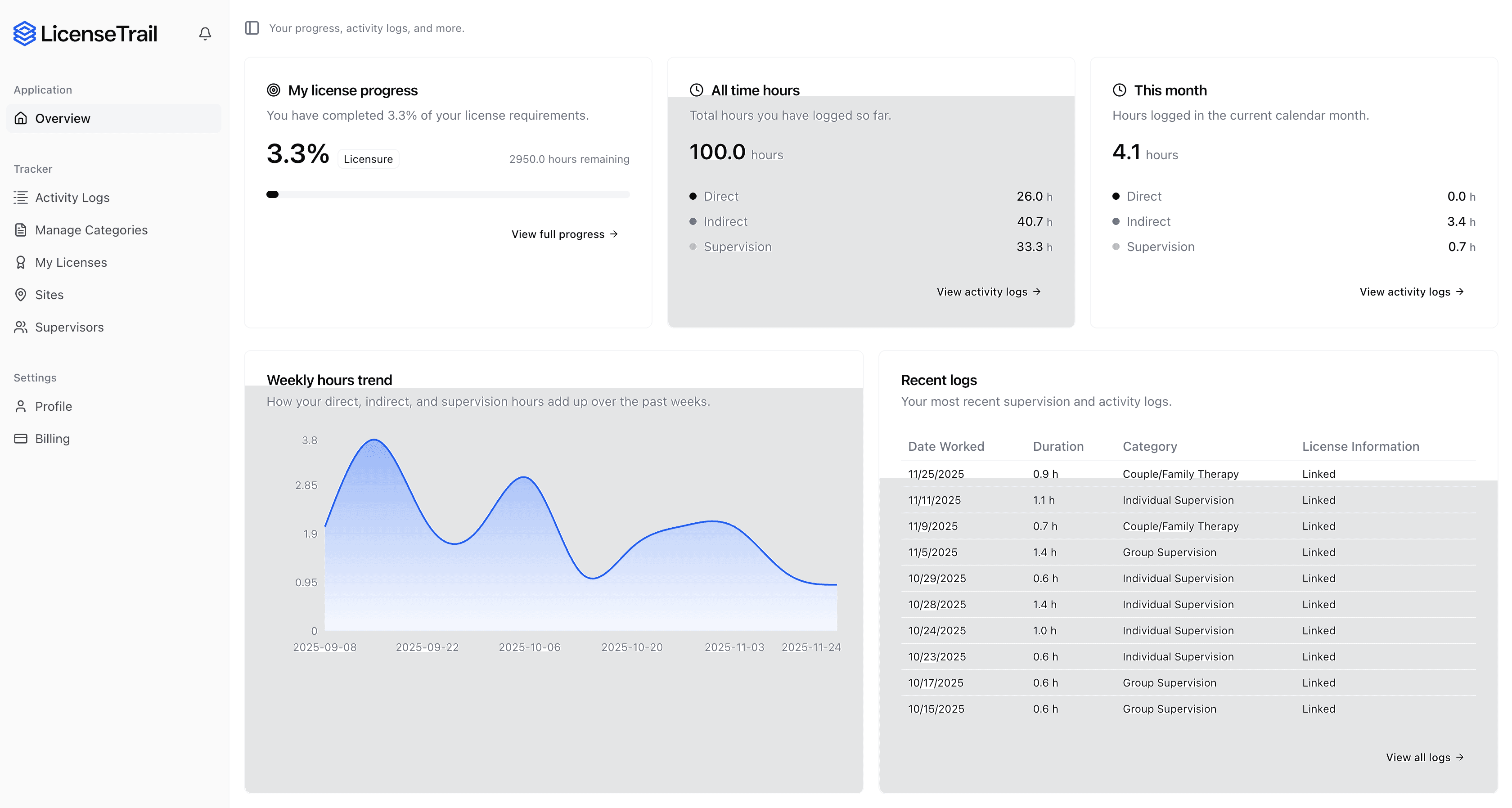
License Trail checks your direct, indirect, and supervision hours against Kansas LMLP requirements continuously and flags mismatches before you submit.
 Start Tracking for Free
No credit card required · Free plan available
Related Licenses
Licensed Addiction Counselor
LAC
Licensed Behavior Analyst
LBA
Licensed Clinical Addiction Counselor
LCAC
Licensed Clinical Marriage and Family Therapist
LCMFT
Licensed Clinical Psychotherapist
LCP
Licensed Clinical Professional Counselor
LCPC
Licensed Marriage and Family Therapist
LMFT
Licensed Psychologist
LP
Licensed Specialist Clinical Social Worker
LSCSW
Is your spreadsheet hiding Kansas LMLP risks?
Stop guessing if your categories match Kansas Behavioral Sciences Regulatory Board requirements. License Trail checks your direct, indirect, and supervision hours continuously and flags mismatches before you submit.
Import or log
Bring your spreadsheet or start fresh
Upload your existing tracking spreadsheet and we'll map every hour into the right Kansas Behavioral Sciences Regulatory Board categories automatically.
Verify against Kansas
Catch mismatches before the board does
License Trail checks your direct, indirect, and supervision hours against Kansas LMLP requirements continuously.
Export board-ready
One-click clean reports
Generate professional, board-ready reports for supervision meetings and Kansas Behavioral Sciences Regulatory Board submissions in seconds.
No credit card required · Free plan available